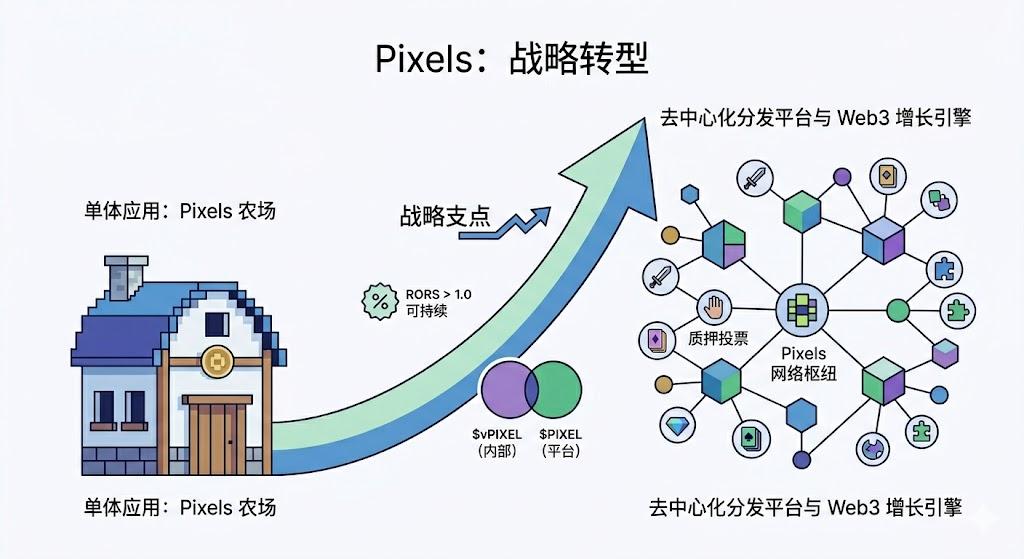
I have always felt that in the Web3 gaming space, falling from 'the peak' often only requires an inflation cycle. Countless once-glorious Play-to-Earn (P2E) projects ultimately cannot escape the fate of token selling pressure and the death spiral. But when I saw the choice made by Pixels founder Luke, I was completely moved by his decisiveness—he did not continue to 'squeeze toothpaste' and muddle through with existing users, but instead formally announced Pixels' identity reconstruction to the outside world through the newly released white paper: it is no longer just a pixel-style farming game with millions of daily active users, but is transforming into a decentralized game distribution platform and Web3 growth engine.
In my opinion, this 'strategic shift' is not just a simple upgrade of product form but a violent reconstruction of the underlying economic logic of Web3 gaming.
The traditional P2E model is essentially an extremely fragile Ponzi economy: the funds or attention of new entrants are forced to pay rewards to old players. In 2024, when Pixels achieves $20 million in revenue and firmly stays at the top of the Web3 gaming DAU list, I can read Luke's anxiety from all his public statements—he knows better than anyone that beneath the prosperous facade lie three fatal cracks: excessive token inflation, misdirected rewards, and the lack of ecological feedback leading to ruthless selling pressure.
Faced with these industry common ailments, Luke's shift surprised me: he did not evade the problem, nor did he use empty words like 'long-termism' to appease the community, but directly acknowledged the dangers of inflation and decided to hedge against it with 'data science'.
After finishing the new version of the white paper, my biggest feeling is that they are no longer talking empty talk about 'community consensus', but have introduced an extremely cold yet precise core metric: RORS (Return on Reward Spend). This metric is identical to the ROAS in traditional advertising, calculated in a straightforward and brutal manner—comparing the amount of rewards distributed with the income gained through protocol fees.
• Currently, Pixels' RORS is about 0.8, which means the entire ecosystem is still in a slight state of bleeding.
• And their self-imposed 'North Star goal' is to break through 1.0.
This step is significant in my view: it marks Pixels' complete shift from emotional game development thinking to rational traffic and economic model thinking. If RORS<1.0, any growth is false and unsustainable; but once RORS > 1.0, Pixels will truly cross the death spiral and become the first game infrastructure in the entire Web3 industry with self-sustaining capabilities.
I think the cleverest move in this strategic transformation is the launch of $vPIXEL.
The Achilles' heel of the vast majority of Web3 games is that the tokens players earn are directly exposed to the selling pressure of the secondary market; any hint of market panic can trigger a chain reaction, directly destroying the entire game economy. However, vPIXEL, as a 'consumption-only' token based on ERC-20c technology (backed 1:1 by PIXEL), cleverly builds a 'game internal circulation firewall' for the entire ecosystem.
• For players: $vPIXEL allows seamless transactions across all partner games without additional fees, significantly reducing the friction costs of cross-game transfers.
• For the ecosystem: It fundamentally delays and blocks pure 'mining and selling' behaviors, forcing funds to circulate within different games on the platform rather than flowing directly to the secondary market for dumping.
This move clearly shows me that Pixels has officially transitioned from 'game tokenization' to 'economic platformization'. At this point, the main token **$PIXEL** has undergone a qualitative leap—it is no longer simply in-game gold coins but has become the 'ballot' and 'capital' within the entire distribution network, anchoring the underlying value of the entire ecosystem.
If the dual-token model is the defensive wall that Luke has built for the ecosystem, then the decentralized distribution system is the offensive horn he has sounded. The grand vision he proposed in the white paper—to create a 'decentralized AppsFlyer or Applovin'—to be honest, I was skeptical at first, but after carefully studying their staking model, I completely changed my mind.
This is the most revolutionary Staking 2.0 design I've ever seen: in traditional PoS chains, nodes are validators; under Pixels' new framework, every third-party game on the connected platform is, in effect, a 'validator'.
1. Power is completely decentralized: Players stake their $PIXEL in a single game they favor, essentially using real money to 'vote', directly deciding which games qualify for reward distribution in the Pixels ecosystem.
2. A gladiatorial arena of survival of the fittest: Games on the connected platform can no longer 'lie flat' and ride on traffic. They must demonstrate real skills by showing extremely high player retention, increasing net consumption within the game, and effectively utilizing ecological tools to compete for stakers.
This design completely returned the 'traffic distribution rights' that were originally tightly held by centralized publishers back to the market. In my view, what Luke really wants to do is establish a foundational settlement protocol for Web3 traffic. In the future, whether the trend is hardcore strategies or casual games, as long as they need precise, high-quality Web3 users, they cannot avoid the $PIXEL 'release flywheel' for cold starts and user retention.
In my view, Luke's strategic shift essentially boils down to two words: upgrading dimensions and clearing out.
Upgrading dimensions lies in crossing cycles. I have always believed that any single game cannot escape the limits of its lifecycle. Even if the initial heat of the pixel farming game gradually fades in the future, as long as the @Pixels platform holds a massive amount of real player behavior data, an efficient distribution protocol, and a functioning RORS positive cycle model, it will build a business moat a hundred times deeper than a single blockbuster.
Clearing out is an unavoidable growing pain. I also know that strengthening the VIP structure, increasing withdrawal liquidity fees, and forcing guidance on consumption-type tokens... these measures will inevitably offend a large number of profit-driven gold mining studios and free-to-play players in the short term, and may even lead to a significant decline in DAU. But this is the necessary 'bone scraping therapy' that must be experienced, with the ultimate goal of filtering out truly valuable contributors to the ecosystem who can support the RORS metric and become highly sticky users.
Watching Pixels evolve from a simple pixel-style farm to attempting to build a data-driven, stake-governed gaming empire today, I sincerely admire Luke and his team's ambition and execution.
In my eyes,#pixel the second half is no longer a game operation issue of 'how to grow a good vegetable', but an industry proposition of 'how to plant a set of sustainable standards for the entire Web3 gaming industry'. This perilous leap from single applications to distribution platforms, if successful, will provide a perfect answer sheet for breaking through the entire industry; even if faced with challenges, it will inevitably leave behind the most valuable practical samples of decentralized game distribution for future generations.