

Friends who haven't read my popular science content, you'd better go and read all the contents in the column [Nine and a Half Chapters of Emperor's Theory].
For those friends who have been following my pace of popular science, the first step you need to take now is to forget all the previous content.
The text begins below:
Core values: The purpose of all market behaviors is always to arouse public regret.
Difficulty: Judging public sentiment.
In the practice of Emperor Theory, public sentiment is divided into three simple categories: stable, weak, and strong.
Public sentiment is composed of three factors that influence people’s participation in the market: time cost, risk assessment, and temptation.
These three factors also convey to you the three changes in public sentiment: gathering, dissipation, and release.
The most important thing for gathering emotions is time; the most important thing for dissipating emotions is risk; and the most important thing for releasing emotions is temptation.
There are also only three ways to express market behavior: rising, sideways, and falling.
What is attractive to people is: ups and downs.
After buying, the only thing that allows you to hold it permanently is if the price goes up.
This means that only an increase in prices can gather public sentiment for a long time, and only an increase in prices can gather public sentiment in the market and achieve unity.
This also means that all declines come from the excessive unification of public sentiment. Because the public cannot have a group ideology with unified self-awareness, they cannot actively gather emotions, nor can they actively release emotions, and they cannot and will not actively dissipate emotions. The dissipation of emotions must be achieved by constantly breaking the sense of security generated by sideways trading and not satisfying emotional expectations to destroy the temptation.
Rises, falls and sideways trading are all subjective operations of the market. The market is a self-aware interest group whose purpose is to make profits.
To summarize, three more important keywords are mentioned, namely time, risk and temptation.
What exactly are these and how can you identify these concepts using a diagram?
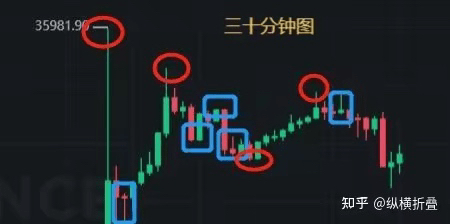
Time is the time period; risk refers to the reasonable price of the chart; temptation refers to the situation limit of the chart.
As shown in the figure: thirty minutes is the time period, the high and low points in the red circle represent the extreme values of temptation, and the high and low points in the blue frame represent the reasonable price of risk, which is the median.
These are easy to understand, but you may ask: time can be long or short, risks can be high or low, temptations can be big or small, what are the criteria for judging them?
The standard of time is the perception of time: periods within one day are short, and periods of one day or more are long.
The standard of temptation is visual perception: if you can feel the sum of three normal candles, the temptation is small, and if you can't feel the sum of three normal candles, the temptation is large. (The candlestick chart, that is, the average value of the K line, is affected by the market state, and the normal length of each cycle is different.)
The standard of risk is the feeling of funds: the higher the stop loss budget ratio, the higher the level, and the lower the stop loss budget ratio, the lower the level. This is usually determined by the candle length and time period. Generally, the longer the time period, the higher the risk, and vice versa. If it is an extreme case of great temptation and great risk, the public will usually ignore the risk.
So how do we judge public sentiment specifically?
The answer is in the table below:
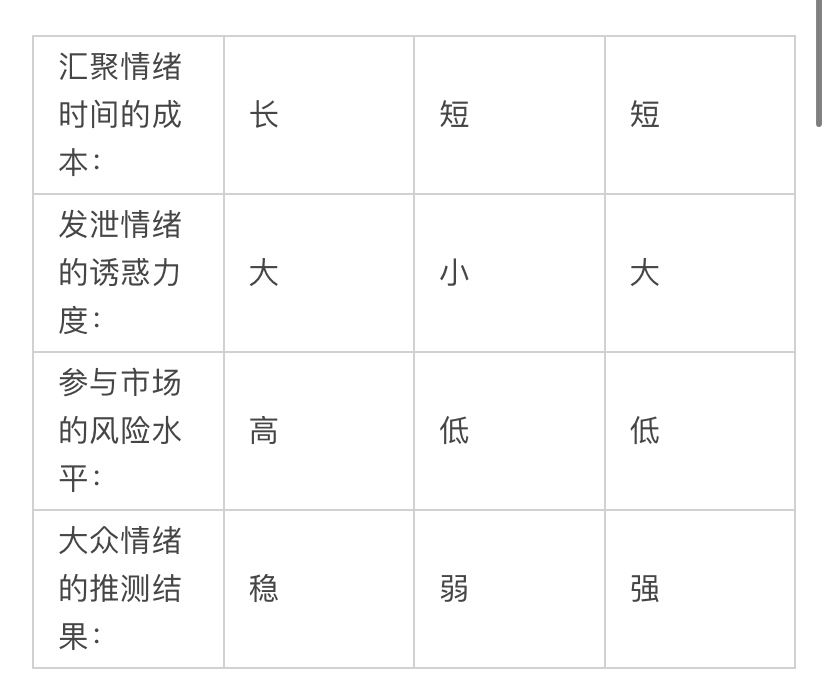
We have spent a lot of time learning how to speculate public sentiment. What do stable, weak, and strong specifically represent?
Stable means that public sentiment is resisting the rise.
Weak, indicating that the public sentiment is determined to leave the market. (Leaving the market means not playing anymore)
Strong, which means that public sentiment is fighting for the short term.
What is the operational significance of knowing the public sentiment?
This brings us back to our core values: the purpose of all market behavior is always to create public regret.
Therefore, the market reaction will always be the combination that makes the public most uncomfortable:
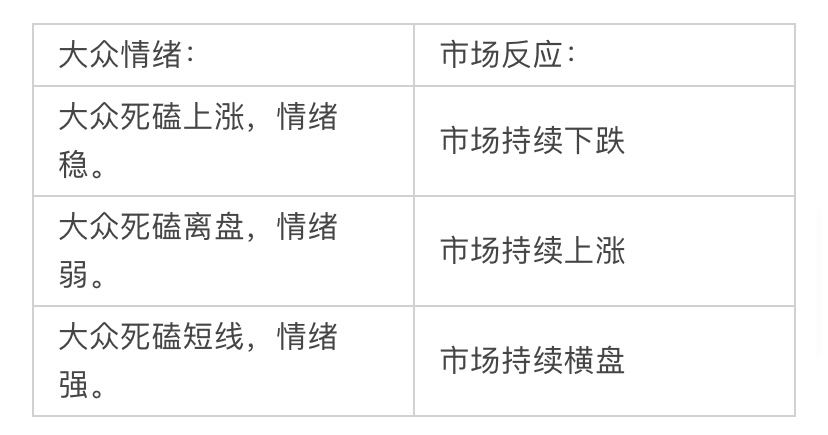
If you understand all the above contents, you will immediately find the validity of these contents when you pick up any chart that records K-line.
At the same time, new problems will be discovered: each cycle has its own independent public sentiment.
If they conflict, how do you handle it?
It is not difficult to find that these three emotions and three market reactions are mutually transformed and mutually reinforcing.
The rise calls for unity and stabilizes emotions, but once unified, it will immediately lead to a fall. Therefore, the main public sentiment during the rise is actually weak.
A decline encourages short-sightedness and makes emotions intense and diverse. Once emotions become diverse, the market will enter a sideways phase. Therefore, the main public sentiment during a decline is stable.
Sideways trading denies expectations and makes sentiment depressed. Once sentiment is depressed, the market will unify through calls for an increase and attract public attention again. Therefore, the main public sentiment during sideways trading is strong.
It is easy to understand that the cycle repeats like this. Because before the information explosion era, people's operation cycles were not so rich. At that time, no one could get profit opportunities from the changes of cotton in a few minutes or a few days. Because of the lack of information and difficult communication.
But in the Internet age, a large number of investors can gather every minute for the same product, and merchants naturally commercialize these small opportunities in pursuit of profit. This means that the fancy small cycle changes you see are actually financial derivatives. When you buy and sell a product, whether you buy it for a few minutes or a few months, you are actually not buying the same financial product. It is just called by the same name, but the connotation is completely different.
So what is the essential difference between cycles?
The essential difference is class. As I said earlier, small cycles are just financial derivatives. The derivatives market usually survives by relying on the native market environment. When the native market sentiment is low, the derivatives market will only be more depressed. When the native market sentiment is high, the derivatives market may be more prosperous.
It is also said that in the relationship between cycles, the big cycle is superior to the small cycle during the economic growth stage, while the small cycle will dominate the big cycle changes during the economic contraction stage. The difference between the two is that the former is that the market can be better and the big cycle dominates, while the latter is that the market can be worse and the small cycle dominates.
The time periods we see on the chart were divided into nine levels: 1 minute, 5 minutes, 30 minutes, 4 hours, days, weeks, months, half a year, three years, and fifteen years, as early as the early stage of popular science. Later, I taught everyone in the community to divide them into three levels: hot flow mainstream and source flow. In fact, technical analysis mainly analyzes the changes in hot flow and mainstream. Once the variables in the source flow layer are involved, it is necessary to understand the changes in the political news analysis era. Because the price changes and emotional guidance of the source flow layer are parasitic on the changes in the social demand cycle, they are closely related to political games and the era pattern. That is, trading strategies for more than half a year must take into account social changes and cannot rely solely on the internal emotional judgment of the market. However, it is completely possible to hold orders within half a year.
Through the above content, we can summarize new rules:
All declines on any chart are a reaction to stabilization of popular sentiment in their immediate higher cycle.
All rallies on any chart are a reaction to weakening public sentiment in the immediate underlying cycle.
All sideways movements on any chart are a strong reaction to the public sentiment of the higher cycle.
After knowing these things, what should we do?
There are three absolute operation signals that can be derived from the new rules:
In the economic upswing cycle.
There are only two signals before any cycle starts to fall: 1. The whip end of this level. 2. The top divergence of the sub-level.
Before any cycle starts to rise, there may be no signals from its direct subordinates.
What this means is that the top divergence and whip end must be effective, while the bottom divergence and whip end are just illusions, and the only thing required for a rise is sideways trading.
In an economic downturn, the opposite is true.
Well, I have finished talking about the useful information. I know some of you still want to listen to nonsense.
If it gets complicated, we will have to talk about the underlying cognition based on the three consciousnesses and the six strategies of game theory. These are very important but require training, so I won’t waste time talking about them.
If you really want a strategic approach, the effective advice I can give you is, in short:
The first is to avoid periods of strong reactions and stay away from turbulence. Don't try to conquer the chaos in the market.
The second is to find the top of the stabilization cycle and the bottom of the weakening cycle for speculation.
As for the buying and selling points, I have already talked about a lot of popular science content before, so I don’t want to talk about it more.
Because point differences are not the core competitiveness of traders to make continuous and stable profits, and they are not scarce in this world. As long as you understand the public sentiment, it doesn’t matter who you learn those things from.
I won’t talk about things like capital management, position management, trading psychology, life system, and world view here.
For those who have tasted the sweetness of learning my imperial theories, if you still have questions, or if you really want to learn how to be a person like me, then come to the Dust Fate Hall of the Emperor's Gate.
If there are any mistakes in formatting or typos, that's your fate and has nothing to do with me.