


Original title: "Ethereum's native LST designs two layers of pledge: Lido killer?"
Original author: 0XNATALIE
Original source: Chainfeeds

Not long ago, five staking service providers including RocketPool, StakeWise, and Stader Labs jointly signed a binding proposal, promising to limit the validator share to less than 22%, while the leading protocol Lido Finance, which has a market share of up to 32%, did not make a statement on this. The Ethereum community is concerned about Lido's expanding influence in the liquid staking market, and the community's criticism of this is growing. So can the Ethereum protocol layer be improved to directly perform liquidity staking, thereby eliminating the centralization threat to Ethereum caused by the excessive market share of applications?
The idea of two-tiered staking was first proposed by Dankrad, a researcher at the Ethereum Foundation, in April 2023. After discussion, Mike, a researcher at the Ethereum Foundation, further expanded and elaborated on it. The two-tiered staking mechanism divides the staked ETH into two layers, Node Operator Bonds (C1) and Delegated Stake (C2), similar to a tiered fund. C1 may still face slashing risk, but C2 will not. Today's LST ecosystem relies on users' trust in node operators. The main purpose of doing this is to reduce the slashing risk that ordinary users need to bear when choosing validators and improve capital efficiency.
Two-tiered staking design
Node Operator Bonds (C1): C1 holders are node operators who provide network services and maintain the security of the network. These bonds are slashable, and staked funds may be slashed when node operators violate network rules.
Delegated Tokens (C2): C2 is the ETH that the delegator gives to the node operator. Unlike C1, this portion of the deposited ETH cannot be cut, so even if the node operator’s staked funds are cut, the delegator’s funds will not be affected.
Delegation Ratio (g): Each C1 is eligible for g C2 delegations. This parameter ensures a maximum ratio between slashable funds (C1) and non-slashable funds (C2).
R1 (Interest rate for node operators): R1 is the interest rate received by node operators, which is usually higher than R2 to cover the operating costs of node operators and the risk of slashing. Node operators need to receive enough rewards to encourage them to participate in the verification of the Ethereum network.
R2 (Delegator’s Rate): R2 is the rate delegators receive for the rewards they receive for the stake they delegate. This rate is typically lower because delegators are not at risk of slashing. R2 is considered a “risk-free rate” for Ethereum, and can be earned by simply staking without taking on risk.
LST: Each unit of C2 generates a corresponding native liquidity staking token. These LST are unique to each node operator and minted through delegation with them. Only non-slashable ETH can mint LST.
These two interest rates are key components of the design. If r1 is set too high, then the rewards for becoming a node operator exceed the rewards for delegating, which may lead to more people choosing to become node operators instead of delegating, or the emergence of LST layers based on trust assumptions like Lido, then the two-tiered staking model loses its original meaning. If r1 is set too low, then there may not be enough incentive for people to become node operators, the profits of node operations are compressed, and only efficient and large-scale operators can survive, leading to node centralization.
Two-tiered staking model features and potential problems
In this model, each unit of C1 is associated with a certain amount (coefficient g) of C2. Typically, C1 can earn a higher interest rate r1 to make up for the cost of operating nodes and the opportunity cost of holding illiquid pledges. The security of the consensus layer depends only on C1, which must pass through activation and exit queues. C2 can be re-delegated flexibly.
For example, there are two delegators Delegator 1 and Delegator 2 and two node operators Node Operator A and Node Operator B. Each node operator will provide a 1 ETH bond to obtain authorization, and these bonds are interest-limited and can be cut. The red and blue dotted lines in the figure below represent the interest earned by each of the four participants. Delegator: Delegated pledge*r2 = interest, node operator: (delegated pledge + bond)*r1 = interest. Node operator A's g is 19, which means that Delegator 1 delegates 19 ETH to node operator A, and A provides a 1 ETH bond to obtain authorization. The interest earned by Delegator 1 is 19*r2, and the interest earned by node operator A is 20*r1.
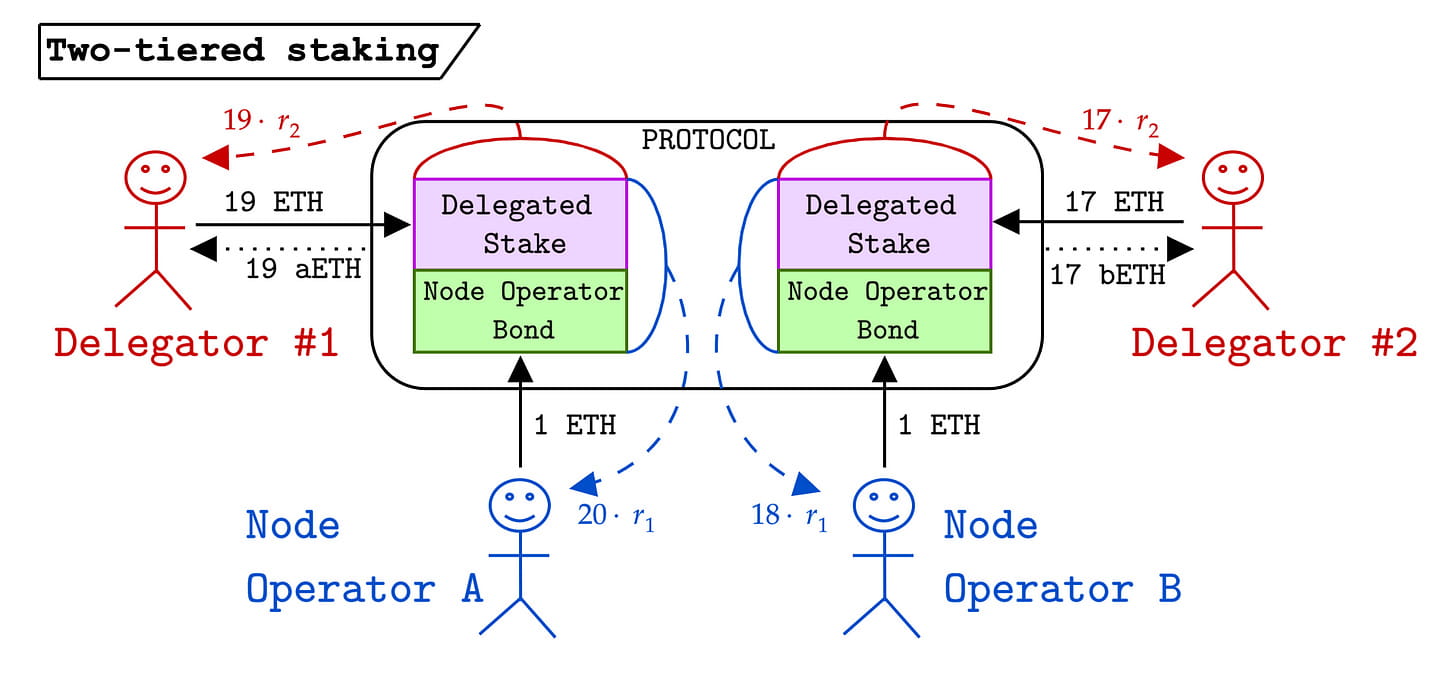
Two-tiered Staking improves capital efficiency by dividing the pledge into two tiers, allowing more ETH to be used for delegation, thereby improving liquidity. Continuing the above example, node operator A has C1=1, C2=19 (collateral ratio is 1:19, leverage ratio is 19 times), which means that 19 out of 20 ETH are in circulation, with a capital efficiency of 95%. Node operator B has C1=1, C2=17 (collateral ratio is 1:17, leverage ratio is 17 times), which means that 17 out of 18 ETH are in circulation, with a capital efficiency of 94.4%. In contrast, A has high capital efficiency but also high risk, because a larger proportion of ETH is used for delegation and a relatively small proportion of ETH is used for slashing.
Through different interest rates and reward mechanisms, this mechanism attempts to encourage more people to participate in node operations and improve the decentralization of the network. At the same time, it also raises the issue that since part of the staked assets in the model are no longer at risk of being slashed, attackers may think that the cost of attacking the network is lower. If a large-scale attack occurs, the attacker may only need to attack the slashable part instead of the entire network, which reduces the theoretical economic security.
In addition, the proposal also raises some open questions. Community discussions on these issues will help researchers explore in depth how the new model interacts with the existing blockchain ecosystem. I am personally more interested in whether there is a dynamic way to set interest rates and whether LST will form a monopoly or oligopoly in the market, and how to ensure diversity and competition. I look forward to more discussions in the community.
Original link