The staking mechanism in cryptocurrencies has multiple uses and different networks can be chosen for this purpose. However, they all have one thing in common. Staking tokens reward their owners with a stake in each cryptocurrency staked on the network or app.
Data provided by ChatGPT-4 continues to provide clues to investors. Artificial Intelligence identifies Ethereum (ETH), Tezos (XTZ), and Cardano (ADA) as the coins whose owners have invested the most in order to receive rewards.
Ethereum (ETH)
Ethereum is one of the largest and most famous cryptocurrencies. It uses a proof-of-stake (PoS) consensus mechanism and supports staking on Ethereum 2.0. ETH holders can stake their tokens and earn rewards while participating in the security and governance of the network. (Public account: Pepe Stud)
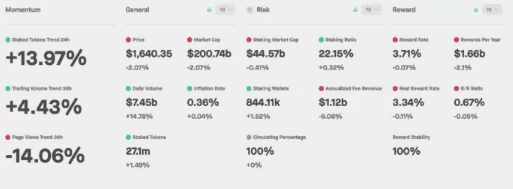
According to StakeRewards.com, investors who stake ETH to become a validator can earn returns of approximately 3.71% per year based on the amount staked. It’s important to calculate the “real reward rate” adjusted for the token’s long-term inflation, and Ethereum’s annual reward rate is 3.34%.
As of this writing, the total amount of Ethereum pledged is $44.57 billion, accounting for 22.15% of ETH’s $200.74 billion market cap. The number of staked tokens on the network has increased significantly over the past 24 hours, growing by 14%.
Tezos (XTZ)
Tezos is a blockchain platform using the PoS consensus mechanism. XTZ holders can stake their tokens and earn staking rewards while participating in network governance. Tezos is known for its on-chain governance and the ability for token holders to vote on protocol upgrades.
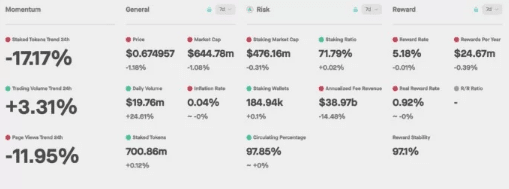
After investors pledge XTZ, the expected return rate is 5.18%. However, according to calculations by StakeRewards.com, the “real reward rate” after adjusting for token inflation is actually very low at 0.92%.
On the other hand, things are not going well for Tezos. Token holders unlocked 17.17% of their stake in the past 24 hours. As of this writing, XTZ has a market cap of $644.87 million, of which 71.79% or $476.16 million is locked in staking rewards.
Cardano (ADA)
Cardano is another popular cryptocurrency that uses a PoS consensus mechanism. ADA holders can stake their tokens on the Cardano network and participate in the block verification and creation process. Staking ADA allows participants to earn rewards.
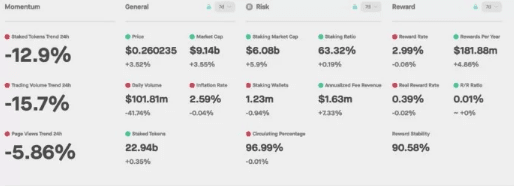
According to data obtained by StakeRewards.com, as of October 7, the Cardano network was rewarding users who staked tokens nearly 3% annually. According to ChatGPT-4, among the three altcoins, ADA has the lowest yield. Taking into account ADA’s token inflation, the calculated reward rate of 0.39% means a lower return for investors. Additionally, like Tezos, Cardano has a negative staking ratio of 12.9%.