
#quantumcomputers
quantumcomputers
150,864 views
333 Discussing
Hot
Latest


·
--
Verified
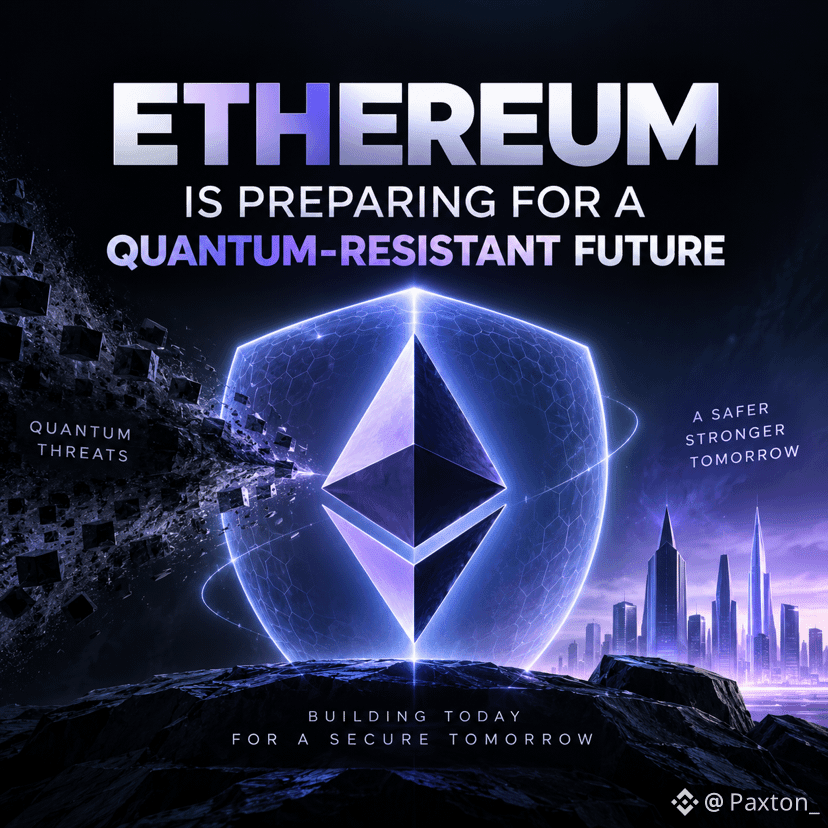
@Ethereum_official Is Preparing for the Quantum Era
Quantum computing is not an immediate threat to Ethereum, but the network is already preparing for a future where today’s cryptography may not be strong enough.
The Ethereum Foundation has set December 2029 as its target for making Ethereum L1 quantum-resistant across its execution, consensus and data layers.
Here’s what that means in simple terms:
❥ Accounts: Ethereum is working toward making it easier to move accounts to stronger signature systems.
❥ Validators: The cryptography securing validators will need to be upgraded as well.
❥ Data: Ethereum is also developing stronger protection for the data layer.
❥ ZK systems: The network is preparing its proof infrastructure for a post-quantum environment.
This is not about fixing an attack that is happening today.
It’s about giving Ethereum enough time to research, test and roll out these changes before quantum computing becomes a serious security concern.
The threat may still be years away. The preparation has already started.
$ETH
#Ethereum #ETH #quantumcomputers
@Ethereum Is Preparing for the Quantum Era
Quantum computing is not an immediate threat to Ethereum, but the network is already preparing for a future where today’s cryptography may not be strong enough.
The Ethereum Foundation has set December 2029 as its target for making Ethereum L1 quantum-resistant across its execution, consensus and data layers.
Here’s what that means in simple terms:
❥ Accounts: Ethereum is working toward making it easier to move accounts to stronger signature systems.
❥ Validators: The cryptography securing validators will need to be upgraded as well.
❥ Data: Ethereum is also developing stronger protection for the data layer.
❥ ZK systems: The network is preparing its proof infrastructure for a post-quantum environment.
This is not about fixing an attack that is happening today.
It’s about giving Ethereum enough time to research, test and roll out these changes before quantum computing becomes a serious security concern.
The threat may still be years away. The preparation has already started.
$ETH
#Ethereum #ETH #quantumcomputers
Quantum computing is not an immediate threat to Ethereum, but the network is already preparing for a future where today’s cryptography may not be strong enough.
The Ethereum Foundation has set December 2029 as its target for making Ethereum L1 quantum-resistant across its execution, consensus and data layers.
Here’s what that means in simple terms:
❥ Accounts: Ethereum is working toward making it easier to move accounts to stronger signature systems.
❥ Validators: The cryptography securing validators will need to be upgraded as well.
❥ Data: Ethereum is also developing stronger protection for the data layer.
❥ ZK systems: The network is preparing its proof infrastructure for a post-quantum environment.
This is not about fixing an attack that is happening today.
It’s about giving Ethereum enough time to research, test and roll out these changes before quantum computing becomes a serious security concern.
The threat may still be years away. The preparation has already started.
$ETH
#Ethereum #ETH #quantumcomputers
1
4
927

·
--
Will a Quantum Computer Crack Bitcoin?
Could a quantum computer break $BTC one day? Theoretically, yes - if sufficiently powerful quantum systems emerge that can attack modern cryptography. However, current quantum computers are far too limited for this task.
This is why the crypto industry is already preparing for future threats and exploring quantum-resistant algorithms. Perhaps the main question isn't whether Bitcoin will be cracked, but whether the network will adapt in time.
#quantumcomputers #BTC
Will a Quantum Computer Crack Bitcoin?
Could a quantum computer break $BTC one day? Theoretically, yes - if sufficiently powerful quantum systems emerge that can attack modern cryptography. However, current quantum computers are far too limited for this task.
This is why the crypto industry is already preparing for future threats and exploring quantum-resistant algorithms. Perhaps the main question isn't whether Bitcoin will be cracked, but whether the network will adapt in time.
#quantumcomputers #BTC
Could a quantum computer break $BTC one day? Theoretically, yes - if sufficiently powerful quantum systems emerge that can attack modern cryptography. However, current quantum computers are far too limited for this task.
This is why the crypto industry is already preparing for future threats and exploring quantum-resistant algorithms. Perhaps the main question isn't whether Bitcoin will be cracked, but whether the network will adapt in time.
#quantumcomputers #BTC
98

🔥 StarkWare is preparing ₿ Bitcoin for the Quantum era
StarkWare has reportedly been able to successfully conduct the world’s first Quantum-Safe transaction on the Bitcoin Mainnet, as an important step toward the future security of ₿ Bitcoin.
As Quantum Computer technology advances, the cryptographic security measures currently in use may become risky in the future. Being able to use quantum-resistant cryptography could become an important technology for Bitcoin’s long-term security.
This achievement by StarkWare can be considered a significant milestone—demonstrating in practice whether Bitcoin can be readied from its current state for the future Quantum Computing era. 🚀
$BTC #quantumcomputers
{future}(BTCUSDT)
🔥 StarkWare is preparing ₿ Bitcoin for the Quantum era
StarkWare has reportedly been able to successfully conduct the world’s first Quantum-Safe transaction on the Bitcoin Mainnet, as an important step toward the future security of ₿ Bitcoin.
As Quantum Computer technology advances, the cryptographic security measures currently in use may become risky in the future. Being able to use quantum-resistant cryptography could become an important technology for Bitcoin’s long-term security.
This achievement by StarkWare can be considered a significant milestone—demonstrating in practice whether Bitcoin can be readied from its current state for the future Quantum Computing era. 🚀
$BTC #quantumcomputers
StarkWare has reportedly been able to successfully conduct the world’s first Quantum-Safe transaction on the Bitcoin Mainnet, as an important step toward the future security of ₿ Bitcoin.
As Quantum Computer technology advances, the cryptographic security measures currently in use may become risky in the future. Being able to use quantum-resistant cryptography could become an important technology for Bitcoin’s long-term security.
This achievement by StarkWare can be considered a significant milestone—demonstrating in practice whether Bitcoin can be readied from its current state for the future Quantum Computing era. 🚀
$BTC #quantumcomputers
107

·
--
Article
Crypto Apocalypse FUD: Will Quantum Computers Hack Our Wallets and Steal Our Assets?Recently, a number of narratives have been circulating that are quite worrying across various communities. It is rumored that a new generation of quantum computers will soon break through blockchain network encryption and completely drain your Bitcoin and other crypto. It’s very reasonable that this rumor could trigger panic among asset holders. The question is: should you panic and withdraw all your funds right now?
The answer: NO.
Your crypto assets are not in danger today. Let’s rationally examine the facts and clear up the existing misunderstandings.
Crypto Apocalypse FUD: Will Quantum Computers Hack Our Wallets and Steal Our Assets?
Recently, a number of narratives have been circulating that are quite worrying across various communities. It is rumored that a new generation of quantum computers will soon break through blockchain network encryption and completely drain your Bitcoin and other crypto. It’s very reasonable that this rumor could trigger panic among asset holders. The question is: should you panic and withdraw all your funds right now?
The answer: NO.
Your crypto assets are not in danger today. Let’s rationally examine the facts and clear up the existing misunderstandings.
The answer: NO.
Your crypto assets are not in danger today. Let’s rationally examine the facts and clear up the existing misunderstandings.
2
3
3.7k

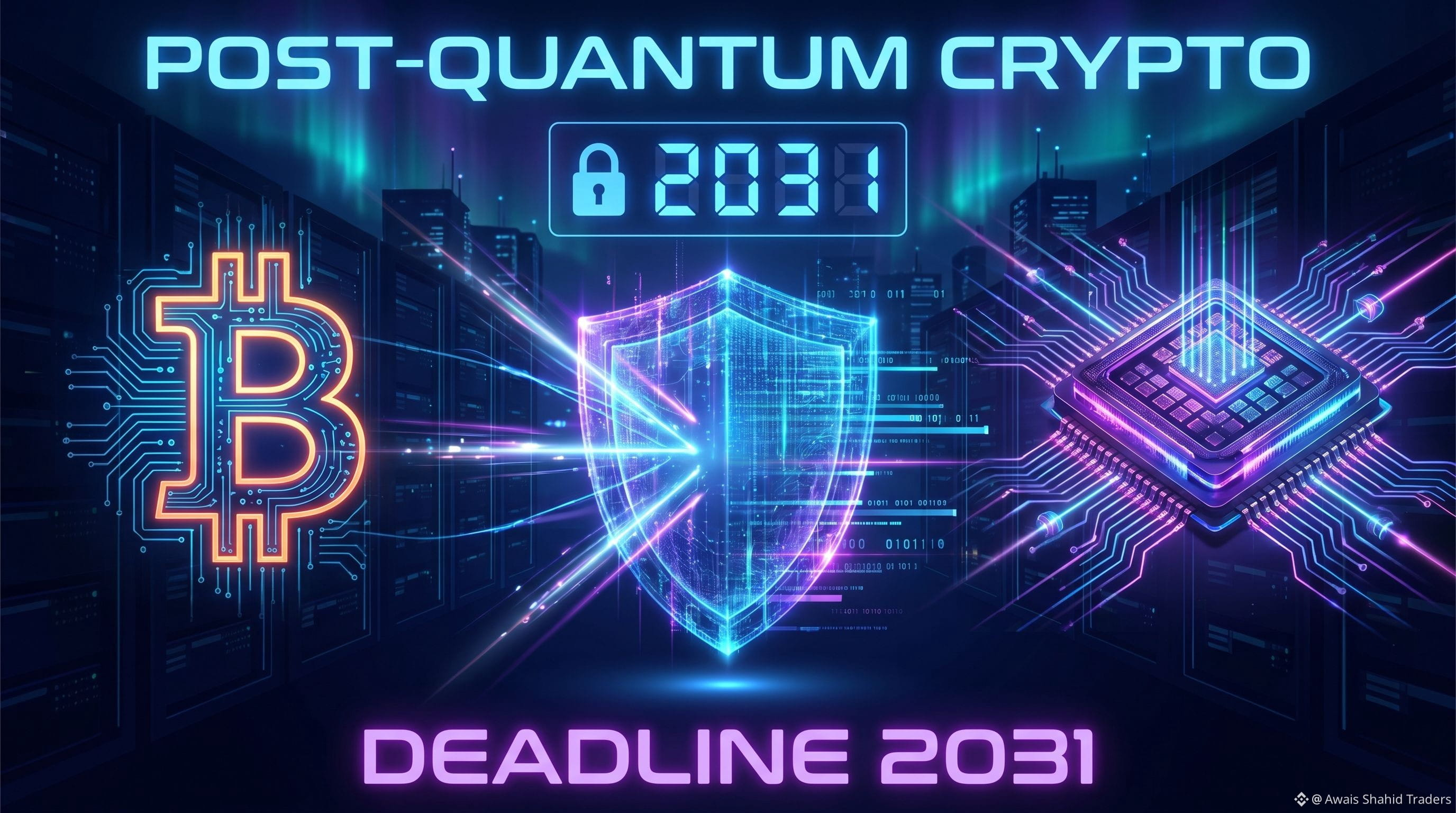
🚨 US Sets 2031 Deadline for Post-Quantum Crypto Migration
Big news for crypto! The US government just signed executive orders to protect against quantum computer attacks. Here's what you need to know in simple terms 👇
---
🔐 What's Happening?
Quantum computers are getting powerful enough to break current encryption - including the math that secures $BTC , $ETH
$NVDAB , and all crypto wallets .
{spot}(BTCUSDT)
{spot}(ETHUSDT)
The new US orders give federal agencies hard deadlines :
· By Dec 31, 2030 - Update important systems to quantum-resistant encryption
· By Dec 31, 2031 - All high-security systems must be fully upgraded
Why this matters for crypto: Hackers could use powerful quantum computers to figure out private keys from public addresses, potentially stealing funds . About 6% of all Bitcoin (worth billions) sits in old addresses that could be vulnerable .
---
📊 What It Means for Crypto
Impact Details
Short-term No immediate threat - quantum computers need 10+ years to scale
Medium-term Major blockchains will need to adopt new "post-quantum" signatures
Long-term Networks that upgrade fast will survive; those that don't face risk
---
💡 Bottom Line
The US government is taking quantum threats seriously. While the 2031 deadline is for federal systems, it signals that crypto networks must start planning their upgrades now .
Ethereum is expected to upgrade before Bitcoin due to its more flexible development culture .
Are you worried about quantum computers affecting your crypto? Drop your thoughts below! 👇
#CryptoNewss #BitcoinDunyamiz #quantumcomputers #PostQuantumCryptography #USPostQuantumCryptographyDeadline2031
NFA, DYOR.
🚨 US Sets 2031 Deadline for Post-Quantum Crypto Migration
Big news for crypto! The US government just signed executive orders to protect against quantum computer attacks. Here's what you need to know in simple terms 👇
---
🔐 What's Happening?
Quantum computers are getting powerful enough to break current encryption - including the math that secures $BTC , $ETH
$NVDAB , and all crypto wallets .
The new US orders give federal agencies hard deadlines :
· By Dec 31, 2030 - Update important systems to quantum-resistant encryption
· By Dec 31, 2031 - All high-security systems must be fully upgraded
Why this matters for crypto: Hackers could use powerful quantum computers to figure out private keys from public addresses, potentially stealing funds . About 6% of all Bitcoin (worth billions) sits in old addresses that could be vulnerable .
---
📊 What It Means for Crypto
Impact Details
Short-term No immediate threat - quantum computers need 10+ years to scale
Medium-term Major blockchains will need to adopt new "post-quantum" signatures
Long-term Networks that upgrade fast will survive; those that don't face risk
---
💡 Bottom Line
The US government is taking quantum threats seriously. While the 2031 deadline is for federal systems, it signals that crypto networks must start planning their upgrades now .
Ethereum is expected to upgrade before Bitcoin due to its more flexible development culture .
Are you worried about quantum computers affecting your crypto? Drop your thoughts below! 👇
#CryptoNewss #BitcoinDunyamiz #quantumcomputers #PostQuantumCryptography #USPostQuantumCryptographyDeadline2031
NFA, DYOR.
Big news for crypto! The US government just signed executive orders to protect against quantum computer attacks. Here's what you need to know in simple terms 👇
---
🔐 What's Happening?
Quantum computers are getting powerful enough to break current encryption - including the math that secures $BTC , $ETH
$NVDAB , and all crypto wallets .
The new US orders give federal agencies hard deadlines :
· By Dec 31, 2030 - Update important systems to quantum-resistant encryption
· By Dec 31, 2031 - All high-security systems must be fully upgraded
Why this matters for crypto: Hackers could use powerful quantum computers to figure out private keys from public addresses, potentially stealing funds . About 6% of all Bitcoin (worth billions) sits in old addresses that could be vulnerable .
---
📊 What It Means for Crypto
Impact Details
Short-term No immediate threat - quantum computers need 10+ years to scale
Medium-term Major blockchains will need to adopt new "post-quantum" signatures
Long-term Networks that upgrade fast will survive; those that don't face risk
---
💡 Bottom Line
The US government is taking quantum threats seriously. While the 2031 deadline is for federal systems, it signals that crypto networks must start planning their upgrades now .
Ethereum is expected to upgrade before Bitcoin due to its more flexible development culture .
Are you worried about quantum computers affecting your crypto? Drop your thoughts below! 👇
#CryptoNewss #BitcoinDunyamiz #quantumcomputers #PostQuantumCryptography #USPostQuantumCryptographyDeadline2031
NFA, DYOR.
112

·
--
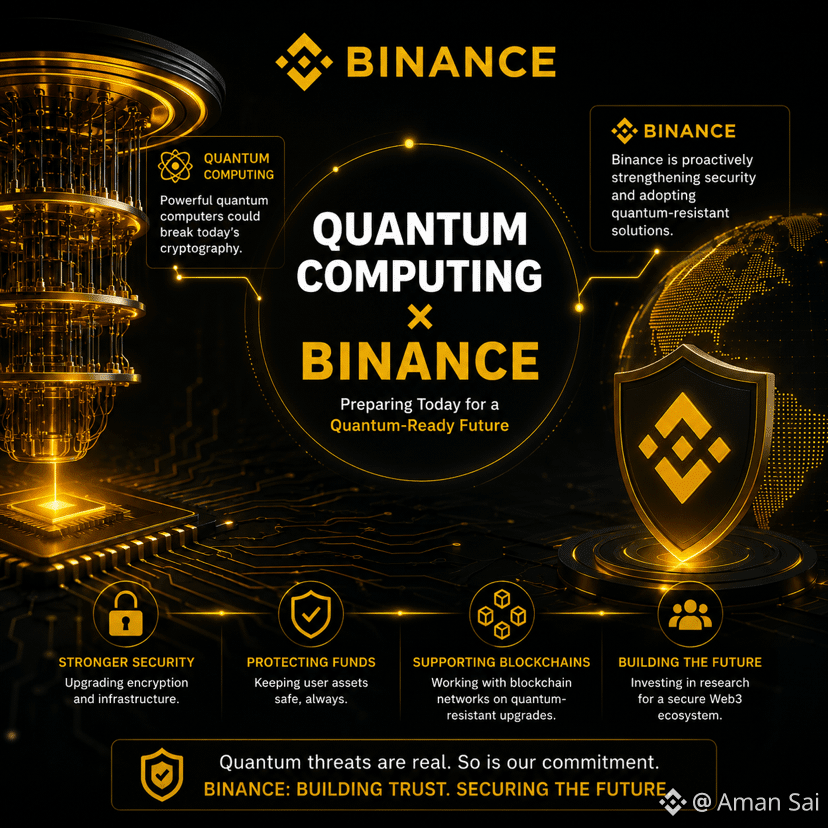
My friend asked me today:
“Bro, will #Binance be affected by quantum computing?”
My answer is in the description. 👇
Yes, quantum computing could affect Binance, but not in the way many people imagine. The risk is primarily to the cryptography used across the internet and blockchains not to Binance as a company itself.
Here’s how it could affect Binance:
User wallets and private keys
If a sufficiently powerful quantum computer could break today’s public-key cryptography (such as ECDSA), attackers might be able to derive private keys from exposed public keys.
This could put some blockchain wallets at risk if they haven’t migrated to quantum-resistant cryptography.
@Binance infrastructure
Binance relies on encryption (TLS, digital certificates, authentication systems) just like banks and other online services.
If current encryption standards become vulnerable,
Binance would need to upgrade its systems to quantum safe encryption. The broader internet will face the same transition.
Blockchain networks
Binance depends on networks like Bitcoin, Ethereum, and BNB Chain.
If these blockchains adopt quantum resistant signature schemes in time, Binance will support those upgrades.
The exchange itself cannot solve the problem alone if the underlying blockchain doesn’t evolve.
Custody and security
Binance holds assets in cold wallets with multiple security layers.
It will likely be among the first major exchanges to implement quantum safe security measures as standards mature.
It will not affect anything instantly on in upcoming days.
Experts generally believe we do not yet have a quantum computer capable of breaking the cryptography that secures Bitcoin, Ethereum, BNB Chain, or Binance.
The industry is actively preparing by developing and standardizing quantum resistant cryptography before such machines become practical.
#quantumcomputers #binance #bitcoin $BTC
My friend asked me today:
“Bro, will #Binance be affected by quantum computing?”
My answer is in the description. 👇
Yes, quantum computing could affect Binance, but not in the way many people imagine. The risk is primarily to the cryptography used across the internet and blockchains not to Binance as a company itself.
Here’s how it could affect Binance:
User wallets and private keys
If a sufficiently powerful quantum computer could break today’s public-key cryptography (such as ECDSA), attackers might be able to derive private keys from exposed public keys.
This could put some blockchain wallets at risk if they haven’t migrated to quantum-resistant cryptography.
@Binance infrastructure
Binance relies on encryption (TLS, digital certificates, authentication systems) just like banks and other online services.
If current encryption standards become vulnerable,
Binance would need to upgrade its systems to quantum safe encryption. The broader internet will face the same transition.
Blockchain networks
Binance depends on networks like Bitcoin, Ethereum, and BNB Chain.
If these blockchains adopt quantum resistant signature schemes in time, Binance will support those upgrades.
The exchange itself cannot solve the problem alone if the underlying blockchain doesn’t evolve.
Custody and security
Binance holds assets in cold wallets with multiple security layers.
It will likely be among the first major exchanges to implement quantum safe security measures as standards mature.
It will not affect anything instantly on in upcoming days.
Experts generally believe we do not yet have a quantum computer capable of breaking the cryptography that secures Bitcoin, Ethereum, BNB Chain, or Binance.
The industry is actively preparing by developing and standardizing quantum resistant cryptography before such machines become practical.
#quantumcomputers #binance #bitcoin $BTC
“Bro, will #Binance be affected by quantum computing?”
My answer is in the description. 👇
Yes, quantum computing could affect Binance, but not in the way many people imagine. The risk is primarily to the cryptography used across the internet and blockchains not to Binance as a company itself.
Here’s how it could affect Binance:
User wallets and private keys
If a sufficiently powerful quantum computer could break today’s public-key cryptography (such as ECDSA), attackers might be able to derive private keys from exposed public keys.
This could put some blockchain wallets at risk if they haven’t migrated to quantum-resistant cryptography.
@Binance infrastructure
Binance relies on encryption (TLS, digital certificates, authentication systems) just like banks and other online services.
If current encryption standards become vulnerable,
Binance would need to upgrade its systems to quantum safe encryption. The broader internet will face the same transition.
Blockchain networks
Binance depends on networks like Bitcoin, Ethereum, and BNB Chain.
If these blockchains adopt quantum resistant signature schemes in time, Binance will support those upgrades.
The exchange itself cannot solve the problem alone if the underlying blockchain doesn’t evolve.
Custody and security
Binance holds assets in cold wallets with multiple security layers.
It will likely be among the first major exchanges to implement quantum safe security measures as standards mature.
It will not affect anything instantly on in upcoming days.
Experts generally believe we do not yet have a quantum computer capable of breaking the cryptography that secures Bitcoin, Ethereum, BNB Chain, or Binance.
The industry is actively preparing by developing and standardizing quantum resistant cryptography before such machines become practical.
#quantumcomputers #binance #bitcoin $BTC
265

·
--
Everyone is talking about quantum computers stealing crypto. But are they actually capable of doing that today? No, and that distinction matters.
Binance Chief Security Officer Jimmy Su explains that current quantum computers are nowhere near the capability needed to break the cryptography protecting digital assets.
#quantumcomputers
Everyone is talking about quantum computers stealing crypto. But are they actually capable of doing that today? No, and that distinction matters.
Binance Chief Security Officer Jimmy Su explains that current quantum computers are nowhere near the capability needed to break the cryptography protecting digital assets.
#quantumcomputers
Binance Chief Security Officer Jimmy Su explains that current quantum computers are nowhere near the capability needed to break the cryptography protecting digital assets.
#quantumcomputers
217

·
--
Article
How does post-quantum cryptography protect Bitcoin?Post-quantum cryptography (PQC) refers to cryptographic algorithms designed to resist attacks from both classical and future large-scale quantum computers (often called Cryptographically Relevant Quantum Computers or CRQCs). Bitcoin currently relies on ECDSA (Elliptic Curve Digital Signature Algorithm) using the secp256k1 curve for transaction signatures and ownership control. This is vulnerable to Shor's algorithm, which could efficiently solve the discrete logarithm problem underlying elliptic curve cryptography on a sufficiently powerful quantum computer.
The Quantum Threat to Bitcoin#
Public keys are the main target. In many Bitcoin transactions (especially pre-Taproot or certain spends), exposing a public key allows a quantum adversary to derive the private key.
Once a public key is revealed (e.g., when spending from an address), there's a window for a quantum computer to forge signatures and steal funds.
The blockchain history itself and SHA-256-based Proof-of-Work are generally considered more resistant (Grover's algorithm provides only quadratic speedup for hashing, not a practical break).
Estimates for "Q-Day" (when this becomes feasible) vary, but recent analyses (including from Google researchers) suggest it could happen sooner than previously thought, potentially with fewer resources, though still likely years away (e.g., late 2020s to 2030s).
Bitcoin does not natively use PQC today. Protection comes from ongoing research, proposals, and community-driven upgrades.
How PQC Would Protect Bitcoin
PQC replaces or augments vulnerable primitives with algorithms based on hard problems that quantum computers (using Shor's or similar) are not known to solve efficiently. Common categories include:
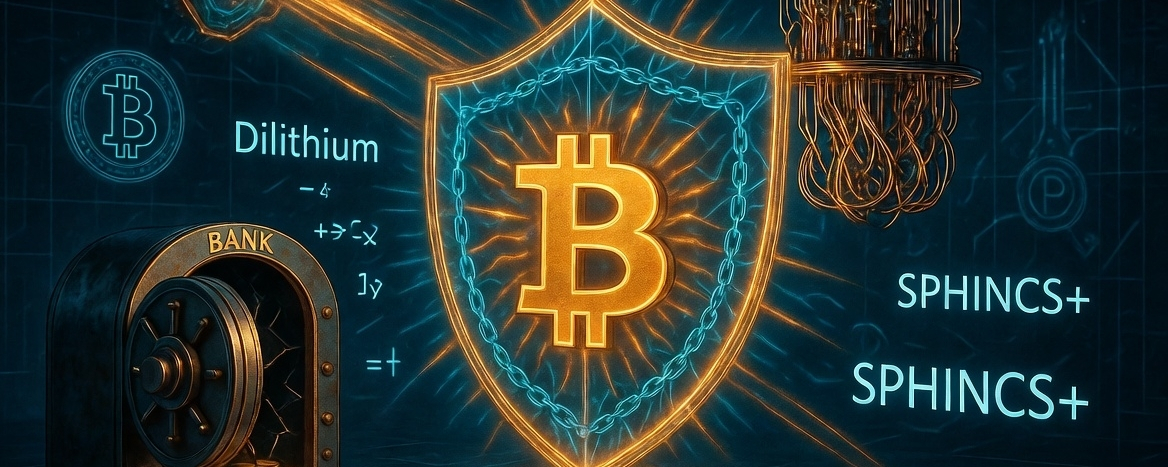
Lattice-based (e.g., ML-DSA/Dilithium, Falcon) — Rely on learning with errors (LWE) or similar problems.
Hash-based (e.g., SPHINCS+/SLH-DSA, XMSS) — Security reduces to the collision-resistance or preimage resistance of hash functions (like SHA-256, which Bitcoin already trusts). These are conservative and well-understood.
Others like code-based or multivariate, but hash- and lattice-based are most discussed for Bitcoin.
Key mechanisms in proposals:
New Output Types — BIP 360 (Pay-to-Merkle-Root or P2MR/P2QRH variants) introduces quantum-resistant address schemes. It removes the "key path" that exposes public keys on-chain (similar to Taproot but without the vulnerable internal key). Users can spend via script paths that support PQC signatures. This protects new transactions and addresses immediately upon adoption.
Post-Quantum Signatures — Integrate schemes like SPHINCS+ (hash-based, NIST-standardized) or ML-DSA into the script system. Signatures would be larger (hundreds to thousands of bytes vs. ~70 bytes for ECDSA), impacting fees and block space, so optimizations and hybrid approaches are explored.
Hybrid and Migration Strategies — Combine old (ECDSA) and new signatures for backward compatibility during transition. Proposals like BIP 361 outline phased sunsetting of legacy outputs, potentially freezing un-migrated coins after a deadline to force migration.
Other Defenses:
Commit/Reveal schemes to hide public keys longer in the mempool.
Encouraging users to move funds from exposed (e.g., legacy P2PKH) addresses to new quantum-safe ones.
Wallets and services adding PQC support proactively.
Current Status (as of 2026)
BIP 360 is a formal proposal and has been implemented in experimental/testnet forks (e.g., by BTQ Technologies). It's a foundational step but not yet activated on mainnet.
Discussions around SPHINCS+ and other schemes continue in Bitcoin dev communities. Full migration would likely require soft forks and could take years due to Bitcoin's conservative governance.
Forks and alternative projects (e.g., Quantum Resistant Ledger, custom Bitcoin forks) have already implemented PQC.
No immediate threat exists today, but "harvest now, decrypt later" attacks mean long-term data (like unspent outputs) should migrate proactively.
In summary, PQC protects Bitcoin by swapping out quantum-vulnerable math (elliptic curves) for quantum-resistant alternatives, primarily through new address types, signature schemes, and careful migration plans. This ensures that even if a quantum computer breaks ECDSA, new and migrated funds remain secure. The process emphasizes crypto-agility—Bitcoin's decentralized nature allows upgrades, but it requires broad consensus. Users can help by moving to modern, Taproot/P2MR-style addresses now and staying informed on proposals.
#BTC走势分析 #quantumcomputers
How does post-quantum cryptography protect Bitcoin?
Post-quantum cryptography (PQC) refers to cryptographic algorithms designed to resist attacks from both classical and future large-scale quantum computers (often called Cryptographically Relevant Quantum Computers or CRQCs). Bitcoin currently relies on ECDSA (Elliptic Curve Digital Signature Algorithm) using the secp256k1 curve for transaction signatures and ownership control. This is vulnerable to Shor's algorithm, which could efficiently solve the discrete logarithm problem underlying elliptic curve cryptography on a sufficiently powerful quantum computer.
The Quantum Threat to Bitcoin#
Public keys are the main target. In many Bitcoin transactions (especially pre-Taproot or certain spends), exposing a public key allows a quantum adversary to derive the private key.
Once a public key is revealed (e.g., when spending from an address), there's a window for a quantum computer to forge signatures and steal funds.
The blockchain history itself and SHA-256-based Proof-of-Work are generally considered more resistant (Grover's algorithm provides only quadratic speedup for hashing, not a practical break).
Estimates for "Q-Day" (when this becomes feasible) vary, but recent analyses (including from Google researchers) suggest it could happen sooner than previously thought, potentially with fewer resources, though still likely years away (e.g., late 2020s to 2030s).
Bitcoin does not natively use PQC today. Protection comes from ongoing research, proposals, and community-driven upgrades.
How PQC Would Protect Bitcoin
PQC replaces or augments vulnerable primitives with algorithms based on hard problems that quantum computers (using Shor's or similar) are not known to solve efficiently. Common categories include:
Lattice-based (e.g., ML-DSA/Dilithium, Falcon) — Rely on learning with errors (LWE) or similar problems.
Hash-based (e.g., SPHINCS+/SLH-DSA, XMSS) — Security reduces to the collision-resistance or preimage resistance of hash functions (like SHA-256, which Bitcoin already trusts). These are conservative and well-understood.
Others like code-based or multivariate, but hash- and lattice-based are most discussed for Bitcoin.
Key mechanisms in proposals:
New Output Types — BIP 360 (Pay-to-Merkle-Root or P2MR/P2QRH variants) introduces quantum-resistant address schemes. It removes the "key path" that exposes public keys on-chain (similar to Taproot but without the vulnerable internal key). Users can spend via script paths that support PQC signatures. This protects new transactions and addresses immediately upon adoption.
Post-Quantum Signatures — Integrate schemes like SPHINCS+ (hash-based, NIST-standardized) or ML-DSA into the script system. Signatures would be larger (hundreds to thousands of bytes vs. ~70 bytes for ECDSA), impacting fees and block space, so optimizations and hybrid approaches are explored.
Hybrid and Migration Strategies — Combine old (ECDSA) and new signatures for backward compatibility during transition. Proposals like BIP 361 outline phased sunsetting of legacy outputs, potentially freezing un-migrated coins after a deadline to force migration.
Other Defenses:
Commit/Reveal schemes to hide public keys longer in the mempool.
Encouraging users to move funds from exposed (e.g., legacy P2PKH) addresses to new quantum-safe ones.
Wallets and services adding PQC support proactively.
Current Status (as of 2026)
BIP 360 is a formal proposal and has been implemented in experimental/testnet forks (e.g., by BTQ Technologies). It's a foundational step but not yet activated on mainnet.
Discussions around SPHINCS+ and other schemes continue in Bitcoin dev communities. Full migration would likely require soft forks and could take years due to Bitcoin's conservative governance.
Forks and alternative projects (e.g., Quantum Resistant Ledger, custom Bitcoin forks) have already implemented PQC.
No immediate threat exists today, but "harvest now, decrypt later" attacks mean long-term data (like unspent outputs) should migrate proactively.
In summary, PQC protects Bitcoin by swapping out quantum-vulnerable math (elliptic curves) for quantum-resistant alternatives, primarily through new address types, signature schemes, and careful migration plans. This ensures that even if a quantum computer breaks ECDSA, new and migrated funds remain secure. The process emphasizes crypto-agility—Bitcoin's decentralized nature allows upgrades, but it requires broad consensus. Users can help by moving to modern, Taproot/P2MR-style addresses now and staying informed on proposals.
#BTC走势分析 #quantumcomputers
The Quantum Threat to Bitcoin#
Public keys are the main target. In many Bitcoin transactions (especially pre-Taproot or certain spends), exposing a public key allows a quantum adversary to derive the private key.
Once a public key is revealed (e.g., when spending from an address), there's a window for a quantum computer to forge signatures and steal funds.
The blockchain history itself and SHA-256-based Proof-of-Work are generally considered more resistant (Grover's algorithm provides only quadratic speedup for hashing, not a practical break).
Estimates for "Q-Day" (when this becomes feasible) vary, but recent analyses (including from Google researchers) suggest it could happen sooner than previously thought, potentially with fewer resources, though still likely years away (e.g., late 2020s to 2030s).
Bitcoin does not natively use PQC today. Protection comes from ongoing research, proposals, and community-driven upgrades.
How PQC Would Protect Bitcoin
PQC replaces or augments vulnerable primitives with algorithms based on hard problems that quantum computers (using Shor's or similar) are not known to solve efficiently. Common categories include:
Lattice-based (e.g., ML-DSA/Dilithium, Falcon) — Rely on learning with errors (LWE) or similar problems.
Hash-based (e.g., SPHINCS+/SLH-DSA, XMSS) — Security reduces to the collision-resistance or preimage resistance of hash functions (like SHA-256, which Bitcoin already trusts). These are conservative and well-understood.
Others like code-based or multivariate, but hash- and lattice-based are most discussed for Bitcoin.
Key mechanisms in proposals:
New Output Types — BIP 360 (Pay-to-Merkle-Root or P2MR/P2QRH variants) introduces quantum-resistant address schemes. It removes the "key path" that exposes public keys on-chain (similar to Taproot but without the vulnerable internal key). Users can spend via script paths that support PQC signatures. This protects new transactions and addresses immediately upon adoption.
Post-Quantum Signatures — Integrate schemes like SPHINCS+ (hash-based, NIST-standardized) or ML-DSA into the script system. Signatures would be larger (hundreds to thousands of bytes vs. ~70 bytes for ECDSA), impacting fees and block space, so optimizations and hybrid approaches are explored.
Hybrid and Migration Strategies — Combine old (ECDSA) and new signatures for backward compatibility during transition. Proposals like BIP 361 outline phased sunsetting of legacy outputs, potentially freezing un-migrated coins after a deadline to force migration.
Other Defenses:
Commit/Reveal schemes to hide public keys longer in the mempool.
Encouraging users to move funds from exposed (e.g., legacy P2PKH) addresses to new quantum-safe ones.
Wallets and services adding PQC support proactively.
Current Status (as of 2026)
BIP 360 is a formal proposal and has been implemented in experimental/testnet forks (e.g., by BTQ Technologies). It's a foundational step but not yet activated on mainnet.
Discussions around SPHINCS+ and other schemes continue in Bitcoin dev communities. Full migration would likely require soft forks and could take years due to Bitcoin's conservative governance.
Forks and alternative projects (e.g., Quantum Resistant Ledger, custom Bitcoin forks) have already implemented PQC.
No immediate threat exists today, but "harvest now, decrypt later" attacks mean long-term data (like unspent outputs) should migrate proactively.
In summary, PQC protects Bitcoin by swapping out quantum-vulnerable math (elliptic curves) for quantum-resistant alternatives, primarily through new address types, signature schemes, and careful migration plans. This ensures that even if a quantum computer breaks ECDSA, new and migrated funds remain secure. The process emphasizes crypto-agility—Bitcoin's decentralized nature allows upgrades, but it requires broad consensus. Users can help by moving to modern, Taproot/P2MR-style addresses now and staying informed on proposals.
#BTC走势分析 #quantumcomputers
1
157

·
--

Article
Trump signs two executive orders on quantum computing. And Bitcoin has a problem.Today, June 22, 2026, President Donald Trump signed two executive orders focused on quantum tech. One is about development and research in the sector. The other concerns post-quantum cryptography. Both have direct implications for crypto that most media outlets aren't connecting the dots on.
What do the orders say?
The first order tasks the FBI and the intelligence community with protecting U.S. quantum research from foreign espionage, and directs the Departments of Energy and Defense to build and house a quantum computer for scientific use. The Commerce Department will need to draft plans to ramp up federal investment in sector companies.
Trump signs two executive orders on quantum computing. And Bitcoin has a problem.
Today, June 22, 2026, President Donald Trump signed two executive orders focused on quantum tech. One is about development and research in the sector. The other concerns post-quantum cryptography. Both have direct implications for crypto that most media outlets aren't connecting the dots on.
What do the orders say?
The first order tasks the FBI and the intelligence community with protecting U.S. quantum research from foreign espionage, and directs the Departments of Energy and Defense to build and house a quantum computer for scientific use. The Commerce Department will need to draft plans to ramp up federal investment in sector companies.
What do the orders say?
The first order tasks the FBI and the intelligence community with protecting U.S. quantum research from foreign espionage, and directs the Departments of Energy and Defense to build and house a quantum computer for scientific use. The Commerce Department will need to draft plans to ramp up federal investment in sector companies.
1
166

·
--
Bullish
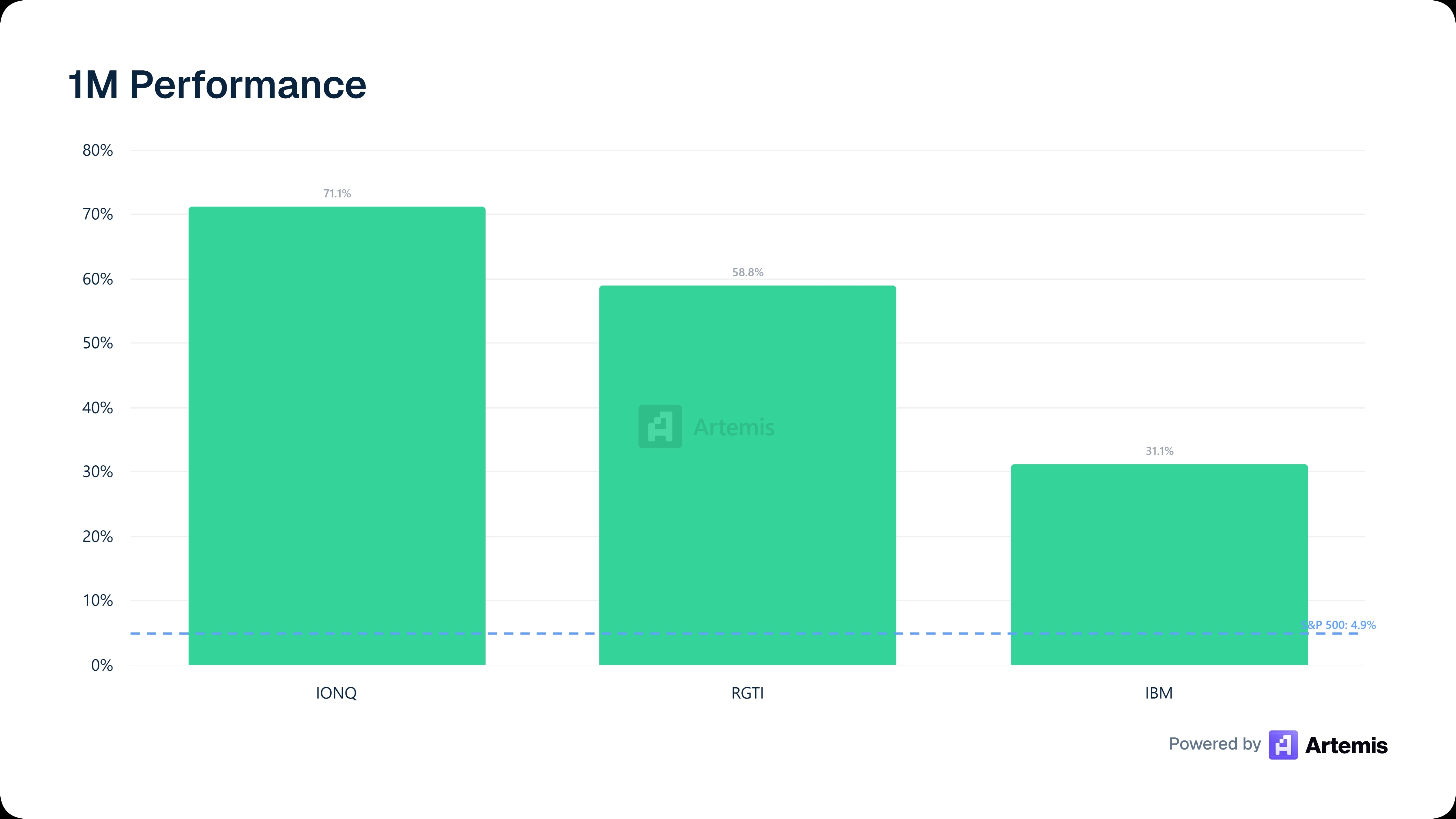
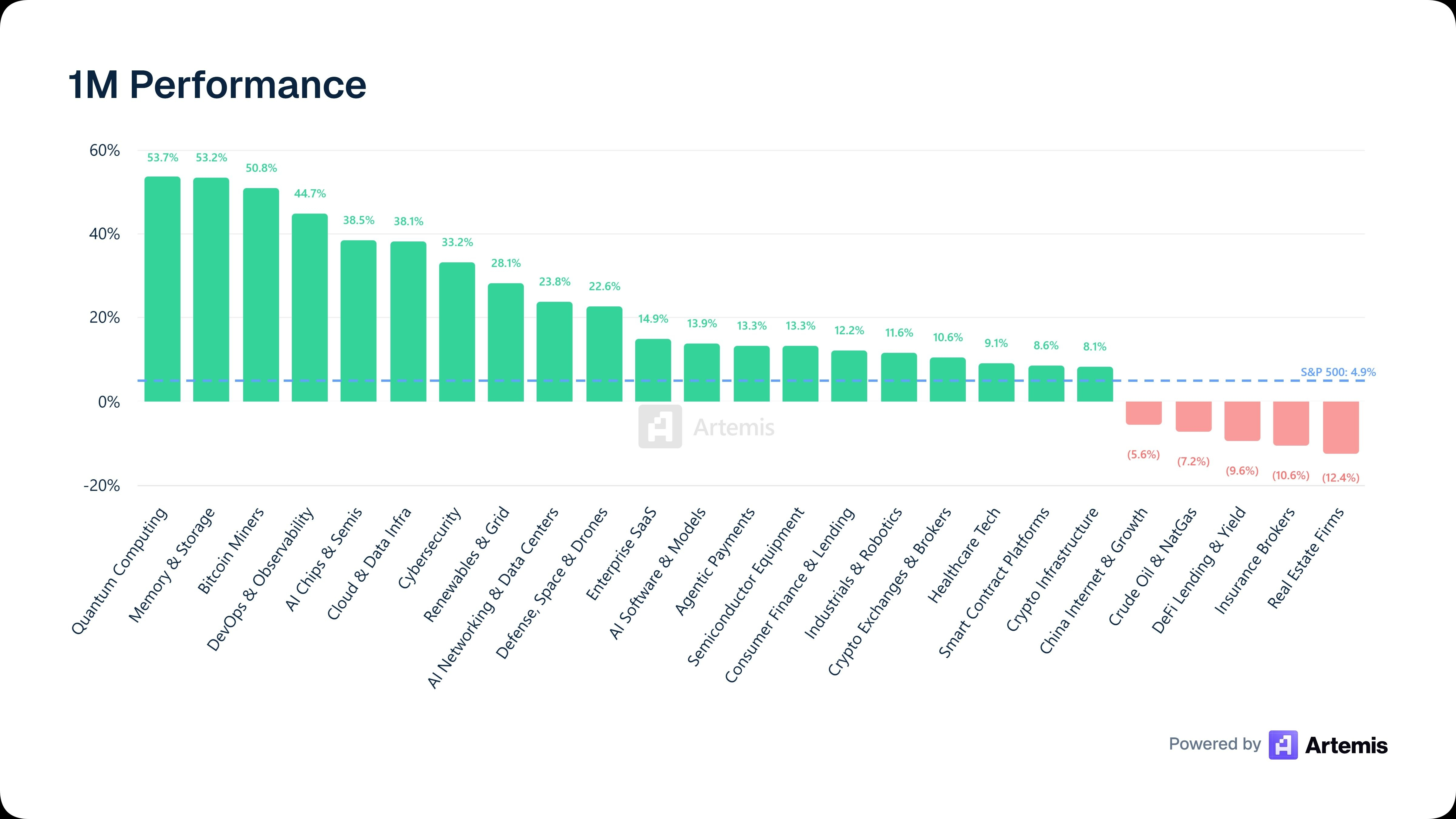
If you're a player in the stock market, these companies are the next liquidity hotspots! 📈 Traders chase daily candlestick movements, while savvy investors keep an eye on where the hot money is building its base for the years to come. Monthly statistics on liquidity flows reveal that the Quantum Computing sector is no longer just futuristic tech; it's now an investment reality soaking up major fund dollars.
If you're looking for strong investment positions backed by real financial momentum, these companies are leading the charge:
🎯 Targeted investment center options:
IONQ: This company is dominating the sector with a staggering monthly growth of 71.1%, showcasing the confidence of market whales in its technological framework as the leader for the next phase.
RGTI (Rigetti Computing): The second investment option with solid upward momentum reaching 58.8%, confirming that the financial flow encompasses the sector as a system, not just a singular company.
IBM: The historical giant is moving steadily with an investment growth of 31.1%, making it the ideal choice for investors seeking safety with excellent upward dynamics that significantly outpace the S&P 500 (4.9%).
#quantumcomputers #AI #ibm
If you're a player in the stock market, these companies are the next liquidity hotspots! 📈 Traders chase daily candlestick movements, while savvy investors keep an eye on where the hot money is building its base for the years to come. Monthly statistics on liquidity flows reveal that the Quantum Computing sector is no longer just futuristic tech; it's now an investment reality soaking up major fund dollars.
If you're looking for strong investment positions backed by real financial momentum, these companies are leading the charge:
🎯 Targeted investment center options:
IONQ: This company is dominating the sector with a staggering monthly growth of 71.1%, showcasing the confidence of market whales in its technological framework as the leader for the next phase.
RGTI (Rigetti Computing): The second investment option with solid upward momentum reaching 58.8%, confirming that the financial flow encompasses the sector as a system, not just a singular company.
IBM: The historical giant is moving steadily with an investment growth of 31.1%, making it the ideal choice for investors seeking safety with excellent upward dynamics that significantly outpace the S&P 500 (4.9%).
#quantumcomputers #AI #ibm
If you're looking for strong investment positions backed by real financial momentum, these companies are leading the charge:
🎯 Targeted investment center options:
IONQ: This company is dominating the sector with a staggering monthly growth of 71.1%, showcasing the confidence of market whales in its technological framework as the leader for the next phase.
RGTI (Rigetti Computing): The second investment option with solid upward momentum reaching 58.8%, confirming that the financial flow encompasses the sector as a system, not just a singular company.
IBM: The historical giant is moving steadily with an investment growth of 31.1%, making it the ideal choice for investors seeking safety with excellent upward dynamics that significantly outpace the S&P 500 (4.9%).
#quantumcomputers #AI #ibm
2
709

#quantumcomputers
🔥 IBM announces “reliable quantum supremacy”: what does this mean for $BTC ?
IBM researchers in collaboration with the University of Chicago have announced another breakthrough in the field of quantum computing. Using 70 logical qubits and a new error correction method, the company performed a calculation in just 15 minutes — a task that requires an unrealistic amount of time for modern classical supercomputers.
📌 Key facts of the experiment:
Technical parameters: 2,415 logical two-qubit operations and 468 T-gates were performed.
Accuracy: the level of logical errors was reduced to 1/10 of the level of physical errors of the system.
Verification: a structured verification method was developed that allows errors to be detected directly during calculations, solving the long-standing problem of confirming results.
⚠️ Is there a threat to Bitcoin?
No, nothing is changing for the security of the network in the foreseeable future.
Bitcoin relies on elliptic curve cryptography. Researchers estimate that it would take a fault-tolerant quantum computer with thousands of logical qubits to break such protection.
IBM’s achievement is an important step in its Starling roadmap (which envisions large-scale fault-tolerant systems by 2029), but quantum engineering still has a long way to go before a real “Q-Day.”
{future}(BTCUSDT)
#quantumcomputers
🔥 IBM announces “reliable quantum supremacy”: what does this mean for $BTC ?
IBM researchers in collaboration with the University of Chicago have announced another breakthrough in the field of quantum computing. Using 70 logical qubits and a new error correction method, the company performed a calculation in just 15 minutes — a task that requires an unrealistic amount of time for modern classical supercomputers.
📌 Key facts of the experiment:
Technical parameters: 2,415 logical two-qubit operations and 468 T-gates were performed.
Accuracy: the level of logical errors was reduced to 1/10 of the level of physical errors of the system.
Verification: a structured verification method was developed that allows errors to be detected directly during calculations, solving the long-standing problem of confirming results.
⚠️ Is there a threat to Bitcoin?
No, nothing is changing for the security of the network in the foreseeable future.
Bitcoin relies on elliptic curve cryptography. Researchers estimate that it would take a fault-tolerant quantum computer with thousands of logical qubits to break such protection.
IBM’s achievement is an important step in its Starling roadmap (which envisions large-scale fault-tolerant systems by 2029), but quantum engineering still has a long way to go before a real “Q-Day.”
🔥 IBM announces “reliable quantum supremacy”: what does this mean for $BTC ?
IBM researchers in collaboration with the University of Chicago have announced another breakthrough in the field of quantum computing. Using 70 logical qubits and a new error correction method, the company performed a calculation in just 15 minutes — a task that requires an unrealistic amount of time for modern classical supercomputers.
📌 Key facts of the experiment:
Technical parameters: 2,415 logical two-qubit operations and 468 T-gates were performed.
Accuracy: the level of logical errors was reduced to 1/10 of the level of physical errors of the system.
Verification: a structured verification method was developed that allows errors to be detected directly during calculations, solving the long-standing problem of confirming results.
⚠️ Is there a threat to Bitcoin?
No, nothing is changing for the security of the network in the foreseeable future.
Bitcoin relies on elliptic curve cryptography. Researchers estimate that it would take a fault-tolerant quantum computer with thousands of logical qubits to break such protection.
IBM’s achievement is an important step in its Starling roadmap (which envisions large-scale fault-tolerant systems by 2029), but quantum engineering still has a long way to go before a real “Q-Day.”

48


·
--
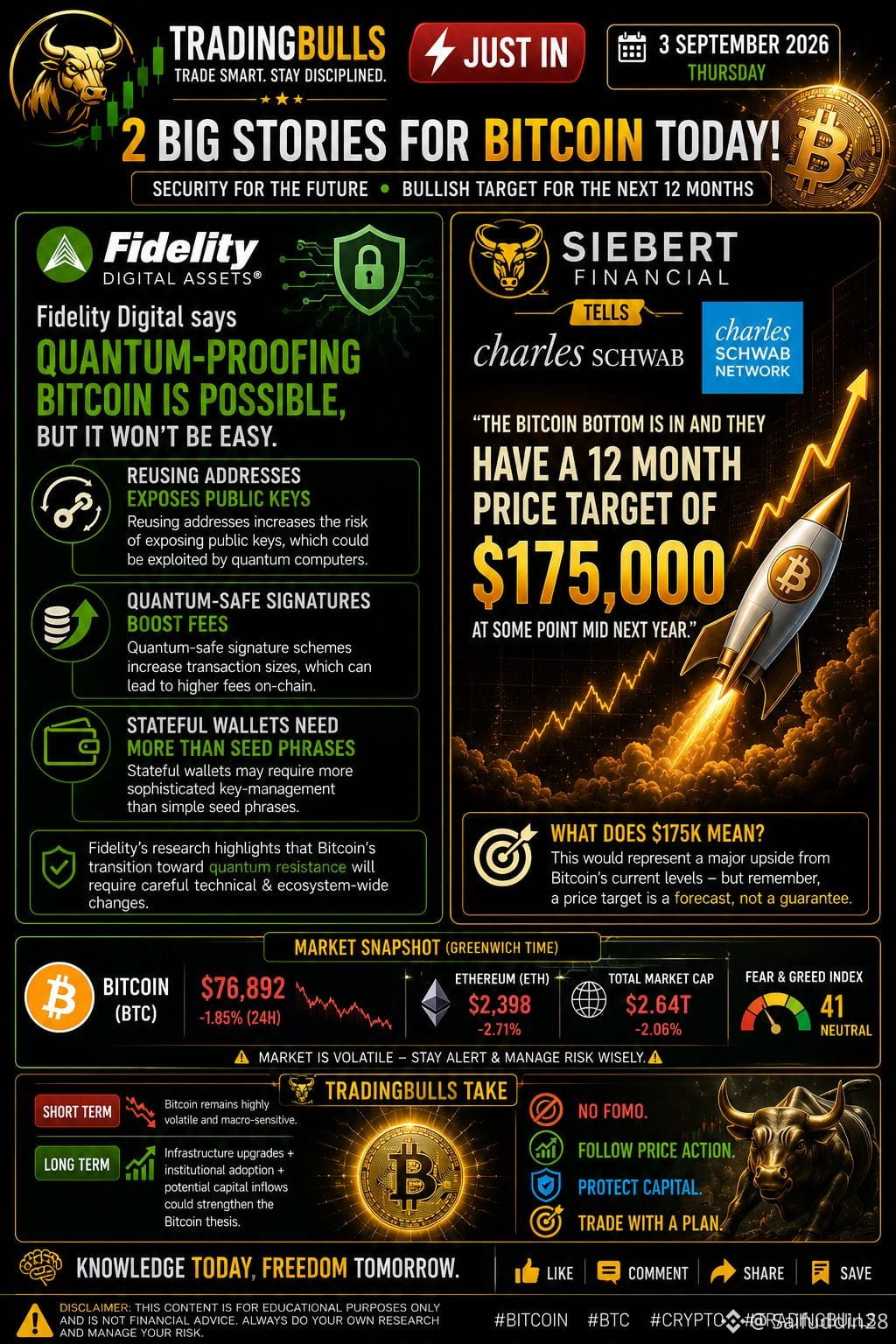
🐂 TRADINGBULLS | BITCOIN — 2 BIG STORIES TODAY 🚨
Bitcoin is getting attention from both sides of the long-term story:
🔐 Quantum resistance for Bitcoin’s future security
🚀 A bullish $175K price target for the next 12 months
🔐 1. Fidelity Digital Assets: Bitcoin Can Become Quantum-Resistant
Fidelity Digital Assets says quantum-proofing Bitcoin is technically possible — but it won’t be easy.
Key challenges include:
🔸 Address reuse can expose public keys
🔸 Quantum-safe signatures could increase transaction sizes and fees
🔸 Stateful wallets may require more sophisticated key-management than simply relying on seed phrases
Fidelity's latest research highlights that Bitcoin's transition toward quantum resistance would require careful technical and ecosystem-wide changes.
Source: https://x.com/BitcoinArchive/status/2095158819105931695
🚀 2. Siebert Financial Sees $175,000 Bitcoin
A new market call making waves:
Siebert Financial reportedly believes the Bitcoin bottom is in and sees a 12-month price target of around $175,000.
That would represent a major upside from Bitcoin's current levels — but remember, a price target is a forecast, not a guarantee.
🧠 TRADINGBULLS TAKE
The bigger picture is interesting:
Short term: 📉 Bitcoin remains highly volatile and macro-sensitive.
Long term: 🔐 Infrastructure upgrades + institutional adoption + potential capital inflows could strengthen the Bitcoin thesis.
But don't trade a headline blindly.
🐂 No FOMO.
📊 Follow price action.
🛡️ Protect capital.
🎯 Trade with a plan.
⚠️ Educational content only. Not financial advice. Always do your own research and manage risk.
$BTC ❤️
#BitcoinNewAllTimeHigh #Fidelity #quantumcomputers #bitcointradin g #CryptoNews
{spot}(BTCUSDT)
🐂 TRADINGBULLS | BITCOIN — 2 BIG STORIES TODAY 🚨
Bitcoin is getting attention from both sides of the long-term story:
🔐 Quantum resistance for Bitcoin’s future security
🚀 A bullish $175K price target for the next 12 months
🔐 1. Fidelity Digital Assets: Bitcoin Can Become Quantum-Resistant
Fidelity Digital Assets says quantum-proofing Bitcoin is technically possible — but it won’t be easy.
Key challenges include:
🔸 Address reuse can expose public keys
🔸 Quantum-safe signatures could increase transaction sizes and fees
🔸 Stateful wallets may require more sophisticated key-management than simply relying on seed phrases
Fidelity's latest research highlights that Bitcoin's transition toward quantum resistance would require careful technical and ecosystem-wide changes.
Source: https://x.com/BitcoinArchive/status/2095158819105931695
🚀 2. Siebert Financial Sees $175,000 Bitcoin
A new market call making waves:
Siebert Financial reportedly believes the Bitcoin bottom is in and sees a 12-month price target of around $175,000.
That would represent a major upside from Bitcoin's current levels — but remember, a price target is a forecast, not a guarantee.
🧠 TRADINGBULLS TAKE
The bigger picture is interesting:
Short term: 📉 Bitcoin remains highly volatile and macro-sensitive.
Long term: 🔐 Infrastructure upgrades + institutional adoption + potential capital inflows could strengthen the Bitcoin thesis.
But don't trade a headline blindly.
🐂 No FOMO.
📊 Follow price action.
🛡️ Protect capital.
🎯 Trade with a plan.
⚠️ Educational content only. Not financial advice. Always do your own research and manage risk.
$BTC ❤️
#BitcoinNewAllTimeHigh #Fidelity #quantumcomputers #bitcointradin g #CryptoNews
Bitcoin is getting attention from both sides of the long-term story:
🔐 Quantum resistance for Bitcoin’s future security
🚀 A bullish $175K price target for the next 12 months
🔐 1. Fidelity Digital Assets: Bitcoin Can Become Quantum-Resistant
Fidelity Digital Assets says quantum-proofing Bitcoin is technically possible — but it won’t be easy.
Key challenges include:
🔸 Address reuse can expose public keys
🔸 Quantum-safe signatures could increase transaction sizes and fees
🔸 Stateful wallets may require more sophisticated key-management than simply relying on seed phrases
Fidelity's latest research highlights that Bitcoin's transition toward quantum resistance would require careful technical and ecosystem-wide changes.
Source: https://x.com/BitcoinArchive/status/2095158819105931695
🚀 2. Siebert Financial Sees $175,000 Bitcoin
A new market call making waves:
Siebert Financial reportedly believes the Bitcoin bottom is in and sees a 12-month price target of around $175,000.
That would represent a major upside from Bitcoin's current levels — but remember, a price target is a forecast, not a guarantee.
🧠 TRADINGBULLS TAKE
The bigger picture is interesting:
Short term: 📉 Bitcoin remains highly volatile and macro-sensitive.
Long term: 🔐 Infrastructure upgrades + institutional adoption + potential capital inflows could strengthen the Bitcoin thesis.
But don't trade a headline blindly.
🐂 No FOMO.
📊 Follow price action.
🛡️ Protect capital.
🎯 Trade with a plan.
⚠️ Educational content only. Not financial advice. Always do your own research and manage risk.
$BTC ❤️
#BitcoinNewAllTimeHigh #Fidelity #quantumcomputers #bitcointradin g #CryptoNews
62

·
--

Article
💔 From 243 USDT to 77 USDT — Maybe Luck Really MattersI’ve been thinking about this since early morning. The moment I opened the app and saw that TAC had dropped around 88%, my heart sank. My asset value had fallen from approximately 243 USDT to just 77 USDT. It wasn’t just a number on the screen—it felt like watching weeks of hope and expectations disappear in seconds.
Sometimes I ask myself: Why can’t I make profits? Why does almost every trade seem to turn against me? Maybe the answer is partly strategy, partly timing, and honestly, maybe luck plays a role too. And I feel like I have had terrible luck with my trades.
But I also don’t want to blame everything on luck. TAC is not necessarily a worthless project. It has an ecosystem, development, and a real narrative behind it. That’s exactly why the sudden price collapse is so difficult to understand.
There are also major token unlocks coming in the next few days, and that can create significant selling pressure. But in my opinion, even knowing about upcoming unlocks, it is difficult to understand such an extreme price move. An unlock can increase supply and pressure the market, but the actual impact depends on how much is sold, who receives the tokens, liquidity, market sentiment, and overall demand.
Today, I’m not trying to predict whether TAc will recover or fall further. I’m simply sharing what I’m feeling as a trader who watched 243 USDT become 77 USDT.
Maybe this is another lesson: never become too emotionally attached to one coin, no matter how strong the project looks.
Crypto can reward patience, but it can also punish overconfidence.
For now, I’m taking a step back, studying what happened, and trying to learn from this loss rather than letting one trade define my entire journey.
Sometimes the market teaches lessons that no chart can explain. 💔📉
But one thing is clear...
I will not sell the TAC COINS..
BECAUSE I CAN'T....
I DON'T WANT TO SELL AT A HUGE LOSS...
I WILL WAIT...
BECAUSE ONLY OPTION I HAVE IS ....
PATIENCE AND WAIT.....
#PatienceWins
#MarketRebound
#quantumcomputers
#BinanceSquareTalks
#LearnFromMistakes
$TAC
{future}(TACUSDT)
$DEXE
{future}(DEXEUSDT)
@heyi
@BiBi
@BinanceTG
$BNB
@undefined
@jiucaicai250131
@AndyYang
@Square-Creator-313083175
@qunghuan
@CT988
@HawkWanly1688
@Square-Creator-f950685a3c52
@Square-Creator-78c0accc6334
@HeaDBaner
@Qazaxli
@buchiquanyu
@Danhuang_ETH
@mx99999
@RiskSonder
@Square-Creator-118a1167b5f42
@Square-Creator-898f7ffa03c8
@Square-Creator-3a83b9cf9303f
@Square-Creator-453834bca5237
@Square-Creator-887e63b9adcdb
@Jeonlees
@Alice0320
@KZG6886
@Square-Creator-258347967
@Paris13Jeanne
@Square-Creator-0ce7b4b8c1641
@LianShenkai
@InternetComputer
@palubsc
@Square-Creator-a26ce267a8909
@undefined
@Square-Creator-3b4282380
@DolphinQ
@xMoney_com
@Xenea
@BUILDonBsc_AI
@NianNianCommunity
@Square-Creator-5ea6beb8b895
@NUTS_btc
@Square-Creator-a8750d12ea6c0
@happynaccy
@melody888
@VanOrz
@vivimoney
@Square-Creator-652545512
💔 From 243 USDT to 77 USDT — Maybe Luck Really Matters
I’ve been thinking about this since early morning. The moment I opened the app and saw that TAC had dropped around 88%, my heart sank. My asset value had fallen from approximately 243 USDT to just 77 USDT. It wasn’t just a number on the screen—it felt like watching weeks of hope and expectations disappear in seconds.
Sometimes I ask myself: Why can’t I make profits? Why does almost every trade seem to turn against me? Maybe the answer is partly strategy, partly timing, and honestly, maybe luck plays a role too. And I feel like I have had terrible luck with my trades.
But I also don’t want to blame everything on luck. TAC is not necessarily a worthless project. It has an ecosystem, development, and a real narrative behind it. That’s exactly why the sudden price collapse is so difficult to understand.
There are also major token unlocks coming in the next few days, and that can create significant selling pressure. But in my opinion, even knowing about upcoming unlocks, it is difficult to understand such an extreme price move. An unlock can increase supply and pressure the market, but the actual impact depends on how much is sold, who receives the tokens, liquidity, market sentiment, and overall demand.
Today, I’m not trying to predict whether TAc will recover or fall further. I’m simply sharing what I’m feeling as a trader who watched 243 USDT become 77 USDT.
Maybe this is another lesson: never become too emotionally attached to one coin, no matter how strong the project looks.
Crypto can reward patience, but it can also punish overconfidence.
For now, I’m taking a step back, studying what happened, and trying to learn from this loss rather than letting one trade define my entire journey.
Sometimes the market teaches lessons that no chart can explain. 💔📉
But one thing is clear...
I will not sell the TAC COINS..
BECAUSE I CAN'T....
I DON'T WANT TO SELL AT A HUGE LOSS...
I WILL WAIT...
BECAUSE ONLY OPTION I HAVE IS ....
PATIENCE AND WAIT.....
#PatienceWins
#MarketRebound
#quantumcomputers
#BinanceSquareTalks
#LearnFromMistakes
$TAC
$DEXE
@Yi He
@Binance BiBi
@Binance TG Community
$BNB
@undefined
@Web3菜菜子
@Andy-加密不落客
@anna睿婕
@QC青茶
@Luna春婷
@Wanli一本万莉168
@Cherry 上帝的宝贝
@Lisa丽萨
@HeadBanger
@QAZAXLI3535
@paodun
@TC小蛋黄
@TaiShen傲泰资本
@RiskSonder
@Rose时间玫瑰
@Max_Crypto_
@yoyoyo切克闹
@Yo-yo糖悠悠
@YZ-说缠
@Jeonlees
@Jax 斩棘
@KZG Crypto 口罩哥
@kaige凯歌520
@K线教主宝宝
@K大宝
@Kaige 塏哥
@Internet Computer
@OG Palu Community
@Odin 奥丁
@undefined
@sapna
@Dolphin晴竹
@xMoney.com
@Xenea Official
@BUILDON GALAXY
@NianNianCommunity
@Nolan南山南
@Nuts坚果
@Nancy小妹
@Naccy小妹
@Melody麦麦
@Van社长
@vivimoney
@miqi–米奇
Sometimes I ask myself: Why can’t I make profits? Why does almost every trade seem to turn against me? Maybe the answer is partly strategy, partly timing, and honestly, maybe luck plays a role too. And I feel like I have had terrible luck with my trades.
But I also don’t want to blame everything on luck. TAC is not necessarily a worthless project. It has an ecosystem, development, and a real narrative behind it. That’s exactly why the sudden price collapse is so difficult to understand.
There are also major token unlocks coming in the next few days, and that can create significant selling pressure. But in my opinion, even knowing about upcoming unlocks, it is difficult to understand such an extreme price move. An unlock can increase supply and pressure the market, but the actual impact depends on how much is sold, who receives the tokens, liquidity, market sentiment, and overall demand.
Today, I’m not trying to predict whether TAc will recover or fall further. I’m simply sharing what I’m feeling as a trader who watched 243 USDT become 77 USDT.
Maybe this is another lesson: never become too emotionally attached to one coin, no matter how strong the project looks.
Crypto can reward patience, but it can also punish overconfidence.
For now, I’m taking a step back, studying what happened, and trying to learn from this loss rather than letting one trade define my entire journey.
Sometimes the market teaches lessons that no chart can explain. 💔📉
But one thing is clear...
I will not sell the TAC COINS..
BECAUSE I CAN'T....
I DON'T WANT TO SELL AT A HUGE LOSS...
I WILL WAIT...
BECAUSE ONLY OPTION I HAVE IS ....
PATIENCE AND WAIT.....
#PatienceWins
#MarketRebound
#quantumcomputers
#BinanceSquareTalks
#LearnFromMistakes
$TAC
$DEXE
@Yi He
@Binance BiBi
@Binance TG Community
$BNB
@undefined
@Web3菜菜子
@Andy-加密不落客
@anna睿婕
@QC青茶
@Luna春婷
@Wanli一本万莉168
@Cherry 上帝的宝贝
@Lisa丽萨
@HeadBanger
@QAZAXLI3535
@paodun
@TC小蛋黄
@TaiShen傲泰资本
@RiskSonder
@Rose时间玫瑰
@Max_Crypto_
@yoyoyo切克闹
@Yo-yo糖悠悠
@YZ-说缠
@Jeonlees
@Jax 斩棘
@KZG Crypto 口罩哥
@kaige凯歌520
@K线教主宝宝
@K大宝
@Kaige 塏哥
@Internet Computer
@OG Palu Community
@Odin 奥丁
@undefined
@sapna
@Dolphin晴竹
@xMoney.com
@Xenea Official
@BUILDON GALAXY
@NianNianCommunity
@Nolan南山南
@Nuts坚果
@Nancy小妹
@Naccy小妹
@Melody麦麦
@Van社长
@vivimoney
@miqi–米奇
37
5
567

·
--
$Q In mid-August 2026, Q coin, the original token of the Q Protocol network (also known as the QGOV governance token), continues to maintain its position as one of the innovative solutions tailored to address the governance dilemma and smart-contract security within the decentralized finance ecosystem (DeFi) and decentralized autonomous organizations (DAOs).
What is the Q Protocol project?
The Q Protocol is designed to function as a “top governance layer” and a set of independent, EVM-compatible blockchains running in parallel with major networks:
The Encrypted Q Constitution (Q Constitution): a legal-digital framework that defines the rights and duties of participants, preventing large capital holders from taking over protocol decisions (Governance Attacks).
The Guardians System (Root Nodes): an independent and delegated protection network to enforce constitutional rules and resolve software disputes.
The utility of the Q token: the token is used as fuel to pay gas fees on the network, secure the system through staking (Staking), and also exercise constitutional voting rights and shared governance.
Market performance and trading indicators today
Today, the coin shows calm price movement reflecting stability within a long-term accumulation range:
Price range: Q token is trading today at very small levels near $0.00034 to $0.00045.
$Q #q #QueencryptoNews #Qubic #quantumcomputers #quickfarm
{future}(QUSDT)
$Q In mid-August 2026, Q coin, the original token of the Q Protocol network (also known as the QGOV governance token), continues to maintain its position as one of the innovative solutions tailored to address the governance dilemma and smart-contract security within the decentralized finance ecosystem (DeFi) and decentralized autonomous organizations (DAOs).
What is the Q Protocol project?
The Q Protocol is designed to function as a “top governance layer” and a set of independent, EVM-compatible blockchains running in parallel with major networks:
The Encrypted Q Constitution (Q Constitution): a legal-digital framework that defines the rights and duties of participants, preventing large capital holders from taking over protocol decisions (Governance Attacks).
The Guardians System (Root Nodes): an independent and delegated protection network to enforce constitutional rules and resolve software disputes.
The utility of the Q token: the token is used as fuel to pay gas fees on the network, secure the system through staking (Staking), and also exercise constitutional voting rights and shared governance.
Market performance and trading indicators today
Today, the coin shows calm price movement reflecting stability within a long-term accumulation range:
Price range: Q token is trading today at very small levels near $0.00034 to $0.00045.
$Q #q #QueencryptoNews #Qubic #quantumcomputers #quickfarm
What is the Q Protocol project?
The Q Protocol is designed to function as a “top governance layer” and a set of independent, EVM-compatible blockchains running in parallel with major networks:
The Encrypted Q Constitution (Q Constitution): a legal-digital framework that defines the rights and duties of participants, preventing large capital holders from taking over protocol decisions (Governance Attacks).
The Guardians System (Root Nodes): an independent and delegated protection network to enforce constitutional rules and resolve software disputes.
The utility of the Q token: the token is used as fuel to pay gas fees on the network, secure the system through staking (Staking), and also exercise constitutional voting rights and shared governance.
Market performance and trading indicators today
Today, the coin shows calm price movement reflecting stability within a long-term accumulation range:
Price range: Q token is trading today at very small levels near $0.00034 to $0.00045.
$Q #q #QueencryptoNews #Qubic #quantumcomputers #quickfarm

77

·
--
Bearish
Achieving the Sales Target $AKE
Entry 0.0078928
Closing 0.0072719
$SNXX $BR
b
#nft #Binance #solana #TrendingTopic #quantumcomputers
Achieving the Sales Target $AKE
Entry 0.0078928
Closing 0.0072719
$SNXX $BR
b
#nft #Binance #solana #TrendingTopic #quantumcomputers
Entry 0.0078928
Closing 0.0072719
$SNXX $BR
b
#nft #Binance #solana #TrendingTopic #quantumcomputers
105

🛑 Bitcoin Security and Quantum Computers: Is Danger Looming? ⚛️💻
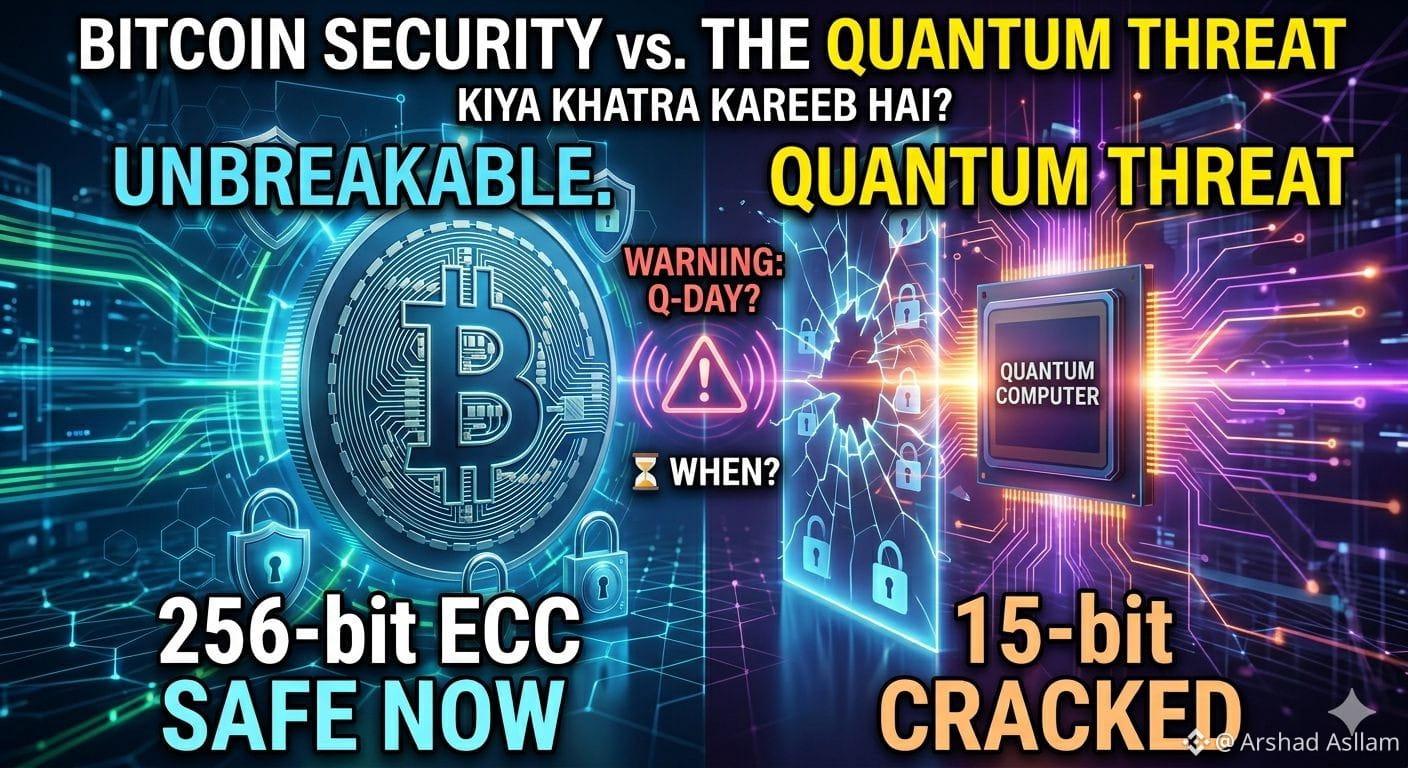
Today, a big news is making waves in the crypto world! Researcher Giancarlo Lelli cracked a 15-bit Bitcoin ECC key using a quantum computer and won 1 BTC as a reward.
✨ What's the Real Deal?
Leveling Up: Last year, tests only succeeded up to 6-bits, but now we've jumped to 15-bits.
Shor’s Algorithm: This is the same formula that could be used in the future to extract a Bitcoin "Private Key" from its "Public Key".
Legacy Wallets: The biggest risk is for those old wallets that haven’t been active for years because their security is outdated.
🛡️ Is Bitcoin in Danger?
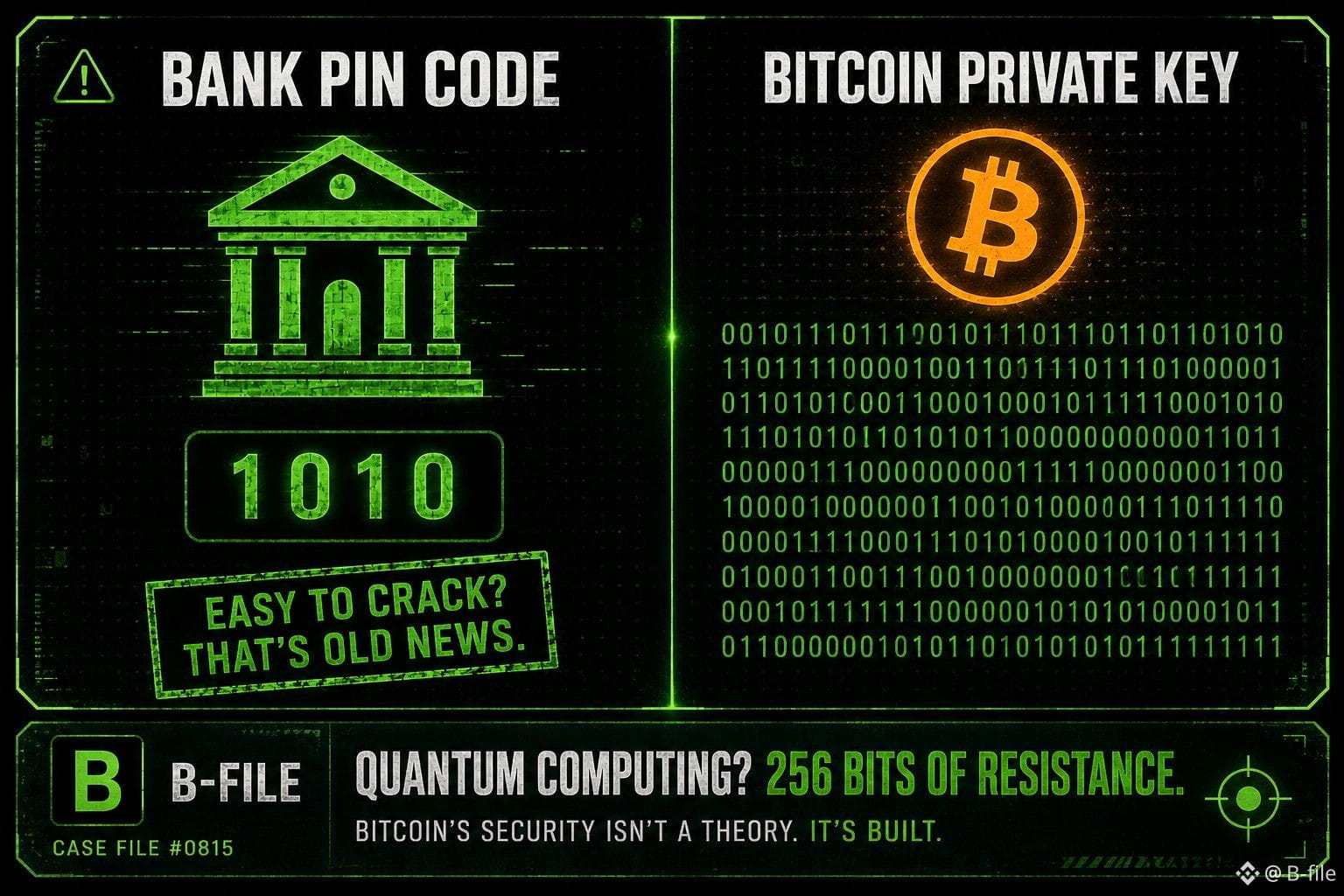
No need to panic just yet! Bitcoin's actual security is 256-bits, which is millions of times stronger than this 15-bit. However, it's proof that the "Quantum Age" is not far off.
💡 Lesson:
The crypto world will need to move towards "Quantum-Resistant" algorithms in the future to ensure our digital gold remains safe.
What do you think? Will quantum computers really take down Bitcoin in the next 5-10 years? 👇
$BTC
{spot}(BTCUSDT)
#bitcoin #CryptoNewss #quantumcomputers #Technology #FutureOfFinance #BTC
🛑 Bitcoin Security and Quantum Computers: Is Danger Looming? ⚛️💻
Today, a big news is making waves in the crypto world! Researcher Giancarlo Lelli cracked a 15-bit Bitcoin ECC key using a quantum computer and won 1 BTC as a reward.
✨ What's the Real Deal?
Leveling Up: Last year, tests only succeeded up to 6-bits, but now we've jumped to 15-bits.
Shor’s Algorithm: This is the same formula that could be used in the future to extract a Bitcoin "Private Key" from its "Public Key".
Legacy Wallets: The biggest risk is for those old wallets that haven’t been active for years because their security is outdated.
🛡️ Is Bitcoin in Danger?
No need to panic just yet! Bitcoin's actual security is 256-bits, which is millions of times stronger than this 15-bit. However, it's proof that the "Quantum Age" is not far off.
💡 Lesson:
The crypto world will need to move towards "Quantum-Resistant" algorithms in the future to ensure our digital gold remains safe.
What do you think? Will quantum computers really take down Bitcoin in the next 5-10 years? 👇
$BTC
#bitcoin #CryptoNewss #quantumcomputers #Technology #FutureOfFinance #BTC
Today, a big news is making waves in the crypto world! Researcher Giancarlo Lelli cracked a 15-bit Bitcoin ECC key using a quantum computer and won 1 BTC as a reward.
✨ What's the Real Deal?
Leveling Up: Last year, tests only succeeded up to 6-bits, but now we've jumped to 15-bits.
Shor’s Algorithm: This is the same formula that could be used in the future to extract a Bitcoin "Private Key" from its "Public Key".
Legacy Wallets: The biggest risk is for those old wallets that haven’t been active for years because their security is outdated.
🛡️ Is Bitcoin in Danger?
No need to panic just yet! Bitcoin's actual security is 256-bits, which is millions of times stronger than this 15-bit. However, it's proof that the "Quantum Age" is not far off.
💡 Lesson:
The crypto world will need to move towards "Quantum-Resistant" algorithms in the future to ensure our digital gold remains safe.
What do you think? Will quantum computers really take down Bitcoin in the next 5-10 years? 👇
$BTC
#bitcoin #CryptoNewss #quantumcomputers #Technology #FutureOfFinance #BTC
88

Article
BREAKING: Quantum Breakthrough Sparks New Debate on Crypto Security ⚡₿
A major milestone in quantum#BTC BREAKING: Quantum Breakthrough Sparks New Debate on Crypto Security ⚡₿
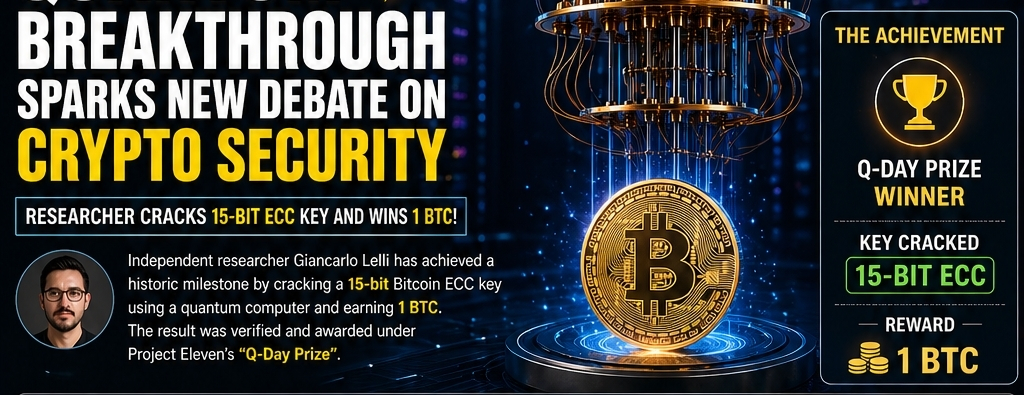
A major milestone in quantum computing has just been achieved, raising serious questions about the future of digital security. Independent researcher Giancarlo Lelli has successfully cracked a small-scale Bitcoin-style cryptographic key—earning a 1 BTC reward in the process.
🏆 The achievement was officially recognized under the Q-Day Prize, marking one of the most advanced public demonstrations of quantum cryptanalysis to date.
📊 FROM THEORY TO REALITY
Just a year ago, quantum systems could barely handle a 6-bit ECC test. Now, that limit has jumped to 15-bit, proving that Shor’s algorithm is gradually becoming practical as quantum hardware evolves.
💡 WHAT THIS MEANS FOR BITCOIN
While Bitcoin still relies on Elliptic Curve Cryptography with 256-bit security, this breakthrough sends a clear signal:
Quantum computing is no longer just theoretical
Real-world cryptographic tests are accelerating
Future risks are becoming more visible
Experts believe that older “legacy wallets,” where public keys are already exposed, could be the first to face potential threats once quantum machines scale further.
⚠️ REALITY CHECK
Let’s keep things in perspective:
A 15-bit key is extremely small compared to Bitcoin’s 256-bit encryption
The gap between current capability and real-world attacks is still massive
No quantum computer today can break Bitcoin’s security
👉 In simple terms: this is like unlocking a basic padlock—not breaking a high-security vault.
🔮 THE FUTURE OF CRYPTO SECURITY
The crypto industry isn’t ignoring this. Developers are already researching post-quantum cryptography, which could protect networks even in a quantum-powered world.
And remember—Bitcoin has evolved before. If needed, it can adapt again.
📌 FINAL THOUGHT
This isn’t the end of crypto—it’s a glimpse into the future.
The real question is no longer “Can quantum break crypto?”
It’s “How long do we $have before it can?” ⏳⚡
#BTCSurpasses$79K #StrategyBTCPurchase #quantumcomputers $BTC
{spot}(BTCUSDT)
$ETH
{future}(ETHUSDT)
$XRP
{future}(XRPUSDT)
BREAKING: Quantum Breakthrough Sparks New Debate on Crypto Security ⚡₿ A major milestone in quantum
#BTC BREAKING: Quantum Breakthrough Sparks New Debate on Crypto Security ⚡₿
A major milestone in quantum computing has just been achieved, raising serious questions about the future of digital security. Independent researcher Giancarlo Lelli has successfully cracked a small-scale Bitcoin-style cryptographic key—earning a 1 BTC reward in the process.
🏆 The achievement was officially recognized under the Q-Day Prize, marking one of the most advanced public demonstrations of quantum cryptanalysis to date.
📊 FROM THEORY TO REALITY
Just a year ago, quantum systems could barely handle a 6-bit ECC test. Now, that limit has jumped to 15-bit, proving that Shor’s algorithm is gradually becoming practical as quantum hardware evolves.
💡 WHAT THIS MEANS FOR BITCOIN
While Bitcoin still relies on Elliptic Curve Cryptography with 256-bit security, this breakthrough sends a clear signal:
Quantum computing is no longer just theoretical
Real-world cryptographic tests are accelerating
Future risks are becoming more visible
Experts believe that older “legacy wallets,” where public keys are already exposed, could be the first to face potential threats once quantum machines scale further.
⚠️ REALITY CHECK
Let’s keep things in perspective:
A 15-bit key is extremely small compared to Bitcoin’s 256-bit encryption
The gap between current capability and real-world attacks is still massive
No quantum computer today can break Bitcoin’s security
👉 In simple terms: this is like unlocking a basic padlock—not breaking a high-security vault.
🔮 THE FUTURE OF CRYPTO SECURITY
The crypto industry isn’t ignoring this. Developers are already researching post-quantum cryptography, which could protect networks even in a quantum-powered world.
And remember—Bitcoin has evolved before. If needed, it can adapt again.
📌 FINAL THOUGHT
This isn’t the end of crypto—it’s a glimpse into the future.
The real question is no longer “Can quantum break crypto?”
It’s “How long do we $have before it can?” ⏳⚡
#BTCSurpasses$79K #StrategyBTCPurchase #quantumcomputers $BTC
$ETH
$XRP
A major milestone in quantum computing has just been achieved, raising serious questions about the future of digital security. Independent researcher Giancarlo Lelli has successfully cracked a small-scale Bitcoin-style cryptographic key—earning a 1 BTC reward in the process.
🏆 The achievement was officially recognized under the Q-Day Prize, marking one of the most advanced public demonstrations of quantum cryptanalysis to date.
📊 FROM THEORY TO REALITY
Just a year ago, quantum systems could barely handle a 6-bit ECC test. Now, that limit has jumped to 15-bit, proving that Shor’s algorithm is gradually becoming practical as quantum hardware evolves.
💡 WHAT THIS MEANS FOR BITCOIN
While Bitcoin still relies on Elliptic Curve Cryptography with 256-bit security, this breakthrough sends a clear signal:
Quantum computing is no longer just theoretical
Real-world cryptographic tests are accelerating
Future risks are becoming more visible
Experts believe that older “legacy wallets,” where public keys are already exposed, could be the first to face potential threats once quantum machines scale further.
⚠️ REALITY CHECK
Let’s keep things in perspective:
A 15-bit key is extremely small compared to Bitcoin’s 256-bit encryption
The gap between current capability and real-world attacks is still massive
No quantum computer today can break Bitcoin’s security
👉 In simple terms: this is like unlocking a basic padlock—not breaking a high-security vault.
🔮 THE FUTURE OF CRYPTO SECURITY
The crypto industry isn’t ignoring this. Developers are already researching post-quantum cryptography, which could protect networks even in a quantum-powered world.
And remember—Bitcoin has evolved before. If needed, it can adapt again.
📌 FINAL THOUGHT
This isn’t the end of crypto—it’s a glimpse into the future.
The real question is no longer “Can quantum break crypto?”
It’s “How long do we $have before it can?” ⏳⚡
#BTCSurpasses$79K #StrategyBTCPurchase #quantumcomputers $BTC
$ETH
$XRP
26

Which blockchains are ready for the quantum age, and which aren't?The quantum threat to crypto no longer feels like a distant concern. After NIST's decisions, warnings from Coinbase, and updates from Google, projects need to decide: is the talk about being 'quantum-ready' backed by a real plan or just a marketing gimmick?
In August 2024, NIST approved the first three standards for post-quantum cryptography and directly recommended starting the transition now. The deadline is set in stone — by 2035, vulnerable public key algorithms must be phased out.
Which blockchains are ready for the quantum age, and which aren't?
The quantum threat to crypto no longer feels like a distant concern. After NIST's decisions, warnings from Coinbase, and updates from Google, projects need to decide: is the talk about being 'quantum-ready' backed by a real plan or just a marketing gimmick?
In August 2024, NIST approved the first three standards for post-quantum cryptography and directly recommended starting the transition now. The deadline is set in stone — by 2035, vulnerable public key algorithms must be phased out.
In August 2024, NIST approved the first three standards for post-quantum cryptography and directly recommended starting the transition now. The deadline is set in stone — by 2035, vulnerable public key algorithms must be phased out.
2
139

·
--
Bullish
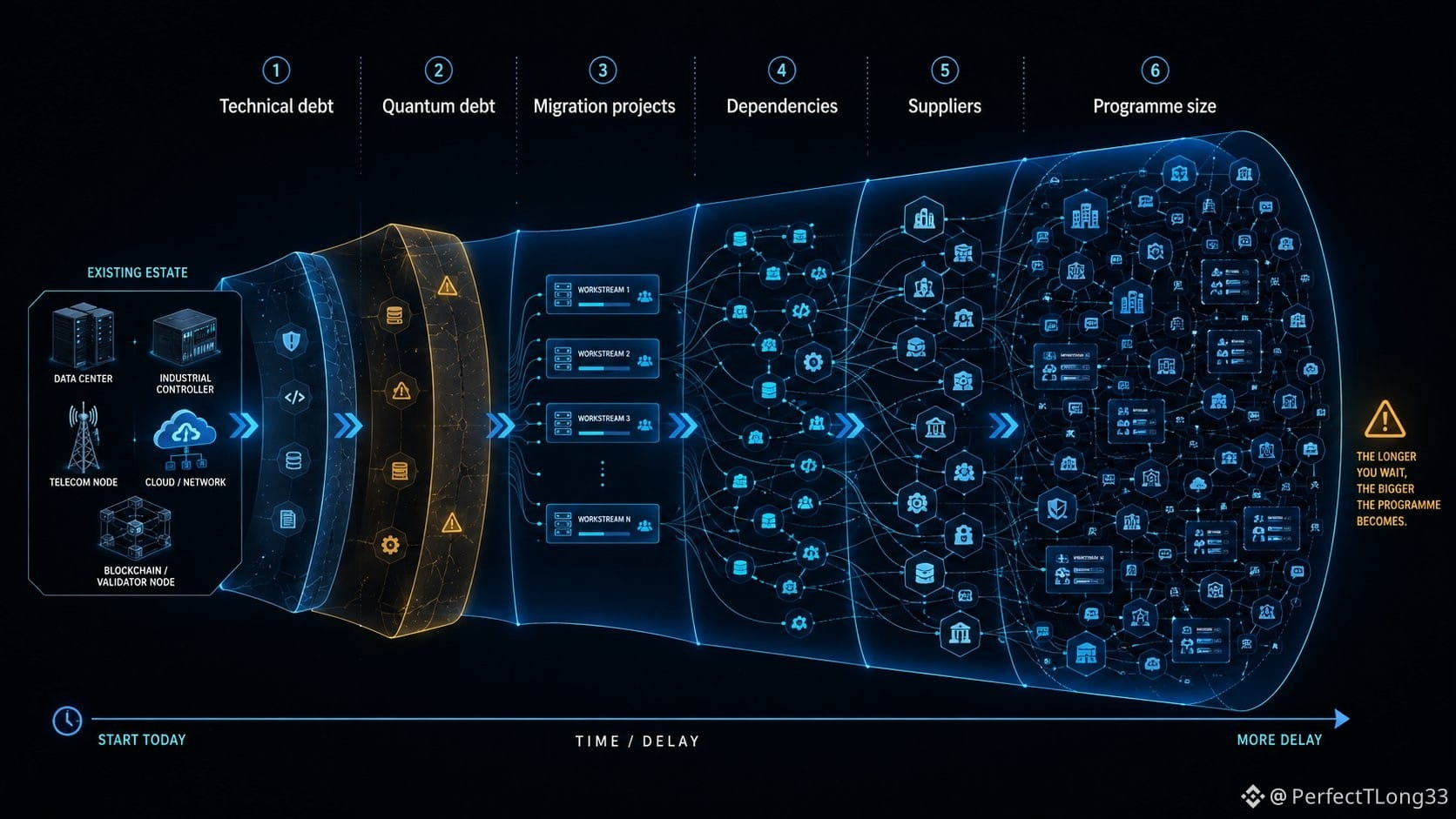
Companies already carry technical debt.
Most are now accumulating quantum debt.
Every system left unprepared becomes another migration project.
Every dependency becomes another integration.
Every supplier becomes another conversation.
Delay does not leave the problem unchanged.
It expands it.
The longer infrastructure waits, the larger the programme becomes.
Qustream.com QST/SOL
"coming soon layer 1
ca:AUuCEHQ7sm2i5GmaHrpE961voWcTY8U6mgrkhcV7pump
$BTC $SOL $ETH #BTC #solana #ETH
#quantum #quantumcomputers
Companies already carry technical debt.
Most are now accumulating quantum debt.
Every system left unprepared becomes another migration project.
Every dependency becomes another integration.
Every supplier becomes another conversation.
Delay does not leave the problem unchanged.
It expands it.
The longer infrastructure waits, the larger the programme becomes.
Qustream.com QST/SOL
"coming soon layer 1
ca:AUuCEHQ7sm2i5GmaHrpE961voWcTY8U6mgrkhcV7pump
$BTC $SOL $ETH #BTC #solana #ETH
#quantum #quantumcomputers
Most are now accumulating quantum debt.
Every system left unprepared becomes another migration project.
Every dependency becomes another integration.
Every supplier becomes another conversation.
Delay does not leave the problem unchanged.
It expands it.
The longer infrastructure waits, the larger the programme becomes.
Qustream.com QST/SOL
"coming soon layer 1
ca:AUuCEHQ7sm2i5GmaHrpE961voWcTY8U6mgrkhcV7pump
$BTC $SOL $ETH #BTC #solana #ETH
#quantum #quantumcomputers
127
Log in to explore more content
Join global crypto users on Binance Square
⚡️ Get latest and useful information about crypto.
💬 Trusted by the world’s largest crypto exchange.
👍 Discover real insights from verified creators.
Email / Phone number
Trending Topics
1
#BitcoinReboundsTo$79K
27,179 views
241 Discussing
2
#USDCOnChainVolumeTops$100Trillion
58 views
9 Discussing
3
#BitcoinSpotETFsNetInflow$160M
983 views
59 Discussing
4
#SouthKoreaCryptoTaxDelayPetitionTops50000
19,873 views
608 Discussing
5
#SolanaTransactionV1GoesLiveOnMainnet
13,757 views
400 Discussing
6
#RussianCentralBankFlagsCryptoAsFinancialRisk
10,618 views
344 Discussing
7
#GrayscalePutsXRPAt26.11%InAdvisorPortfolio
26,404 views
474 Discussing
8
#PhiladelphiaSemiconductorIndexFalls5.9%
10,779 views
296 Discussing
9
#SECChairUrgesCongressToAdvanceClarityAct
25,593 views
323 Discussing
10
#FedHikeOddsRiseTo89%
127,238 views
1,362 Discussing