

#deepseek
deepseek
2.5M views
1,360 Discussing
Hot
Latest


🤖🔥 US restrictions aren't stopping the flow of capital into Chinese AI. DeepSeek reportedly raised $15B to expand infrastructure despite federal bans on its tech in US agencies. This massive injection shows a determined push for global competitiveness and suggests that geopolitical barriers may not hinder funding for top-tier AI labs 🇨🇳. #DeepSeek #AI #ArtificialIntelligence #AINews #CryptoverseNews
Full story: https://cryptoversenews.eu/ai/deepseek-reportedly-raises-15b-days-after-us-restrictions/?utm_source=binance_square&utm_medium=social&utm_campaign=autopost
Full story: https://cryptoversenews.eu/ai/deepseek-reportedly-raises-15b-days-after-us-restrictions/?utm_source=binance_square&utm_medium=social&utm_campaign=autopost
42

·
--
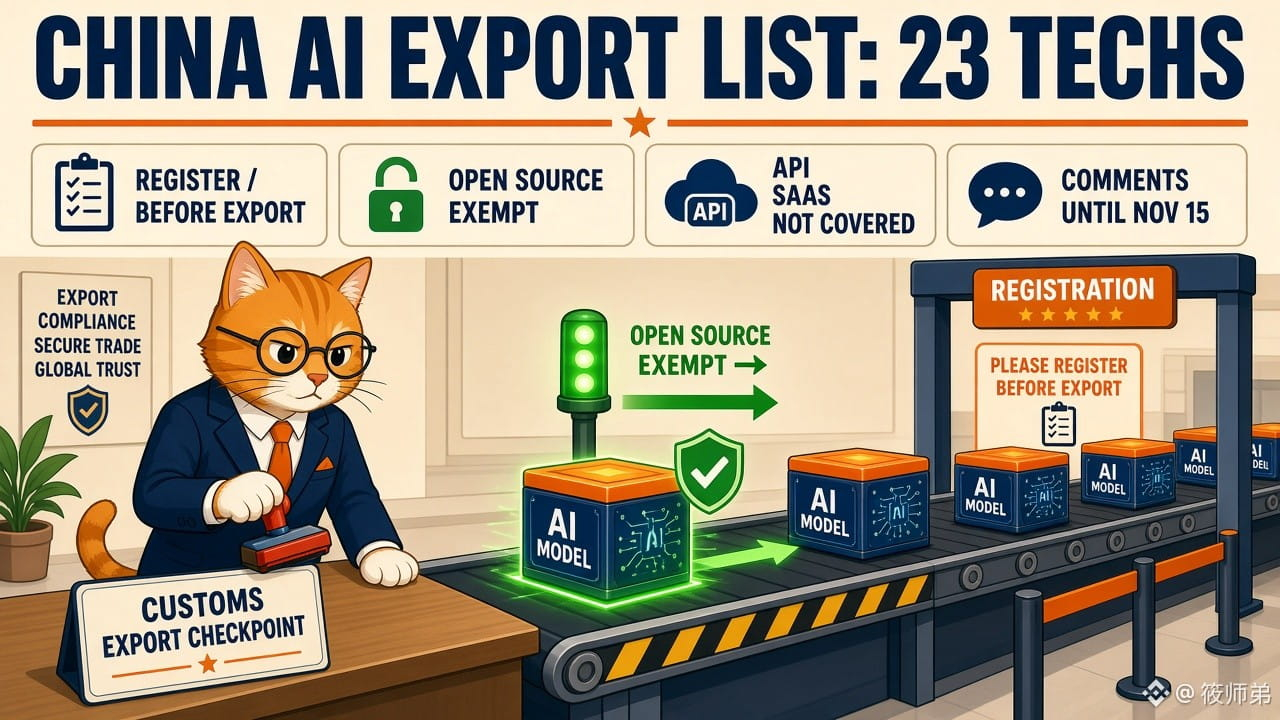
China’s New AI Technology Export Rules: 23 Items Listed; DeepSeek and MiniMax Have Already Obtained the “Permit to Go Global”
📌 On 10/16, the Ministry of Commerce and the Ministry of Science and Technology issued Announcement No. 48 of 2026, proposing to add 40 technologies covering AI, biopharmaceuticals, and solar photovoltaics to the Catalog of Technologies Prohibited or Restricted from Export. The 23 AI-related items include large models, AI agents, computing clusters, and information processing. Starting immediately, exports of these technologies must be registered in advance. Public comments are being solicited until 11/15 (Ministry of Commerce website).
📌 Technologies that have been open-sourced or published in academic papers and entered the public domain are not subject to these rules. Providing APIs, apps/websites, SaaS, or lightweight on-device deployment based on restricted large models does not count as a technology export; overseas localized deployment does. The use of a company’s own overseas cloud may qualify for an automatic license (Ministry of Commerce Q&A with reporters).
📌 DeepSeek and MiniMax have completed registration and received approval for open-source releases and overseas licensing. MiniMax confirmed this in a 10/23 announcement on the Hong Kong Stock Exchange (Yuyuantantian / IT Home / Yicai / The Register).
【Analysis】
This looks more like “drawing boundaries” than “shutting the door”: the rules govern the transfer of model weights and core technologies, while APIs and open-source releases going global are largely unaffected. Leading companies completed registration within days, suggesting the channel is open. The rules are likely to have limited immediate impact on Chinese models expanding overseas, while giving international customers clearer compliance expectations.
【Opportunities / Risks】
✅ Open-source models are explicitly exempt, so the rationale for distributing Chinese open-source models overseas and offering APIs abroad remains unchanged. Watch sentiment around AI computing and decentralized AI.
⚠️ Uncertainty remains until the final catalog is issued. The final wording after the public-comment period ends on 11/15 will be key. “Overseas localized deployment” requires approval, which could slow business involving private deployments.
⚠️ This week’s FOMC meeting (early morning Beijing time on 10/29), alongside U.S. tech earnings, means AI-themed tokens may be more affected by macro risk appetite.
Do you think these rules will make Chinese models more likely to “open-source first, then go global”?
#AI #DeepSeek #出口管制 #AI-themed tokens
$TAO $FET
For reference only; this is not investment advice.
272

·
--
【Market Update】APIs don’t count as technology exports, giving DeepSeek and MiniMax a breather. On October 16, two government departments proposed regulating 23 AI technologies, with public comments open until November 15. “Pre-export registration” applies only to sellers and licensors; APIs, apps, and SaaS are not considered exports, while open-source technologies can be “reported and released immediately.” But the claim that they are “already registered” comes only from state media; no list has been published. Does regulation mark out clear lanes, or sow uncertainty? What do you think?
$BTC $ETH $AI
#DeepSeek #AI #MiniMax
(Source: BlockTempo)
⚠️Risk reminder: The above is shared for market information purposes only and does not constitute investment advice. Investing involves risks; please exercise caution.
$BTC $ETH $AI
#DeepSeek #AI #MiniMax
(Source: BlockTempo)
⚠️Risk reminder: The above is shared for market information purposes only and does not constitute investment advice. Investing involves risks; please exercise caution.
262
·
--
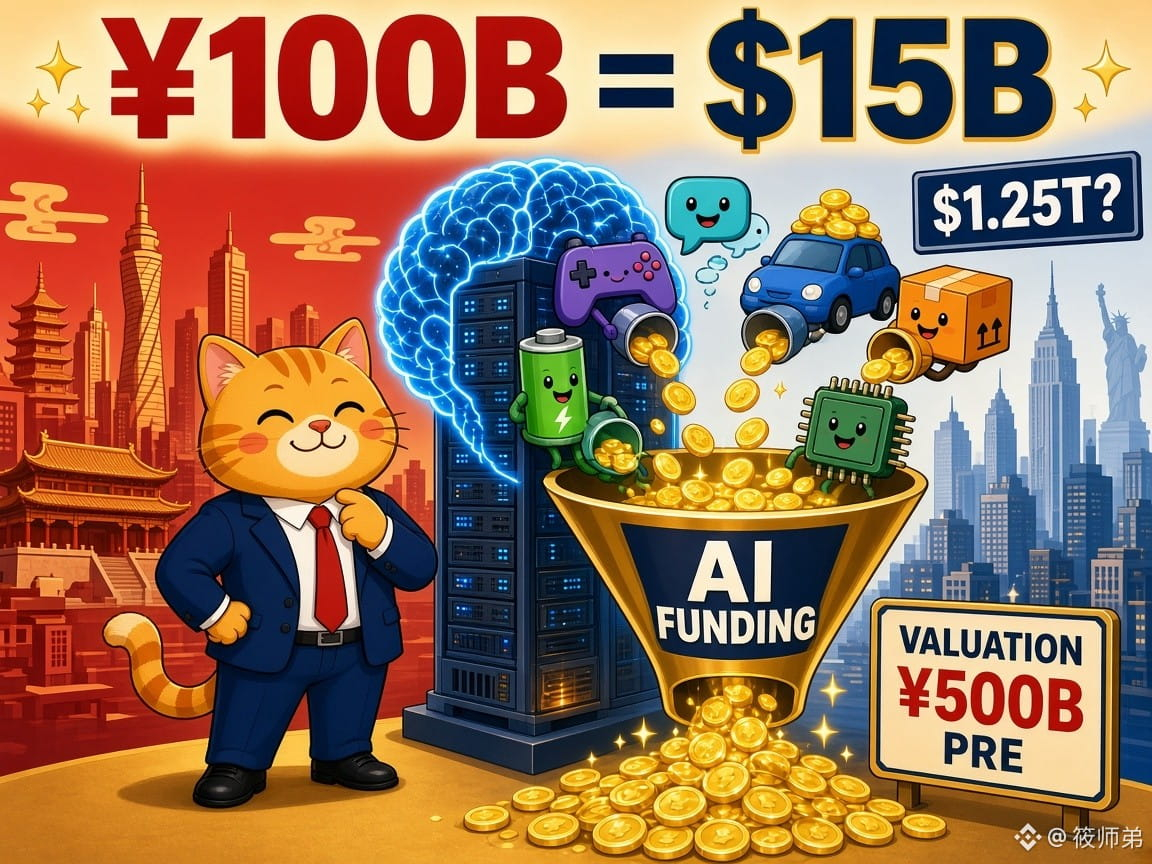
DeepSeek raises 100 billion yuan in latest funding round! CATL and Tencent lead, as China’s AI players begin to “band together with industrial capital”
📌 Reuters, citing people familiar with the matter: DeepSeek’s latest funding round is around 100 billion yuan (about $15 billion), with CATL and Tencent as the largest investors. Geely, Meituan, GigaDevice, Midea, NetEase, Boyu and IDG are among the participants. More than 15 investors are involved, and the pre-money valuation is around 500 billion yuan.
📌 Bloomberg says the fundraising target was raised at least twice (from 50 billion to 80 billion to 100 billion yuan). CNBC previously reported that the company preferred state-owned and industrial capital, and may be preparing for an IPO next year. The deal is expected to close within days, though the terms may still change.
📌 In the same week: CNBC reported that OpenAI plans to raise up to $30 billion at a $1.25 trillion valuation, while US AI stocks had just undergone a sell-off, with the Nasdaq down 2.6% on Thursday.
【Viewpoint】
The funding paths for AI in China and the US are diverging: the US relies on sovereign wealth funds and public markets, while China draws on industrial capital from battery, automotive, chip and internet giants. At a pre-money valuation of around $75 billion—only a fraction of OpenAI’s—DeepSeek’s “value for money” narrative remains intact. With 100 billion yuan in hand, DeepSeek could keep pushing down prices through open-source models and lower inference costs. This benefits application-layer companies and compute-rental providers, but puts pressure on closed-source models and new cloud providers that depend on high valuations.
【Opportunities/Risks】
✅ Watch: Demand dynamics for AI agent and decentralized computing plays (such as $FET) as open-source models become cheaper; a potential sentiment recovery in domestic compute supply chains and AI applications listed in mainland China and Hong Kong.
⚠️ Risks: The funding round has not yet been finalized; the US AI sell-off may not be over. $BTC remains near 81,000 and is falling alongside the Nasdaq. Bitfinex notes that a close below 81,300 could lead to a further decline toward 79,821.
Do you think this 100-billion-yuan war chest will lead DeepSeek to launch another “price-cutting shock”? Is that bullish or bearish for AI-related crypto assets?
#DeepSeek #AI #人工智能 #融资 #Binance Square
For informational purposes only; this is not investment advice.
DeepSeek raises 100 billion yuan in latest funding round! CATL and Tencent lead, as China’s AI players begin to “band together with industrial capital”
📌 Reuters, citing people familiar with the matter: DeepSeek’s latest funding round is around 100 billion yuan (about $15 billion), with CATL and Tencent as the largest investors. Geely, Meituan, GigaDevice, Midea, NetEase, Boyu and IDG are among the participants. More than 15 investors are involved, and the pre-money valuation is around 500 billion yuan.
📌 Bloomberg says the fundraising target was raised at least twice (from 50 billion to 80 billion to 100 billion yuan). CNBC previously reported that the company preferred state-owned and industrial capital, and may be preparing for an IPO next year. The deal is expected to close within days, though the terms may still change.
📌 In the same week: CNBC reported that OpenAI plans to raise up to $30 billion at a $1.25 trillion valuation, while US AI stocks had just undergone a sell-off, with the Nasdaq down 2.6% on Thursday.
【Viewpoint】
The funding paths for AI in China and the US are diverging: the US relies on sovereign wealth funds and public markets, while China draws on industrial capital from battery, automotive, chip and internet giants. At a pre-money valuation of around $75 billion—only a fraction of OpenAI’s—DeepSeek’s “value for money” narrative remains intact. With 100 billion yuan in hand, DeepSeek could keep pushing down prices through open-source models and lower inference costs. This benefits application-layer companies and compute-rental providers, but puts pressure on closed-source models and new cloud providers that depend on high valuations.
【Opportunities/Risks】
✅ Watch: Demand dynamics for AI agent and decentralized computing plays (such as $FET ) as open-source models become cheaper; a potential sentiment recovery in domestic compute supply chains and AI applications listed in mainland China and Hong Kong.
⚠️ Risks: The funding round has not yet been finalized; the US AI sell-off may not be over. $BTC remains near 81,000 and is falling alongside the Nasdaq. Bitfinex notes that a close below 81,300 could lead to a further decline toward 79,821.
Do you think this 100-billion-yuan war chest will lead DeepSeek to launch another “price-cutting shock”? Is that bullish or bearish for AI-related crypto assets?
#DeepSeek #AI #人工智能 #融资 #Binance Square
For informational purposes only; this is not investment advice.
268

DeepSeek raised another 100 billion in its second funding round. Here’s how everyone stacks up:
Liang Wenfeng: Other people seek capital when they fundraise; I get to choose my investors. You can share the money, but don’t touch the steering wheel. Locked in for five years, with no voting rights. Invest if you want; don’t if you don’t.
Tencent, CATL: Existing shareholders are back for another round, doubling down from their cornerstone positions.
Perfect World, Century Huatong: Gaming is the main business; funding AI is the side hustle—the endgame for gaming companies is computing power.
Retail investors: That 100 billion has absolutely nothing to do with you. You can’t get a piece of the equity, so all you can do is watch crypto AI shitcoins rewrite their white papers overnight and bold the word “AI” in size 3.
The most painful part: demand was so hot that the raise doubled from 50 billion to 100 billion, while the 500 billion pre-money valuation didn’t budge an inch. This isn’t fundraising; it’s an order being issued: there are no seats for retail investors at the AI table.
Comment section, sound off: Team A says the AI narrative is heating up again, with crypto AI tokens rising in sympathy; Team B says a funding round is just a funding round, and shitcoins will still go to zero. Roll call.
#DeepSeek #AI
$BTC $ETH $SOL
562

·
--
U.S. Government Orders DeepSeek Removed: Keep a Close Watch on AI Chatbots and Halt Procurement!
The U.S. government has ordered all government agencies to remove the DeepSeek AI chatbot from their systems and banned new purchases. The open-source model once attracted widespread attention, but is now a target of heightened scrutiny. Keep an eye on where the money is flowing and stay on top of AI trends. #DeepSeek #Money Trackers.
The U.S. government has ordered all government agencies to remove the DeepSeek AI chatbot from their systems and banned new purchases. The open-source model once attracted widespread attention, but is now a target of heightened scrutiny. Keep an eye on where the money is flowing and stay on top of AI trends. #DeepSeek #Money Trackers.
27

·
--
Reuters, citing people familiar with the matter, reports that DeepSeek is finalizing a funding round of about RMB 100 billion (approximately US$15 billion), with Tencent and CATL among the largest investors. The target has risen from an initial roughly RMB 50 billion to RMB 80 billion and then to around RMB 100 billion. The deal is expected to close within days, though the terms could still change.
Bloomberg previously reported that the target had been raised twice and was nearing RMB 100 billion. Wallstreetcn reports that CATL plans to add about RMB 10 billion in this round, following an initial investment of roughly RMB 5 billion. If the deal closes, DeepSeek’s total fundraising over six months could reach around RMB 150 billion, while it is also advancing plans for a STAR Market IPO.
In September, The Information also reported that Liang Wenfeng had told investors that annualized revenue had reached around US$1 billion, mainly from APIs. A RMB 100-billion-scale funding round is massive by Chinese private-market standards, but it is still nowhere near the scale of OpenAI and Anthropic’s combined fundraising, which is in the hundreds of billions of dollars.
#DeepSeek #AI #funding
2

·
--
Bullish
🚨UNITED STATES ORDERS DEEPSEEK BAN IN GOVERNMENT AGENCIES: THE IMPACT ON THE AI MARKET! 🛑🇺🇸
The geopolitical and regulatory landscape of Artificial Intelligence has just reached another pivotal moment: the U.S. Department of Homeland Security (DHS) issued a direct order requiring all federal civilian agencies to uninstall DeepSeek and immediately stop using technologies based on the Chinese model!
📌 KEY POINTS OF THE DECISION:
1️⃣ Federal Restriction: The measure requires the complete removal of systems using DeepSeek’s architecture and blocks new contracts or purchases. 2️⃣ Data Security and Geopolitics: The move reflects growing tensions and U.S. authorities’ concerns about data sovereignty and the expansion of Chinese AI into public infrastructure. 3️⃣ Impact on AI Tokens: News like this often directly affects sentiment around memecoins and tokens in ecosystems linked to DeepSeek or AI on the BNB Chain and other networks, triggering spikes in volatility.
💡 PROFESSIONAL PERSPECTIVE:
Regulation and government restrictions are critical factors that every technology and crypto investor needs to monitor. While AI technology is advancing rapidly, geopolitical restrictions can change the course of institutional adoption overnight (DYOR).
📊 KEEP A CLOSE EYE ON THE MARKET:
👇 Check the liquidity and performance of tokens in the Artificial Intelligence sector in the WIDGET below before taking any position!
$DEEP
Do you think government sanctions could delay the global advancement of Artificial Intelligence, or will open-source development overcome these barriers? Share your analysis in the comments! 👇💬
#Write2Earn #BinanceSquare #DeepSeek #AI #CryptoNews
Binance BiBi:
Working on it. Your reply is on the way.
2
49
·
--
🐳 DeepSeek open-sources its in-house API inference engine, DeepInfer, bringing Huawei Ascend and NVIDIA onto the same stage!
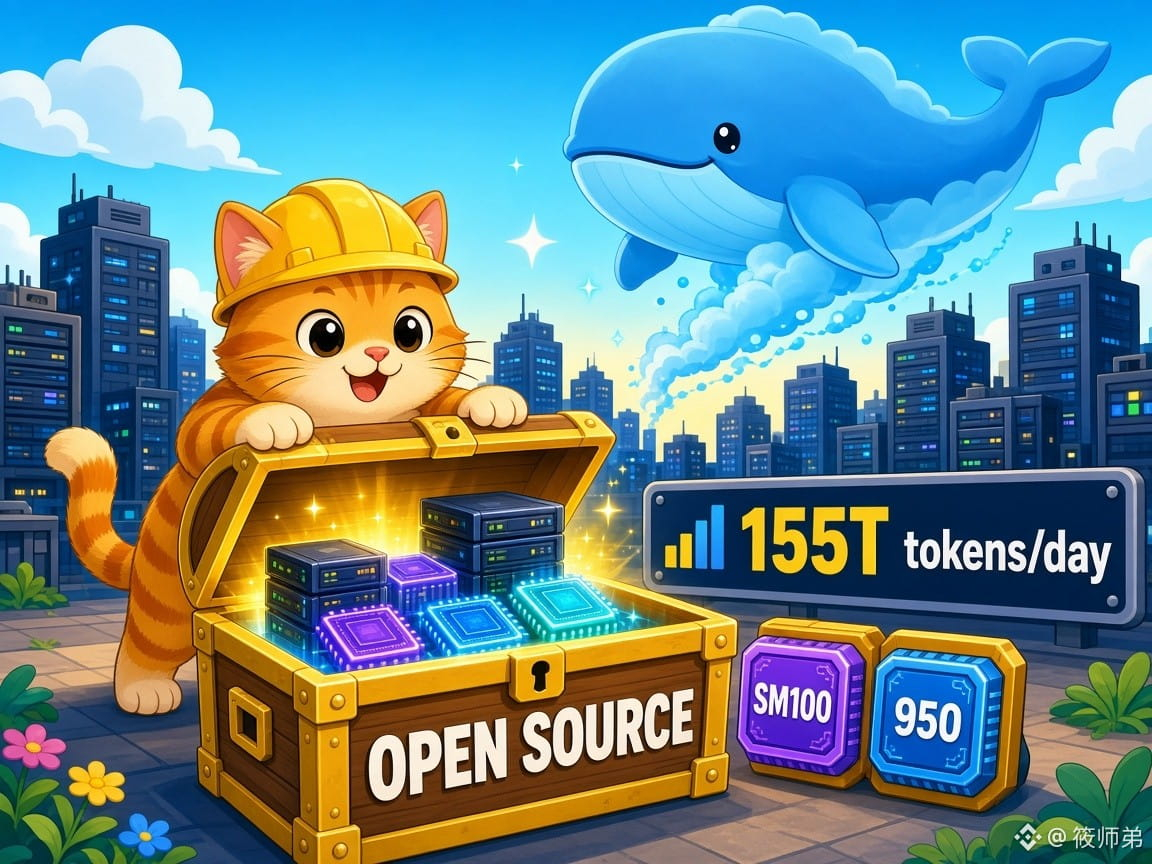
📌 DeepInfer is the inference framework powering DeepSeek V4.1 Flash’s online services, released under the Apache 2.0 license
📌 Initial support includes NVIDIA SM100 (Blackwell) and Huawei Ascend 950; older architectures such as Hopper aren’t on the list
📌 The company says a single cluster processes 155 trillion tokens per day, with revenue of about $38 per GPU-hour at off-peak prices
📌 But only offline inference is being released this time: KV caching, PD disaggregation, and load balancing aren’t open-sourced, so you’ll need to build those pieces yourself to run a complete service
📌 In the same space: Mistral Large 4 (1T parameters) is scheduled for an open-weights release at the end of October
AI compute is becoming increasingly “domestic + open source.” As compute and inference costs fall, will on-chain trading by AI agents become more widespread? $BTC
Do you think open-source inference will bring down prices for large-model APIs? Share your thoughts in the comments 👇
#AI #DeepSeek #开源 #Compute
For reference only; this is not investment advice
68

·
--
DeepSeek has open-sourced its own reasoning framework too.
Do you get how huge this is?
Before, open-sourcing a model was like publishing the recipe.
This time, they’ve brought out the entire kitchen for you to tour,
and they’re even teaching you how to toss a wok in person.
One comment summed it up so perfectly I’m dying:
“Who taught you that when you open-source something, you have to open-source the revenue too?”
To the folks next door still agonizing over subscription fees—
this whole “making money with your head held high” thing has really got you rattled.
One runs on love, the other makes money by taking a cut—
whose side do you think consumers are on?😏
#DeepSeek #开源

2
·
--
🐋 DeepSeek has open-sourced its own inference engine! So why are Chinese tech giants still buying NVIDIA like crazy?
🔹 DeepSeek open-sourced DeepInfer, the inference framework it uses for its own online services. Licensed under Apache 2.0, it supports both NVIDIA GPUs and Huawei Ascend NPUs, and topped the Hacker News daily leaderboard (2,000+ upvotes).
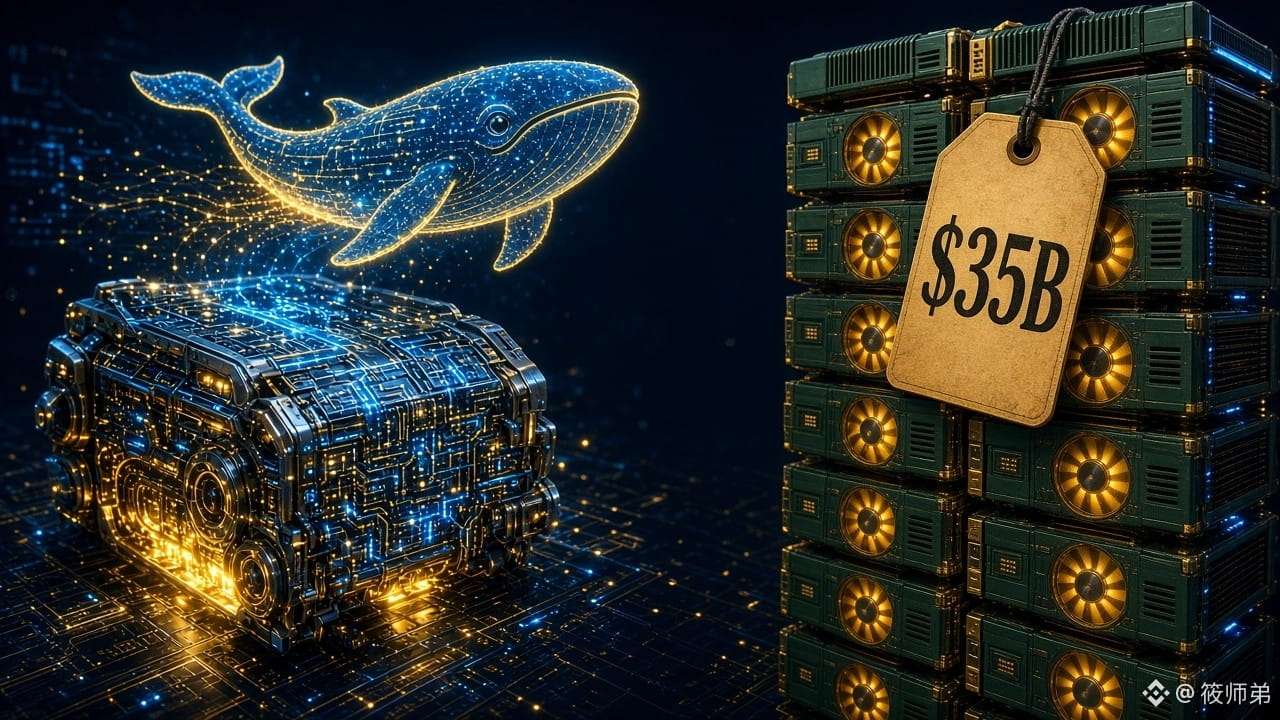
🔹 Meanwhile, foreign media report that ByteDance, Alibaba, and Tencent have collectively ordered over 3 million NVIDIA RTX PRO 5500 cards, with the total potentially exceeding $35 billion (not yet confirmed by all the companies).
🔹 Open source to cut costs on one side, huge spending to secure computing power on the other—the AI arms race is still accelerating.
As demand for AI computing power surges, is this good news for $BTC miners and the computing-power sector, or will it mean more competition for electricity and chips?
💬 Do you think open-source models will eventually beat the closed-source giants? Share your thoughts in the comments 👇
#AI #DeepSeek #英伟达 #ComputingPower
For reference only; this is not investment advice.
133
·
--
Analysis of the DeepSeek V4.1 Flash-1017 Update: Wish-Driven Programming Leads a New Trend
The DeepSeek V4.1 Flash-1017 update focuses on “wish-driven programming,” with significant improvements to technical metrics. Key-level analysis reveals potential growth areas that investors should watch. #DeepSeek #TechnicalAnalysis
The DeepSeek V4.1 Flash-1017 update focuses on “wish-driven programming,” with significant improvements to technical metrics. Key-level analysis reveals potential growth areas that investors should watch. #DeepSeek #TechnicalAnalysis
12

·
--
One thousand searches for five yuan. Half a fen per search—cheaper than printing a sheet of paper.
On October 17, DeepSeek turned its in-house search into two APIs: Search finds webpages, Fetch retrieves their content. It indexes hundreds of billions of webpages and handles hundreds of millions of requests a day. Then it posted the price: five yuan per thousand calls. One yuan for 200. That’s the number.
The price is just the surface. I compared the announcement with the pricing page, and the striking part was how they bill. Failed calls aren’t charged, timeouts don’t count, and empty search results are free. You’re charged only for a call that successfully returns content.
Look through the cloud providers’ price lists and you’ll see that billing per call is the default: once you send a request, it goes on the bill, whether it succeeds or not. This shifts the risk from the buyer back to the seller.
They can do this because they’re the judge. And there’s only one judge. They produce the search results, and they decide whether a call succeeded.
Think one step further, and you get to the blockchain.
A lot of people think micropayments are held back by transaction fees. Send a fen at a time, and miners won’t bother, so it can’t work. That’s only half true. Fees can come down. These days, an on-chain stablecoin transfer costs just a few thousandths of a yuan—not much more than this search API. The thing you can’t bring down is the counter.
There’s no service provider on-chain, just a bunch of nodes that each recalculate everything independently. For a transaction to count, every node has to run the same rules and get the same result. No one has the authority to sign off on behalf of everyone else, and no one can be authorized to keep the books for another person.
So there’s no such thing as “the 50,000th call” on-chain. Who gets to decide? No one has the authority to count it, and no one accepts someone else’s count.
Failed transactions still consume gas. Same principle. The work was dispatched, the nodes processed it, the result didn’t go through, but the bill still has to be settled. On-chain, you can’t charge only for success; you can only deduct first and refund later.
The crypto world has been talking about micropayments for nearly a decade. Lightning Network, state channels, prepaid balances—they’ve all been circling the same problem: how do you count usage accurately when nobody is keeping the books? So far, the thing that’s actually turned half-a-fen-per-call into a business is a centralized API. A little ironic. That’s it.
Midnight on November 1 is the cutoff. Before then, search calls made server-side through Harness, Claude Code, and Codex are free. After that, they’ll be billed per call.
The announcement only gives the unit price. It doesn’t say how calls already being made these past few days will be counted, or whether they’ll be settled by the day or by usage.
The connection to crypto isn’t really about the price; that’s just the hook. When AI starts searching, fetching, and placing orders on its own, payments between agents will be broken down into tiny amounts—just a few thousandths at a time. Who will keep the books then? Whoever keeps the books is the clearing party. If blockchains want to handle this business, being cheap isn’t enough. They first need to make clear how the counter works.
Take a look at your API bill. Of the calls you’ve been charged for, how many returned nothing at all?
$TAO $USDC $BTC
#DeepSeek #AI搜索 #微支付 #Agent

170

·
--
Officials called it a “minor update.” But after the community took it apart, they found it was clearly a major overhaul.
On October 17, DeepSeek released V4.1-Flash-1017. The model card said it would “shorten task time and reduce output length.” The API name and pricing stayed the same, and the weights were open-sourced under MIT.
One developer compared the new weights with the September version layer by layer and reportedly found that about 40% of routed experts, 30% of memory, and 50% of the vision-tower expert tensors had been rewritten. Another developer ran quantization on two DGX Sparks and reportedly got 56.8 tokens/second for text and 92.2 tokens/second for code with the TensorFold engine—nearly twice vLLM’s speed. The architecture hadn’t changed, but the scale of the changes was on the level of a “major version.”
The price war has entered a new dimension, too: according to an engineer’s tests, DeepSeek completed a real coding task for only about 4.5 cents, but burned through roughly 550,000 tokens (Opus used only 30,000). Tokens are so cheap you can “waste” them and still pay less. OpenRouter data shows it processed about 38.7T tokens over the past 7 days—three times as many as the runner-up.
The timing is intriguing: the day before the MIT-licensed weights were released (October 16), the Ministry of Commerce and the Ministry of Science and Technology published a draft export-control proposal for public comment. It proposed adding 40 technologies to the control list, 23 of them AI-related. Models with compute of 10²⁶ FLOPs, more than 2 trillion parameters, or a global top-ten ranking would have their weights, source code, and architecture brought under controls. APIs and SaaS would be unaffected, and already open-sourced models would not be covered retroactively. The public comment period runs until November 15, as confirmed by multiple media outlets.
I think this was the week the AI narrative of “openness vs. control” blew its opening whistle: for the first time, model weights were written into an export-control list. In the short term, the cheaper models get, the less it costs to run AI agents at scale—and the more fuel there’ll be for on-chain AI narratives (such as $TAO $RENDER).
There’s still the mystery of V4.1-Pro: reportedly, some accounts spotted its hidden model name in early access as far back as late September. Prediction markets put the odds of a release before the end of October at around 16%. One thing to watch: how the draft is finalized on November 15.
This is not investment advice. DYOR; trading involves risk.
#DeepSeekReleasesUpdatedAIModel
#DeepSeek #AI
Officials called it a “minor update.” But after the community took it apart, they found it was clearly a major overhaul.
On October 17, DeepSeek released V4.1-Flash-1017. The model card said it would “shorten task time and reduce output length.” The API name and pricing stayed the same, and the weights were open-sourced under MIT.
One developer compared the new weights with the September version layer by layer and reportedly found that about 40% of routed experts, 30% of memory, and 50% of the vision-tower expert tensors had been rewritten. Another developer ran quantization on two DGX Sparks and reportedly got 56.8 tokens/second for text and 92.2 tokens/second for code with the TensorFold engine—nearly twice vLLM’s speed. The architecture hadn’t changed, but the scale of the changes was on the level of a “major version.”
The price war has entered a new dimension, too: according to an engineer’s tests, DeepSeek completed a real coding task for only about 4.5 cents, but burned through roughly 550,000 tokens (Opus used only 30,000). Tokens are so cheap you can “waste” them and still pay less. OpenRouter data shows it processed about 38.7T tokens over the past 7 days—three times as many as the runner-up.
The timing is intriguing: the day before the MIT-licensed weights were released (October 16), the Ministry of Commerce and the Ministry of Science and Technology published a draft export-control proposal for public comment. It proposed adding 40 technologies to the control list, 23 of them AI-related. Models with compute of 10²⁶ FLOPs, more than 2 trillion parameters, or a global top-ten ranking would have their weights, source code, and architecture brought under controls. APIs and SaaS would be unaffected, and already open-sourced models would not be covered retroactively. The public comment period runs until November 15, as confirmed by multiple media outlets.
I think this was the week the AI narrative of “openness vs. control” blew its opening whistle: for the first time, model weights were written into an export-control list. In the short term, the cheaper models get, the less it costs to run AI agents at scale—and the more fuel there’ll be for on-chain AI narratives (such as $TAO $RENDER ).
There’s still the mystery of V4.1-Pro: reportedly, some accounts spotted its hidden model name in early access as far back as late September. Prediction markets put the odds of a release before the end of October at around 16%. One thing to watch: how the draft is finalized on November 15.
This is not investment advice. DYOR; trading involves risk.
#DeepSeekReleasesUpdatedAIModel
#DeepSeek #AI


5
98


·
--
Bullish
🚨 BREAKING AI NEWS: DeepSeek Releases an Updated AI Model! 🤖🔥
#DeepSeek has introduced DeepSeek-V4.1-Flash-1017, an upgraded AI model announced on October 17, 2026.
⚡ What's new? ✅ Faster task completion
✅ Improved coding and AI agent performance
✅ Shorter, more efficient responses
✅ Better benchmark results
✅ Search & Fetch APIs now available to users
📊 DeepSeek reported a score of 77.0 on the DeepSWE v1.1 benchmark, up from 74.2 in the previous version.
🌐 The updated model is available through DeepSeek's website, mobile app and API.
💡 Why does it matter? The AI race is heating up, with companies competing to deliver more powerful tools at lower costs.
Will DeepSeek challenge the biggest names in AI? 👀
💬 What do you think? Is DeepSeek becoming a serious competitor in the AI industry?
#DeepSeek #TechNews #Innovation
#deepseekreleasesupdatedaimodel
1
4
701

·
--
🤖 DeepSeek Upgrades Again: Is the AI Sector Primed for a Breakout?
DeepSeek has officially rolled out its latest model update (V4.1-Flash), delivering high-speed reasoning and complex coding at a fraction of traditional computing costs.
Here is why this matters for tech and Web3 AI sectors:
💡 1. Efficiency Over Hype High-throughput, lower-cost inference models force established AI giants to drop prices, accelerating global developer adoption.
⚡ 2. Web3 AI & Decentralized Compute Efficient models drive real-world demand for decentralized GPU networks ($RENDER, $AKT) and decentralized intelligence protocols ($TAO, $NEAR,$ASTER).
🎯 3. The Reality Check Headlines create initial spikes, but real value capture comes from developer usage, integration, and actual fee generation—not just hype.
💬 What’s your take? Will open-weights efficiency disrupt closed AI giants, or will big tech hold the throne? Drop your thoughts below! 👇
#DeepSeek #AI #CryptoNews #TAO #NEAR
115

·
--
#GrayscaleAndRepublicLaunchThreeCryptoFunds
🚀 DeepSeek Upgrades AI Performance Without Raising Prices!
DeepSeek-V4.1-Flash-1017, announced on October 17, improves coding, reasoning, and AI-agent performance. Its DeepSWE v1.1 score rose to 77.0 from 74.2, while API pricing remains unchanged.
📊 My Take: Better efficiency, faster execution, and stable pricing could increase competition among AI providers. However, real-world reliability matters more than benchmarks alone.
💬 Will efficient AI models challenge expensive AI services?
Follow for more AI & tech insights!
#DeepSeek #AI #ArtificialIntelligence #TechNews
1
77

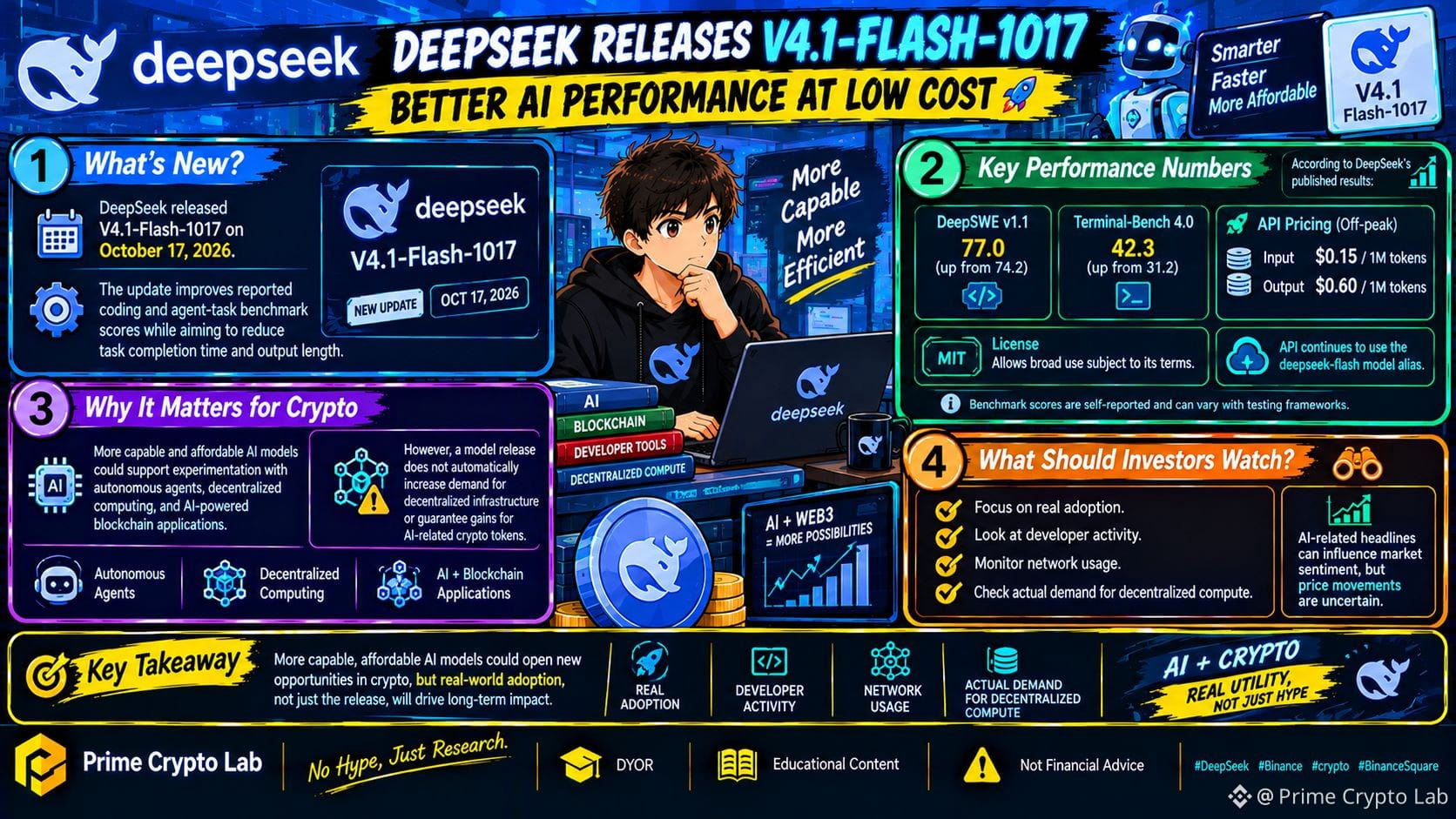
🚀 DeepSeek Releases V4.1-Flash-1017: Better AI Performance at Low Cost
🔍 1. What’s New?
$FET — DeepSeek released V4.1-Flash-1017 on October 17, 2026. The update improves reported coding and agent-task benchmark scores while aiming to reduce task completion time and output length.
📊 2. Key Performance Numbers
According to DeepSeek’s published results:
DeepSWE v1.1: 77.0, up from 74.2.
Terminal-Bench 4.0: 42.3, up from 31.2.
API pricing: Off-peak input at $0.15 and output at $0.60 per million tokens.
License: MIT, allowing broad use subject to its terms.
The API continues to use the deepseek-flash model alias. Benchmark scores are self-reported and can vary with testing frameworks.
🤖 3. Why It Matters for Crypto
$RENDER — More capable and affordable AI models could support experimentation with autonomous agents, decentralized computing, and AI-powered blockchain applications.
However, a model release does not automatically increase demand for decentralized infrastructure or guarantee gains for AI-related crypto tokens.
🎯 4. What Should Investors Watch?
$NEAR — Focus on real adoption, developer activity, network usage, and actual demand for decentralized compute. AI-related headlines can influence market sentiment, but price movements are uncertain.
Prime Crypto Lab — No Hype, Just Research.
DYOR | Educational Content | Not Financial Advice
#DeepSeek #Binance #DeepSeekReleasesUpdatedAIModel #BinanceSquareTalks
371

·
--
China Released AI Developer Released DeepSeek V4.1-Flash-1017#DeepSeekReleasesUpdatedAIModel
#BinanceSquareTalks #DeepSeek
$BTC $USDT $BTTC
What Traders Should Know About the Latest AI Efficiency Update
The AI sector continues to shift its focus from raw model size to practical efficiency. On October 17, 2026, Chinese AI developer DeepSeek released an update to its Flash series: DeepSeek V4.1-Flash-1017. While the version name suggests a minor revision, the changes carry implications for developers, quantitative analysts, and anyone who relies on AI tools for data processing and automation.
For the crypto community, this release is less about hype and more about the underlying economics of AI compute. Here is a factual breakdown of what was announced and why it matters.
What Was Released?
DeepSeek updated its V4.1 Flash model to the 1017 snapshot (October 17, 2026). The new version is live across the company’s web interface, mobile app, and API. According to DeepSeek’s official documentation, the update delivers a Pareto improvement: better benchmark performance with reduced output length and faster run times. In practical terms, this means lower cost per API call for developers and firms that use the model for tasks such as code generation, data analysis, and agentic automation.
Architecture and Technical Highlights
The V4.1-Flash-1017 is a sparse mixture-of-experts (MoE) model built on DeepSeek’s proprietary Causal Encoder-Decoder architecture. It activates approximately 8 billion parameters on input and 16 billion on output from a 552-billion-parameter backbone. This asymmetric design keeps per-token compute low while maintaining capability.
Key technical features include:
· Native image understanding (multimodal input support)
· Compressed KV caching that reduces cache memory to roughly one-quarter of the previous generation
· Tuning for agentic workloads, meaning the model is optimized for multi-step autonomous tasks
The company also highlighted a capability called “wish-style programming,” which allows users to generate a runnable project from a short prompt with minimal reference material. This is attributed to reinforcement learning based on self-feedback during training.
Benchmark Improvements
DeepSeek published specific benchmark gains to support its efficiency claims. On Terminal-Bench 4.0, a metric for agentic coding, the score increased from 31.2 to 42.3. Other benchmarks showed double-digit percentage improvements:
· ProgramBench: 20.3 → 29.1
· DeepSWE v1.1: 74.2 → 77.0
· Automation-Bench: 54.8 → 60.5
For the crypto industry, improved coding and automation benchmarks are relevant to smart contract auditing, trading algorithm development, and on-chain data analysis. Better performance in these areas can reduce development time and operational overhead.
Pricing and Open-Source Availability
Despite the performance upgrades, DeepSeek has kept API pricing unchanged. The model remains accessible via the deepseek-flash endpoint at $0.10 per million input tokens** and **$0.50 per million output tokens.
The model weights are available on Hugging Face and ModelScope under the MIT License. This open-source approach allows independent developers and decentralized AI projects to fine-tune the model without restrictive licensing fees, which aligns with the transparency and permissionless innovation valued in the crypto ecosystem.
Why This Matters for the Market
From an editorial perspective, this release reinforces two trends shaping the tech-crypto intersection:
1. The efficiency race: Competition is shifting from parameter count to cost-per-task. DeepSeek’s ability to improve benchmarks while reducing output length challenges the cost structures of larger AI providers.
2. Agentic readiness: The specific tuning for agentic tasks suggests that the next wave of AI adoption will involve autonomous agents. In crypto, this could lead to more sophisticated
The Bencmark Increased Not The Pricing.
China Released AI Developer Released DeepSeek V4.1-Flash-1017
#DeepSeekReleasesUpdatedAIModel
#BinanceSquareTalks #DeepSeek
$BTC $USDT $BTTC
What Traders Should Know About the Latest AI Efficiency Update
The AI sector continues to shift its focus from raw model size to practical efficiency. On October 17, 2026, Chinese AI developer DeepSeek released an update to its Flash series: DeepSeek V4.1-Flash-1017. While the version name suggests a minor revision, the changes carry implications for developers, quantitative analysts, and anyone who relies on AI tools for data processing and automation.
For the crypto community, this release is less about hype and more about the underlying economics of AI compute. Here is a factual breakdown of what was announced and why it matters.
What Was Released?
DeepSeek updated its V4.1 Flash model to the 1017 snapshot (October 17, 2026). The new version is live across the company’s web interface, mobile app, and API. According to DeepSeek’s official documentation, the update delivers a Pareto improvement: better benchmark performance with reduced output length and faster run times. In practical terms, this means lower cost per API call for developers and firms that use the model for tasks such as code generation, data analysis, and agentic automation.
Architecture and Technical Highlights
The V4.1-Flash-1017 is a sparse mixture-of-experts (MoE) model built on DeepSeek’s proprietary Causal Encoder-Decoder architecture. It activates approximately 8 billion parameters on input and 16 billion on output from a 552-billion-parameter backbone. This asymmetric design keeps per-token compute low while maintaining capability.
Key technical features include:
· Native image understanding (multimodal input support)
· Compressed KV caching that reduces cache memory to roughly one-quarter of the previous generation
· Tuning for agentic workloads, meaning the model is optimized for multi-step autonomous tasks
The company also highlighted a capability called “wish-style programming,” which allows users to generate a runnable project from a short prompt with minimal reference material. This is attributed to reinforcement learning based on self-feedback during training.
Benchmark Improvements
DeepSeek published specific benchmark gains to support its efficiency claims. On Terminal-Bench 4.0, a metric for agentic coding, the score increased from 31.2 to 42.3. Other benchmarks showed double-digit percentage improvements:
· ProgramBench: 20.3 → 29.1
· DeepSWE v1.1: 74.2 → 77.0
· Automation-Bench: 54.8 → 60.5
For the crypto industry, improved coding and automation benchmarks are relevant to smart contract auditing, trading algorithm development, and on-chain data analysis. Better performance in these areas can reduce development time and operational overhead.
Pricing and Open-Source Availability
Despite the performance upgrades, DeepSeek has kept API pricing unchanged. The model remains accessible via the deepseek-flash endpoint at $0.10 per million input tokens** and **$0.50 per million output tokens.
The model weights are available on Hugging Face and ModelScope under the MIT License. This open-source approach allows independent developers and decentralized AI projects to fine-tune the model without restrictive licensing fees, which aligns with the transparency and permissionless innovation valued in the crypto ecosystem.
Why This Matters for the Market
From an editorial perspective, this release reinforces two trends shaping the tech-crypto intersection:
1. The efficiency race: Competition is shifting from parameter count to cost-per-task. DeepSeek’s ability to improve benchmarks while reducing output length challenges the cost structures of larger AI providers.
2. Agentic readiness: The specific tuning for agentic tasks suggests that the next wave of AI adoption will involve autonomous agents. In crypto, this could lead to more sophisticated
The Bencmark Increased Not The Pricing.
1
1
36
Log in to explore more content
Join global crypto users on Binance Square
⚡️ Get latest and useful information about crypto.
💬 Trusted by the world’s largest crypto exchange.
👍 Discover real insights from verified creators.
Email / Phone number
Trending Topics
1
#BinancePick
2.7M views
143,316 Discussing
2
#EarningsSeason
5M views
24,599 Discussing
3
#SouthKoreaReportedlyWeighsFourthCryptoTaxDelay
1,176 views
81 Discussing
4
#FranklinTempletonFilesForTwoDividendToBitcoinETFs
6,154 views
213 Discussing
5
#StrategyMSTRSurpassesNasdaqInMarketCap
5,573 views
181 Discussing
6
#CanadaProposesStablecoinRedemptionWithin3BusinessDays
181 views
15 Discussing
7
#ElectrumWalletBugLetRogueServersStealFunds
11,820 views
303 Discussing
8
#ArgentineCourtDismissesLIBRACaseAgainstMilei
21,891 views
369 Discussing
9
#SKHynixReportedlyPlansSpecialDividendFromKioxiaStakeSale
3,417 views
48 Discussing
10
#KeystoneWebsiteBreachExposesBuyersShippingAddresses
1,801 views
41 Discussing