

#boj
boj
572,379 views
1,737 Discussing
Hot
Latest

#BinanceLaunchesBinanceIntelligence bojraisesratesto31yearhigh
🇯🇵 Bank of Japan Sends a Strong Signal to Global Markets
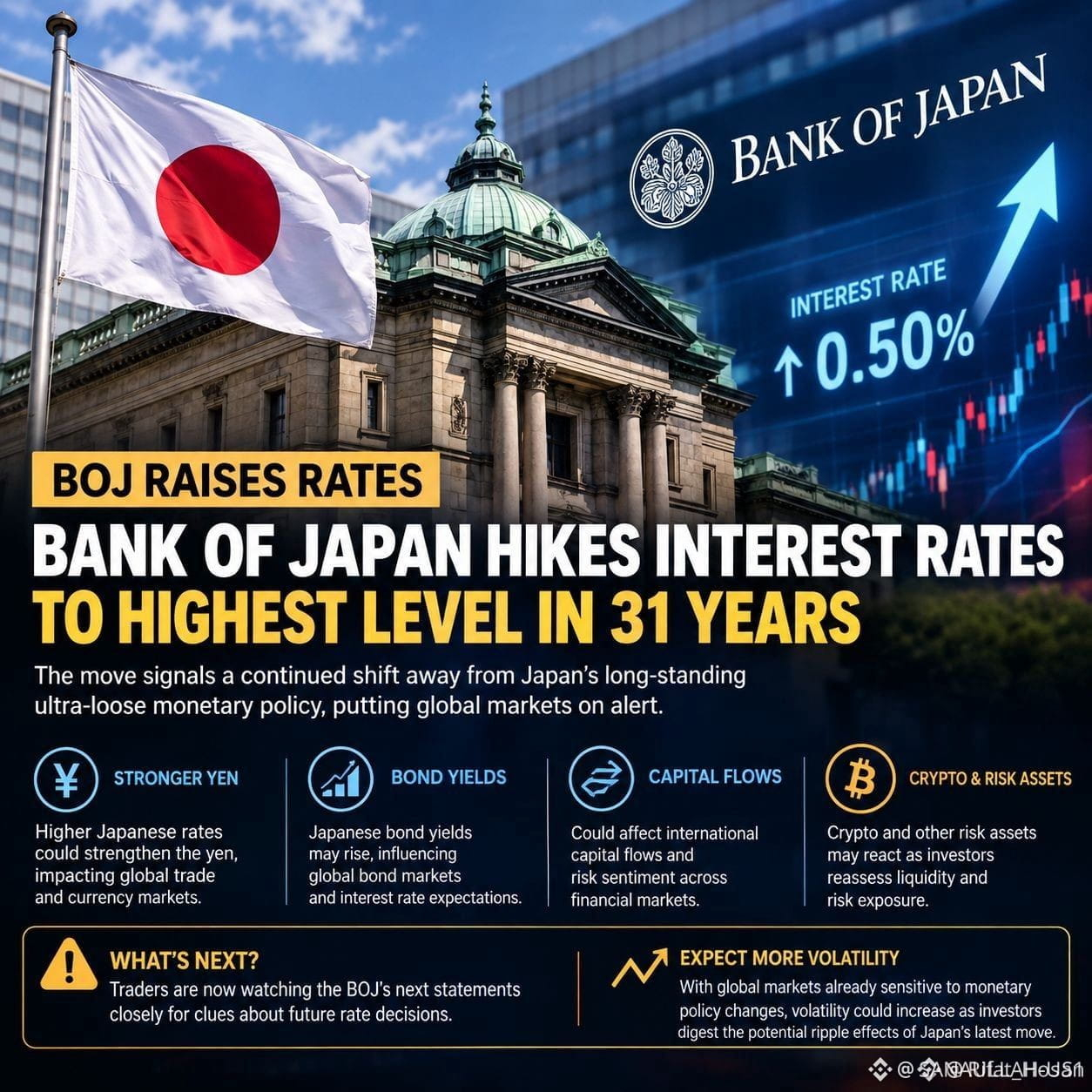
The Bank of Japan has raised interest rates to their highest level in more than three decades, marking another important step away from its long-running ultra-loose monetary policy.
The decision could have wider implications for global financial markets. A stronger yen, changing Japanese bond yields, and shifts in international capital flows could affect equities, bonds, and other risk-sensitive assets.
Crypto markets may also feel the impact as investors reassess liquidity conditions and overall risk exposure.
📊 Traders are now closely watching the BOJ’s upcoming statements for signals on whether further rate adjustments could follow.
⚠️ With global markets already sensitive to monetary policy changes, volatility could increase as investors digest the potential ripple effects of Japan’s latest move.
$BTC
{spot}(BTCUSDT)
$ETH
{spot}(ETHUSDT)
$BNB
{spot}(BNBUSDT)
#BOJ #BankOfJapan #Japan #InterestRates #Crypto #Bitcoin #MarketUpdate #GlobalMarkets #Trading
#BinanceLaunchesBinanceIntelligence bojraisesratesto31yearhigh
🇯🇵 Bank of Japan Sends a Strong Signal to Global Markets
The Bank of Japan has raised interest rates to their highest level in more than three decades, marking another important step away from its long-running ultra-loose monetary policy.
The decision could have wider implications for global financial markets. A stronger yen, changing Japanese bond yields, and shifts in international capital flows could affect equities, bonds, and other risk-sensitive assets.
Crypto markets may also feel the impact as investors reassess liquidity conditions and overall risk exposure.
📊 Traders are now closely watching the BOJ’s upcoming statements for signals on whether further rate adjustments could follow.
⚠️ With global markets already sensitive to monetary policy changes, volatility could increase as investors digest the potential ripple effects of Japan’s latest move.
$BTC
$ETH
$BNB
#BOJ #BankOfJapan #Japan #InterestRates #Crypto #Bitcoin #MarketUpdate #GlobalMarkets #Trading
🇯🇵 Bank of Japan Sends a Strong Signal to Global Markets
The Bank of Japan has raised interest rates to their highest level in more than three decades, marking another important step away from its long-running ultra-loose monetary policy.
The decision could have wider implications for global financial markets. A stronger yen, changing Japanese bond yields, and shifts in international capital flows could affect equities, bonds, and other risk-sensitive assets.
Crypto markets may also feel the impact as investors reassess liquidity conditions and overall risk exposure.
📊 Traders are now closely watching the BOJ’s upcoming statements for signals on whether further rate adjustments could follow.
⚠️ With global markets already sensitive to monetary policy changes, volatility could increase as investors digest the potential ripple effects of Japan’s latest move.
$BTC
$ETH
$BNB
#BOJ #BankOfJapan #Japan #InterestRates #Crypto #Bitcoin #MarketUpdate #GlobalMarkets #Trading
26
·
--
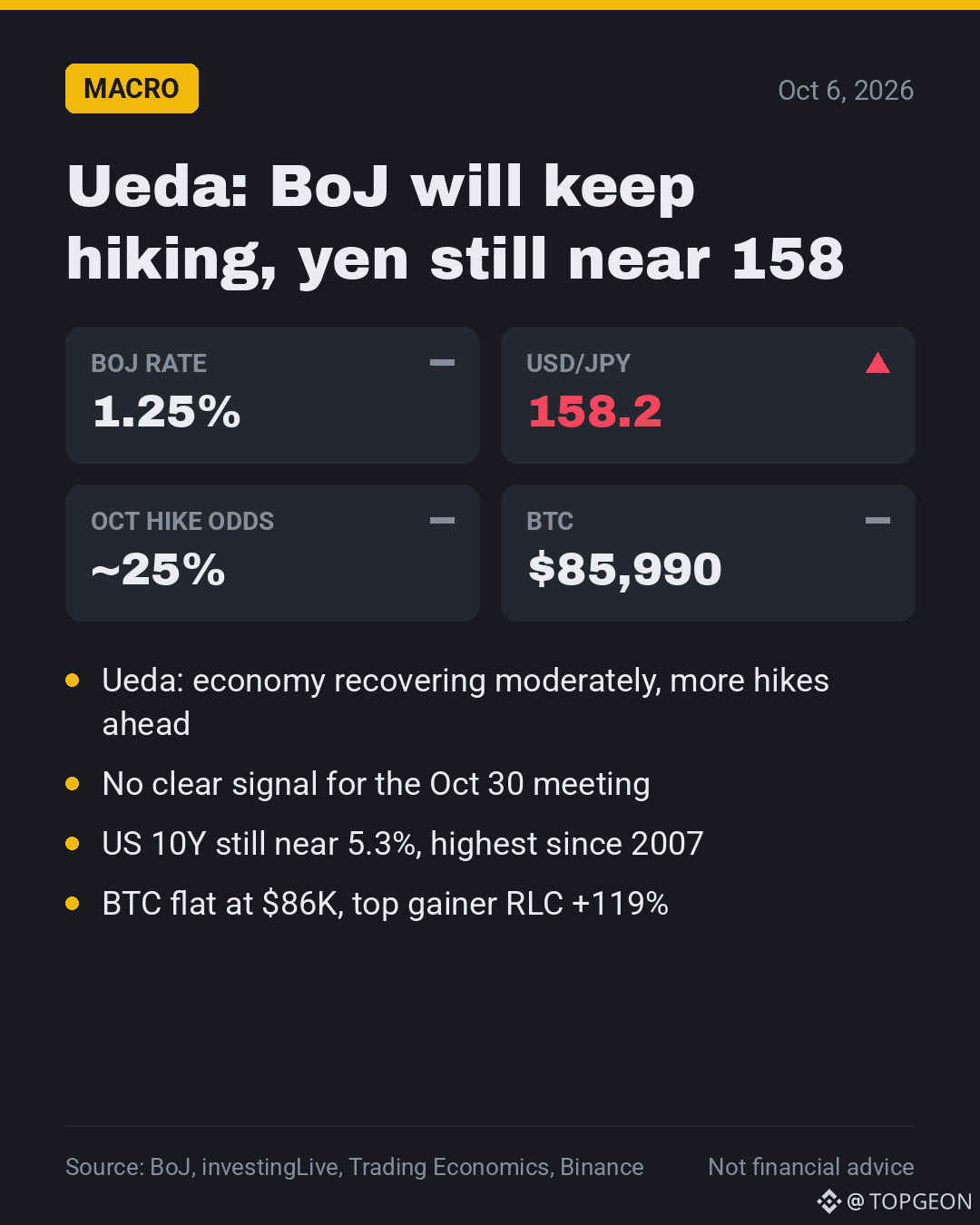
🇯🇵 $BTC flat at $86K as BoJ's Ueda says more hikes are coming
• Ueda today: Japan's recovery is moderate, rates keep rising
• No clear hint for Oct 30; markets price ~25% odds
• Yen stays weak: USD/JPY 158.2, up 0.2% today
• US 10Y near 5.3% keeps global risk appetite cautious
• Top gainer today: $RLC +119% while majors sit still
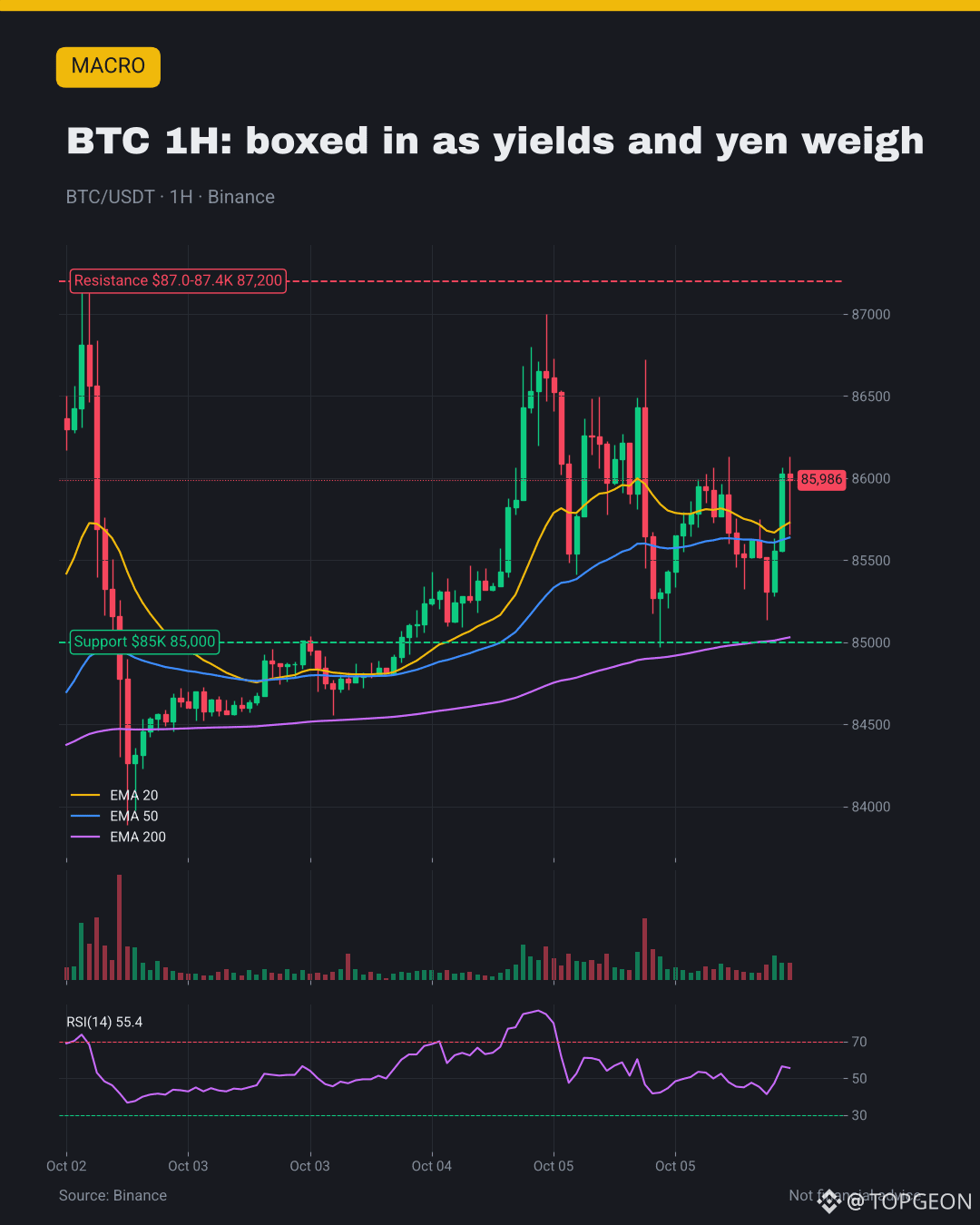
🎯 My take: $85K holding = range; a strong yen spike → test $85K
💬 Is a BoJ hike a real risk for crypto this month? 👇
#BoJ #Macro #Bitcoin
🇯🇵 $BTC flat at $86K as BoJ's Ueda says more hikes are coming
• Ueda today: Japan's recovery is moderate, rates keep rising
• No clear hint for Oct 30; markets price ~25% odds
• Yen stays weak: USD/JPY 158.2, up 0.2% today
• US 10Y near 5.3% keeps global risk appetite cautious
• Top gainer today: $RLC +119% while majors sit still
🎯 My take: $85K holding = range; a strong yen spike → test $85K
💬 Is a BoJ hike a real risk for crypto this month? 👇
#BoJ #Macro #Bitcoin
• Ueda today: Japan's recovery is moderate, rates keep rising
• No clear hint for Oct 30; markets price ~25% odds
• Yen stays weak: USD/JPY 158.2, up 0.2% today
• US 10Y near 5.3% keeps global risk appetite cautious
• Top gainer today: $RLC +119% while majors sit still
🎯 My take: $85K holding = range; a strong yen spike → test $85K
💬 Is a BoJ hike a real risk for crypto this month? 👇
#BoJ #Macro #Bitcoin
146

Bank of Japan Governor Kazuo Ueda noted today that the latest September Tankan survey reflects solid business sentiment, while core inflation continues to approach the 2% target.
These remarks signal growing confidence within the central bank regarding Japan's economic recovery and sustained wage-price momentum. Markets increasingly expect the BOJ to stay on its policy normalization path rather than holding rates near zero indefinitely.
A hawkish posture from Tokyo tends to strengthen the Japanese yen and exert upward pressure on global sovereign yields. This dynamic often forces a gradual unwinding of the long-standing yen carry trade across broader traditional financial markets.
For the crypto sector, tighter global liquidity conditions could restrain aggressive risk-taking and prompt short-term volatility for $BTC. Investors should monitor whether renewed yen strength triggers temporary capital outflows from speculative digital assets.
#BOJ #JapanEconomy #InterestRates
Bank of Japan Governor Kazuo Ueda noted today that the latest September Tankan survey reflects solid business sentiment, while core inflation continues to approach the 2% target.
These remarks signal growing confidence within the central bank regarding Japan's economic recovery and sustained wage-price momentum. Markets increasingly expect the BOJ to stay on its policy normalization path rather than holding rates near zero indefinitely.
A hawkish posture from Tokyo tends to strengthen the Japanese yen and exert upward pressure on global sovereign yields. This dynamic often forces a gradual unwinding of the long-standing yen carry trade across broader traditional financial markets.
For the crypto sector, tighter global liquidity conditions could restrain aggressive risk-taking and prompt short-term volatility for $BTC . Investors should monitor whether renewed yen strength triggers temporary capital outflows from speculative digital assets.
#BOJ #JapanEconomy #InterestRates
These remarks signal growing confidence within the central bank regarding Japan's economic recovery and sustained wage-price momentum. Markets increasingly expect the BOJ to stay on its policy normalization path rather than holding rates near zero indefinitely.
A hawkish posture from Tokyo tends to strengthen the Japanese yen and exert upward pressure on global sovereign yields. This dynamic often forces a gradual unwinding of the long-standing yen carry trade across broader traditional financial markets.
For the crypto sector, tighter global liquidity conditions could restrain aggressive risk-taking and prompt short-term volatility for $BTC . Investors should monitor whether renewed yen strength triggers temporary capital outflows from speculative digital assets.
#BOJ #JapanEconomy #InterestRates
8

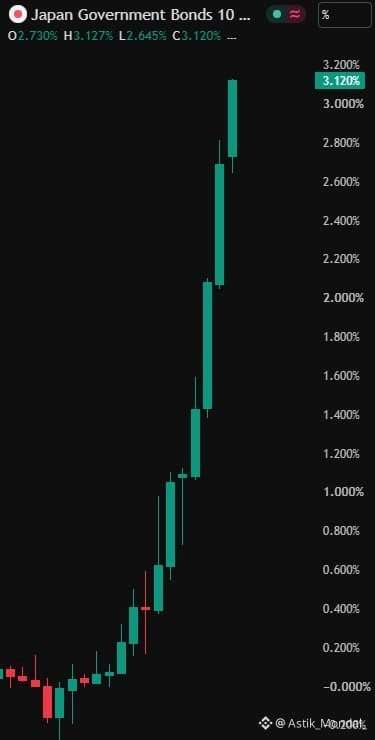
🇯🇵🚨 JAPAN’S BOND MARKET JUST HIT A 30-YEAR HIGH.
Japan’s new 10-year government bond will carry a 3.1% coupon the highest level in roughly 30 years.
That’s a major shift for one of the world’s biggest bond markets.
For decades, Japan was synonymous with ultra-low interest rates and cheap money.
Now borrowing costs are climbing sharply.
And the consequences extend far beyond Japan.
Higher Japanese yields can make domestic bonds more attractive, potentially pulling capital away from overseas markets.
That matters for global bonds, stocks, currencies and even risk assets like crypto.
The era of near-zero Japanese borrowing costs is facing a very different reality.
The question markets are watching:
How much global liquidity changes if Japanese yields keep rising?
#Japan #Bonds #BOJ #Markets #Crypto
🇯🇵🚨 JAPAN’S BOND MARKET JUST HIT A 30-YEAR HIGH.
Japan’s new 10-year government bond will carry a 3.1% coupon the highest level in roughly 30 years.
That’s a major shift for one of the world’s biggest bond markets.
For decades, Japan was synonymous with ultra-low interest rates and cheap money.
Now borrowing costs are climbing sharply.
And the consequences extend far beyond Japan.
Higher Japanese yields can make domestic bonds more attractive, potentially pulling capital away from overseas markets.
That matters for global bonds, stocks, currencies and even risk assets like crypto.
The era of near-zero Japanese borrowing costs is facing a very different reality.
The question markets are watching:
How much global liquidity changes if Japanese yields keep rising?
#Japan #Bonds #BOJ #Markets #Crypto
Japan’s new 10-year government bond will carry a 3.1% coupon the highest level in roughly 30 years.
That’s a major shift for one of the world’s biggest bond markets.
For decades, Japan was synonymous with ultra-low interest rates and cheap money.
Now borrowing costs are climbing sharply.
And the consequences extend far beyond Japan.
Higher Japanese yields can make domestic bonds more attractive, potentially pulling capital away from overseas markets.
That matters for global bonds, stocks, currencies and even risk assets like crypto.
The era of near-zero Japanese borrowing costs is facing a very different reality.
The question markets are watching:
How much global liquidity changes if Japanese yields keep rising?
#Japan #Bonds #BOJ #Markets #Crypto
EWJETF-1.18%
1
10

The Bank of Japan today announced details of its latest routine bond-buying operation, officially reducing the purchase amounts across several maturities. Purchases of Japanese government bonds with maturities of 10 to 25 years were cut from the previous 100 billion yen to 85 billion yen, while purchases of bonds with maturities of 1 to 3 years were reduced from 355 billion yen to 330 billion yen. This move clearly demonstrates the central bank’s continued efforts to scale back quantitative intervention and normalize monetary policy.
Reducing bond purchases is more than a technical operation; it also sends a tightening signal to the market. Against a backdrop of diverging policies among the world’s major central banks, the Bank of Japan’s continued reduction in asset purchases reflects its confidence in the persistence of domestic inflation and wage growth, while also heightening market expectations of further rate hikes.
In traditional financial markets, the reduction in bond purchases has directly pushed up yields across Japanese government bond maturities and provided some support for the yen. However, as a major source of low-cost liquidity for the global economy over the long term, the yen carry trade faces renewed risk of unwinding, potentially increasing volatility in global bond and foreign exchange markets.
Risk assets such as cryptocurrencies, including major tokens like $BTC , may face potential pressure from liquidity withdrawal. Tighter global liquidity at the margin, combined with macroeconomic uncertainty, could weigh on risk appetite in the short term. Investors should be alert to the risk of a market pullback driven by deleveraging. 📉
#BOJ #QuantitativeTightening #GlobalLiquidity
The Bank of Japan today announced details of its latest routine bond-buying operation, officially reducing the purchase amounts across several maturities. Purchases of Japanese government bonds with maturities of 10 to 25 years were cut from the previous 100 billion yen to 85 billion yen, while purchases of bonds with maturities of 1 to 3 years were reduced from 355 billion yen to 330 billion yen. This move clearly demonstrates the central bank’s continued efforts to scale back quantitative intervention and normalize monetary policy.
Reducing bond purchases is more than a technical operation; it also sends a tightening signal to the market. Against a backdrop of diverging policies among the world’s major central banks, the Bank of Japan’s continued reduction in asset purchases reflects its confidence in the persistence of domestic inflation and wage growth, while also heightening market expectations of further rate hikes.
In traditional financial markets, the reduction in bond purchases has directly pushed up yields across Japanese government bond maturities and provided some support for the yen. However, as a major source of low-cost liquidity for the global economy over the long term, the yen carry trade faces renewed risk of unwinding, potentially increasing volatility in global bond and foreign exchange markets.
Risk assets such as cryptocurrencies, including major tokens like $BTC , may face potential pressure from liquidity withdrawal. Tighter global liquidity at the margin, combined with macroeconomic uncertainty, could weigh on risk appetite in the short term. Investors should be alert to the risk of a market pullback driven by deleveraging. 📉
#BOJ #QuantitativeTightening #GlobalLiquidity
Reducing bond purchases is more than a technical operation; it also sends a tightening signal to the market. Against a backdrop of diverging policies among the world’s major central banks, the Bank of Japan’s continued reduction in asset purchases reflects its confidence in the persistence of domestic inflation and wage growth, while also heightening market expectations of further rate hikes.
In traditional financial markets, the reduction in bond purchases has directly pushed up yields across Japanese government bond maturities and provided some support for the yen. However, as a major source of low-cost liquidity for the global economy over the long term, the yen carry trade faces renewed risk of unwinding, potentially increasing volatility in global bond and foreign exchange markets.
Risk assets such as cryptocurrencies, including major tokens like $BTC , may face potential pressure from liquidity withdrawal. Tighter global liquidity at the margin, combined with macroeconomic uncertainty, could weigh on risk appetite in the short term. Investors should be alert to the risk of a market pullback driven by deleveraging. 📉
#BOJ #QuantitativeTightening #GlobalLiquidity
43

In its latest regular bond-purchase operation announced today, the Bank of Japan (BOJ) said it would reduce purchases of Japanese government bonds with maturities of 10–25 years to ¥85 billion (from ¥100 billion), while lowering purchases of 1–3-year bonds to ¥330 billion (from ¥355 billion).
This substantial move to scale back bond purchases is in line with market expectations that the BOJ will gradually normalize monetary policy. The pace of quantitative tightening remains steady and controlled, with no unusual spike in short-term yields, indicating that the policy transition has been very smooth.
From a macro-technical perspective, the yen has found solid support after the balance-sheet reduction was confirmed, while global carry-trade liquidity is being restructured in an orderly manner. After safe-haven sentiment eased, global risk appetite remained intact, and the overall pattern of asset prices fluctuating upward remains unchanged.
As for the crypto market, $BTC and major assets have maintained a bullish technical structure after liquidity expectations were rebalanced. Greater policy clarity has removed the uncertainty premium and, instead, laid a solid foundation for another rally in risk assets.📈
#BOJ #BondMarket #MacroEconomics
In its latest regular bond-purchase operation announced today, the Bank of Japan (BOJ) said it would reduce purchases of Japanese government bonds with maturities of 10–25 years to ¥85 billion (from ¥100 billion), while lowering purchases of 1–3-year bonds to ¥330 billion (from ¥355 billion).
This substantial move to scale back bond purchases is in line with market expectations that the BOJ will gradually normalize monetary policy. The pace of quantitative tightening remains steady and controlled, with no unusual spike in short-term yields, indicating that the policy transition has been very smooth.
From a macro-technical perspective, the yen has found solid support after the balance-sheet reduction was confirmed, while global carry-trade liquidity is being restructured in an orderly manner. After safe-haven sentiment eased, global risk appetite remained intact, and the overall pattern of asset prices fluctuating upward remains unchanged.
As for the crypto market, $BTC and major assets have maintained a bullish technical structure after liquidity expectations were rebalanced. Greater policy clarity has removed the uncertainty premium and, instead, laid a solid foundation for another rally in risk assets.📈
#BOJ #BondMarket #MacroEconomics
This substantial move to scale back bond purchases is in line with market expectations that the BOJ will gradually normalize monetary policy. The pace of quantitative tightening remains steady and controlled, with no unusual spike in short-term yields, indicating that the policy transition has been very smooth.
From a macro-technical perspective, the yen has found solid support after the balance-sheet reduction was confirmed, while global carry-trade liquidity is being restructured in an orderly manner. After safe-haven sentiment eased, global risk appetite remained intact, and the overall pattern of asset prices fluctuating upward remains unchanged.
As for the crypto market, $BTC and major assets have maintained a bullish technical structure after liquidity expectations were rebalanced. Greater policy clarity has removed the uncertainty premium and, instead, laid a solid foundation for another rally in risk assets.📈
#BOJ #BondMarket #MacroEconomics
77
Official data released today by Japan’s Ministry of Health, Labour and Welfare showed that Japan’s real wages rose 1.5% year over year in August. Although that was below July’s revised 2.0%, it marked eight consecutive months of growth. Nominal average wages rose 3.8% year over year, while overtime pay growth accelerated to 5.2%. Against the backdrop of Tokyo’s core inflation hitting a 10-month high in September last week, the figures underscore the resilience of the local wage-price spiral.
The data are significant because they further strengthen the Bank of Japan’s (BOJ) case for continuing to normalize monetary policy after raising rates last month. Markets had been divided over the pace of further hikes, but persistently positive real wage growth suggests domestic demand has not stalled, substantially lowering the bar for another rate increase by the BOJ before year-end.
In the broader financial markets, expectations of tighter policy are likely to support the yen and push Japanese government bond yields higher. For global investors, yen-funded carry trades face a greater risk of further unwinding. Global liquidity conditions may continue to tighten at the margin, heightening risk aversion among cross-border investors.
For crypto assets, a sustained reversal of yen carry trades has long been a potential headwind for high-risk assets. Expectations of tighter liquidity may curb inflows of new over-the-counter capital. If the yen experiences sharp volatility, BTC and the broader crypto market could face the risk of liquidity outflows and valuation declines in the short term. #BOJ #InterestRates #JapanEconomy
Official data released today by Japan’s Ministry of Health, Labour and Welfare showed that Japan’s real wages rose 1.5% year over year in August. Although that was below July’s revised 2.0%, it marked eight consecutive months of growth. Nominal average wages rose 3.8% year over year, while overtime pay growth accelerated to 5.2%. Against the backdrop of Tokyo’s core inflation hitting a 10-month high in September last week, the figures underscore the resilience of the local wage-price spiral.
The data are significant because they further strengthen the Bank of Japan’s (BOJ) case for continuing to normalize monetary policy after raising rates last month. Markets had been divided over the pace of further hikes, but persistently positive real wage growth suggests domestic demand has not stalled, substantially lowering the bar for another rate increase by the BOJ before year-end.
In the broader financial markets, expectations of tighter policy are likely to support the yen and push Japanese government bond yields higher. For global investors, yen-funded carry trades face a greater risk of further unwinding. Global liquidity conditions may continue to tighten at the margin, heightening risk aversion among cross-border investors.
For crypto assets, a sustained reversal of yen carry trades has long been a potential headwind for high-risk assets. Expectations of tighter liquidity may curb inflows of new over-the-counter capital. If the yen experiences sharp volatility, BTC and the broader crypto market could face the risk of liquidity outflows and valuation declines in the short term. #BOJ #InterestRates #JapanEconomy
The data are significant because they further strengthen the Bank of Japan’s (BOJ) case for continuing to normalize monetary policy after raising rates last month. Markets had been divided over the pace of further hikes, but persistently positive real wage growth suggests domestic demand has not stalled, substantially lowering the bar for another rate increase by the BOJ before year-end.
In the broader financial markets, expectations of tighter policy are likely to support the yen and push Japanese government bond yields higher. For global investors, yen-funded carry trades face a greater risk of further unwinding. Global liquidity conditions may continue to tighten at the margin, heightening risk aversion among cross-border investors.
For crypto assets, a sustained reversal of yen carry trades has long been a potential headwind for high-risk assets. Expectations of tighter liquidity may curb inflows of new over-the-counter capital. If the yen experiences sharp volatility, BTC and the broader crypto market could face the risk of liquidity outflows and valuation declines in the short term. #BOJ #InterestRates #JapanEconomy
80

·
--
Bank of Japan (BOJ) Governor Kazuo Ueda has given his latest economic assessment, emphasizing that the September Tankan survey reflects positive business sentiment. Notably, he confirmed that Japan’s core inflation is getting very close to the 2% target.
These remarks strengthen the likelihood that the BOJ will continue normalizing policy and raise interest rates at upcoming meetings. The economy’s sustained recovery is allowing the central bank to gradually bring the era of ultra-loose monetary policy to an end.
The BOJ’s moves are creating upward pressure on the yen while also driving volatility in global bond yields. Financial markets are beginning to grow more cautious amid the risk that yen carry trades could be further unwound.
For crypto markets, the risk of carry-trade unwinding could put short-term downward pressure on liquidity in $BTC and across the broader market. Investors should maintain cautious positions and closely monitor further policy developments from the BOJ.
#BOJ #InterestRates #CryptoLiquidity
Bank of Japan (BOJ) Governor Kazuo Ueda has given his latest economic assessment, emphasizing that the September Tankan survey reflects positive business sentiment. Notably, he confirmed that Japan’s core inflation is getting very close to the 2% target.
These remarks strengthen the likelihood that the BOJ will continue normalizing policy and raise interest rates at upcoming meetings. The economy’s sustained recovery is allowing the central bank to gradually bring the era of ultra-loose monetary policy to an end.
The BOJ’s moves are creating upward pressure on the yen while also driving volatility in global bond yields. Financial markets are beginning to grow more cautious amid the risk that yen carry trades could be further unwound.
For crypto markets, the risk of carry-trade unwinding could put short-term downward pressure on liquidity in $BTC and across the broader market. Investors should maintain cautious positions and closely monitor further policy developments from the BOJ.
#BOJ #InterestRates #CryptoLiquidity
These remarks strengthen the likelihood that the BOJ will continue normalizing policy and raise interest rates at upcoming meetings. The economy’s sustained recovery is allowing the central bank to gradually bring the era of ultra-loose monetary policy to an end.
The BOJ’s moves are creating upward pressure on the yen while also driving volatility in global bond yields. Financial markets are beginning to grow more cautious amid the risk that yen carry trades could be further unwound.
For crypto markets, the risk of carry-trade unwinding could put short-term downward pressure on liquidity in $BTC and across the broader market. Investors should maintain cautious positions and closely monitor further policy developments from the BOJ.
#BOJ #InterestRates #CryptoLiquidity
132
Official data released this morning showed Tokyo's September headline CPI jumped to 2.7% YoY, topping the 2.5% forecast, while core CPI also surged to 2.7%. Meanwhile, nationwide unemployment for August edged up slightly to 2.5% with a stable jobs-to-applications ratio of 1.18.
This sharp acceleration in Tokyo inflation, a key leading indicator for Japan, amplifies pressure on the Bank of Japan to hike interest rates faster. Persistent price pressures suggest underlying domestic inflation is broadening well beyond initial expectations.
The data strengthens the Yen and lifts bond yields as markets price in tighter BOJ policy. A more hawkish stance threatens to unwind global Yen carry trades, potentially draining cross-border liquidity across major asset classes.
For crypto, rising Japanese yields and carry trade unwinding pose liquidity headwinds for risk assets like $BTC. Continued monetary tightening in Japan could trigger short-term market volatility before sentiment stabilizes.
#TokyoCPI #BOJ #MacroEconomics
Official data released this morning showed Tokyo's September headline CPI jumped to 2.7% YoY, topping the 2.5% forecast, while core CPI also surged to 2.7%. Meanwhile, nationwide unemployment for August edged up slightly to 2.5% with a stable jobs-to-applications ratio of 1.18.
This sharp acceleration in Tokyo inflation, a key leading indicator for Japan, amplifies pressure on the Bank of Japan to hike interest rates faster. Persistent price pressures suggest underlying domestic inflation is broadening well beyond initial expectations.
The data strengthens the Yen and lifts bond yields as markets price in tighter BOJ policy. A more hawkish stance threatens to unwind global Yen carry trades, potentially draining cross-border liquidity across major asset classes.
For crypto, rising Japanese yields and carry trade unwinding pose liquidity headwinds for risk assets like $BTC . Continued monetary tightening in Japan could trigger short-term market volatility before sentiment stabilizes.
#TokyoCPI #BOJ #MacroEconomics
This sharp acceleration in Tokyo inflation, a key leading indicator for Japan, amplifies pressure on the Bank of Japan to hike interest rates faster. Persistent price pressures suggest underlying domestic inflation is broadening well beyond initial expectations.
The data strengthens the Yen and lifts bond yields as markets price in tighter BOJ policy. A more hawkish stance threatens to unwind global Yen carry trades, potentially draining cross-border liquidity across major asset classes.
For crypto, rising Japanese yields and carry trade unwinding pose liquidity headwinds for risk assets like $BTC . Continued monetary tightening in Japan could trigger short-term market volatility before sentiment stabilizes.
#TokyoCPI #BOJ #MacroEconomics
38

·
--
Japan’s Ministry of Internal Affairs and Communications released the latest inflation data on Friday afternoon. Tokyo’s core CPI rose 2.7% year-on-year in September, which was not only well above the prior figure of 1.8%, but also above market expectations of 2.3%. As the effects of the government’s temporary subsidies fade, food processing and accommodation costs have clearly moved higher, and price pressures are rebounding across the board.
This data is highly critical for the Bank of Japan. As a leading indicator of nationwide inflation, Tokyo’s core CPI has resumed accelerating upward, confirming concerns that inflation may remain above the 2% target for longer. This undoubtedly puts additional pressure on the BOJ for further tightening—especially as it just completed a rate hike last month.
At the macro level, the Japan–US interest-rate differential and the global liquidity backdrop are undergoing subtle shifts. The warming of expectations for yen rate hikes may continue to suppress cross-currency arbitrage trades, while also driving correlated repricing in global bond yields.
For the crypto market, potential tightening of Japan’s monetary policy often affects the global liquidity “water tap.” In the short term, deleveraging risks and capital rebalancing coexist, and the broader market may maintain a choppy, range-bound trend amid a wait-and-see mood. $BTC
#BOJ #Inflation #MacroEconomics
Japan’s Ministry of Internal Affairs and Communications released the latest inflation data on Friday afternoon. Tokyo’s core CPI rose 2.7% year-on-year in September, which was not only well above the prior figure of 1.8%, but also above market expectations of 2.3%. As the effects of the government’s temporary subsidies fade, food processing and accommodation costs have clearly moved higher, and price pressures are rebounding across the board.
This data is highly critical for the Bank of Japan. As a leading indicator of nationwide inflation, Tokyo’s core CPI has resumed accelerating upward, confirming concerns that inflation may remain above the 2% target for longer. This undoubtedly puts additional pressure on the BOJ for further tightening—especially as it just completed a rate hike last month.
At the macro level, the Japan–US interest-rate differential and the global liquidity backdrop are undergoing subtle shifts. The warming of expectations for yen rate hikes may continue to suppress cross-currency arbitrage trades, while also driving correlated repricing in global bond yields.
For the crypto market, potential tightening of Japan’s monetary policy often affects the global liquidity “water tap.” In the short term, deleveraging risks and capital rebalancing coexist, and the broader market may maintain a choppy, range-bound trend amid a wait-and-see mood. $BTC
#BOJ #Inflation #MacroEconomics
This data is highly critical for the Bank of Japan. As a leading indicator of nationwide inflation, Tokyo’s core CPI has resumed accelerating upward, confirming concerns that inflation may remain above the 2% target for longer. This undoubtedly puts additional pressure on the BOJ for further tightening—especially as it just completed a rate hike last month.
At the macro level, the Japan–US interest-rate differential and the global liquidity backdrop are undergoing subtle shifts. The warming of expectations for yen rate hikes may continue to suppress cross-currency arbitrage trades, while also driving correlated repricing in global bond yields.
For the crypto market, potential tightening of Japan’s monetary policy often affects the global liquidity “water tap.” In the short term, deleveraging risks and capital rebalancing coexist, and the broader market may maintain a choppy, range-bound trend amid a wait-and-see mood. $BTC
#BOJ #Inflation #MacroEconomics
75
Japan’s Ministry of Internal Affairs and Communications released the latest data on Friday afternoon. In September, Tokyo’s core CPI rose 2.7% year-on-year, significantly above economists’ expectations of 2.3%, and up sharply from August’s 1.8%. This increase was mainly driven by a surge in processed food costs (+3.6%) and the temporary government subsidy program coming to an end. The data further strengthened market expectations for the Bank of Japan (BOJ) to raise rates again.
As a leading indicator of nationwide inflation, Tokyo’s CPI coming in well above expectations confirms that Japan’s underlying inflation is continuing to take root steadily above 2%. After the BOJ has just completed its most aggressive rate-hike cycle in nearly 30 years, the current inflation momentum provides solid fundamentals to support subsequent normalization of monetary policy.
From the perspective of asset prices and macro trading, the Japanese yen and Japanese government bond yields face short-term upward repricing momentum. Although potential adjustments to FX carry trades may trigger cross-asset volatility in the near term, the realization of policy uncertainty is dispelling the long-standing cloud hanging over Asian financial markets.
For crypto assets, clearer expectations for yen liquidity are likely to help the market absorb macro volatility in advance. With key technical support levels holding firm, liquidity rebuilding often provides healthier medium- to long-term rebound momentum for risk assets. It is recommended to closely watch for a volume-expansion breakout opportunity after macro data is released: $BTC . 📈
#BOJ #Inflation #CryptoMarket
Japan’s Ministry of Internal Affairs and Communications released the latest data on Friday afternoon. In September, Tokyo’s core CPI rose 2.7% year-on-year, significantly above economists’ expectations of 2.3%, and up sharply from August’s 1.8%. This increase was mainly driven by a surge in processed food costs (+3.6%) and the temporary government subsidy program coming to an end. The data further strengthened market expectations for the Bank of Japan (BOJ) to raise rates again.
As a leading indicator of nationwide inflation, Tokyo’s CPI coming in well above expectations confirms that Japan’s underlying inflation is continuing to take root steadily above 2%. After the BOJ has just completed its most aggressive rate-hike cycle in nearly 30 years, the current inflation momentum provides solid fundamentals to support subsequent normalization of monetary policy.
From the perspective of asset prices and macro trading, the Japanese yen and Japanese government bond yields face short-term upward repricing momentum. Although potential adjustments to FX carry trades may trigger cross-asset volatility in the near term, the realization of policy uncertainty is dispelling the long-standing cloud hanging over Asian financial markets.
For crypto assets, clearer expectations for yen liquidity are likely to help the market absorb macro volatility in advance. With key technical support levels holding firm, liquidity rebuilding often provides healthier medium- to long-term rebound momentum for risk assets. It is recommended to closely watch for a volume-expansion breakout opportunity after macro data is released: $BTC . 📈
#BOJ #Inflation #CryptoMarket
As a leading indicator of nationwide inflation, Tokyo’s CPI coming in well above expectations confirms that Japan’s underlying inflation is continuing to take root steadily above 2%. After the BOJ has just completed its most aggressive rate-hike cycle in nearly 30 years, the current inflation momentum provides solid fundamentals to support subsequent normalization of monetary policy.
From the perspective of asset prices and macro trading, the Japanese yen and Japanese government bond yields face short-term upward repricing momentum. Although potential adjustments to FX carry trades may trigger cross-asset volatility in the near term, the realization of policy uncertainty is dispelling the long-standing cloud hanging over Asian financial markets.
For crypto assets, clearer expectations for yen liquidity are likely to help the market absorb macro volatility in advance. With key technical support levels holding firm, liquidity rebuilding often provides healthier medium- to long-term rebound momentum for risk assets. It is recommended to closely watch for a volume-expansion breakout opportunity after macro data is released: $BTC . 📈
#BOJ #Inflation #CryptoMarket
64
·
--
The Japanese Ministry of Finance recently released Friday afternoon data showing that core CPI for September in the Tokyo area jumped to 2.7% year-on-year. The increase far exceeded analysts’ forecast of 2.3% and August’s figure of 1.8%, reflecting pressures in food processing costs and the end of temporary subsidy packages.
The strong acceleration of capital-city inflation—an early indicator of the nationwide trend—strengthens the likelihood that the Bank of Japan (BOJ) will raise interest rates again soon. After two consecutive tightening moves in the past three months, new data suggests Japan’s underlying inflation could remain firmly anchored at the 2% target.
The BOJ’s policy shift has continued to narrow global yield differentials, especially as the JPY gains further momentum for a robust recovery. This indirectly pressures the YEN carry trade capital flows that have flowed heavily into risk assets and international bond markets over the past several years.
For the crypto market, the risk of tightening global liquidity as positions in the Yen carry trade are unwound could trigger short-term bouts of volatility for $BTC. Even so, when money reallocates as traditional financial markets fluctuate, it will also create an attractive opportunity to accumulate at firmly supported levels. 📊
#BOJ #Inflation #MacroEconomics
The Japanese Ministry of Finance recently released Friday afternoon data showing that core CPI for September in the Tokyo area jumped to 2.7% year-on-year. The increase far exceeded analysts’ forecast of 2.3% and August’s figure of 1.8%, reflecting pressures in food processing costs and the end of temporary subsidy packages.
The strong acceleration of capital-city inflation—an early indicator of the nationwide trend—strengthens the likelihood that the Bank of Japan (BOJ) will raise interest rates again soon. After two consecutive tightening moves in the past three months, new data suggests Japan’s underlying inflation could remain firmly anchored at the 2% target.
The BOJ’s policy shift has continued to narrow global yield differentials, especially as the JPY gains further momentum for a robust recovery. This indirectly pressures the YEN carry trade capital flows that have flowed heavily into risk assets and international bond markets over the past several years.
For the crypto market, the risk of tightening global liquidity as positions in the Yen carry trade are unwound could trigger short-term bouts of volatility for $BTC . Even so, when money reallocates as traditional financial markets fluctuate, it will also create an attractive opportunity to accumulate at firmly supported levels. 📊
#BOJ #Inflation #MacroEconomics
The strong acceleration of capital-city inflation—an early indicator of the nationwide trend—strengthens the likelihood that the Bank of Japan (BOJ) will raise interest rates again soon. After two consecutive tightening moves in the past three months, new data suggests Japan’s underlying inflation could remain firmly anchored at the 2% target.
The BOJ’s policy shift has continued to narrow global yield differentials, especially as the JPY gains further momentum for a robust recovery. This indirectly pressures the YEN carry trade capital flows that have flowed heavily into risk assets and international bond markets over the past several years.
For the crypto market, the risk of tightening global liquidity as positions in the Yen carry trade are unwound could trigger short-term bouts of volatility for $BTC . Even so, when money reallocates as traditional financial markets fluctuate, it will also create an attractive opportunity to accumulate at firmly supported levels. 📊
#BOJ #Inflation #MacroEconomics
83
The Japanese Ministry of Internal Affairs and Communications latest data shows that Tokyo’s CPI year-on-year rose 2.7% in September, significantly exceeding market expectations of 2.5% and the prior reading of 1.9%. Core CPI was also recorded at 2.7%, far above the expected 2.3%. Meanwhile, Japan’s August unemployment rate came in at 2.5%, slightly higher than the expected 2.4%, while the job-to-applicant ratio remained unchanged at 1.18.
With Tokyo CPI—an early indicator of national inflation—making a sharp upside rebound above expectations, it suggests that price pressure in Japan has not eased; instead, there are risks that it may accelerate higher. Even if the labor market loosens somewhat, an inflation level that has remained above the 2% target for a sustained period will further strengthen market expectations that the Bank of Japan (BOJ) will continue tightening its policy.
Inflation resilience will directly push up Japanese government bond yields, narrow the US-Japan interest rate differential, and support the yen exchange rate. Against the backdrop of tighter global liquidity and the Federal Reserve maintaining high interest rates, ongoing normalization of the BOJ’s monetary policy will continue to drive faster unwinding of global carry trades, creating persistent pressure from liquidity withdrawal on global risk assets.
For the crypto market, the reverse unwinding of yen carry trades is a systemic macro risk that cannot be ignored. As yen liquidity tightens, risk assets represented by $BTC may face continued selling pressure and outflows in the near term. Investors should remain alert to the pullback risk stemming from tighter global liquidity. #JapanCPI #BOJ #MacroEconomics
The Japanese Ministry of Internal Affairs and Communications latest data shows that Tokyo’s CPI year-on-year rose 2.7% in September, significantly exceeding market expectations of 2.5% and the prior reading of 1.9%. Core CPI was also recorded at 2.7%, far above the expected 2.3%. Meanwhile, Japan’s August unemployment rate came in at 2.5%, slightly higher than the expected 2.4%, while the job-to-applicant ratio remained unchanged at 1.18.
With Tokyo CPI—an early indicator of national inflation—making a sharp upside rebound above expectations, it suggests that price pressure in Japan has not eased; instead, there are risks that it may accelerate higher. Even if the labor market loosens somewhat, an inflation level that has remained above the 2% target for a sustained period will further strengthen market expectations that the Bank of Japan (BOJ) will continue tightening its policy.
Inflation resilience will directly push up Japanese government bond yields, narrow the US-Japan interest rate differential, and support the yen exchange rate. Against the backdrop of tighter global liquidity and the Federal Reserve maintaining high interest rates, ongoing normalization of the BOJ’s monetary policy will continue to drive faster unwinding of global carry trades, creating persistent pressure from liquidity withdrawal on global risk assets.
For the crypto market, the reverse unwinding of yen carry trades is a systemic macro risk that cannot be ignored. As yen liquidity tightens, risk assets represented by $BTC may face continued selling pressure and outflows in the near term. Investors should remain alert to the pullback risk stemming from tighter global liquidity. #JapanCPI #BOJ #MacroEconomics
With Tokyo CPI—an early indicator of national inflation—making a sharp upside rebound above expectations, it suggests that price pressure in Japan has not eased; instead, there are risks that it may accelerate higher. Even if the labor market loosens somewhat, an inflation level that has remained above the 2% target for a sustained period will further strengthen market expectations that the Bank of Japan (BOJ) will continue tightening its policy.
Inflation resilience will directly push up Japanese government bond yields, narrow the US-Japan interest rate differential, and support the yen exchange rate. Against the backdrop of tighter global liquidity and the Federal Reserve maintaining high interest rates, ongoing normalization of the BOJ’s monetary policy will continue to drive faster unwinding of global carry trades, creating persistent pressure from liquidity withdrawal on global risk assets.
For the crypto market, the reverse unwinding of yen carry trades is a systemic macro risk that cannot be ignored. As yen liquidity tightens, risk assets represented by $BTC may face continued selling pressure and outflows in the near term. Investors should remain alert to the pullback risk stemming from tighter global liquidity. #JapanCPI #BOJ #MacroEconomics
24
According to the latest figures released by Japan’s Ministry of Internal Affairs and Communications, Tokyo’s core CPI rose sharply year over year to 2.7% in September, significantly exceeding the market expectation of 2.3% and the prior figure of 1.8%. Meanwhile, August’s unemployment rate came in at 2.5%, and the job openings-to-applicants ratio remained steady at 1.18, indicating that both the inflation rebound and the resilience of the employment structure are in place.
From a technical and macro-cycle perspective, Tokyo’s CPI—viewed as a leading national indicator—has broken through a key resistance level, completely shattering the channel of slowing inflation that had been in place. This above-expectations jump strengthens Japan’s real, underlying logic for exiting deflation, and gradually makes the market’s expectations for monetary policy normalization clearer.
In the FX market, the yen has received strong fundamental support. Expectations of a narrowing interest-rate differential are being progressively priced in by the market in advance. For global assets, once the uncertainty “shoe drops,” it actually releases the risk-off sentiment that had been weighing on long positions. There is no sign of a severe tightening in dollar liquidity, and the overall technical structure of risk assets remains stable.
As for the crypto market, $BTC and major coins showed very strong buy-side absorption after the macro data was released. The repricing of the interest-rate differential did not trigger large-scale deleveraging. Instead, as liquidity expectations move toward stability, it creates a rebound window for a recovery in risk appetite, and the technical breakout structure remains healthy.
#BOJ #Inflation #JapanEconomy
According to the latest figures released by Japan’s Ministry of Internal Affairs and Communications, Tokyo’s core CPI rose sharply year over year to 2.7% in September, significantly exceeding the market expectation of 2.3% and the prior figure of 1.8%. Meanwhile, August’s unemployment rate came in at 2.5%, and the job openings-to-applicants ratio remained steady at 1.18, indicating that both the inflation rebound and the resilience of the employment structure are in place.
From a technical and macro-cycle perspective, Tokyo’s CPI—viewed as a leading national indicator—has broken through a key resistance level, completely shattering the channel of slowing inflation that had been in place. This above-expectations jump strengthens Japan’s real, underlying logic for exiting deflation, and gradually makes the market’s expectations for monetary policy normalization clearer.
In the FX market, the yen has received strong fundamental support. Expectations of a narrowing interest-rate differential are being progressively priced in by the market in advance. For global assets, once the uncertainty “shoe drops,” it actually releases the risk-off sentiment that had been weighing on long positions. There is no sign of a severe tightening in dollar liquidity, and the overall technical structure of risk assets remains stable.
As for the crypto market, $BTC and major coins showed very strong buy-side absorption after the macro data was released. The repricing of the interest-rate differential did not trigger large-scale deleveraging. Instead, as liquidity expectations move toward stability, it creates a rebound window for a recovery in risk appetite, and the technical breakout structure remains healthy.
#BOJ #Inflation #JapanEconomy
From a technical and macro-cycle perspective, Tokyo’s CPI—viewed as a leading national indicator—has broken through a key resistance level, completely shattering the channel of slowing inflation that had been in place. This above-expectations jump strengthens Japan’s real, underlying logic for exiting deflation, and gradually makes the market’s expectations for monetary policy normalization clearer.
In the FX market, the yen has received strong fundamental support. Expectations of a narrowing interest-rate differential are being progressively priced in by the market in advance. For global assets, once the uncertainty “shoe drops,” it actually releases the risk-off sentiment that had been weighing on long positions. There is no sign of a severe tightening in dollar liquidity, and the overall technical structure of risk assets remains stable.
As for the crypto market, $BTC and major coins showed very strong buy-side absorption after the macro data was released. The repricing of the interest-rate differential did not trigger large-scale deleveraging. Instead, as liquidity expectations move toward stability, it creates a rebound window for a recovery in risk appetite, and the technical breakout structure remains healthy.
#BOJ #Inflation #JapanEconomy
4

Article
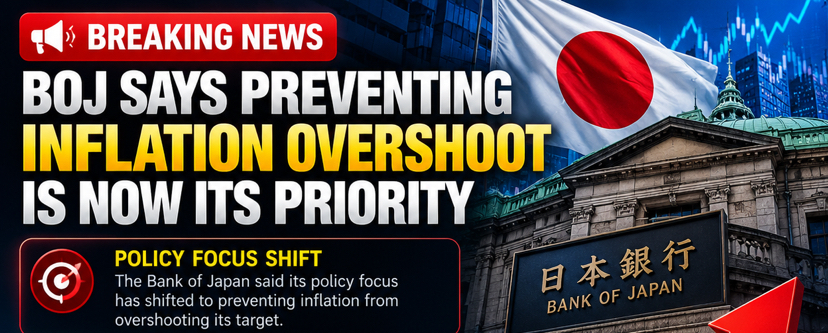
🚨 BOJ POLICY SHIFT: INFLATION RISKS IN FOCUS 🇯🇵The Bank of Japan has shifted greater attention toward preventing underlying inflation from moving materially above its 2% price-stability target. Its September policy summary says the policy phase has changed as underlying inflation approaches 2%, while the BOJ’s current policy rate is 1.25%.
📊 Why markets care:
Higher Japanese rates can influence the yen, bond yields, global liquidity and risk assets, including crypto.
👀 The next major BOJ policy meeting is scheduled for October 29–30, 2026.
Follow for more fast market updates, macro news & crypto analysis. 🔔
#BoJ #Japan #Bitcoin
🚨 BOJ POLICY SHIFT: INFLATION RISKS IN FOCUS 🇯🇵
The Bank of Japan has shifted greater attention toward preventing underlying inflation from moving materially above its 2% price-stability target. Its September policy summary says the policy phase has changed as underlying inflation approaches 2%, while the BOJ’s current policy rate is 1.25%.
📊 Why markets care:
Higher Japanese rates can influence the yen, bond yields, global liquidity and risk assets, including crypto.
👀 The next major BOJ policy meeting is scheduled for October 29–30, 2026.
Follow for more fast market updates, macro news & crypto analysis. 🔔
#BoJ #Japan #Bitcoin
📊 Why markets care:
Higher Japanese rates can influence the yen, bond yields, global liquidity and risk assets, including crypto.
👀 The next major BOJ policy meeting is scheduled for October 29–30, 2026.
Follow for more fast market updates, macro news & crypto analysis. 🔔
#BoJ #Japan #Bitcoin
68
In Japan’s government bond spot market, the yield on the Japan 10-year benchmark government bond saw a notable bout of volatility today, jumping sharply by 8 basis points intraday and touching 3.055%, thereby breaking to the highest level since September 1996. Judging by the price action on the chart, this indicator has strongly pushed through a key resistance zone that has held for nearly three decades, indicating that Japan’s long-end yield curve is undergoing an exceptionally deep technical remapping.
The deeper significance of this move lies in a reconfiguration of the global macro liquidity framework. Decades of extremely accommodative monetary conditions have been thoroughly altered. With yields moving above the 3.055% high, the market appears to have fully priced in the normalization of the Bank of Japan’s policy. While the initial rise in nominal interest rates may bring volatility, from a macro health perspective, the shift upward in the interest-rate center signals the end of the deflationary cycle and the recovery of real economic growth momentum, eliminating tail risks that have long weighed on financial markets.
From a cross-asset linkage perspective, the rise in the benchmark rate has further driven the unwinding and rebalancing of global carry-trade positions. From a technical and quantitative standpoint, once key rate levels complete a surge in a pulse-like manner, volatility often reverts to its mean. The clarification of sovereign bond yields worldwide effectively dispels the cloud of uncertainty that had hung over the market for the long term, laying a more solid macro floor for risk appetite to recover and for risk assets to build.
For the crypto market, the phase of adjusting liquidity expectations is often accompanied by healthy turnover of positions—ironically, this is an ideal accumulation structure within a bullish trend. Core assets represented by $BTC have demonstrated very strong ability to absorb sell pressure during the liquidity rebalancing process. The weekly-level uptrend channel has not been broken. As macro headwinds are fully digested on the tape, with capital seeking higher Alpha returns, there is potential for an accelerated inflow back into the crypto space, which could help the broader market kick off a new round of right-side upside pursuit.📈
#BOJ #BondYields #MacroEconomics #Bitcoin
In Japan’s government bond spot market, the yield on the Japan 10-year benchmark government bond saw a notable bout of volatility today, jumping sharply by 8 basis points intraday and touching 3.055%, thereby breaking to the highest level since September 1996. Judging by the price action on the chart, this indicator has strongly pushed through a key resistance zone that has held for nearly three decades, indicating that Japan’s long-end yield curve is undergoing an exceptionally deep technical remapping.
The deeper significance of this move lies in a reconfiguration of the global macro liquidity framework. Decades of extremely accommodative monetary conditions have been thoroughly altered. With yields moving above the 3.055% high, the market appears to have fully priced in the normalization of the Bank of Japan’s policy. While the initial rise in nominal interest rates may bring volatility, from a macro health perspective, the shift upward in the interest-rate center signals the end of the deflationary cycle and the recovery of real economic growth momentum, eliminating tail risks that have long weighed on financial markets.
From a cross-asset linkage perspective, the rise in the benchmark rate has further driven the unwinding and rebalancing of global carry-trade positions. From a technical and quantitative standpoint, once key rate levels complete a surge in a pulse-like manner, volatility often reverts to its mean. The clarification of sovereign bond yields worldwide effectively dispels the cloud of uncertainty that had hung over the market for the long term, laying a more solid macro floor for risk appetite to recover and for risk assets to build.
For the crypto market, the phase of adjusting liquidity expectations is often accompanied by healthy turnover of positions—ironically, this is an ideal accumulation structure within a bullish trend. Core assets represented by $BTC have demonstrated very strong ability to absorb sell pressure during the liquidity rebalancing process. The weekly-level uptrend channel has not been broken. As macro headwinds are fully digested on the tape, with capital seeking higher Alpha returns, there is potential for an accelerated inflow back into the crypto space, which could help the broader market kick off a new round of right-side upside pursuit.📈
#BOJ #BondYields #MacroEconomics #Bitcoin
The deeper significance of this move lies in a reconfiguration of the global macro liquidity framework. Decades of extremely accommodative monetary conditions have been thoroughly altered. With yields moving above the 3.055% high, the market appears to have fully priced in the normalization of the Bank of Japan’s policy. While the initial rise in nominal interest rates may bring volatility, from a macro health perspective, the shift upward in the interest-rate center signals the end of the deflationary cycle and the recovery of real economic growth momentum, eliminating tail risks that have long weighed on financial markets.
From a cross-asset linkage perspective, the rise in the benchmark rate has further driven the unwinding and rebalancing of global carry-trade positions. From a technical and quantitative standpoint, once key rate levels complete a surge in a pulse-like manner, volatility often reverts to its mean. The clarification of sovereign bond yields worldwide effectively dispels the cloud of uncertainty that had hung over the market for the long term, laying a more solid macro floor for risk appetite to recover and for risk assets to build.
For the crypto market, the phase of adjusting liquidity expectations is often accompanied by healthy turnover of positions—ironically, this is an ideal accumulation structure within a bullish trend. Core assets represented by $BTC have demonstrated very strong ability to absorb sell pressure during the liquidity rebalancing process. The weekly-level uptrend channel has not been broken. As macro headwinds are fully digested on the tape, with capital seeking higher Alpha returns, there is potential for an accelerated inflow back into the crypto space, which could help the broader market kick off a new round of right-side upside pursuit.📈
#BOJ #BondYields #MacroEconomics #Bitcoin
108

·
--
🌍 MACRO ALERT
BOJ tightening is putting global liquidity back in focus.
🇯🇵 Yen → 💰 Liquidity → 📊 Risk Assets
Traders are watching how this could affect crypto and equities.
👀 Keep an eye on:
$BTC $ETH $BNB
#BoJ #CryptoMarket #bitcoin #MarketInsights #CryptoAnalysis
{spot}(BTCUSDT)
🌍 MACRO ALERT
BOJ tightening is putting global liquidity back in focus.
🇯🇵 Yen → 💰 Liquidity → 📊 Risk Assets
Traders are watching how this could affect crypto and equities.
👀 Keep an eye on:
$BTC $ETH $BNB
#BoJ #CryptoMarket #bitcoin #MarketInsights #CryptoAnalysis
BOJ tightening is putting global liquidity back in focus.
🇯🇵 Yen → 💰 Liquidity → 📊 Risk Assets
Traders are watching how this could affect crypto and equities.
👀 Keep an eye on:
$BTC $ETH $BNB
#BoJ #CryptoMarket #bitcoin #MarketInsights #CryptoAnalysis

87

🚨BOJ JUST SHOCKED GLOBAL MARKETS! 🇯🇵💥
The Bank of Japan has raised its policy rate from 1.00% to 1.25%, pushing borrowing costs to a 31-year high — the highest level since 1995.
⚠️Why every trader must pay attention
• 💴 The Yen Carry Trade is unwinding, driving massive global capital flows that hit $BTC first
• 🏦 Ultra-easy money is ending as the BOJ accelerates policy normalization
• 🌍Tighter global liquidity is fueling sharper swings across risk assets
• 📊 Sticky inflation keeps central banks in restrictive mode
• 🔥Further rate hikes remain firmly on the table if price pressures persist
The vote was a split **7–2**. Two board members opposed the hike, underscoring how divided and unpredictable the path ahead remains.
For risk assets, this is a clear warning signal. Volatility in USD/JPY, $ETH , and major indices is set to rise — creating both danger and opportunity.
🧠The Bigger Picture
News like this can trigger rapid moves, but the real edge comes from staying disciplined. Protect capital, avoid emotional decisions, and watch how $LINK and other risk assets react to the liquidity shift.
📌Market commentary only. Not financial advice. DYOR.
#BoJ #bitcoin #CryptoTrading #MacroNews
🚨BOJ JUST SHOCKED GLOBAL MARKETS! 🇯🇵💥
The Bank of Japan has raised its policy rate from 1.00% to 1.25%, pushing borrowing costs to a 31-year high — the highest level since 1995.
⚠️Why every trader must pay attention
• 💴 The Yen Carry Trade is unwinding, driving massive global capital flows that hit $BTC first
• 🏦 Ultra-easy money is ending as the BOJ accelerates policy normalization
• 🌍Tighter global liquidity is fueling sharper swings across risk assets
• 📊 Sticky inflation keeps central banks in restrictive mode
• 🔥Further rate hikes remain firmly on the table if price pressures persist
The vote was a split **7–2**. Two board members opposed the hike, underscoring how divided and unpredictable the path ahead remains.
For risk assets, this is a clear warning signal. Volatility in USD/JPY, $ETH , and major indices is set to rise — creating both danger and opportunity.
🧠The Bigger Picture
News like this can trigger rapid moves, but the real edge comes from staying disciplined. Protect capital, avoid emotional decisions, and watch how $LINK and other risk assets react to the liquidity shift.
📌Market commentary only. Not financial advice. DYOR.
#BoJ #bitcoin #CryptoTrading #MacroNews
The Bank of Japan has raised its policy rate from 1.00% to 1.25%, pushing borrowing costs to a 31-year high — the highest level since 1995.
⚠️Why every trader must pay attention
• 💴 The Yen Carry Trade is unwinding, driving massive global capital flows that hit $BTC first
• 🏦 Ultra-easy money is ending as the BOJ accelerates policy normalization
• 🌍Tighter global liquidity is fueling sharper swings across risk assets
• 📊 Sticky inflation keeps central banks in restrictive mode
• 🔥Further rate hikes remain firmly on the table if price pressures persist
The vote was a split **7–2**. Two board members opposed the hike, underscoring how divided and unpredictable the path ahead remains.
For risk assets, this is a clear warning signal. Volatility in USD/JPY, $ETH , and major indices is set to rise — creating both danger and opportunity.
🧠The Bigger Picture
News like this can trigger rapid moves, but the real edge comes from staying disciplined. Protect capital, avoid emotional decisions, and watch how $LINK and other risk assets react to the liquidity shift.
📌Market commentary only. Not financial advice. DYOR.
#BoJ #bitcoin #CryptoTrading #MacroNews

88

·
--
#BOJRaisesRatesTo31YearHigh
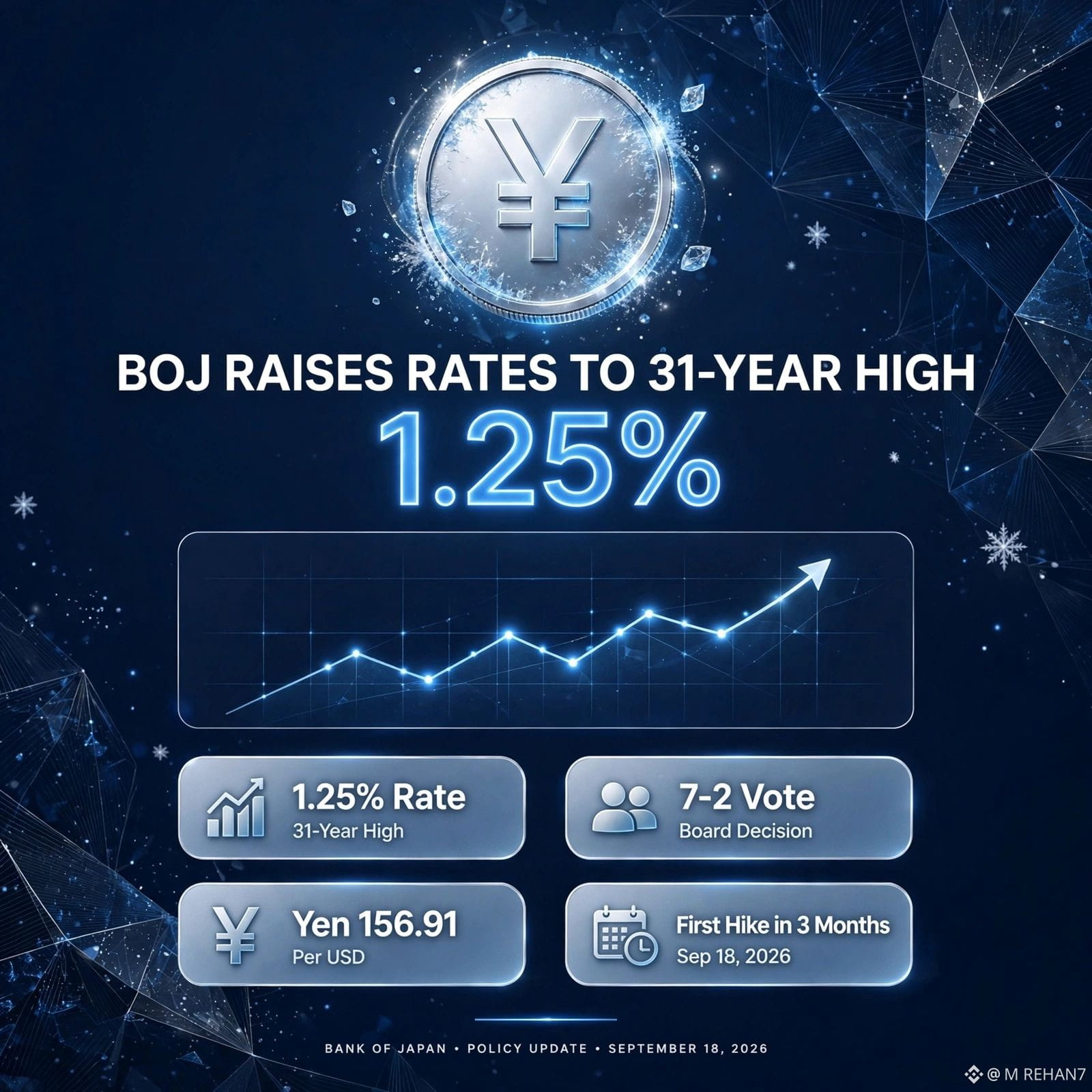
BOJ RAISES RATES TO 31-YEAR HIGH — 1.25% ❄️
Bank of Japan hits 31-year high. End of free yen era.
🔍 VERIFIED AUTHENTIC - Sep 18, 2026 - NEW ANGLE:
- Rate: 1.25% from 1% by 7-2 vote. Highest since 1995. Inside neutral range 1.1%-2.5% now.
- Why Yen Dropped to 156.91 Despite Hike: Dovish dissent by Asada & Sato + no hawkish guidance = market says “not aggressive enough”.
- Trigger: Wholesale inflation elevated, B2B spillover to consumer, Iran war oil spike, AI capex boom.
- First Hike in 3 Months: Last was June, now Sep 18. Slow but steady normalization.
UNIQUE MASTER TAKE (New Colour = New Insight):
Old theme was “Japan hikes”. New theme is “Ice Age Ending”. Japan kept rates near 0% for 31 years = entire crypto leverage built on cheap yen. Now ice is melting. Short-term: Yen carry unwind = volatility for BTC $SOL. Long-term: Stronger yen = global risk reset, BTC becomes hedge.
Crypto Play: $BTC $ETH $SOL $SAGA — watch funding rates. Cheap yen leverage going away.
Is this the start of global liquidity tightening?
#BoJ #BuffettStepsDownAsBerkshireChairman #CryptoNews
BTC ETH $SAGA ETH $MYX $AKE $B2
#BOJRaisesRatesTo31YearHigh
BOJ RAISES RATES TO 31-YEAR HIGH — 1.25% ❄️
Bank of Japan hits 31-year high. End of free yen era.
🔍 VERIFIED AUTHENTIC - Sep 18, 2026 - NEW ANGLE:
- Rate: 1.25% from 1% by 7-2 vote. Highest since 1995. Inside neutral range 1.1%-2.5% now.
- Why Yen Dropped to 156.91 Despite Hike: Dovish dissent by Asada & Sato + no hawkish guidance = market says “not aggressive enough”.
- Trigger: Wholesale inflation elevated, B2B spillover to consumer, Iran war oil spike, AI capex boom.
- First Hike in 3 Months: Last was June, now Sep 18. Slow but steady normalization.
UNIQUE MASTER TAKE (New Colour = New Insight):
Old theme was “Japan hikes”. New theme is “Ice Age Ending”. Japan kept rates near 0% for 31 years = entire crypto leverage built on cheap yen. Now ice is melting. Short-term: Yen carry unwind = volatility for BTC $SOL . Long-term: Stronger yen = global risk reset, BTC becomes hedge.
Crypto Play: $BTC $ETH $SOL $SAGA — watch funding rates. Cheap yen leverage going away.
Is this the start of global liquidity tightening?
#BoJ #BuffettStepsDownAsBerkshireChairman #CryptoNews
BTC ETH $SAGA ETH $MYX $AKE $B2
BOJ RAISES RATES TO 31-YEAR HIGH — 1.25% ❄️
Bank of Japan hits 31-year high. End of free yen era.
🔍 VERIFIED AUTHENTIC - Sep 18, 2026 - NEW ANGLE:
- Rate: 1.25% from 1% by 7-2 vote. Highest since 1995. Inside neutral range 1.1%-2.5% now.
- Why Yen Dropped to 156.91 Despite Hike: Dovish dissent by Asada & Sato + no hawkish guidance = market says “not aggressive enough”.
- Trigger: Wholesale inflation elevated, B2B spillover to consumer, Iran war oil spike, AI capex boom.
- First Hike in 3 Months: Last was June, now Sep 18. Slow but steady normalization.
UNIQUE MASTER TAKE (New Colour = New Insight):
Old theme was “Japan hikes”. New theme is “Ice Age Ending”. Japan kept rates near 0% for 31 years = entire crypto leverage built on cheap yen. Now ice is melting. Short-term: Yen carry unwind = volatility for BTC $SOL . Long-term: Stronger yen = global risk reset, BTC becomes hedge.
Crypto Play: $BTC $ETH $SOL $SAGA — watch funding rates. Cheap yen leverage going away.
Is this the start of global liquidity tightening?
#BoJ #BuffettStepsDownAsBerkshireChairman #CryptoNews
BTC ETH $SAGA ETH $MYX $AKE $B2
2
355

Article
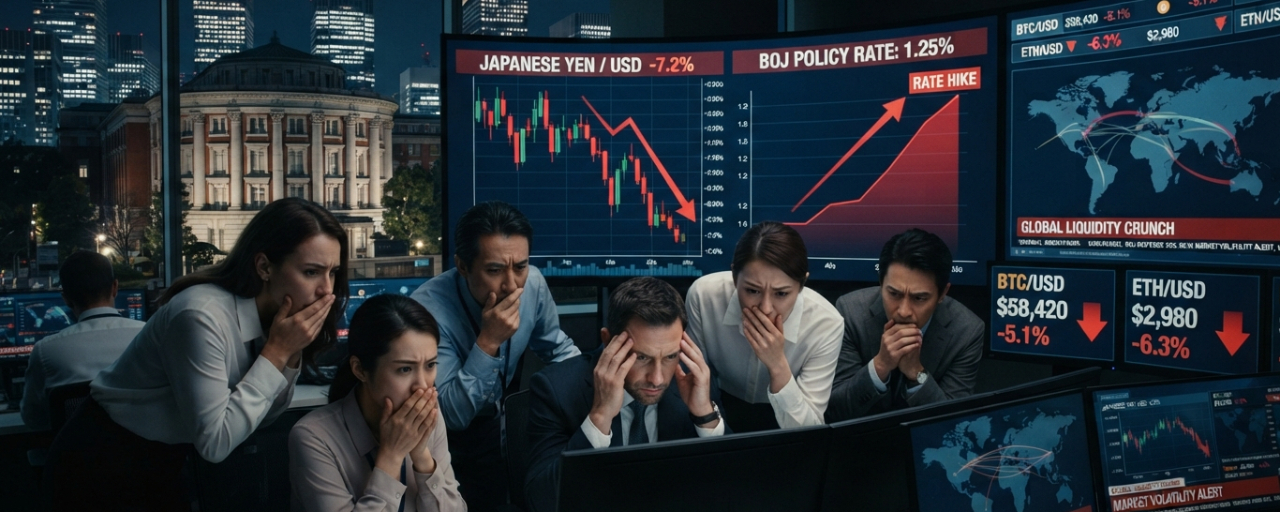
BOJ Raises Rates to 31 Year High: Why Did the Yen Fall?🚨🇯🇵 BOJ just raised rates to a 31 year high. 😳
The Bank of Japan lifted its policy rate from 1.00% to 1.25%, the highest level in 31 years.
But here’s the twist… 👀
The yen weakened after the decision instead of strengthening.
Why?
Markets had already expected the hike, while investors focused on the BOJ’s cautious guidance.
Governor Ueda also kept the door open to further rate increases, depending on inflation and economic data.
🌍 Why does crypto care?
Japan has long been an important source of low cost funding. Higher Japanese rates can change global liquidity and investor positioning.
Now BTC and ETH traders are watching closely. 👀
🔥 Could the next BOJ move create another shock across risk assets?
#BOJ
{spot}(ETHUSDT)
{spot}(BTCUSDT)
{spot}(ZECUSDT)
#Japan #Crypto #GlobalMarkets
BOJ Raises Rates to 31 Year High: Why Did the Yen Fall?
🚨🇯🇵 BOJ just raised rates to a 31 year high. 😳
The Bank of Japan lifted its policy rate from 1.00% to 1.25%, the highest level in 31 years.
But here’s the twist… 👀
The yen weakened after the decision instead of strengthening.
Why?
Markets had already expected the hike, while investors focused on the BOJ’s cautious guidance.
Governor Ueda also kept the door open to further rate increases, depending on inflation and economic data.
🌍 Why does crypto care?
Japan has long been an important source of low cost funding. Higher Japanese rates can change global liquidity and investor positioning.
Now BTC and ETH traders are watching closely. 👀
🔥 Could the next BOJ move create another shock across risk assets?
#BOJ
#Japan #Crypto #GlobalMarkets
The Bank of Japan lifted its policy rate from 1.00% to 1.25%, the highest level in 31 years.
But here’s the twist… 👀
The yen weakened after the decision instead of strengthening.
Why?
Markets had already expected the hike, while investors focused on the BOJ’s cautious guidance.
Governor Ueda also kept the door open to further rate increases, depending on inflation and economic data.
🌍 Why does crypto care?
Japan has long been an important source of low cost funding. Higher Japanese rates can change global liquidity and investor positioning.
Now BTC and ETH traders are watching closely. 👀
🔥 Could the next BOJ move create another shock across risk assets?
#BOJ
#Japan #Crypto #GlobalMarkets
47
Log in to explore more content
Join global crypto users on Binance Square
⚡️ Get latest and useful information about crypto.
💬 Trusted by the world’s largest crypto exchange.
👍 Discover real insights from verified creators.
Email / Phone number
Trending Topics
1
#FedMinutesFocusOnOctoberPause
43,190 views
686 Discussing
2
#BinanceLaunchesBinanceIntelligence
983,436 views
5,943 Discussing
3
#EvernorthDelaysNasdaqDebutToOct12
1,444 views
87 Discussing
4
#RobinhoodAdds$25MInBitcoinToBalanceSheet
1,424 views
38 Discussing
5
#SP500AndNasdaqHitRecordHighs
8,524 views
298 Discussing
6
#USMortgageRatesRiseTo7.49%
8,922 views
265 Discussing
7
#BTCFallsBelow$84K
87,385 views
208 Discussing
8
#DubaiVARAIssuesReserveAssetAuditCircular
34,031 views
850 Discussing
9
#SECApproves3XBitcoinETF
32,616 views
687 Discussing
10
#WinklevossFilesSpotZcashETFApplication
41,198 views
804 Discussing