
CryptoMishra
1.6k Posts

CryptoMishra
请关注我的频道 Follow me frd
Open Trade
Occasional Trader
2 Years
2.6K+ Following
1.0K+ Followers
330 Liked
Posts
Portfolio
All
Quotes
Videos
Live
DUSK NETWORK — PRIVACY FOR GLOBAL FINANCE
#dusk #BINNANCEPIXEL #Binnancetopcreater
#BinanceSquareTalks $DUSK
#dusk #BINNANCEPIXEL #Binnancetopcreater
#BinanceSquareTalks $DUSK
#dusk $DUSK @Dusk @binance square
🔐 Dusk Network: Privacy Meets Blockchain Finance
🚀 Dusk Network: The Privacy Blockchain Powering the Future of Finance
Dusk Network is a Layer-1 blockchain designed to bring privacy, compliance, and programmable finance together. Its infrastructure is built for financial applications that require transactions and smart contracts to protect sensitive information without sacrificing blockchain functionality.
At the core of Dusk Network is the Confidential Security Contract (XSC) standard, which enables confidential smart contracts and privacy-focused financial workflows. This approach allows developers to build applications where sensitive financial data can remain protected while still benefiting from the transparency, security, and programmability of blockchain technology.
With its focus on confidential smart contracts and financial infrastructure, Dusk Network aims to provide a foundation for the next generation of privacy-preserving digital assets and decentralized financial applications.#Dusk
🔐 Dusk Network: Privacy Meets Blockchain Finance
🚀 Dusk Network: The Privacy Blockchain Powering the Future of Finance
Dusk Network is a Layer-1 blockchain designed to bring privacy, compliance, and programmable finance together. Its infrastructure is built for financial applications that require transactions and smart contracts to protect sensitive information without sacrificing blockchain functionality.
At the core of Dusk Network is the Confidential Security Contract (XSC) standard, which enables confidential smart contracts and privacy-focused financial workflows. This approach allows developers to build applications where sensitive financial data can remain protected while still benefiting from the transparency, security, and programmability of blockchain technology.
With its focus on confidential smart contracts and financial infrastructure, Dusk Network aims to provide a foundation for the next generation of privacy-preserving digital assets and decentralized financial applications.#Dusk
·
--
🎙️ Accumulating chips in a bear market, stacking BNB spot at the dips!
End
05 h 27 m 21 s
27.9k
47
nic

Pradeep¹¹
·
--
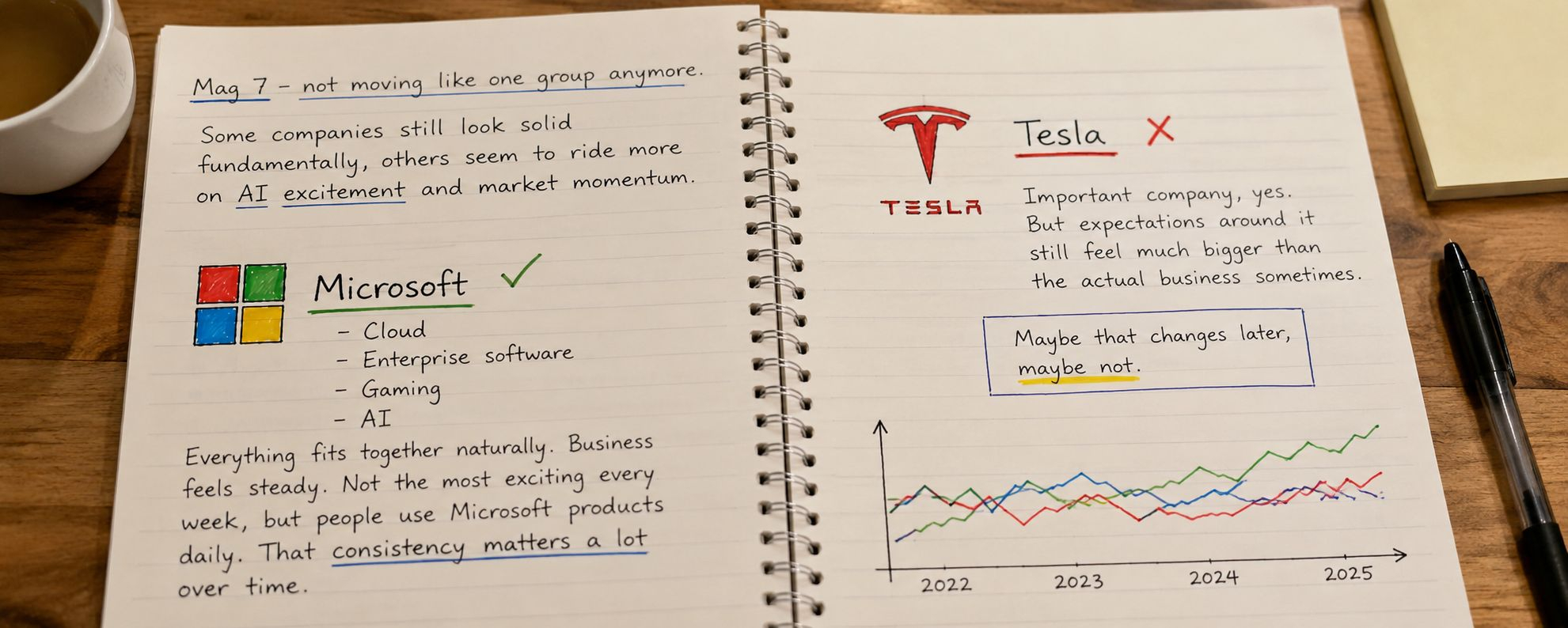
BearishThe Mag 7 honestly feels less connected now than it did before. A few companies still look strong fundamentally, while others seem to move mostly from AI excitement and market momentum.
For me, Microsoft still looks like the safest long-term name in the group. The business feels steady. Cloud, enterprise software, gaming, AI — everything fits together naturally instead of feeling forced. It’s not the most exciting stock every week, but people use Microsoft products daily and that consistency matters a lot over time.
Tesla is probably the one that feels most driven by hype right now. Important company, yes, but the expectations around it still feel much bigger than the actual business sometimes. Maybe that changes later, maybe not.
#PostonTradFi
For me, Microsoft still looks like the safest long-term name in the group. The business feels steady. Cloud, enterprise software, gaming, AI — everything fits together naturally instead of feeling forced. It’s not the most exciting stock every week, but people use Microsoft products daily and that consistency matters a lot over time.
Tesla is probably the one that feels most driven by hype right now. Important company, yes, but the expectations around it still feel much bigger than the actual business sometimes. Maybe that changes later, maybe not.
#PostonTradFi
giga
LEGEND SK-MARS ARMY
·
--
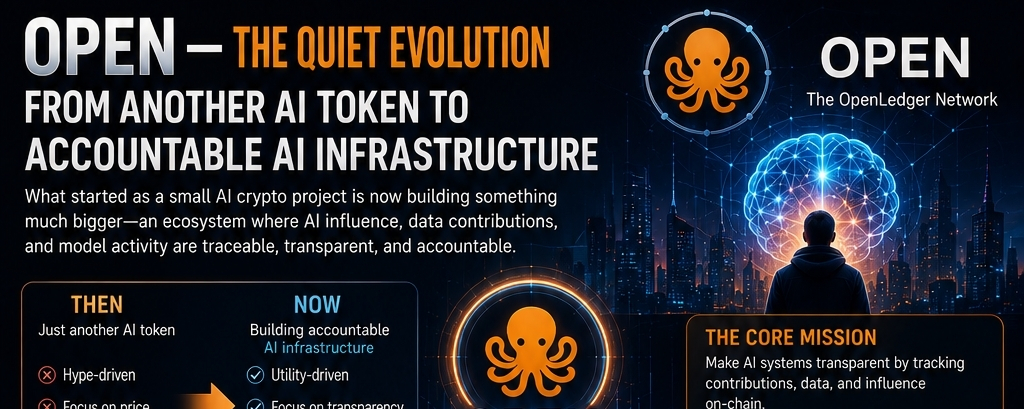
There was a time when most people looked at OPEN as just another small AI-related crypto project try
survive in a crowded market. Back then, the attention around the ecosystem was limited mainly to speculation, token movement, and the usual excitement that follows every new Web3 narrative. But over time, the direction of the project started changing quietly.
Instead of focusing only on short-term hype, OPEN gradually pushed deeper into AI infrastructure, attribution systems, and transparent data contribution models. That shift may sound technical on the surface, but it changes the entire identity of the project. The discussion is no longer only about price or market momentum. It is increasingly about whether AI systems can become more accountable in the future.
One thing that separates OPEN from many trend-driven projects is the way it approaches visibility inside AI networks. In most traditional systems, contributors disappear after their data enters the pipeline. Models evolve, outputs improve, companies profit, but the original influence becomes almost impossible to trace. $OPEN is trying to challenge that structure by building systems where contributions and influence can remain measurable instead of invisible.
Recent developments around attribution-focused AI infrastructure and ecosystem expansion have pushed this narrative even further. The project appears more interested in creating long-term utility than chasing temporary attention cycles. Discussions connected to rights-cleared AI training, builder participation, and ecosystem-level transparency have helped OPEN gain a more serious reputation compared to its earlier phase.
At the same time, this does not automatically guarantee success.
The AI + blockchain sector has become extremely competitive. Every few weeks, a new project enters the market promising decentralization, transparency, or next-generation AI integration. In that environment, standing out becomes difficult even with a strong concept. OPEN still faces the same challenge every infrastructure project faces: turning ideas into consistent real-world usage.
Another important issue is adoption speed. Transparency is valuable, but many users still prioritize convenience and profits over accountability. This means OPEN may grow slower than highly speculative ecosystems because its narrative is based more on long-term relevance than short-term excitement. Markets often reward hype faster than infrastructure.
There is also the execution risk. Building traceable AI systems sounds impressive in theory, but scaling them into something developers, companies, and institutions actively use every day is a completely different challenge. Partnerships and announcements create visibility, but sustainable activity matters much more than headlines.
Even token performance reflects this uncertainty. Like many utility-focused projects, $OPEN has experienced periods where market sentiment became stronger than development progress. During bearish conditions, investors often lose patience with ecosystems that require time to mature. That pressure can affect community energy even if the technology continues improving in the background.
Still, despite these concerns, OPEN feels more focused today than it did in its early phase. Earlier, the project looked like another participant in the AI-token trend. Now, it appears to be shaping an identity around accountable AI infrastructure and transparent contribution systems.
Whether that vision succeeds or not will depend entirely on execution, adoption, and the ability to create practical demand beyond crypto discussions. But one thing is becoming increasingly clear: as artificial intelligence grows more powerful, the demand for explainable and traceable systems may become impossible to ignore.
If that future arrives the way many expect, OPEN may not be remembered for loud marketing or temporary hype. It may instead be remembered as one of the projects that recognized early that trust and transparency could eventually become just as important as intelligence itself.
@OpenLedger #OpenLedger $OPEN
Instead of focusing only on short-term hype, OPEN gradually pushed deeper into AI infrastructure, attribution systems, and transparent data contribution models. That shift may sound technical on the surface, but it changes the entire identity of the project. The discussion is no longer only about price or market momentum. It is increasingly about whether AI systems can become more accountable in the future.
One thing that separates OPEN from many trend-driven projects is the way it approaches visibility inside AI networks. In most traditional systems, contributors disappear after their data enters the pipeline. Models evolve, outputs improve, companies profit, but the original influence becomes almost impossible to trace. $OPEN is trying to challenge that structure by building systems where contributions and influence can remain measurable instead of invisible.
Recent developments around attribution-focused AI infrastructure and ecosystem expansion have pushed this narrative even further. The project appears more interested in creating long-term utility than chasing temporary attention cycles. Discussions connected to rights-cleared AI training, builder participation, and ecosystem-level transparency have helped OPEN gain a more serious reputation compared to its earlier phase.
At the same time, this does not automatically guarantee success.
The AI + blockchain sector has become extremely competitive. Every few weeks, a new project enters the market promising decentralization, transparency, or next-generation AI integration. In that environment, standing out becomes difficult even with a strong concept. OPEN still faces the same challenge every infrastructure project faces: turning ideas into consistent real-world usage.
Another important issue is adoption speed. Transparency is valuable, but many users still prioritize convenience and profits over accountability. This means OPEN may grow slower than highly speculative ecosystems because its narrative is based more on long-term relevance than short-term excitement. Markets often reward hype faster than infrastructure.
There is also the execution risk. Building traceable AI systems sounds impressive in theory, but scaling them into something developers, companies, and institutions actively use every day is a completely different challenge. Partnerships and announcements create visibility, but sustainable activity matters much more than headlines.
Even token performance reflects this uncertainty. Like many utility-focused projects, $OPEN has experienced periods where market sentiment became stronger than development progress. During bearish conditions, investors often lose patience with ecosystems that require time to mature. That pressure can affect community energy even if the technology continues improving in the background.
Still, despite these concerns, OPEN feels more focused today than it did in its early phase. Earlier, the project looked like another participant in the AI-token trend. Now, it appears to be shaping an identity around accountable AI infrastructure and transparent contribution systems.
Whether that vision succeeds or not will depend entirely on execution, adoption, and the ability to create practical demand beyond crypto discussions. But one thing is becoming increasingly clear: as artificial intelligence grows more powerful, the demand for explainable and traceable systems may become impossible to ignore.
If that future arrives the way many expect, OPEN may not be remembered for loud marketing or temporary hype. It may instead be remembered as one of the projects that recognized early that trust and transparency could eventually become just as important as intelligence itself.
@OpenLedger #OpenLedger $OPEN

I'm hosting an Audio Live "Trading or Airdrop—Your Choice
#ROBO $ROBO" on Binance Square, tune in here:
https://app.binance.com/uni-qr/cspa/39462640968977?r=UKWVSKQ8&l=en&source=host_share&uc=app_square_share_link&us=copylink
please join my live crypto session, fam!
#ROBO $ROBO" on Binance Square, tune in here:
https://app.binance.com/uni-qr/cspa/39462640968977?r=UKWVSKQ8&l=en&source=host_share&uc=app_square_share_link&us=copylink
please join my live crypto session, fam!
osm

JESSICA MARTIN1
·
--
@Pixels looks simple at first a casual farming game where you plant, craft, and explore. But the deeper you go, the more it feels like something else entirely.
What stands out isn’t the gameplay… it’s the system underneath.
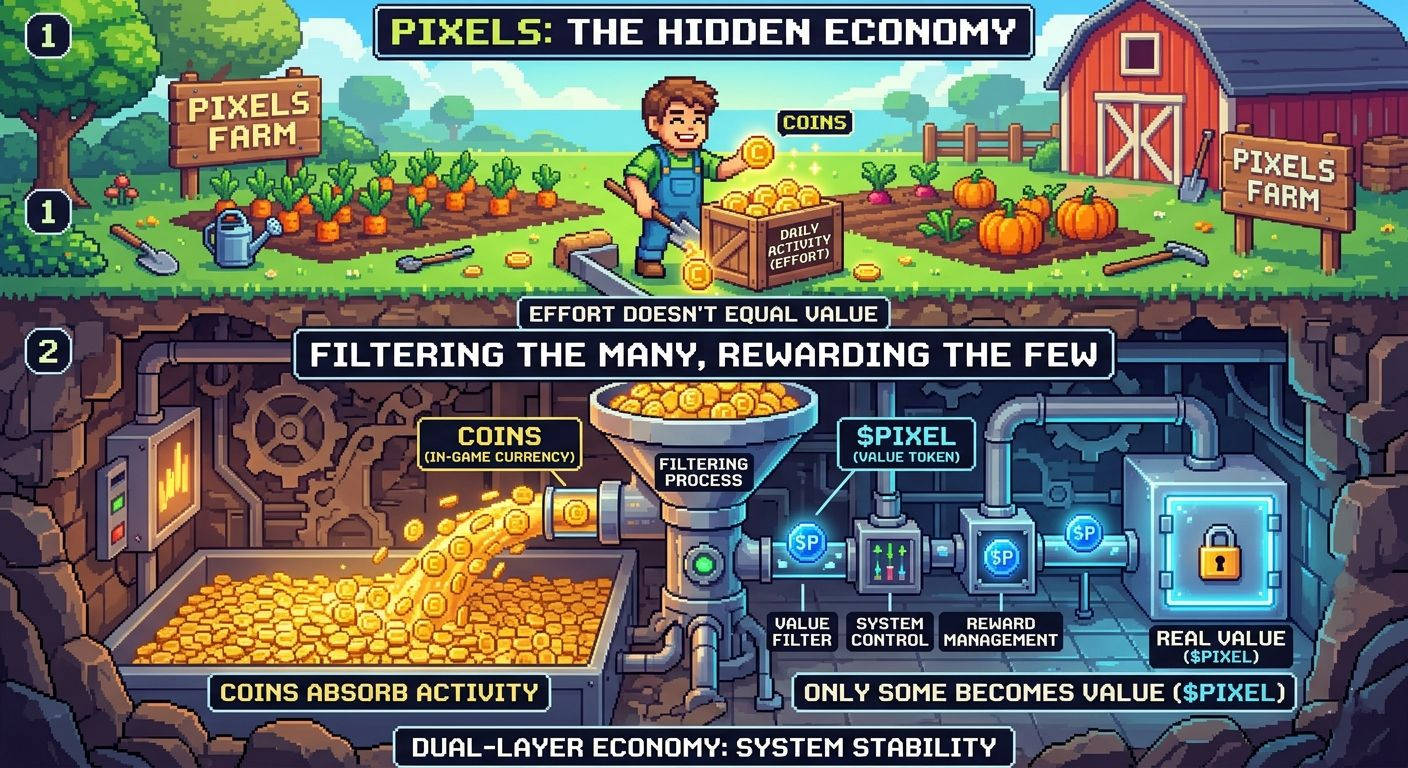
In most games, effort equals reward. The more you play the more you earn. Pixels quietly breaks that expectation. You can spend hours inside the game doing everything right, and still only a small portion of your activity turns into real value.
And the interesting part? It doesn’t feel like failure.
That’s because Pixels isn’t built to reward everything it’s built to filter.
The dual-layer economy explains a lot. Coins absorb most of the activity inside the game, while $PIXEL represents the part that actually “counts.” Without that separation, the system would collapse under constant reward pressure.
In simple terms: not everything is meant to convert.
The same logic shows up in its reward design. Instead of flooding players with incentives, Pixels controls when, where, and how rewards are distributed. It’s less about attracting attention and more about maintaining balance over time.
Then there’s guilds probably one of the strongest pieces of the system. They turn solo gameplay into collective responsibility. You don’t just log in for rewards anymore, you log in because others depend on you. That’s a different kind of retention.
But there are still open questions. Governance, for example hasn’t fully caught up with the complexity of the system. Players participate deeply, but don’t yet have clear visibility into the decisions shaping the economy.
At its core, Pixels feels less like a game and more like a controlled digital economy one that doesn’t just reward behavior but carefully decides which behavior deserves to be rewarded.
And that difference changes everything.
#pixel
What stands out isn’t the gameplay… it’s the system underneath.
In most games, effort equals reward. The more you play the more you earn. Pixels quietly breaks that expectation. You can spend hours inside the game doing everything right, and still only a small portion of your activity turns into real value.
And the interesting part? It doesn’t feel like failure.
That’s because Pixels isn’t built to reward everything it’s built to filter.
The dual-layer economy explains a lot. Coins absorb most of the activity inside the game, while $PIXEL represents the part that actually “counts.” Without that separation, the system would collapse under constant reward pressure.
In simple terms: not everything is meant to convert.
The same logic shows up in its reward design. Instead of flooding players with incentives, Pixels controls when, where, and how rewards are distributed. It’s less about attracting attention and more about maintaining balance over time.
Then there’s guilds probably one of the strongest pieces of the system. They turn solo gameplay into collective responsibility. You don’t just log in for rewards anymore, you log in because others depend on you. That’s a different kind of retention.
But there are still open questions. Governance, for example hasn’t fully caught up with the complexity of the system. Players participate deeply, but don’t yet have clear visibility into the decisions shaping the economy.
At its core, Pixels feels less like a game and more like a controlled digital economy one that doesn’t just reward behavior but carefully decides which behavior deserves to be rewarded.
And that difference changes everything.
#pixel
·
--
🎙️ 🔥 CHIP New Coin Launch! Hot List #1!
AI Infrastructure Permissionless Lending Protocol, Binance went live last night. Join the livestream: we'll break down the launch opportunity, entry points, and risks—don’t miss this hot trend!
End
05 h 59 m 59 s
7.5k
20
·
--
🎙️ Is the bull back or just a trap? How to trade BTC and ETH today?
End
05 h 59 m 59 s
5.2k
34
#pixel $PIXEL
A lot of people think of Pixels as just a game. That was never the full picture.
As we built Pixels, we realized that most Web3 games share the same problem: how to add ownership to games without breaking their economies or attracting the wrong users.
The hard part was never putting assets on-chain. The hard part is managing incentive alignment. And that is the biggest reason so many Web3 games have struggled.
Over the last year, we’ve materially improved the economics within Pixels and gotten much closer to what the market has been chasing for a long time: sustainable play-to-earn.
That problem became our obsession. That problem is what led to @stacked_app.
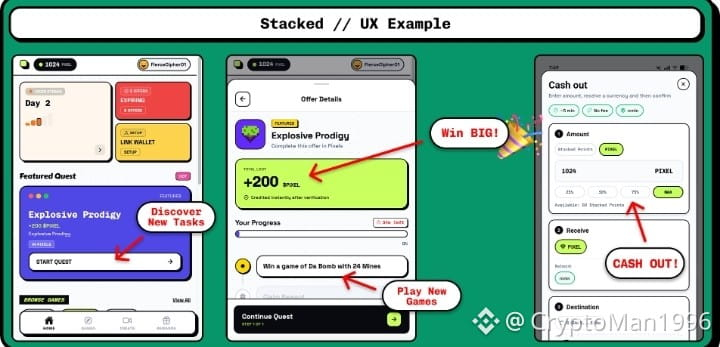
Stacked is a rewards app for players and a rewarded LiveOps engine for games - built from everything we learned scaling Pixels.
So What Is Stacked?
For players, it is one place to: play games, complete missions, build streaks, earn rewards, and cash out across a growing
A lot of people think of Pixels as just a game. That was never the full picture.
As we built Pixels, we realized that most Web3 games share the same problem: how to add ownership to games without breaking their economies or attracting the wrong users.
The hard part was never putting assets on-chain. The hard part is managing incentive alignment. And that is the biggest reason so many Web3 games have struggled.
Over the last year, we’ve materially improved the economics within Pixels and gotten much closer to what the market has been chasing for a long time: sustainable play-to-earn.
That problem became our obsession. That problem is what led to @stacked_app.
Stacked is a rewards app for players and a rewarded LiveOps engine for games - built from everything we learned scaling Pixels.
So What Is Stacked?
For players, it is one place to: play games, complete missions, build streaks, earn rewards, and cash out across a growing
Meet @stacked_app. The App That Makes Play-to-Earn Actually Work.
@Pixels
#PIXEL/USDT
$PIXEL
A lot of people think of Pixels as just a game. That was never the full picture.
As we built Pixels, we realized that most Web3 games share the same problem: how to add ownership to games without breaking their economies or attracting the wrong users.
The hard part was never putting assets on-chain. The hard part is managing incentive alignment. And that is the biggest reason so many Web3 games have struggled.
Over the last year, we’ve materially improved the economics within Pixels and gotten much closer to what the market has been chasing for a long time: sustainable play-to-earn.
That problem became our obsession. That problem is what led to @stacked_app.
Stacked is a rewards app for players and a rewarded LiveOps engine for games - built from everything we learned scaling Pixels.
So What Is Stacked?
For players, it is one place to: play games, complete missions, build streaks, earn rewards, and cash out across a growing ecosystem.
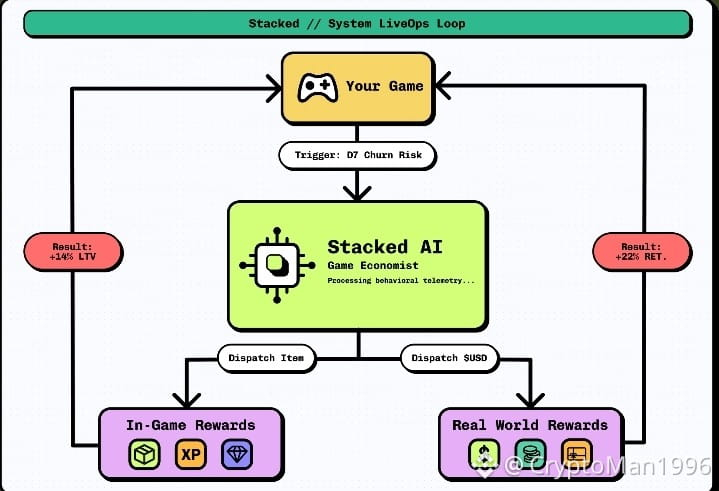
For studios, it is the system underneath that experience: event tracking, targeting, reward logic, fraud controls, payouts, testing, attribution, and, increasingly, an AI game economist that helps teams figure out what to reward and why.
What Stacked means for players
#PIXEL/USDT
@Pixels
#PIXEL/USDT
$PIXEL
A lot of people think of Pixels as just a game. That was never the full picture.
As we built Pixels, we realized that most Web3 games share the same problem: how to add ownership to games without breaking their economies or attracting the wrong users.
The hard part was never putting assets on-chain. The hard part is managing incentive alignment. And that is the biggest reason so many Web3 games have struggled.
Over the last year, we’ve materially improved the economics within Pixels and gotten much closer to what the market has been chasing for a long time: sustainable play-to-earn.
That problem became our obsession. That problem is what led to @stacked_app.
Stacked is a rewards app for players and a rewarded LiveOps engine for games - built from everything we learned scaling Pixels.
So What Is Stacked?
For players, it is one place to: play games, complete missions, build streaks, earn rewards, and cash out across a growing ecosystem.
For studios, it is the system underneath that experience: event tracking, targeting, reward logic, fraud controls, payouts, testing, attribution, and, increasingly, an AI game economist that helps teams figure out what to reward and why.
What Stacked means for players
#PIXEL/USDT
Log in to explore more content