$102 worth of SOL—are you going to miss the run?
First, look at the surface: it’s up too much, so a normal pullback happens, and retail investors panic.
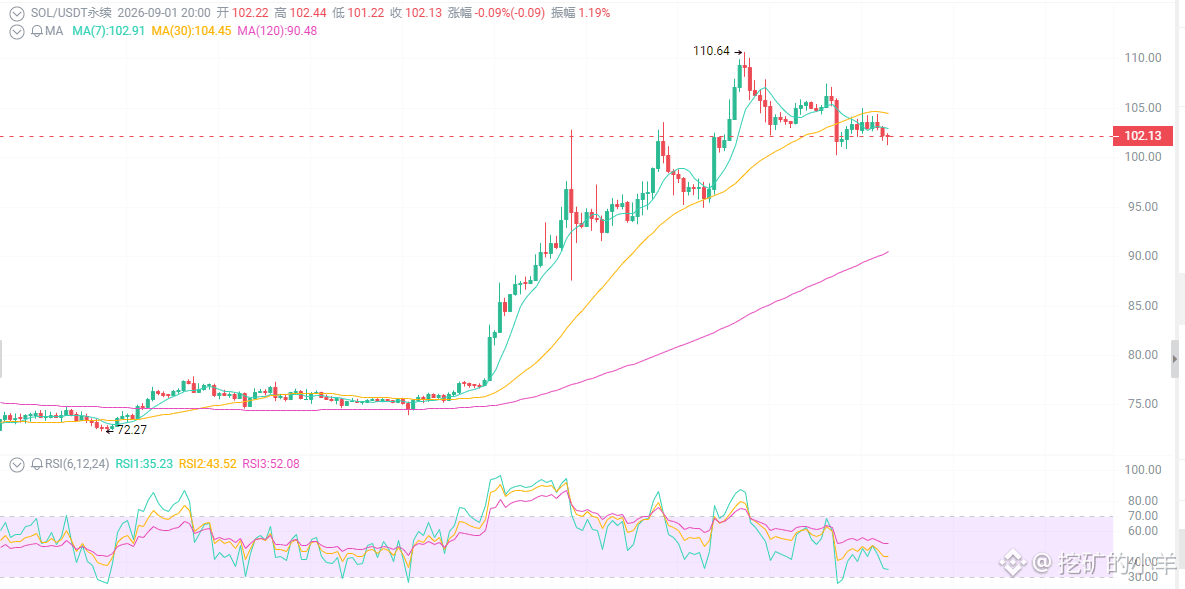
In August, SOL climbed from 70–75 all the way to 110—up over 40%—and it was the first monthly “big bullish” candle in nearly 10 months. Now it’s pulled back to 101, with the drop still under 10%. After breaking 96, it’s back-tested for confirmation—this is textbook healthy consolidation. The structure hasn’t broken. Don’t scare yourself.
First thing: the inflation halving has passed—supply needs to contract.
Proposal SGP-0002 passed with 67% support. Annualized inflation is set to drop from 15% to 30%, meaning that over the next 6 years, 18.9 million fewer SOL will be minted. Staking yields will gradually decline, but the long-term “floor” remains at 1.5%.
Solana’s “printing speed” has been slashed significantly—new coins will be issued far less going forward.
Second thing: the ETF is in a frenzy of inflows, and institutions are accelerating their entry.
Bitwise’s BSOL has surpassed $1 billion in size. Last week alone saw net inflows of $154 million—its strongest single week since the product launched. Charles Schwab also plans to add SOL to its crypto trading product—one of the brokerage firms with the most retail investors in the U.S.
From “can you buy it?” to “anyone can buy it”—the institutional distribution channel is fully opened.
Spot ETF cumulative net inflows have already reached $1.2–1.3 billion. Think about it: for a coin with a market cap in the hundreds of billions, just the ETFs have absorbed over a billion-plus. And this is only the beginning.
Third thing: the September 9 upgrade is coming—Transaction V1.
The per-transaction size limit increases from 1,232 bytes to 4,096 bytes—more than triple. The Alpenglow consensus upgrade is also coming later.
So what does that mean? More complex applications will be able to run on Solana, and throughput will jump to another level.
OpenSea is relaunching Solana NFTs after four years. RWA tokenized stock trading volume makes up a very high share, and daily active users on-chain exceed 2 million. Solana has moved from “a meme chain” to “financial infrastructure.”
Resistance levels: 105 → 108–110 (dense prior highs area) → 112–116 → 125
Support levels: 100 (psychological level) → 96 (breakout confirmation) → 94–95
Trading strategy
For short-term traders:
Try long with a light position between 100–102; stop loss below 96. Target 108–110 to reduce exposure first, then reassess at 112–116.
For swing traders:
94–96 is a better mid-term entry zone. If it reaches there, build positions in batches. Stop loss at 90; target 120–125. Around the September 9 upgrade, volatility is likely amplified—don’t chase. Wait for a pullback.
For long-term believers:
DCA with blind conviction below 100. Solana fell from 294 to 70, then surged back to 101—the bottom is already solidified. The 2027 target is 150–200+—the bet is ETF inflows continuing + RWA exploding + a rate-cut cycle.
First, look at the surface: it’s up too much, so a normal pullback happens, and retail investors panic.
In August, SOL climbed from 70–75 all the way to 110—up over 40%—and it was the first monthly “big bullish” candle in nearly 10 months. Now it’s pulled back to 101, with the drop still under 10%. After breaking 96, it’s back-tested for confirmation—this is textbook healthy consolidation. The structure hasn’t broken. Don’t scare yourself.
First thing: the inflation halving has passed—supply needs to contract.
Proposal SGP-0002 passed with 67% support. Annualized inflation is set to drop from 15% to 30%, meaning that over the next 6 years, 18.9 million fewer SOL will be minted. Staking yields will gradually decline, but the long-term “floor” remains at 1.5%.
Solana’s “printing speed” has been slashed significantly—new coins will be issued far less going forward.
Second thing: the ETF is in a frenzy of inflows, and institutions are accelerating their entry.
Bitwise’s BSOL has surpassed $1 billion in size. Last week alone saw net inflows of $154 million—its strongest single week since the product launched. Charles Schwab also plans to add SOL to its crypto trading product—one of the brokerage firms with the most retail investors in the U.S.
From “can you buy it?” to “anyone can buy it”—the institutional distribution channel is fully opened.
Spot ETF cumulative net inflows have already reached $1.2–1.3 billion. Think about it: for a coin with a market cap in the hundreds of billions, just the ETFs have absorbed over a billion-plus. And this is only the beginning.
Third thing: the September 9 upgrade is coming—Transaction V1.
The per-transaction size limit increases from 1,232 bytes to 4,096 bytes—more than triple. The Alpenglow consensus upgrade is also coming later.
So what does that mean? More complex applications will be able to run on Solana, and throughput will jump to another level.
OpenSea is relaunching Solana NFTs after four years. RWA tokenized stock trading volume makes up a very high share, and daily active users on-chain exceed 2 million. Solana has moved from “a meme chain” to “financial infrastructure.”
Resistance levels: 105 → 108–110 (dense prior highs area) → 112–116 → 125
Support levels: 100 (psychological level) → 96 (breakout confirmation) → 94–95
Trading strategy
For short-term traders:
Try long with a light position between 100–102; stop loss below 96. Target 108–110 to reduce exposure first, then reassess at 112–116.
For swing traders:
94–96 is a better mid-term entry zone. If it reaches there, build positions in batches. Stop loss at 90; target 120–125. Around the September 9 upgrade, volatility is likely amplified—don’t chase. Wait for a pullback.
For long-term believers:
DCA with blind conviction below 100. Solana fell from 294 to 70, then surged back to 101—the bottom is already solidified. The 2027 target is 150–200+—the bet is ETF inflows continuing + RWA exploding + a rate-cut cycle.