
As capital begins to migrate, a new financial order is taking shape.
Over the past decade, the crypto world has appeared bustling, but what has truly determined the direction has never been traders' emotions, KOLs' opinions, or even the judgment of a single institution.
The truly smart entity has always been one—capital itself.
Capital doesn't tell stories, doesn't speak of sentiment, nor does it show loyalty.
It will keep searching for only two places:
a place with lower risk and higher efficiency.
It is precisely under this calm and ruthless selection that the global flow of capital is undergoing a profound and irreversible shift.
Centralized finance is heading towards structural bottlenecks.

For a long time, centralized trading platforms (CEX) took on the main functions of crypto finance. But as the market matured, problems gradually surfaced:
The risk of asset custody cannot be completely eliminated.
Black box operations make transparency a luxury.
Single points of failure make the system extremely vulnerable.
Regulatory uncertainty continues to amplify systemic risks.
More and more users are beginning to realize an essential question:
If the assets belong to me, why is the control not in my hands?
This is not an emotional issue, but a structural issue.
And funds are always quicker to realize structural risks than people.
Decentralization is no longer just an idea, but an infrastructure.
Decentralized finance (DeFi) is not a new concept, but a truly large-scale, sustainable, and professional-capital-carrying decentralized system has only recently begun to take shape.
The new generation of public chains and execution environments is beginning to solve 'hard issues' like performance, latency, clearing, and user experience.
This means a whole new possibility is emerging:
It's not about moving old finance onto the chain, but reconstructing finance itself on the chain.
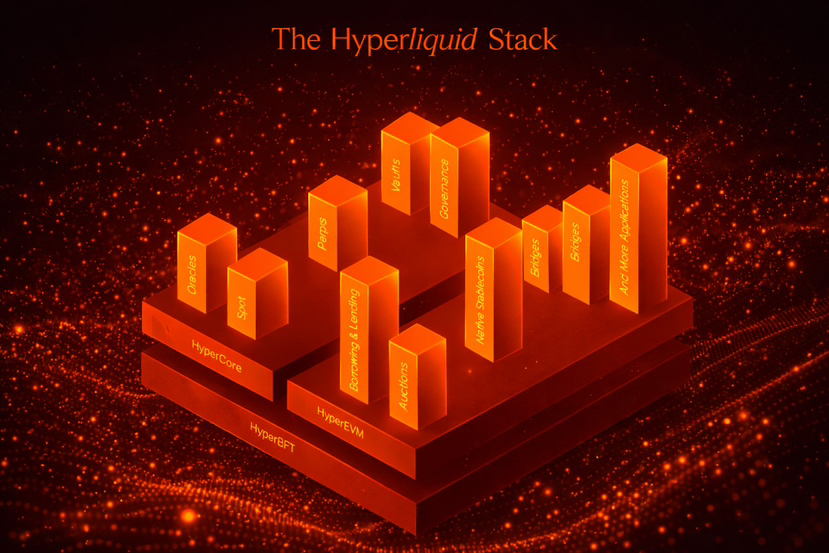
HyperProtocol: born for the migrating funds.
It is in this context that HyperProtocol emerged.
It is not a single product, but a decentralized financial super protocol centered around trading, built on a high-performance execution environment, with only one goal:
Let funds flow freely on the chain with lower risks and higher efficiency.
HyperProtocol is not focused on 'how many functions to implement', but on solving the most critical issues in the financial system.
• Is the trading efficient enough?
• Does liquidity truly exist?
• Is the execution verifiable?
• Is the risk controllable?
• Do assets truly belong to users?
From 'trading' to 'system', rather than another application.
Unlike traditional DeFi applications, HyperProtocol's design philosophy is not about 'splicing modules', but rather building a continuously operating financial system.
In this system:
• Liquidity is not static locking, but continuous flow.
• Execution is not black box matching, but verifiable on-chain.
• Risks are not post-event explanations, but pre-event constraints.
• Returns are not driven by emotions, but generated by structure.
That's why HyperProtocol prefers to be called an 'infrastructure-level protocol', rather than a specific product.
When liquidity begins to 'work' by itself.
In the world of HyperProtocol, liquidity is no longer a resource passively waiting for trades to happen, but a continuously operating system element.
Funds can efficiently flow between different pools.
Trading no longer relies on single point matching.
But is naturally completed throughout the entire system.
The core logic of this design can be summed up in one sentence:
Let money do what it does best, rather than letting people make decisions for it.
The ultimate value of decentralization is not 'against', but 'evolution'.
HyperProtocol does not attempt to 'fight against' traditional finance,
It is more like answering a longer-term question:
When the financial system is sufficiently transparent, efficient, and automated, what role should humans play?
The answer may be:
Set rules, rather than participate in the game;
Design systems, rather than manipulate outcomes.
A new order is unfolding.
When you see funds flowing like whales from the old world to the new world, it is not some marketing story, but a real trend that is happening.
What HyperProtocol does is provide a system-level container that can sustainably carry this trend.
It is not the end, but the beginning.
It's not a slogan, but a structure.
It's not a one-time opportunity, but an evolution.