
GOLF123
7.8k Posts

GOLF123
 Square Verified+
GOLF123: GlobalFinance. Accuracy, like hitting a golf ball. Strategy, like portfolio management.
High-Frequency Trader
1.7 Years
306 Following
48.9K+ Followers
77.9K+ Liked
Posts
All
Quotes
Videos
Live
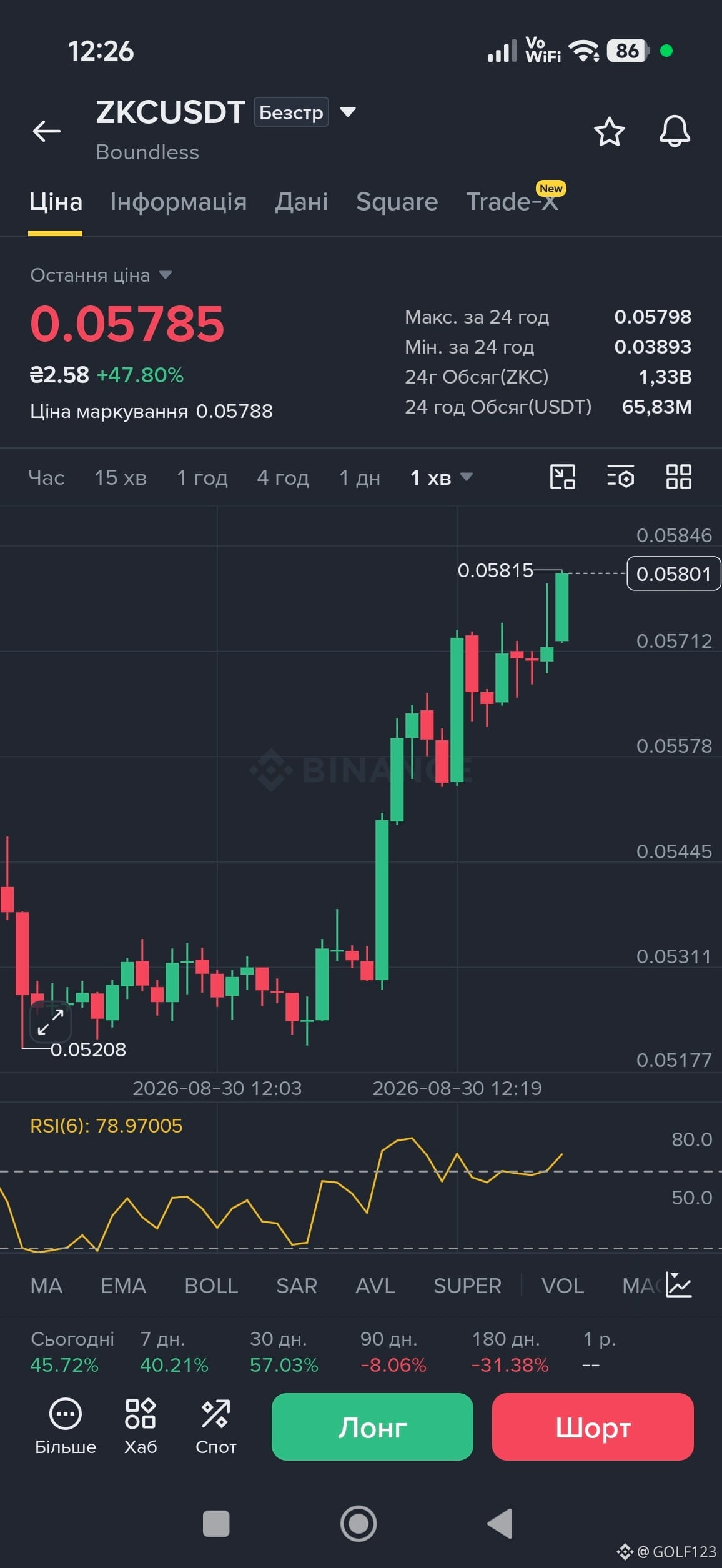
Basically, look at this ZK/USDT chart — something crazy is really happening there! 🚀 The coin just flew into space, plus almost +48% in a day — the numbers speak for themselves. Volumes are insane, and people’s interest is through the roof. But the RSI is already pushing up to almost 80, which means the asset is overbought to the max. Jumping in right at the very top right now — well, that’s a bit scary. So, you decide for yourself, but be careful with these limits!$ZKC
#ZKC
#ZKC
You know, these FOMC meetings are really starting to get under everyone’s skin. Every time it’s the same thing: everyone’s on pins and needles, guessing what they’ll decide about the rate, even though it’s basically clear—more or less. Well, almost everything.
But you can’t skip it, because otherwise the market starts to storm so badly that you barely have time to save your portfolio.
So what’s the point? You look at the numbers, listen to what Powell is again saying about inflation and the economy, and try to guess where all of it will roll next. Spoiler: nobody knows for sure. But you need at least some sense of the trend, so you don’t end up grabbing your head later. Bottom line—let’s keep watching.#fomcвідстеження $BTC
$DUSK
$ALGO
But you can’t skip it, because otherwise the market starts to storm so badly that you barely have time to save your portfolio.
So what’s the point? You look at the numbers, listen to what Powell is again saying about inflation and the economy, and try to guess where all of it will roll next. Spoiler: nobody knows for sure. But you need at least some sense of the trend, so you don’t end up grabbing your head later. Bottom line—let’s keep watching.#fomcвідстеження $BTC
$DUSK
$ALGO

The figure of 300 million from NPEX really impresses; the main thing for me personally is that I’m very interested in how it will work in practice.
#dusk $DUSK It’s a great project 🥰🥰
#dusk $DUSK It’s a great project 🥰🥰

SERgg UA
·
--
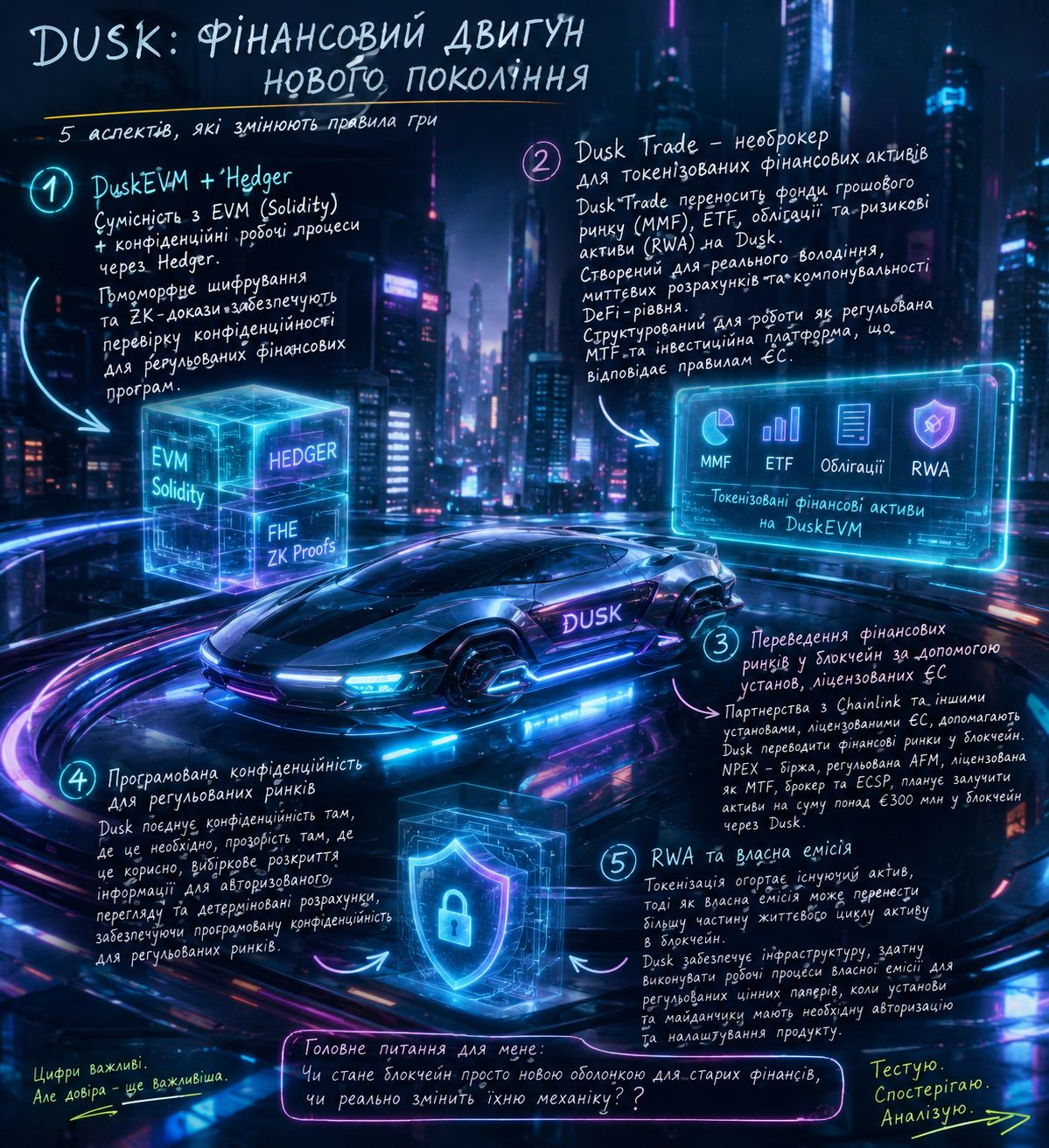
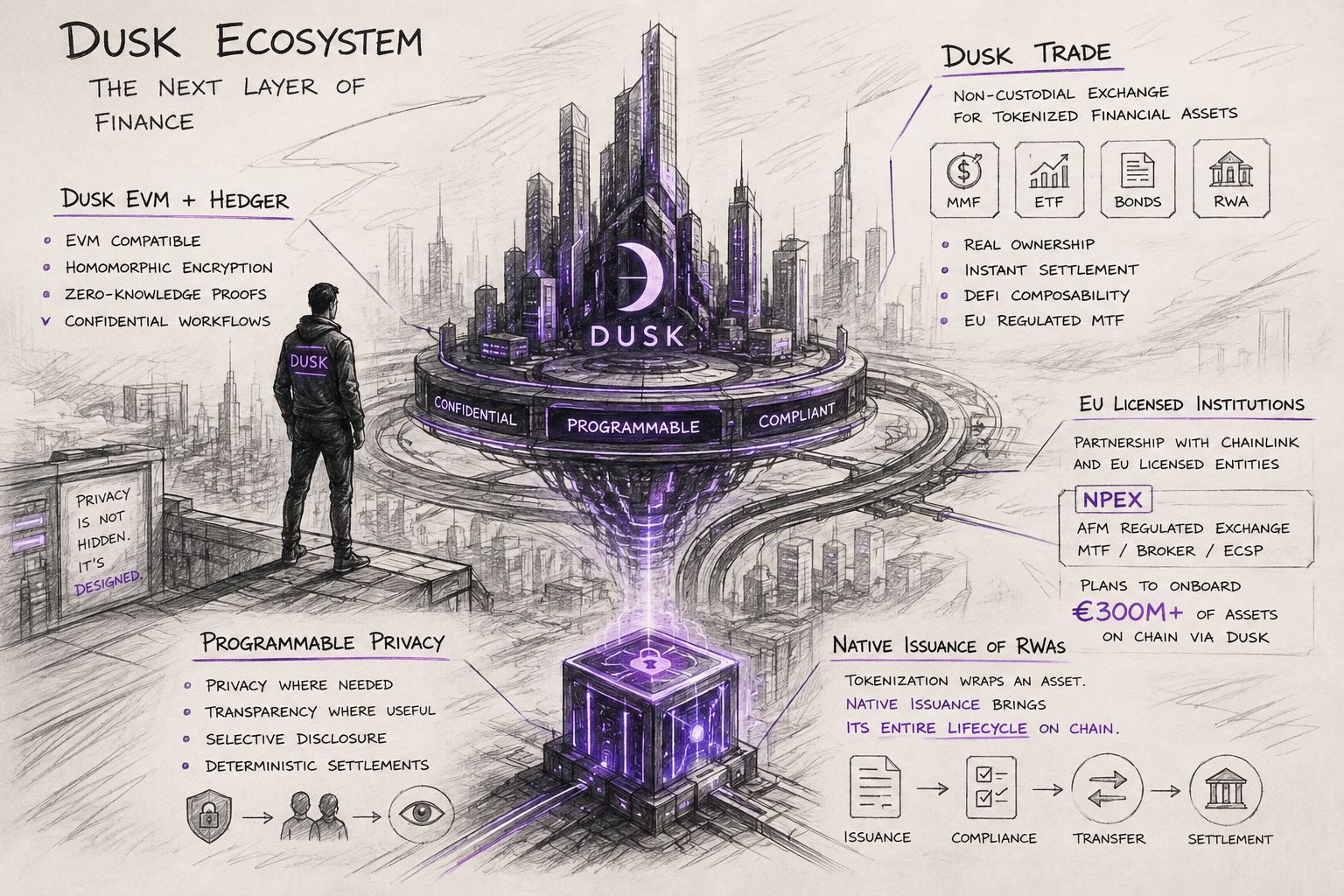
#dusk $DUSK @Dusk Subscribers. The campaign is ending. I’m sharing my thoughts based on my own observations. First, I looked at Dusk as a trader: where the liquidity is, how the assets will move, and who will be buying them.
And then I realized that the most interesting thing here isn’t in the tokens at all.
Imagine a financial asset like a car. Right now, blockchain often just slaps a new license plate on it—tokenizing an already finished product.
With Dusk, the logic is different. The idea is to build the car right on the road: issuance, checks, access rules, and handover and settlement can be part of a single environment.
DuskEVM gives developers a familiar EVM path. Hedger adds privacy through homomorphic encryption and ZK proofs. And Dusk Trade shows what all this structure is actually for—from MMFs and ETFs to bonds and RWA.
One number really gets to me: NPEX plans to bring more than €300 million worth of assets into this infrastructure. But the number by itself proves nothing.
#Dusk
For me, the real test is simpler: will traditional financial businesses want to move here not only the asset, but also their daily operational kitchen?
That’s when I wouldn’t be talking about tokenization anymore.
I’d be talking about changing the financial machine itself.
#DUSK
And then I realized that the most interesting thing here isn’t in the tokens at all.
Imagine a financial asset like a car. Right now, blockchain often just slaps a new license plate on it—tokenizing an already finished product.
With Dusk, the logic is different. The idea is to build the car right on the road: issuance, checks, access rules, and handover and settlement can be part of a single environment.
DuskEVM gives developers a familiar EVM path. Hedger adds privacy through homomorphic encryption and ZK proofs. And Dusk Trade shows what all this structure is actually for—from MMFs and ETFs to bonds and RWA.
One number really gets to me: NPEX plans to bring more than €300 million worth of assets into this infrastructure. But the number by itself proves nothing.
#Dusk
For me, the real test is simpler: will traditional financial businesses want to move here not only the asset, but also their daily operational kitchen?
That’s when I wouldn’t be talking about tokenization anymore.
I’d be talking about changing the financial machine itself.
#DUSK
·
--
🎙️ Real-time analysis of the DUSK/USDT pair: looking for an entry point!
End
01 h 14 m 56 s
829
DUSKUSDT
Perp
Market/Long
1
#dusk $DUSK @Dusk
Public blockchains force you to choose between everything being out in the open, or almost nothing being visible. For finance, I think both options are bad 🤔.But I want to stress again that this opinion is only my personal one.
Dusk does it differently. Here, privacy is not an ideology and not a way to hide somewhere. It’s just a tool, because data is closed by default. The network only sees the proofs that everything was done correctly.
And to a specific person—an auditor, a bank, a regulator—you can show exactly what they need to see. And nothing more.
Not “no one can see” and not “everyone can see.”
Just the right information to the right party. Because with real money, that’s how it works: the counterparty knows the contract terms, the regulator knows what the law requires, and the competitor does not.
That’s all the logic.
Confidentiality becomes a feature, not a compromise.🥰
Public blockchains force you to choose between everything being out in the open, or almost nothing being visible. For finance, I think both options are bad 🤔.But I want to stress again that this opinion is only my personal one.
Dusk does it differently. Here, privacy is not an ideology and not a way to hide somewhere. It’s just a tool, because data is closed by default. The network only sees the proofs that everything was done correctly.
And to a specific person—an auditor, a bank, a regulator—you can show exactly what they need to see. And nothing more.
Not “no one can see” and not “everyone can see.”
Just the right information to the right party. Because with real money, that’s how it works: the counterparty knows the contract terms, the regulator knows what the law requires, and the competitor does not.
That’s all the logic.
Confidentiality becomes a feature, not a compromise.🥰
#dusk $DUSK @Dusk
Public blockchains, as we all have noticed, have made transparency almost into a religion. In crypto, these actions are often perceived as a thrill😉 because you can see everything—no one hides anything. But when it comes to tokenized stocks, bonds, or big corporate deals, this openness starts to annoy.
We can imagine that everyone can see position sizes, who trades with whom, and where the money goes. For institutions, it’s simply a risk. Front-running, strategy leaks, and too many eyes on transactions. Regulators need reporting, not for the entire market to read your balances like a newspaper.
To our delight, Dusk is here. It isn’t another “private” project, but a network where you can keep things confidential while still proving compliance. With ZK proofs, amounts and details are hidden, and auditors or regulators can be shown only what’s necessary. And there are also transparent transactions when they’re needed.
Not every asset needs to be shown to everyone. Somewhere, transparency means strength, and elsewhere it’s just treated as unnecessary noise.
Dusk seems to be trying to find this balance for normal finance.
Public blockchains, as we all have noticed, have made transparency almost into a religion. In crypto, these actions are often perceived as a thrill😉 because you can see everything—no one hides anything. But when it comes to tokenized stocks, bonds, or big corporate deals, this openness starts to annoy.
We can imagine that everyone can see position sizes, who trades with whom, and where the money goes. For institutions, it’s simply a risk. Front-running, strategy leaks, and too many eyes on transactions. Regulators need reporting, not for the entire market to read your balances like a newspaper.
To our delight, Dusk is here. It isn’t another “private” project, but a network where you can keep things confidential while still proving compliance. With ZK proofs, amounts and details are hidden, and auditors or regulators can be shown only what’s necessary. And there are also transparent transactions when they’re needed.
Not every asset needs to be shown to everyone. Somewhere, transparency means strength, and elsewhere it’s just treated as unnecessary noise.
Dusk seems to be trying to find this balance for normal finance.
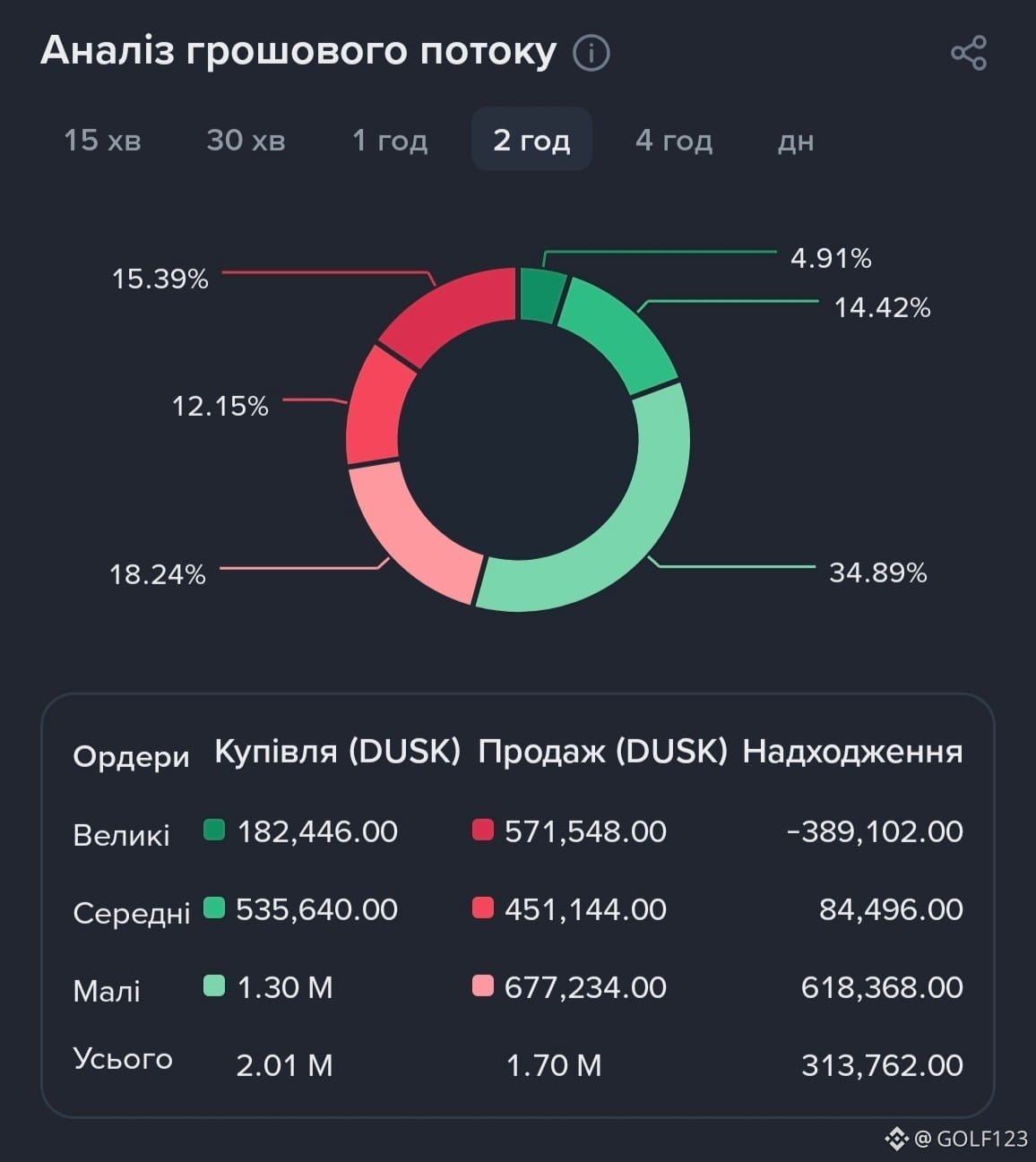
🏌️⛳ welcome 🤗
GOLF123
·
--
[Replay] 🎙️ Trade Together on Binance Live: What to Do with DUSK? Buy or Lock In?
01 h 21 m 15 s · 510 listens
·
--
🎙️ Trade Together on Binance Live: What to Do with DUSK? Buy or Lock In?
End
01 h 21 m 15 s
510
DUSKUSDT
Perp
Limit/Long
2
Verified
Traditional compliance relies on intermediaries. The bank checked you, the broker monitors you, the exchange blocks it—so everything works. I’m not surprised, but in open Web3 this setup simply doesn’t exist. I sometimes get stuck too, because in Web3 we removed intermediaries, but apparently we also removed the usual way of verification.
An address isn’t a person. Anyone can come in. The transaction has already gone through, and you can’t reverse it that easily. Adding KYC on top—then you end up with either centralization or loopholes.
Rules remain a statement.
When compliance becomes part of the chain itself, the picture changes. Eligibility checks and transfer restrictions can be a condition of validity.
Once you’ve confirmed your status, you keep working within the rules—without constant manual checks.
Dusk was built for exactly that. Not as just another “private” chain, but as infrastructure where you can program rules for regulated assets.
Citadel provides identity and selective disclosure, settlement is deterministic, and the connection to NPEX adds a real regulatory framework.
Not perfect and not for every case, but it’s no longer an external patch.😉😉😉@Dusk #dusk $DUSK
An address isn’t a person. Anyone can come in. The transaction has already gone through, and you can’t reverse it that easily. Adding KYC on top—then you end up with either centralization or loopholes.
Rules remain a statement.
When compliance becomes part of the chain itself, the picture changes. Eligibility checks and transfer restrictions can be a condition of validity.
Once you’ve confirmed your status, you keep working within the rules—without constant manual checks.
Dusk was built for exactly that. Not as just another “private” chain, but as infrastructure where you can program rules for regulated assets.
Citadel provides identity and selective disclosure, settlement is deterministic, and the connection to NPEX adds a real regulatory framework.
Not perfect and not for every case, but it’s no longer an external patch.😉😉😉@Dusk #dusk $DUSK
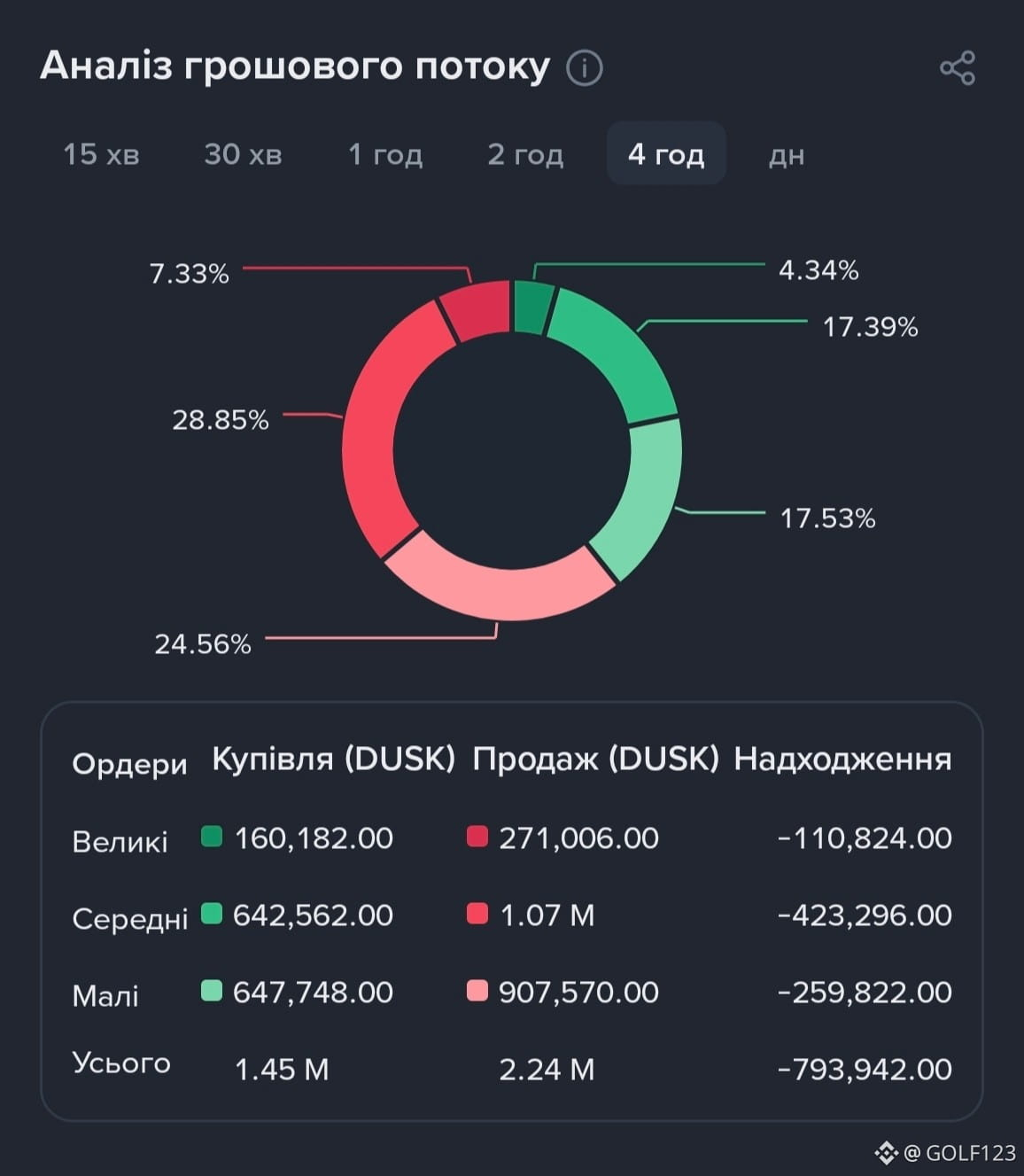
🏌️⛳ Welcome 🏌️⛳
GOLF123
·
--
[Replay] 🎙️ What’s happening with DUSK? 📈 Price forecast and strategies for today
01 h 24 m 58 s · 422 listens
·
--
🎙️ What’s happening with DUSK? 📈 Price forecast and strategies for today
End
01 h 24 m 58 s
422
DUSKUSDT
Perp
Limit/Long
1
Funds and banks do not look at tweets or TVL. Because, as one of my acquaintances told me, they need to understand whether it’s possible to issue regulated instruments here, not to expose competitors’ positions, and at the same time not to violate GDPR or MiCA. Most public chains fail specifically at this point—everything is visible here to everyone.
At Dusk, things are done differently, and we’ve already proven that. Because Privacy and compliance live together through zero-knowledge.
You can keep agreements private, but still provide what the regulator needs to see. Plus, deterministic settlement—this is already quite serious for the market.
And partnering with NPEX adds a real regulatory anchor, not just marketing.
Tokenizing something is very easy. Building a full-fledged market infrastructure where everything works by the rules—completely different conversation. When discussing this project topic with my acquaintance, the further we went, the more interesting things we found, and I was simply delighted with such communication because I found a lot of useful information for myself.@Dusk #dusk $DUSK
At Dusk, things are done differently, and we’ve already proven that. Because Privacy and compliance live together through zero-knowledge.
You can keep agreements private, but still provide what the regulator needs to see. Plus, deterministic settlement—this is already quite serious for the market.
And partnering with NPEX adds a real regulatory anchor, not just marketing.
Tokenizing something is very easy. Building a full-fledged market infrastructure where everything works by the rules—completely different conversation. When discussing this project topic with my acquaintance, the further we went, the more interesting things we found, and I was simply delighted with such communication because I found a lot of useful information for myself.@Dusk #dusk $DUSK
❤️❤️❤️✅ Welcome 🤗
GOLF123
·
--
[Replay] 🎙️ 🔴 DUSK at the bottom or the time to buy? DUSK/USD token breakdown
01 h 27 m 38 s · 1.3k listens
·
--
🎙️ 🔴 DUSK at the bottom or the time to buy? DUSK/USD token breakdown
End
01 h 27 m 38 s
1.3k
DUSKUSDT
Perp
Market/Long
1
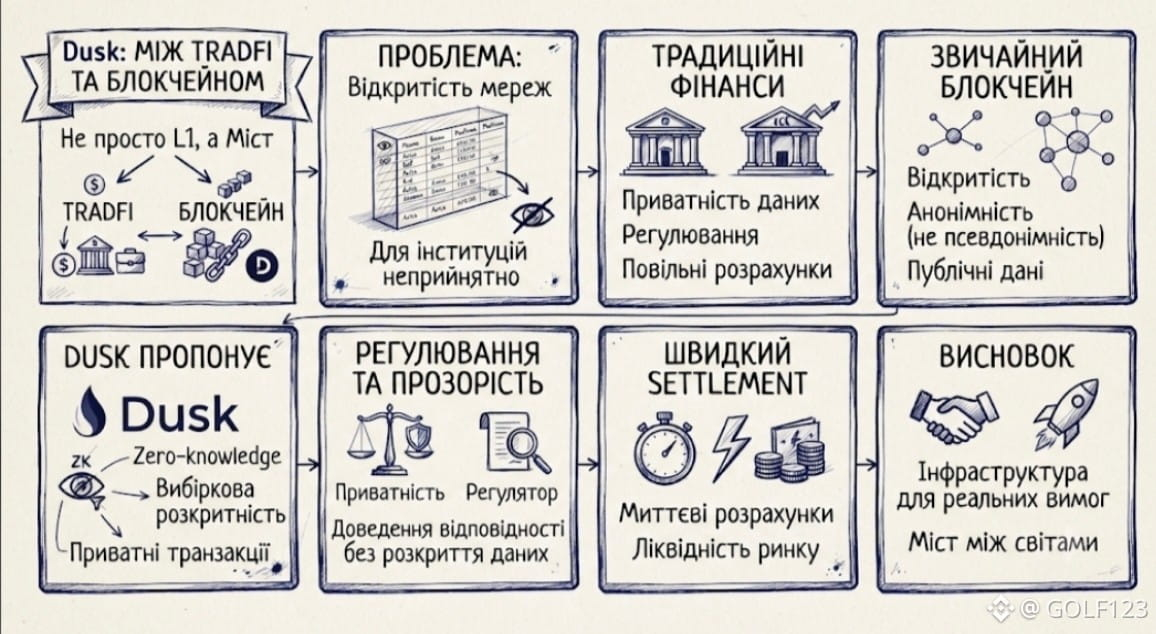
Dusk is often confused with yet another L1. We discussed this with friends yesterday. I told them it’s pointless to compare it.
Because that’s probably what it is in reality: rather an attempt to build a bridge. Between what already exists in traditional finance and what blockchain provides.
From my own experience, I know that in ordinary networks everything is open: balances, positions, who trades with whom—and it’s visible to everyone.
For institutions, however, it’s almost always unacceptable. That’s why they stay on the sidelines.
Dusk offers something completely different. We can keep our data private, but at the same time prove to the regulator that everything is clean. Zero-knowledge, selective disclosure, different transaction models.
And fast settlement, without which the market doesn’t work.
Not an ideal story, of course, and I’ll be honest. At least someone is finally building infrastructure for real requirements—not just for hype. We discussed this topic with friends for quite a long time, and there’s a lot of interesting things to be learned about this project.@Dusk #dusk $DUSK
Because that’s probably what it is in reality: rather an attempt to build a bridge. Between what already exists in traditional finance and what blockchain provides.
From my own experience, I know that in ordinary networks everything is open: balances, positions, who trades with whom—and it’s visible to everyone.
For institutions, however, it’s almost always unacceptable. That’s why they stay on the sidelines.
Dusk offers something completely different. We can keep our data private, but at the same time prove to the regulator that everything is clean. Zero-knowledge, selective disclosure, different transaction models.
And fast settlement, without which the market doesn’t work.
Not an ideal story, of course, and I’ll be honest. At least someone is finally building infrastructure for real requirements—not just for hype. We discussed this topic with friends for quite a long time, and there’s a lot of interesting things to be learned about this project.@Dusk #dusk $DUSK
🧧❤️🎁💕💕 Welcome 💸💸💸
GOLF123
·
--
[Replay] 🎙️ Catching up: DUSK trading scenarios, levels and risks for today
01 h 27 m 40 s · 1.1k listens
·
--
🎙️ Catching up: DUSK trading scenarios, levels and risks for today
End
01 h 27 m 40 s
1.1k
DUSKUSDT
Perp
Market/Long
2
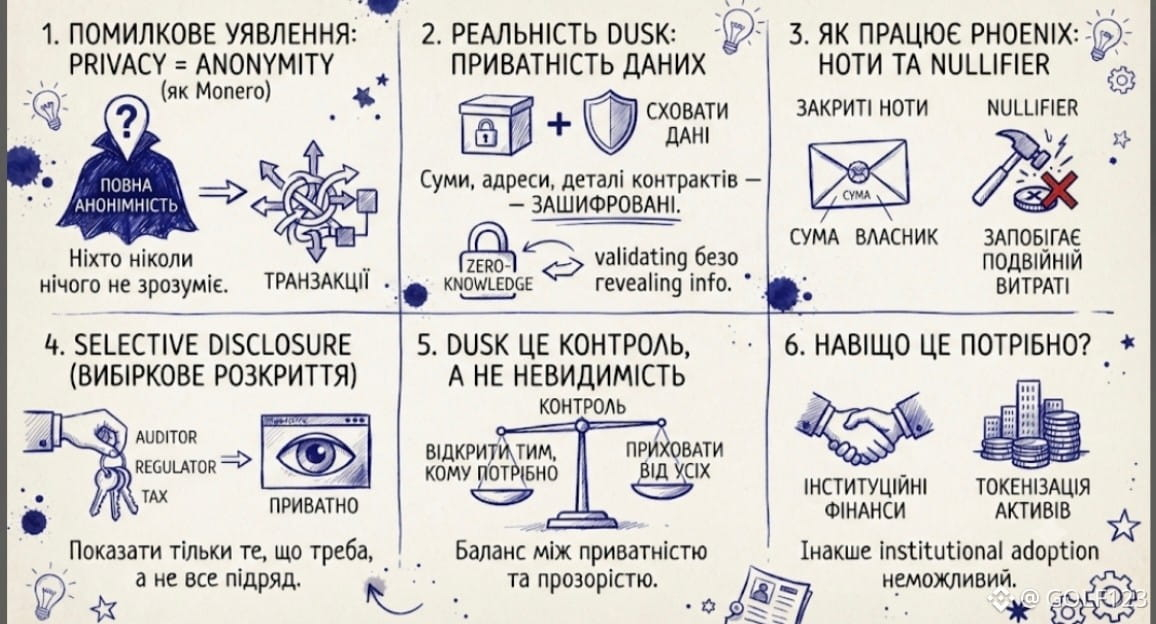
A few days ago I was talking with acquaintances and I told them they’re getting this mixed up. They say “private blockchain” and immediately think it’s complete anonymity. Like Monero. No one will ever understand anything. With Dusk it’s not like that, I told them.
So here, the more important thing is to hide the actual data: amounts, who sent what to whom, what exactly is in the contract. The network still checks that everything is fair and there’s no double spending; the funds are there, and the rules are followed. It just does it through zero-knowledge, not through a public ledger.
That’s how Phoenix works. Notes are closed. The nullifier prevents spending twice. But who exactly stands behind an address—that’s a completely different story. You can do selective disclosure: show the auditor or regulator only what they need. Not everything, just as required.
Privacy here is so it doesn’t turn into “make it invisible forever.” That is, there’s control: what to hide from everyone and what to reveal to those who actually need it, because otherwise institutional funding and asset tokenization simply won’t work.
That’s basically the whole difference—I explained all of this to my acquaintances after yesterday, when we were discussing this project topic #dusk @Dusk $DUSK
So here, the more important thing is to hide the actual data: amounts, who sent what to whom, what exactly is in the contract. The network still checks that everything is fair and there’s no double spending; the funds are there, and the rules are followed. It just does it through zero-knowledge, not through a public ledger.
That’s how Phoenix works. Notes are closed. The nullifier prevents spending twice. But who exactly stands behind an address—that’s a completely different story. You can do selective disclosure: show the auditor or regulator only what they need. Not everything, just as required.
Privacy here is so it doesn’t turn into “make it invisible forever.” That is, there’s control: what to hide from everyone and what to reveal to those who actually need it, because otherwise institutional funding and asset tokenization simply won’t work.
That’s basically the whole difference—I explained all of this to my acquaintances after yesterday, when we were discussing this project topic #dusk @Dusk $DUSK
#termmax @TermMax
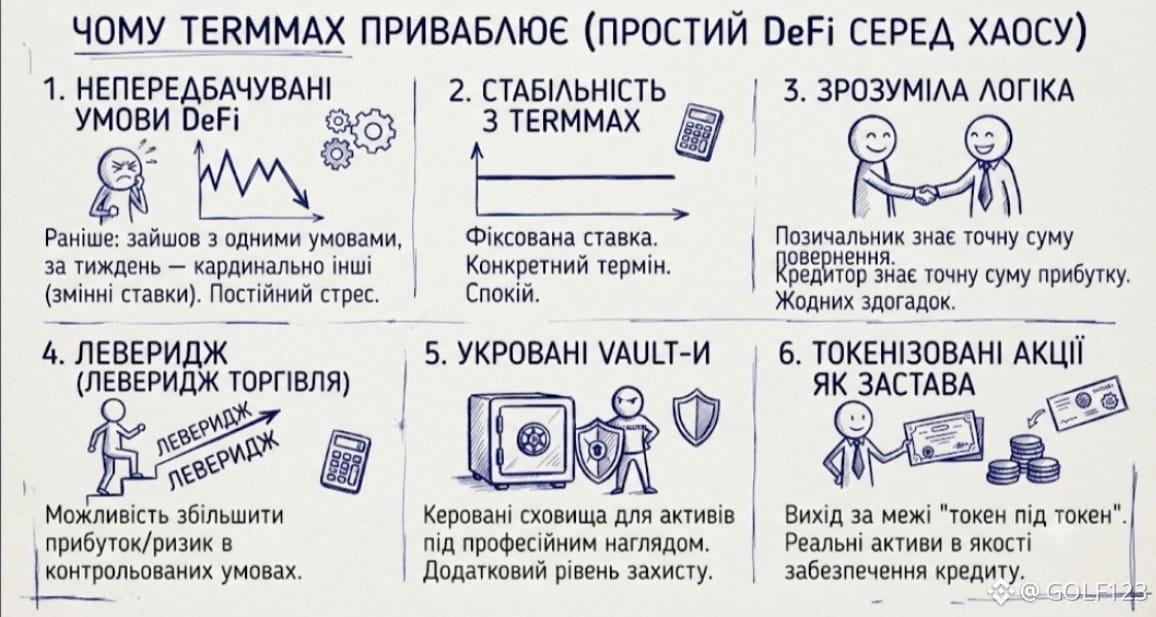
The more I look at DeFi, the more one simple thing annoys me: you can open a position with certain terms, and after a few weeks you get a completely different picture.😠
That’s exactly why TermMax interests me. The logic here is much calmer because there’s a specific term and a fixed rate.
Borrowers can understand in advance how much they’ll pay back, while lenders know how much they’ll receive. No need to constantly guess, like reading coffee grounds))), where the rate might go tomorrow.
There’s also leverage, vaults with curators, and the ability to use tokenized shares as collateral. And the last point especially fascinates me, because DeFi is gradually starting to move beyond the usual “token-on-token” model.
I won’t say that this automatically makes the system safe, because risks don’t just disappear. But I really like the idea of predictability. If DeFi wants to become a place not only for traders, but also for capital that comes for months or years, it will be hard without it.
Maybe this is exactly the kind of simple, clear things DeFi has been lacking.
The more I look at DeFi, the more one simple thing annoys me: you can open a position with certain terms, and after a few weeks you get a completely different picture.😠
That’s exactly why TermMax interests me. The logic here is much calmer because there’s a specific term and a fixed rate.
Borrowers can understand in advance how much they’ll pay back, while lenders know how much they’ll receive. No need to constantly guess, like reading coffee grounds))), where the rate might go tomorrow.
There’s also leverage, vaults with curators, and the ability to use tokenized shares as collateral. And the last point especially fascinates me, because DeFi is gradually starting to move beyond the usual “token-on-token” model.
I won’t say that this automatically makes the system safe, because risks don’t just disappear. But I really like the idea of predictability. If DeFi wants to become a place not only for traders, but also for capital that comes for months or years, it will be hard without it.
Maybe this is exactly the kind of simple, clear things DeFi has been lacking.
Log in to explore more content