
CTSI官方中文社区
480 Posts

CTSI官方中文社区
 Square Verified+
Report
Block User
任何代码:以太坊的安全性。(Any code: Ethereum’s security.)使用您熟悉和喜爱的语言、库和工具构建应用链 Rollups。(Build appchain rollups with languages, libraries, and tool)
12 Following
935 Followers
3.9K+ Liked
1 Badges
Posts
All
Quotes
Videos
PINNED
·
--

Article
Erick de Moura (Cartesi): “Blockchain development is hard, it is our responsibility to make it easier.In an opinion piece, Erick, co-founder of Cartesi, believes that the industry needs to collaborate more to make the work of blockchain developers easier. Cartesi is a second-layer protocol based on Ethereum that is committed to simplifying blockchain development and promoting the development of modular blockchain infrastructure.
The blockchain industry is at a critical inflection point. Web3 lacks consumer applications that can achieve mass adoption, but new infrastructure projects continue to emerge. We have to face an unpleasant reality: 15 years later, our dream of a decentralized web has not yet been realized.
Erick de Moura (Cartesi): “Blockchain development is hard, it is our responsibility to make it easier.
In an opinion piece, Erick, co-founder of Cartesi, believes that the industry needs to collaborate more to make the work of blockchain developers easier. Cartesi is a second-layer protocol based on Ethereum that is committed to simplifying blockchain development and promoting the development of modular blockchain infrastructure.
The blockchain industry is at a critical inflection point. Web3 lacks consumer applications that can achieve mass adoption, but new infrastructure projects continue to emerge. We have to face an unpleasant reality: 15 years later, our dream of a decentralized web has not yet been realized.
The blockchain industry is at a critical inflection point. Web3 lacks consumer applications that can achieve mass adoption, but new infrastructure projects continue to emerge. We have to face an unpleasant reality: 15 years later, our dream of a decentralized web has not yet been realized.
1
4
453
·
--
Cartesi October Ecosystem Roundup
https://mp.weixin.qq.com/s/OLCTM6ALBPKvnQIyt48ZKA
Cartesi October Ecosystem Roundup
https://mp.weixin.qq.com/s/OLCTM6ALBPKvnQIyt48ZKA
https://mp.weixin.qq.com/s/OLCTM6ALBPKvnQIyt48ZKA
1
143
·
--
October was packed with noteworthy developments: with staking rewards set to end around July 2027, the community is being consulted on the $CTSI MinterRole; new versions of Node, CLI, Sequencer, and Machine were also released, along with the Q3 Engineering Report, Foundation support for the Knoss project, and more.
All substance, no gimmicks ↓
https://blog.cartesi.io/ecosystem-updates-october-2026/
Repost: https://x.com/cartesiproject/status/2116530380279062938
All substance, no gimmicks ↓
https://blog.cartesi.io/ecosystem-updates-october-2026/
Repost: https://x.com/cartesiproject/status/2116530380279062938
228
·
--
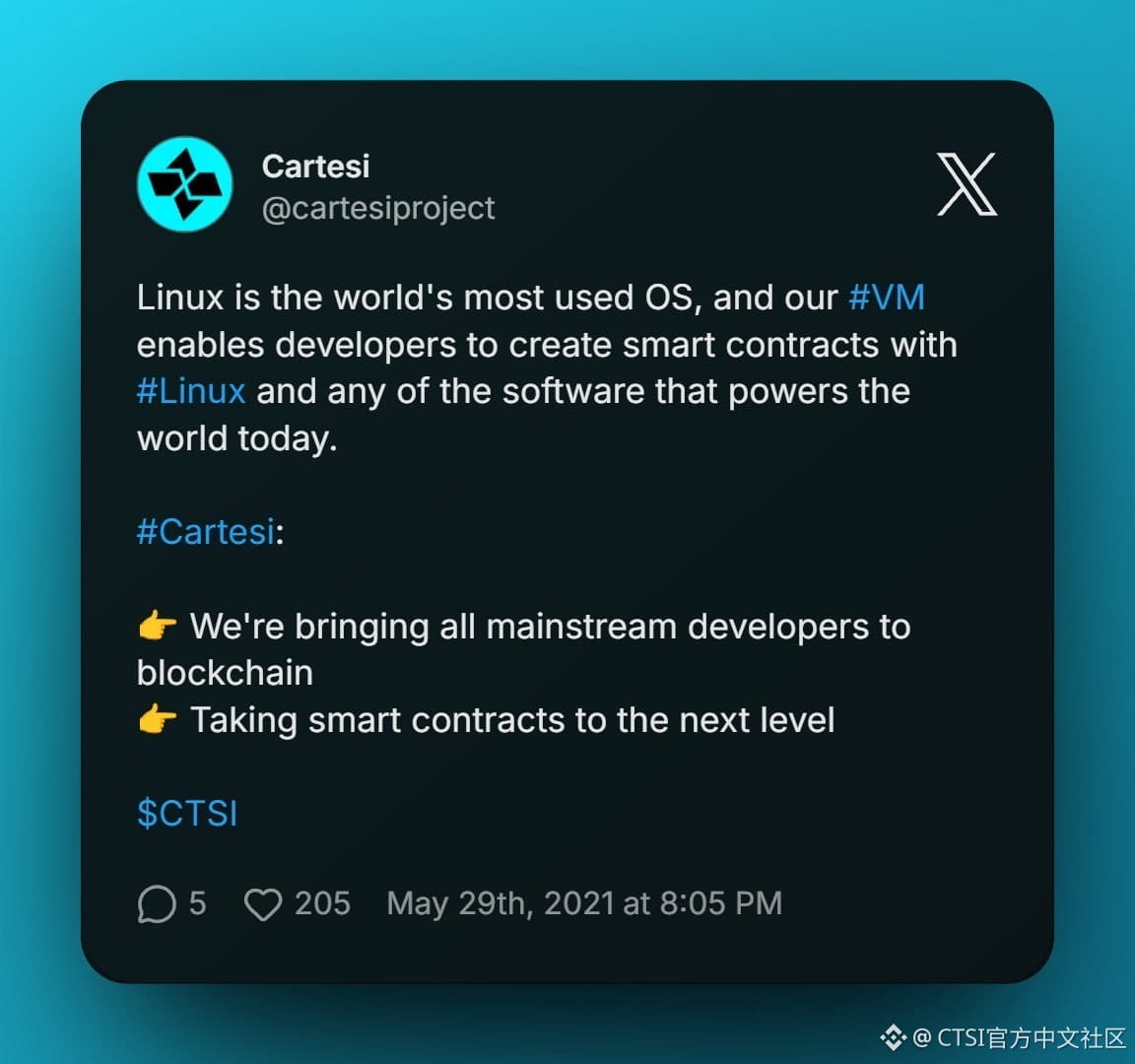
Let's revisit the simplest version of our core idea: The software powering today's world should also be able to power smart contracts.
The idea hasn't changed; we're still building ↑
Repost: https://x.com/cartesiproject/status/2115806359883264120
Let's revisit the simplest version of our core idea: The software powering today's world should also be able to power smart contracts.
The idea hasn't changed; we're still building ↑
Repost: https://x.com/cartesiproject/status/2115806359883264120
The idea hasn't changed; we're still building ↑
Repost: https://x.com/cartesiproject/status/2115806359883264120
193
·
--
Good morning. New week, same mission: any kind of code can be settled on Ethereum.
Let’s build together 🐧
Please help spread the word: https://x.com/cartesiproject/status/21147177081
Good morning. New week, same mission: any kind of code can be settled on Ethereum.
Let’s build together 🐧
Please help spread the word: https://x.com/cartesiproject/status/21147177081
Let’s build together 🐧
Please help spread the word: https://x.com/cartesiproject/status/21147177081
45
·
--
Good morning. New week, same mission: any kind of code can be settled on Ethereum.
Let’s build together 🐧
Please help spread the word: https://x.com/cartesiproject/status/21147177081
Good morning. New week, same mission: any kind of code can be settled on Ethereum.
Let’s build together 🐧
Please help spread the word: https://x.com/cartesiproject/status/21147177081
Let’s build together 🐧
Please help spread the word: https://x.com/cartesiproject/status/21147177081
1
157
·
--
Friday is here again, and the Cartesi weekly roundup is right on time 🐧
Our PRT (fraud-proof system) development has made progress, and Dave v3.0.0-alpha.6 is now available. When an honest participant wins a sub-dispute, their timer is now automatically replenished, up to a cap. This means attackers can no longer exhaust the timer for a correct claim by flooding the system with fake identities. This release also fixes issues found in the latest PRT verification review and is compatible with Cartesi Machine v0.22. Thanks to Gabriel Coutinho de Paula for his contributions:
→ https://github.com/cartesi/dave/releases/tag/v3.0.0-alpha.6
On the staking front, Explorer v3.13.0 is now live. This release introduces a new wallet library and adds transaction receipts for users who access Explorer as a “Safe App” (Gnosis Safe app)—especially useful if your staked assets are held in a multisig wallet. Thanks to Bruno Menezes:
→ https://github.com/cartesi/explorer/releases/tag/v3.13.0
No time to read the full Q3 engineering report? This concise thread recaps 130 pull requests (PRs), 673 commits, and 58 releases across 13 repositories, organized around three technical pillars. Two highlights: the emergency withdrawal flow now has its final piece with “deposit returns”; and Cartesi Machine v0.21.0 ensures every input eventually produces a verifiable result, even if the application crashes. Check out the summary:
→ https://x.com/cartesiproject/status/2112530070510383323
It’s Open Access Week. Research should be freely readable, shareable, and buildable upon—and so should code. Cartesi is open source, brings Linux onchain, and settles on Ethereum, so anyone can independently verify computation.
→ https://x.com/cartesiproject/status/2112167301844009259
There was also some discussion on social media this week. If your tech stack can’t run Linux onchain, it might not be the right choice:
→ https://x.com/cartesiproject/status/2112891152445894867
And a reminder: don’t limit yourself to the L1 EVM model, where every application shares the same block’s computational resources. Make the switch to Cartesi—it offers orders of magnitude more computational power, a full Linux tech stack, and a dedicated virtual machine (VM) for every application:
→ https://x.com/cartesiproject/status/2113254324134678943
That’s all for this week’s roundup. Are you building with Linux onchain, or just stopping by to say hello? Come find us on Discord: discord.gg/cartesi. Have a great weekend!
Repost: https://x.com/cartesiproject/status/2113617454836683141
346
·
--
Stop designing around that “dot.” It’s that simple.
Why can’t most DeFi projects deliver real innovation? That “yellow dot” represents the computational limit of an L1 EVM block. It forces developers to squeeze their logic into a single block, resulting in financial apps with limited functionality.
The “blue grid,” on the other hand, is the Cartesi VM, which offers several orders of magnitude more computing power.
Once you see the gap, you can’t ignore this limitation anymore.
Repost: https://x.com/cartesiproject/status/2113254324134678943
1
1
301
·
--
If your tech stack doesn’t support running Linux environments on-chain, it’s not the ideal choice. 🐧
https://x.com/NewAgeRetroNerd/status/2110402168272355555
No need to rewrite code from scratch or compromise on your choice of libraries. With Cartesi, we’ve brought a complete Linux runtime environment directly to Ethereum and the Web3 ecosystem. If it runs on Linux, it can run on-chain.
Help spread the word: https://x.com/cartesiproject/status/2112891152445894867
90
·
--
Want to see the condensed version of our Q3 engineering report? Across 13 repositories, with 130 merged PRs (pull requests), 673 commits, and 58 releases, what did we actually ship? And what’s the current state of the entire tech stack?
https://x.com/cartesiproject/status/2111808242502254714
The answers are here. Below is a summary across our three technological pillars 🧵↓
Secure infrastructure for real funds
Deposit refunds complete the final step in the emergency withdrawal process. Once an application is foreclosed, anyone can return unfinalized ETH, ERC-20, ERC-721, and ERC-1155 deposits to their original depositors.
The Claims mechanism has also become stricter. Now, every claim must prove that its corresponding machine completed the current epoch successfully. If a machine is halted, throws an exception, or rejects its final input, that state cannot be finalized.
Dave (PRT) introduces claim staging and improves the deposit recovery process, making it harder to manipulate maliciously. Sling Node is now the first PRT validator node that can be run, and is currently in testing as it nears the end of its Alpha phase.
Making computation at scale economically viable
Cartesi Machine v0.21.0 ensures that every input produces a provable result—even if the application crashes. Rejected inputs roll the system back to its previous state, while inputs that exhaust the cycle budget leave it in a fixed state. The emulator and on-chain execution follow exactly the same rules.
Applications can now preserve state across multiple inputs using NVRAM (non-volatile random-access memory), reducing the cost of passing state between inputs.
The sequencer introduces a fee oracle that ties user fees to L1 publication costs. The oracle sets prices based on Uniswap V3’s time-weighted average price (TWAP), aiming to limit price manipulation. Next up: launching on testnet.
A developer-friendly tech stack for fast onboarding
The Rollup Node has upgraded to emulator v0.21 on its dev branch. This version adds JSON-RPC batch requests, brings all services under a single supervisor, and provides clear health signals for Kubernetes. The TypeScript library now uses auto-generated bindings, replacing around 1,800 lines of hand-written wrapper code. In addition, `cartesi/machine` supports running the Cartesi Machine in Node.js, and even directly in a browser tab.
Next, we’ll coordinate the release of Node, SDK, CLI, and Explorer tools to make these features available to developers.
For a deeper look at the bigger picture behind these core components, see our Technical Plan:
https://cartesi.io/technical-plan/
Reposted from: https://x.com/cartesiproject/status/2112530070510383323
361
·
--
Good morning. It’s International Open Access Week. Research, academic papers, and knowledge should be freely accessible to read, share, and build upon.
The same goes for code. Cartesi embraces open source, bringing Linux on-chain and settling through Ethereum, so anyone can verify its execution.
This principle applies not just this week, but every week.
Let’s spread the word: https://x.com/cartesiproject/status/21121673018
The same goes for code. Cartesi embraces open source, bringing Linux on-chain and settling through Ethereum, so anyone can verify its execution.
This principle applies not just this week, but every week.
Let’s spread the word: https://x.com/cartesiproject/status/21121673018
112
·
--
Cartesi Engineering Report: Third Quarter 2026
https://mp.weixin.qq.com/s/_3pnuX7H80QbYBqiGxMivA
Cartesi Engineering Report: Third Quarter 2026
https://mp.weixin.qq.com/s/_3pnuX7H80QbYBqiGxMivA
https://mp.weixin.qq.com/s/_3pnuX7H80QbYBqiGxMivA
135
·
--
As the SDK continues to mature, we’re introducing a new way to track Cartesi’s progress: the “Quarterly Engineering Report.” It covers our technical workstreams, achievements, and key milestones.
130 PRs (pull requests) merged, 673 commits, and 58 releases.
Explore the full details for Q3 2026 ↓
https://blog.cartesi.io/engineering-report-q3-2026/
For an overview of Cartesi’s technical priorities, check out our “Technical Evolution Plan” and the three core pillars guiding our roadmap:
→ Build secure infrastructure for real money
→ Enable large-scale, cost-effective computation
→ Deliver an accessible tech stack that lets you deploy on-chain in a day
🔗 cartesi.io/technical-evolution-plan
Reposted from: https://x.com/cartesiproject/status/2110717673915253174
1
318
·
--
A first deep dive into the Cartesi sequencer! Let’s break down what it is, why it matters, and how it works. 🧵↓
https://fxtwitter.com/cartesiproject/status/2109993133866119399
1/ Interactive applications need speed, while Ethereum settlement takes time. Nobody wants to wait several minutes for L1 (Layer 1) finality after every click. That’s where sequencers come in.
2/ The sequencer receives users’ signed operations and confirms them immediately (a “soft confirmation”).
In the background, it submits these operations to L1 in batches. Users get near-instant responses, while Ethereum remains authoritative as the “source of truth.”
Full details about our sequencer: https://github.com/cartesi/sequencer
3/ How does it work under the hood? Each group of user operations (called a “frame”) points to a secure L1 block. The on-chain scheduler receives all deposits up to that block, then executes the same operations in the same order.
The sequencer and the Rollup follow the same rules, so they ultimately reach the same state.
4/ Although the system uses a single sequencer, it can’t steal funds or forge state. The Rollup checks everything and enforces the results through fraud proofs.
The deposit process bypasses the sequencer entirely. Even if the sequencer tries to censor deposits, at most it can delay them by a few hours—it can never block them completely.
5/ The Cartesi sequencer is still in Alpha, but development is moving quickly.
It’s designed to handle L1 interruptions, crashes, restarts, extended downtime, and malicious mempools. Each time it starts, it checks the database and Ethereum to determine what needs to be repaired.
There’s also an independent “watchdog” program that double-checks its state.
6/ The latest release, v0.1.0-alpha.10, includes the sequencer, machine images, and the watchdog program.
New features include public fee quotes, replayable application history, C application bindings, a rewritten watchdog, and Cartesi Machine v0.21.0. Note: This release includes breaking changes. Please read the notes first: https://github.com/cartesi/sequencer/releases/tag/v0.1.0-alpha.10
Repost: https://x.com/cartesiproject/status/2109993133866119399
223
·
--
GM. Can your code or library already run on Linux? Then it can run on-chain, too. The same tools, Cartesi infrastructure, Ethereum-grade security.
A new week is here—a great time to ship. Who’s ready to start building?
Repost: https://x.com/cartesiproject/status/2109629181785145347
GM. Can your code or library already run on Linux? Then it can run on-chain, too. The same tools, Cartesi infrastructure, Ethereum-grade security.
A new week is here—a great time to ship. Who’s ready to start building?
Repost: https://x.com/cartesiproject/status/2109629181785145347
A new week is here—a great time to ship. Who’s ready to start building?
Repost: https://x.com/cartesiproject/status/2109629181785145347
177
·
--
Friday is here, and Cartesi Weekly is back as promised. This week’s edition includes three releases and a new DeFi build 🐧
https://fxtwitter.com/cartesiproject/status/2108542771804221518
Rollups Node v2.0.0-alpha.13 is now available, with “deposit refunds” as its headline feature. If an application is foreclosed before a deposit reaches consensus, a new refund instruction returns the funds to the original depositor, ensuring users don’t lose control of their funds if an application stops running.
This release also brings the staged settlement mechanism from our fraud-proof system (PRT) to the node, upgrades to Cartesi Machine Emulator v0.21.0, and adds compatibility with the latest Rollups Contracts 3.0.0-alpha.10 and PRT 3.0.0-alpha.5.
This release is for testing only and requires a fresh database and application redeployment, so be sure to read the upgrade notes first:
→ https://github.com/cartesi/rollups-node/releases/tag/v2.0.0-alpha.13
Cartesi CLI 2.0.0-alpha.38, aimed at core developers and testers, is also out. A new command lets you foreclose an application on devnet and reclaim its funds, enabling end-to-end testing of the entire emergency withdrawal flow. Explorer and rollups-ts have also been updated to keep the toolchain in sync.
Head over to Discord for installation instructions, and check out the changelog on GitHub:
→ https://github.com/cartesi/cli/releases/tag/%40cartesi%2Fcli%402.0.0-alpha.38
There’s more: Sequencer v0.1.0-alpha.10 was also released this week. We’ll share more about it soon, but here’s a first look:
→ https://github.com/cartesi/sequencer/releases/tag/v0.1.0-alpha.10
This is exactly what Felipe Argento and Brandon Isaacson had in mind when they stepped down from their roles on the Cartesi Foundation’s board to build applications using this technology stack that can truly unlock its potential.
Knoss is a trading platform focused on options and perpetuals. In our thread, we unpacked why onchain options markets have struggled to take off: the math behind options is difficult to run in a trustless environment, so developers often opt for simplified models and overcollateralization. Knoss, however, will use Cartesi to run these calculations on Ethereum, making the results both reproducible and verifiable. Read the thread to learn more:
→ https://x.com/cartesiproject/status/2107456174664941570
Everyone on X has been writing open letters this week, so we joined in. While the trend is fun, it represents a genuine strategic shift for Cartesi:
→ https://x.com/cartesiproject/status/2107826707432632797
If you missed it, here’s an in-depth article about the next phase of Cartesi’s development:
→ https://x.com/cartesiproject/status/2105643993640136999
Our Monday greeting (gm) celebrated builders, Knoss, and Linux—all of which can thrive on Cartesi Rollups:
→ https://x.com/cartesiproject/status/2107092443258867919
If you haven’t checked out our new website—or didn’t even know it had been updated—take a look here:
→ https://cartesi.io/
That’s all for this week! With Token2049 wrapped up, we can refocus on building. If you have any questions, feel free to chat with us on Discord: https://discord.gg/cartesi
Have a great weekend!
Repost: https://x.com/cartesiproject/status/2108542771804221518
1
351
·
--
Unchanged at the start. May the vision always remain clear and definite.
Empower expression with Linux, achieve scalability with application chains (Appchains), ensure security with Ethereum, and let Cartesi serve as the infrastructure to organically bring it all together.
Repost: https://x.com/cartesiproject/status/2108179607308620022
Empower expression with Linux, achieve scalability with application chains (Appchains), ensure security with Ethereum, and let Cartesi serve as the infrastructure to organically bring it all together.
Repost: https://x.com/cartesiproject/status/2108179607308620022
463
·
--
Cartesi Ecosystem Update #9 (2026)
https://mp.weixin.qq.com/s/xXbKTFHlsLoW7LDU7Z9mkA
Cartesi Ecosystem Update #9 (2026)
https://mp.weixin.qq.com/s/xXbKTFHlsLoW7LDU7Z9mkA
https://mp.weixin.qq.com/s/xXbKTFHlsLoW7LDU7Z9mkA
638
·
--
Deep Dive: Knoss co-founder Felipe Argento takes an in-depth look at why building options products in DeFi remains so challenging.
For years, whenever friends asked what he thought about crypto, his answer was always the same: “ETH either goes to a million or goes to zero.”
The problem is, there’s no trustless way to bet on that outcome onchain. 🧵↓
1/ Holding spot ETH covers the “goes to a million” scenario; going short covers the “goes to zero” scenario; perpetuals (Perps) add one-way leverage. But none of these cover the “or” (that is, volatility in either direction).
Options can. Buy a call and a put with the same strike price, and you can profit whether ETH’s price surges or plunges. Conversely, sell this pair of options, and you can earn a return as long as the price doesn’t move much.
2/ In traditional finance (TradFi), options trading volume is about three times that of futures. But onchain, options trading is negligible because the underlying math is difficult to implement in a trustless way: it involves complex calculations like implied volatility, volatility surfaces, and portfolio margin.
As a result, developers either simplify the math and require extremely high overcollateralization, or run the calculations on centralized servers that users have to trust.
3/ Now, Knoss will run these calculations on Cartesi, ensuring that every step can be reproduced and verified on Ethereum. Users get high capital efficiency without the opacity of a “black box.”
This is an options and perpetuals trading platform built in an “Ethereum-native” way. Follow Knoss and learn more here: https://x.com/knoss_xyz/status/2105638543477399621
Repost: https://x.com/cartesiproject/status/2107456162002260196
440
·
--
Say hello to the developers
Say hello to Knoss
Say hello to Linux 🐧
Greetings from Cartesi Rollups—the on-chain home base for all three!
Feel free to repost and share: https://x.com/cartesiproject/status/2107092443258867919
Say hello to the developers
Say hello to Knoss
Say hello to Linux 🐧
Greetings from Cartesi Rollups—the on-chain home base for all three!
Feel free to repost and share: https://x.com/cartesiproject/status/2107092443258867919
Say hello to Knoss
Say hello to Linux 🐧
Greetings from Cartesi Rollups—the on-chain home base for all three!
Feel free to repost and share: https://x.com/cartesiproject/status/2107092443258867919
253
Log in to explore more content
Join global crypto users on Binance Square
⚡️ Get latest and useful information about crypto.
💬 Trusted by the world’s largest crypto exchange.
👍 Discover real insights from verified creators.
Email / Phone number
Trending Topics
BinanceIncidentReport
64,626 views
710 Discussing
29 October 2026 Binance Security Incident: Initial Findings and Response Update
Binance Blog
·357 Likes
·1.1M views
BinanceReopensWithdrawalsForMoreAssets
190,257 views
1,873 Discussing
BinanceHourlyDepositsExceedWithdrawals
88,774 views
883 Discussing