



Content
Introduction
What is a bear market
Examples of a bear market
Difference between bull and bear markets
How to trade in a bear market
Summary
Introduction
Movement in financial markets is characterized by trends. Understanding the differences between trends is important for making more informed investment decisions. Why? Different market trends lead to completely different market conditions. Without understanding which trend prevails in the market, it is impossible to adapt to its changing conditions.
A market trend is the general direction of market movement. During a bear market, prices tend to decline. During a bearish trend, it is difficult to trade or invest, especially for beginners.
Most crypto traders and technical analysts agree that Bitcoin has been in a macro bullish trend throughout its existence. Despite this, there were also clearly bearish trends. As a rule, they lead to a decrease in the price of Bitcoin by more than 80%, while altcoins can easily fall by more than 90%. How to react to such changes?
In this article, we will discuss what a bear market is, how you should prepare for it, and how you can make money from it.
If you want to learn about the bull market first, read the article “What is a bull market?”
What is a bear market
A bear market can be described as a period of declining prices in the financial market. For inexperienced traders, bear markets can be extremely risky and difficult to trade. They can easily lead to significant losses and scare investors away from the financial markets forever. How to explain this?
There is a saying among traders: “up the stairs, down in the high-speed elevator.” It means that the upward movement is slow and gradual, and the downward movement is sharp and fast. Why? When prices start to fall, many traders rush to exit the market. They either go into cash or take profits on long positions. This situation can quickly lead to a domino effect, where the presence of sellers rushing out of the market leads to more sellers exiting positions, and so on. The decline only intensifies when the market is highly leveraged. Massive liquidations have an even more pronounced cascading effect, leading to a strong sell-off.
Bull markets also have phases of euphoria. During such periods, prices rise at extremely fast rates, correlations are higher than usual, and a large number of assets rise simultaneously.
In a bear market, investors typically express bearish sentiment, meaning they expect prices to fall. This suggests that market sentiment is generally quite low. However, this does not mean that all market participants have active short positions. They simply expect prices to drop and seek to gain the appropriate position whenever possible.
Examples of a bear market
As we have already said, many investors believe that Bitcoin has been in a macro bullish trend since its entry into the market. Does this mean there were no bear markets during the entire bull run? No. After the price of Bitcoin reached $20,000 in December 2017, the market experienced a prolonged bearish trend.
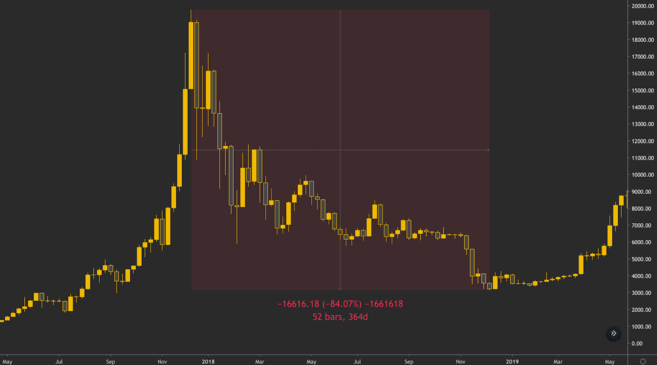
Bitcoin price drop after the 2017 bull market
And before the 2018 bear market, Bitcoin was down 86% in 2014.

Bitcoin price has fallen 86% from its 2013 high.
As of July 2020, Bitcoin tested the low of the previous bearish trend at around $3,000 without breaking through. Breaking this low would be a strong argument in favor of the start of a long-term bear market.

Bitcoin tests past bear market low.
Since this level was not broken, it can be argued that the decline caused by COVID-19 concerns was simply a retest of the range. However, when it comes to technical analysis, you can only work with probabilities.
Other clear examples of a bear market can be found in the stock market. These include the Great Depression, the 2008 financial crisis, and the 2020 stock market crash due to the coronavirus pandemic. All of these events caused enormous damage to Wall Street and affected stock prices in all sectors of the market. During such periods, there is a significant decline in market indices such as the Nasdaq 100, Dow Jones Industrial Average (DJIA) and S&P 500.
Difference between bull and bear markets
The difference is obvious. In bull markets prices rise, in bear markets they fall.
One notable difference is that bear markets often have long periods of consolidation, that is, sideways movement or fluctuating price action. These are times when market volatility is low and trading activity occurs in low volumes. While the same may be true in bull markets, this behavior tends to be more common in bear markets. After all, for most investors, declining prices over an extended period are not particularly attractive.
You should also consider the possibility of opening a short position on an asset. If there is no way to short an asset on the margin or derivatives market, traders express bearish sentiment by selling the asset for fiat or stablecoins. This could lead to a longer and more protracted downtrend with little buying interest, resulting in a slow and passive sideways price movement.
➟ Thinking about where to start working with cryptocurrencies? Buy Bitcoin on Binance!
How to trade in a bear market
One of the simplest strategies for traders in a bear market is to get into cash (or stablecoins). If you are not happy with the price decline, you can simply wait until the market exits the bearish zone. As a new bull market emerges, you can come back and take advantage of it. At the same time, if you are holding a cryptocurrency with an investment time horizon of many years or decades, a bear market is not a direct signal to sell.
When it comes to trading and investing, it is usually best to trade in the direction of the market's trend. Therefore, another profitable strategy in bear markets is to go short. This way, traders can profit when asset prices decline. This could be day trading, swing trading, position trading. The main thing is to trade in the direction of the trend. However, many traders will look for “countertrend” trades, that is, trades that go against the direction of the main trend. Let's look at how this works.
In the case of a bear market, this would be entering a long position on a rebound. This movement is sometimes called a "bear market rally" or a "dead cat bounce." These counter-trend price movements are notoriously volatile, as many traders jump at the opportunity to extend a short-term rebound. However, until the end of the overall bear market is confirmed, the downtrend is expected to resume after a rebound.
Therefore, successful traders take profits (at the level of recent highs) and exit the trade before the bearish trend resumes. On the other hand, during a bear market they may find themselves locked into a long position. That is, we are talking about a very risky strategy. Even the most advanced traders can suffer significant losses when they catch a falling knife.
Summary
We discussed what a bear market is, how traders can protect themselves and profit from it. To summarize, the simplest strategy in a bear market is to stay in the cache and wait for a safer trading opportunity. In addition, many traders are looking for opportunities to open short positions. As we know, in trading it is wise to follow the direction of the market trend.
Do you have questions about trends, bear markets, or trading in general? Visit our Q&A platform, Ask Academy, where the Binance community will answer your questions.