

Although Bitcoin trades 55% below its all-time high, the world's leading cryptocurrency is up 80% so far this year. But this begs the question – should you buy Bitcoin in 2023?
In this guide, we explore the topic of investing in Bitcoin. We examine its price performance, future prospects, and the key reasons why Bitcoin remains a popular alternative asset.
Should you buy Bitcoin now?
Overall, the investment thesis for Bitcoin is very strong. Starting with fundamentals, Bitcoin is a finite asset. Only 21 million Bitcoin tokens exist, and more than 93% of the total supply already exists. This makes Bitcoin an ideal store of value. Bitcoin is also a decentralized asset, meaning no single institution controls the network.
This means that investors retain full control over their BTC tokens and therefore do not need to trust a third party. Bitcoin is also popular because of its fixed supply. Currently, 6.25 BTC tokens enter circulation every 10 minutes. This ensures that the supply of Bitcoin cannot be manipulated. Unlike traditional currencies, Bitcoin is not affected by central bank policies that lead to inflation.

Bitcoin’s 10-minute supply will soon be reduced to 3.125 BTC. This is known as the "Bitcoin halving" and occurs approximately every four years. This is good news for investors, as Bitcoin halving events have historically rejected new bull rallies. In terms of pricing, Bitcoin is trading 55% below its previous all-time high of nearly $69,000.
This provides an attractive entry point for first-time investors. What's more, Bitcoin is one of the best-performing assets in 2023, up 80% year-to-date. By comparison, the S&P 500 rose just 18%. First-time investors will also appreciate that Bitcoin can be divisible. This enables investors to purchase small amounts of Bitcoin.
8 Reasons to Invest in Bitcoin in 2023
In this section, we’ll take a closer look at the question – should you buy Bitcoin?
We explore eight reasons why this alternative asset class remains a viable long-term investment.
Reason 1: Bitcoin supply is limited
The first benefit of buying Bitcoin is that it has a limited supply. This is critical from an investment perspective as it creates scarcity in the market. Additionally, the supply of Bitcoin is fixed, with new BTC tokens entering circulation every 10 minutes. This will continue until approximately 2140, when Bitcoin will reach its maximum supply of 21 million coins.
Finite assets like Bitcoin are attractive to investors looking for storage and value. After all, once Bitcoin reaches its maximum supply, no more coins can enter circulation. In theory, if demand for Bitcoin remains consistent, the lack of new supply could help Bitcoin appreciate over time. A good comparison is gold.
Compared to Bitcoin and gold, traditional currencies like the U.S. dollar have an unlimited supply. In fact, the Fed “printed” over $3.3 trillion in 2020 alone. Every time new dollars are printed, the currency loses value.

In turn, the value of a U.S. dollar savings account becomes less valuable over time. This is because continued money printing leads to inflation, which means the cost of goods and services increases. Bitcoin does not suffer from the same problem due to its limited supply. Bitcoin therefore enables investors to protect their wealth from rising inflation levels – more on that later.
Want to learn more about Bitcoin supply? Read our in-depth guide on how much Bitcoin is there in 2023.
Reason 2: Bitcoin is the best performing asset
Historical price movements should also be considered when asking the question – Should I buy Bitcoin? Simply put, Bitcoin remains one of the best-performing asset classes in the market since its launch in 2009. In 2011, Bitcoin traded at $0.061, according to CoinMarketCap. This means that an investment of just $100 would yield 1,639 BTC tokens.
Fast forward to late 2021, when Bitcoin hit an all-time high of nearly $69,000. That’s an increase of more than 111 million percent compared to 2011. In other words, a $100 investment in 2011 would have been worth more than $111 million. However, it is worth noting that Bitcoin has performed through multiple market cycles.
Just like stocks and other assets, Bitcoin prices have bullish and bearish cycles. History shows that long-term investors always do better than short-term speculators. This is because long-term holders are protected against short-term fluctuations. For example, 2017 was a very good year for Bitcoin. Entering 2017, Bitcoin was trading at just $1,000.

By the end of the year, Bitcoin hit an all-time high of $20,000. So that means an annual return of 1,900%. However, consider an investor who bought Bitcoin when it peaked at $20,000. Just a year later, Bitcoin fell to a low of $3,400. Anyone selling at this price would lose more than 80% of their investment.
In contrast, those holding Bitcoin will eventually see a complete reversal. After all, Bitcoin hit nearly $69,000 in late 2021, up nearly 2,000% from its 2018 lows. Nonetheless, Bitcoin offers significantly higher returns compared to other asset classes, as discussed below.
Bitcoin and the stock market
When asking the question "Should I buy Bitcoin?" it makes sense to compare its performance to the broader stock market.
Through the first seven months of 2023, the S&P 500 is up 18%. During the same period, Bitcoin’s value increased by more than 80%. In one year, the S&P 500 is up 14%, while Bitcoin is up more than 32%.
Long-term Bitcoin investors have fared even better. For example, in 5 years, Bitcoin grew by almost 330%. During the same period, the S&P 500 gained 61%. Things become even clearer when we compare Bitcoin and the S&P 500 over the past decade.

Ten years ago, the S&P 500 was trading at 1,680. Today, the index is at 4,536 points, implying a 10-year return of 170%. By comparison, Bitcoin was trading at just $96 in 2013. This represents a 10-year return for Bitcoin of over 31,000%.
The picture for stocks becomes even bleaker when compared to other global index funds.
Reason 3: Bitcoin is decentralized
Decentralization should also be explored when asking the question – should you buy Bitcoin? Simply put, Bitcoin’s decentralized framework means that no one person or institution can control the network. Instead, Bitcoin is a global ecosystem controlled by the masses. This is because of the “mining” system that keeps the network running.
Here's how it works:
Every 10 minutes, transactions are bundled into a “block.”
Miners - specialized hardware connected to their equipment that will attempt to solve cryptographic equations.
This equation is very complex and requires a lot of energy to solve.
The first miner to solve the equation will receive the block reward.
Currently, the price is 6.25 BTC. Successful miners will also receive transaction fees paid by the sender.
Crucially, anyone can become a miner, ensuring Bitcoin’s inclusivity. So why is this important when discussing Bitcoin investment thesis? Well, decentralization is important to many Bitcoin investors, especially when compared to the traditional financial system.
For example, consider an investor who stores U.S. dollars in a bank account. Investors have no choice but to trust financial institutions to keep their funds safe. But history shows that this has not always been the case. For example, in response to the global financial crisis, the Cyprus government withdrew funds from domestic bank accounts.
According to the BBC, bank accounts under €100,000 lost 6.75% of their savings. Accounts over €100,000 lost 9.9%. In contrast, Bitcoin investors do not need to trust a third party when storing their wealth. In contrast, BTC tokens held in self-hosted wallets can only be accessed by their owners.
This means investors are not at risk of having their funds stolen by financial institutions. Additionally, since BTC tokens are stored securely in wallets, there is no risk of bank failure. Additionally, the decentralized nature of Bitcoin ensures that the transaction process is smooth and trustless. This is because the transaction does not require third-party approval.
This is true regardless of how many Bitcoins are transferred, or where the sender and receiver are located. For example, someone in the UK could transfer $1 million worth of Bitcoin to a beneficiary in Australia. Not only does the transaction only take 10 minutes, but it also costs a few dollars.
Now compare the same transaction using a financial institution. The sender's bank may be required to conduct more rigorous due diligence on the transaction. This may include KYC for senders and receivers, as well as requests for proof of source of funds. The bank's investigation process could take days or weeks.
Not only that, once the transaction is approved, the receiving bank may need to perform the same enhanced due diligence. This can mean recipients have to wait days or weeks before they can withdraw their funds. Ultimately, these regulatory barriers do not exist when it comes to sending and receiving Bitcoin. This makes Bitcoin an ideal medium of exchange and store of value.
Reason 4: Bitcoin is an ideal store of value
We mentioned above that Bitcoin is an ideal store of value. Let's explore this sentiment in more detail. Simply put, a store of value retains its value over time. The supply of a store of value is often limited, while demand remains consistent. Examples of stores of value include gold, silver, art, and real estate.
However, there is a growing consensus that Bitcoin is a more suitable store of value. Especially compared to precious metals like gold. For example, moving gold is not only cumbersome but also costly. Consider the process of selling physical gold back for cash. You need to visit a local gold broker, usually the price is lower than the market price.
Additionally, gold loses value if not stored properly. Then there is the risk of the gold being stolen or damaged. This is why investors often store gold in insured vaults. But again, this can be costly. Another problem is that gold is not easily divided. This makes it challenging to sell a small portion of your physical gold investment.
All of these issues are mitigated when using Bitcoin as a store of value. First and foremost, Bitcoin can be divided into small units. In fact, 1 full Bitcoin token can be divided into 100 million “satoshis.” This is similar to dividing a dollar into 100 cents. But this operation can be performed up to 100 million times per Bitcoin - making it ideal for small transactions.

What's more, unlike gold, Bitcoin is easily transferable. As we mentioned before, Bitcoin transfers only take 10 minutes. This is true regardless of where the parties to the transaction are located. Not to mention the amount of money transferred. Bitcoin storage is also more seamless and cost-effective.
Bitcoins are stored in private wallets and are controlled only by their owners. Additionally, there are no fees for storing Bitcoins in the wallet. Best of all, there is no need to trust a third party when storing Bitcoin. This is not the case when gold is stored in a vault. Bitcoin is also more secure to store compared to gold.
For example, Bitcoin can be stored in a hardware wallet that remains offline at all times. This eliminates the risk of Bitcoin being stolen remotely. If the hardware device is physically stolen, the thief will not be able to access the Bitcoins without knowing the PIN or backup password. The owner of the wallet can then restore the Bitcoin remotely.
However, gold is at risk of being stolen when stored at home. Once obtained, thieves can easily sell the gold through the legal market or the black market. Of course, Bitcoin’s status as a store of value is underpinned by its limited supply. As we mentioned before, there will only ever be 21 million Bitcoin tokens. Once it reaches its maximum supply, Bitcoin will become a deflationary asset.
Reason 5: The next Bitcoin halving is coming
When Bitcoin was first launched in 2009, the mining reward was 50 BTC. It dropped to 25 BTC in 2012 and to 12.5 BTC in 2016. In 2020, mining rewards were reduced by 50% again, to 6.25 BTC. The next Bitcoin halving event is expected to occur in April 2024. So why is this important?
First, the Bitcoin halving means that fewer Bitcoin tokens enter the circulating supply. So instead of having 6.25 BTC entering the supply every 10 minutes, the next Bitcoin halving will be reduced to 3.125 BTC. Considering that there are approximately 144 blocks per day, 450 new BTC tokens will be created every 24 hours instead of 900.
The theory is that when supply decreases, Bitcoin becomes more attractive to investors. This is because there are fewer Bitcoins available, making them more scarce. The same concept can be seen in other asset classes. For example, when OPEC (Organization of the Petroleum Exporting Countries) reduces production, it means less oil is available.

This, in turn, typically leads to higher oil prices. Likewise, when gold's productivity decreases, its value appreciates. The same goes for real estate. When new property development decreases, it can cause property prices to rise. So this begs the question – how will Bitcoin’s price react to the halving event?
Well, history shows that the Bitcoin halving encourages a new, long-term bull market. For example, consider the 2020 Bitcoin halving. On the day of the halving, Bitcoin price was $9,100. Seventeen months later, Bitcoin peaked at nearly $69,000. Likewise, Bitcoin’s price at the time of the 2016 halving was $580. Seventeen months later, Bitcoin peaked at $20,000.
The last halving occurred in 2012, when the price of Bitcoin was $12. Twelve months later, Bitcoin peaked at $1,079. While past performance is no guarantee of future returns, many investors are keeping a close eye on the next Bitcoin halving. If history repeats itself, the halving could lead to an extension of the bull market cycle.
Reason 6: Bitcoin is highly liquid and affordable
Another benefit of buying Bitcoin is that it is highly liquid. Simply put, the liquidity of an asset determines how easy it is to sell. Most stores of value are “illiquid.” This means it may take time to sell the asset back in exchange for funds at a good price. For example, Zillow explains that the average listing-to-sale duration for properties in the U.S. is 55-70 days.
This can be a problem for investors who need quick access to cash. They may be forced to accept a price that is less than the market value of the property. Illiquidity is also a problem for other stores of value such as gold and art. In comparison, Bitcoin is highly liquid. In fact, Bitcoin is even more liquid than stocks. This is because Bitcoin is traded 24 hours a day, 7 days a week.
This means that investors can exchange Bitcoin for money at any given time. Most importantly, there is ample liquidity in the trading market. For example, according to CoinMarketCap data, Bitcoin has a market capitalization of over $580 billion. Over $9 billion has been traded in Bitcoin in the past 24 hours.

This means investors can easily enter and exit the market. No need to accept a price below market value or wait days or weeks to receive payment. Additionally, Bitcoin is one of the most affordable asset classes on the market. For one thing, Bitcoin is currently trading around $30,000.
However, there is no requirement to purchase "full" Bitcoin tokens. In contrast, Bitcoin can be divided a hundred million times. Therefore, investors of all budgets and financial situations can invest in Bitcoin. On eToro, a regulated cryptocurrency exchange with over 30 million users, investors can buy Bitcoin for as little as $10.
Not only is Bitcoin affordable, but even complete beginners can easily navigate the market. For example, many Bitcoin exchanges accept convenient payment methods such as debit/credit cards and e-wallets. Investors just need to open an account on the exchange, upload some identification documents, and make a payment.
Reason 7: Institutional interest in Bitcoin continues to grow
Financial institutions and multinational corporations have stayed away from the Bitcoin market for years. In fact, some of the world’s most influential people have called Bitcoin a “fraud.” In recent years, however, institutional interest in Bitcoin has completely changed. For example, at the end of 2017, the world’s first regulated Bitcoin futures market was launched.
The Bitcoin futures market is supported by CME Group, one of the world’s largest derivatives exchanges. What’s more, some of the world’s largest investment firms have filed with the SEC to launch Bitcoin ETFs. This includes Fidelity, BlackRock and Invesco, according to Bloomberg. Collectively, these three firms alone manage trillions of dollars' worth of assets.

Additionally, there is growing interest in blockchain, the technology that underpins Bitcoin. These include IBM, Amazon, Walmart, Microsoft, Oracle and Accenture. Some of the world’s largest financial institutions are using the Ripple blockchain for cross-border transactions. These include Standard Chartered, Santander, Bank of America and Siam Commercial Bank.
More and more companies are accepting Bitcoin as a payment method. Examples include Microsoft, AMC Theatres, AT&T, Overstock, and Shopify. This lays a solid foundation for Bitcoin as a medium of exchange and store of value. Crucially, as institutional interest in Bitcoin continues to rise, this gives the digital asset real-world legitimacy.
Reason 8: Price predictions suggest Bitcoin is undervalued
Price predictions are also useful when evaluating the question "Should you buy Bitcoin?" At its peak in November 2021, Bitcoin’s price was just under $69,000. This puts Bitcoin’s market capitalization at over $1.2 trillion. Currently, Bitcoin remains in a consolidation zone near the $30,000 level.
This means Bitcoin is trading 55% below its previous all-time high. If Bitcoin could move back to $69,000, this would create a 130% upside. But some believe that during the next bull cycle, Bitcoin could go far beyond its previous all-time highs. But how big can Bitcoin actually get? To answer this question, let's explore the market capitalization of other asset classes.
According to Gold.org, there are currently 209,000 tons of gold in circulation, with a market capitalization of approximately $12 trillion. These include jewellery, gold bars and coins, gold held by central banks and physically-backed gold ETFs. If Bitcoin could replicate gold’s $12 trillion market capitalization, its price would be around $690,000.
That’s 10 times the previous peak of nearly $69,000. From current levels of $30,000, the $12 trillion market cap has room for 2,200% upside. Another angle to consider is real estate. According to World Real Estate Magazine, the total value of all real estate in the United States exceeds $33 trillion. This market capitalization would require a Bitcoin price of $1.9 million.
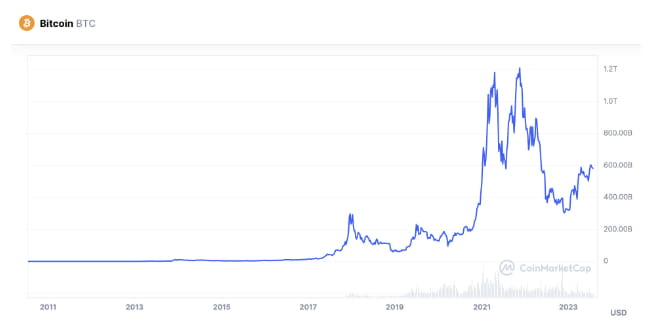
Each BTC token is priced at $1.9 million, an increase of over 6,200% from current pricing levels. Is this realistic? This all relies on the continued adoption of Bitcoin as a store of value and medium of exchange. For the latter, Bitcoin is a global asset unhindered by national borders. Transactions can be sent on a peer-to-peer basis and take just 10 minutes on average.
Anyone can buy and store Bitcoin in a self-hosted wallet, ensuring people can hold wealth without trusting a third party. This is particularly attractive to people in countries with weak financial systems and/or high levels of inflation. So what do experts think the future holds for Bitcoin as an investment?
Apple co-founder Steve Wozniak says Bitcoin will eventually hit $100,000. From current levels, this would yield an upside of over 230%. ARK Investment, a leading fintech ETF managed by Cathie Wood, believes Bitcoin will hit $1 million within the next decade. This would bring Bitcoin’s market capitalization to $19.4 trillion.
This market capitalization would exceed that of gold, but would still be lower than that of the U.S. real estate market. Hal Finney, one of the original pioneers of Bitcoin, believes a $10 million price is possible. This would push Bitcoin’s market capitalization to over $194 trillion. Considering it will exceed the combined value of gold, real estate, and the U.S. dollar, this is probably beyond the realm of possibility.
When is the best time to invest in Bitcoin?
The best time to invest in Bitcoin depends on the investor's financial goals and risk tolerance. Overall, history shows that long-term Bitcoin investors are the most successful. Bitcoin is extremely volatile and can remain in a bear market for years. But by holding Bitcoin during critical market conditions, there is often light at the end of the tunnel.
Bitcoin’s performance during COVID-19 is a perfect example of this.
After peaking at $10,000 on February 18, 2020, Bitcoin fell to a low of $4,800 within a month.
Those who cashed out at this price would have lost over 50%.
Now consider the investors who stay strong by holding onto Bitcoin when prices fall.
As of the end of 2020, Bitcoin was trading at $28,000.
Eleven months later, Bitcoin was trading at a high of nearly $69,000.
As a result, Bitcoin has gone on to grow over 1,300% from its 2020 lows of $4,800.
This example shows that while Bitcoin is highly volatile, long-term investors have had great success. Additionally, some investors have found success by buying Bitcoin when the price drops. For example, the current bear market provides an excellent opportunity to buy Bitcoin at a discount. So should I buy Bitcoin now?
At the current price of $30,000, investors receive a 55% discount. This is based on Bitcoin’s previous all-time high of nearly $69,000. That said, the most risk-averse strategy is to develop a dollar-cost averaging plan. This requires great discipline but can produce attractive long-term results.
The concept of dollar cost averaging eliminates concerns about short-term fluctuations. Not to mention when to enter and exit the market. This is because dollar-cost averaging involves purchasing Bitcoin at regular intervals, with the same amount on each purchase. For example, buy $200 worth of Bitcoin at the end of each month.
After each month's investment is completed, the average cost price is adjusted. This would be in line with broader market trends. This means that when the price of Bitcoin drops, investors will buy Bitcoin at a discount. When the price of Bitcoin increases, the portfolio value also increases.
Here's an example of how dollar-cost averaging works:
Month 1: $30,000
Month 2: $25,000
Month 3: $27,000
Month 4: $28,000
Month 5: $30,000
Month 6: $33,000
Month 7: $41,000
Month 8: $45,000
Month 9: $44,000
Month 10: $41,000
Average cost price: $34,400
As mentioned above, the investor invested for 10 months, investing the same amount each time. Despite Bitcoin's volatility, investors paid an average price of $34,400.
How much Bitcoin should you invest?
Just like when to buy Bitcoin, the amount you should invest is subjective. This will depend on the investor's personal circumstances, budget, risk tolerance, etc.
Let’s explore the most important factors to consider when evaluating how much to invest in Bitcoin.
Budget and expenses
The most important indicator is the investor's personal financial situation.
The best course of action is to create a budget. This should outline the individual's income as well as their core monthly expenses. For example, rent, food, energy, taxes and savings. Anything left over can be considered disposable income.
Risk and volatility tolerance
Investors should also assess their personal risk tolerance before investing in Bitcoin. On the one hand, Bitcoin is one of the best-performing assets of the past decade. But again, there is no guarantee that Bitcoin will generate investment returns.
Bitcoin remains an emerging asset class, especially compared to stocks. After all, Bitcoin was only launched in 2009. And in the case of the S&P 500, it was founded in 1926. Additionally, investors should evaluate their tolerance for Bitcoin volatility.
To provide some insight, in November 2021, the price of Bitcoin was close to $68,000. Twelve months later, Bitcoin hit lows below $16,000. This means that in just one year of trading, Bitcoin is down more than 75%.
History shows that Bitcoin has experienced many similar declines. But it always bounces back and keeps hitting new highs. This means that investors should be prepared to hold on to their Bitcoin investment even if the price falls.
diversification
When asking themselves the question "Should I buy Bitcoin?" investors should avoid going "all in" and buying Bitcoin. Instead, cryptocurrency investors should have a balanced portfolio that spreads risk across multiple asset classes and markets.
For example, say an investor has $10,000. A risk-averse investor might only allocate 5% or $500 to Bitcoin. They may allocate the rest of their portfolio to blue chip stocks, ETFs, commodities and real estate investment trusts. Ultimately, the more diversified a portfolio is, the better.

Some investors will also diversify into other cryptocurrencies. For example, while Bitcoin remains the best cryptocurrency to buy, investors are also bullish on altcoins.
While there are over 26,000 to choose from, some of the best altcoins include BTC20, Ethereum, XRP, BNB, and Cardano. Some investors will also consider buying the best memecoins such as Shiba Inu, Floki, and Dogecoin.
financial goals
Investors should also consider their financial goals before purchasing Bitcoin. For example, Bitcoin is best for long-term investors. This allows investors to navigate volatile Bitcoin cycles. To enhance risk management, long-term investors may consider a dollar-cost averaging strategy.
That said, Bitcoin is also suitable for short-term traders. This requires buying and selling Bitcoin to benefit from fluctuating market prices. However, this strategy does require an understanding of technical analysis.
Additionally, investors should remember that Bitcoin, like many other stores of value, does not generate income. Instead, investment gains are realized only when Bitcoins are sold for more than what investors paid.