

Author: Packy McCormick. Translated by: Cointime.com QDD
White Pill: Elon Musk is intentionally killing Twitter for the good of humanity.
Elon Musk is the richest man in the world, $18 billion richer than the next richest man. He is a member of the PayPal Mafia. He pushed the electric car and made reusable rockets a reality. He plans to wire our brains into the Matrix. He said this before anyone else realized how scary AI is. He is solving the population crisis single-handedly. He thinks about everything with a First Principles™️ mindset.
Do you think Elon Musk doesn't know how to save a simple app like Twitter? You must be kidding!
No, if Twitter is declining, it’s because Elon wants it to decline.
First, is Twitter in decline? I’m no social media expert, but my favorite social media writer, Eugene Wei, wrote an excellent elegy for it in How To Blow Up a Timeline, blaming it on algorithm changes:
Unlike most other social graphs, Twitter's graph is made up of a bunch of social graphs standing on each other's shoulders, disguised as interest graphs. It's not perfect, but it's not completely useless.
The new Twitter algorithm throws that off.
“I haven’t given up completely, but at least I’ve asked the bartender for the check,” he concluded. For our purposes, that’s enough; Twitter is declining.
Which leads to the next question: If Twitter is failing, and Elon Musk is running it, and Elon Musk is the smartest person alive, why would Elon want to kill the company he just spent $44 billion to buy?
Why would Elon want to kill Twitter?
Everything Elon does is to increase humanity's chances of a better future, and Twitter is undermining our chances of a better future.
It wastes time, it distracts, it inspires anger. It always has; the benefits outweigh the drawbacks, as long as you use it correctly. But that is slowly changing.
It's fun to be mad at Elon, but let's be honest, Twitter was going downhill before Elon. It peaked during the lockdown, but it's been getting worse and worse since then.
My best theory for this is that the rules of the game have become too easy to understand.
Write threads and tell people to like and retweet after reading the last tweet. Share videos instead of links. Talk about bad things now and good things in the past. Make fun of people with lots of followers. Write the most pointed responses. Get rewarded with likes, retweets, and followers, and then turn those into online courses or affiliate links, or whatever else you want in return.
Even though we weren't particularly interested in any of it, everything seemed to hold our attention.
Of course, new “For You” features and updated algorithms make the problem worse, but they are just exacerbators. Those who choose to cater to the algorithm are being rewarded, which makes the experience worse for everyone else. As a species, we have become a little dumber.
One of the biggest fears about large language models (LLMs) is that they will make online content very generic and bland by reading everything on the internet and generating responses that resemble the average of everyone’s thoughts. Meanwhile, on Twitter, people have already begun to do this for themselves: tailoring their content to the algorithm’s tastes.
Just as search engine optimization (SEO) makes the internet more boring by pushing people to make more formulaic and less creative websites, Twitter’s algorithm makes us worse off by making us more formulaic and less creative by giving us content that best matches the algorithm rather than the best content.
Obviously, tweets that make people angry get more engagement, which may not be healthy, but the more insidious destructiveness is that we shape the content of our thoughts into forms that suit the algorithm’s desires and lose some of their novelty in the process.
And we could have moved slowly along this path, for years or even decades. Wey notes that inertia and “network effects can keep the party going after the last guest leaves.” Twitter has been pretty badly run from a business perspective, but it’s also been confusingly hard to displace. Network effects, cumulative status, and a carefully curated interest graph are obstacles that are hard to overcome.
In steady state, we will waste hundreds of thousands of years of our brain time on Twitter, scrolling aimlessly because we are angry about things we care about each other, pretending that the time spent on Twitter is actually useful for work, staying aware of the information flow, and getting upset when deep work is interrupted because it is only a click away.
But the plateau didn’t last. Elon saved us. Praise Elon.
Ridiculous Explanations for Twitter's Decline
One of the strangest things on the internet is seeing hundreds or even thousands of strangers defending Elon Musk whenever he does anything. Every time I see this, I feel a little sad because those people just want to get Elon's attention and are even willing to sacrifice their honor and dignity for a notification.
It's annoying to watch these people patting themselves on the back, but the worst part is actually the lack of creativity in their defense. If Elon were playing chess, they'd be praising him for his double jump in checkers.
Take the fact that they believe that since Elon founded Tesla and SpaceX, of course he knows how to run a simple site like Twitter, which is basically just a website with some text, pictures, and an algorithm. It shouldn’t be that hard…
What they can argue is that Elon is sacrificing his reputation to teach us all an important lesson about the duality of human nature, to show us not to blindly worship false idols, or at least to set an example to all entrepreneurs that building physical products requires a completely different skill set. He is showing a generation of potential deep tech entrepreneurs the folly of building software products so that they can use their talents for good. Praise Elon.
Or there’s the free speech issue. Elon has said he wants to buy Twitter to restore free speech. Every time he does something that’s not in line with free speech, they go to great lengths to explain why limiting Substack links or capitulating to government demands is actually very good for free speech. This ignores the overall trend. It doesn’t fully appreciate Elon’s genius and selflessness.
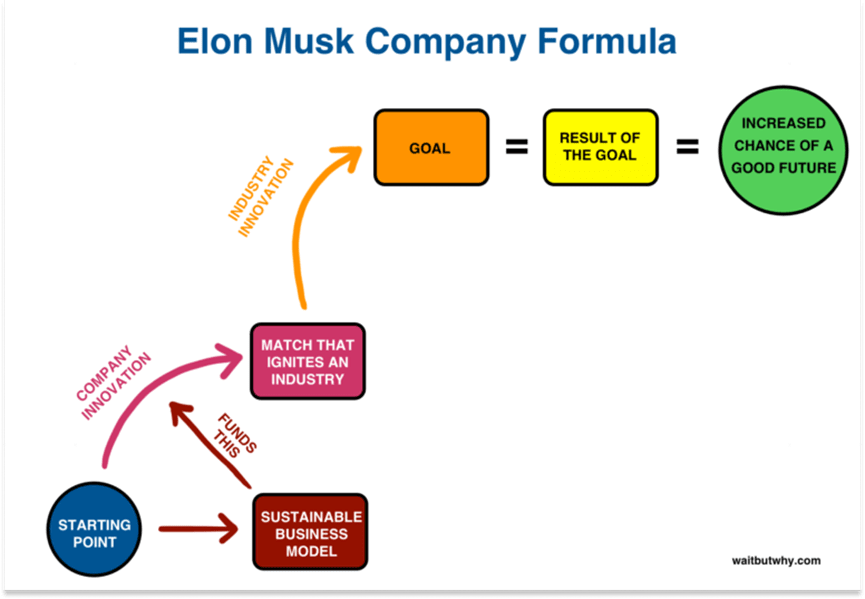
In Neuralink and the Brain's Magical Future, Tim Urban explains Elon's corporate formula:
His initial thinking about a new company always starts on the right side and works his way to the left.
He identified certain specific changes in the world that would increase the probability of humanity's best future. He knew that large-scale global change would happen fastest when the entire world - the human giant - was working toward it. He also knew that the human giant would work toward a goal only if there was an economic compelling mechanism - as long as it was a good business decision to devote resources to innovating toward that goal.
When Elon bought Twitter, the whole free speech issue was just a distraction. He knew it couldn’t be fixed. He knew that highlighting more feuds and far-right conspiracy theories in the “Recommended for You” tab wouldn’t save democracy. He knew AI would only make the bot problem worse, and that new architectures would be needed to fix it.
In his omniscience, he knows these things, and also knows that the only way to increase humanity’s chances of a better future is to destroy Twitter completely.
What happened at Twitter was the product of a seasoned, generational entrepreneur looking for a new challenge at the height of his powers. For Twitter, he took his own approach and did the exact opposite.
Instead of creating a sustainable business model in a cutting-edge industry that didn’t already have an established sustainable business model, he took the sustainable model of an existing industry and made it unsustainable.
Rather than igniting an industry by showing others how something seemingly impossible could be done, he ignited the companies he spent $44 billion to acquire to make room for thousands of new experiments.
Obviously, Elon knows that competition and experimentation are good things, and he sees that potential competitors to Twitter have barely made an impact. He must have read Wey's Status-as-a-Service; he knows that as long as Twitter remains the same, its network effects will crowd out any new entrants - look at Mastodon, look at Bluesky. Twitter dominates the text space, and no one can overthrow it with the effort and time invested in Twitter.
But what if Twitter ceased to exist? A new world of possibilities opened up. Entrepreneurs could once again build competitors. So he made room for startups to replace Twitter.
Yet, in his infinite wisdom, Musk knew that he couldn’t leave the future of global human communication to the experiments of novice entrepreneurs. He realized that he needed the brightest minds in social networking—the real protagonists of the movie “The Social Network”—to join him in his mission to kill Twitter.
But Mark Zuckerberg was distracted. He focused on the Metaverse. Twitter had been an unwelcome target for years, but even the copy-paste-happy Zuckerberg didn’t bother to pay attention.
Judging by Twitter's revenue and slim profits, the chances don't look great. Even if they were, it would be hard to deprive Twitter of its core users -- the crazy people who thrive in 280 characters. And honestly, Zuck seems content with the status quo: working out, spending time with his family. Why would he deal with all those headaches for so little benefit?
But Elon wasn’t going to be stopped, and he came up with a plan that gives me goosebumps just thinking about it:
l Drive away advertisers.
l Annoy core users.
l Get Zach's attention.
l Pretend to be weak by limiting the user's usage speed.
l Challenges Zach's masculinity.
This is great work. Let's look at the evidence.
First, almost immediately, he drove away advertisers. Twitter advertisers are extremely patient; for years they accepted the worst ad product in the industry. And it only took Elon a few days to scare them away.
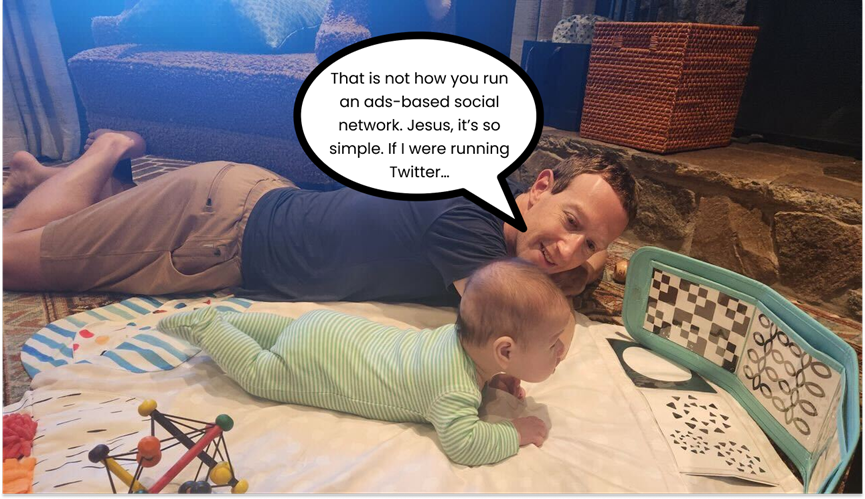
You can almost picture Zuck lying on the floor, teaching his kid to read shapes, muttering, "This is not how you run an advertising social network. God, this is too easy. If I ran Twitter..."
But advertisers don't make a social network. Users do. And Twitter's core users remain addicted. Challenge accepted.
Elon pissed off Twitter’s core users, despite the social capital they’d built on Twitter and the fact that the alternatives were terrible. He limited their influence. He made them pay $8/month for blue checkmark verification. He disrupted their carefully curated feeds. He blocked links to Substack. He made celebrities free agents. This was all done to entice Zuck:
“They’re willing to try other things,” Elon quips telepathically, “but those other people don’t seem to know how to build social products…”
Next, he got the attention of Zach. Zach is a guy who ate everything he ate for a whole year, who proudly talked about his BJJ training, who told people he completed the Murph Challenge in 39 minutes and 58 seconds. And Elon challenged him to a cage fight:
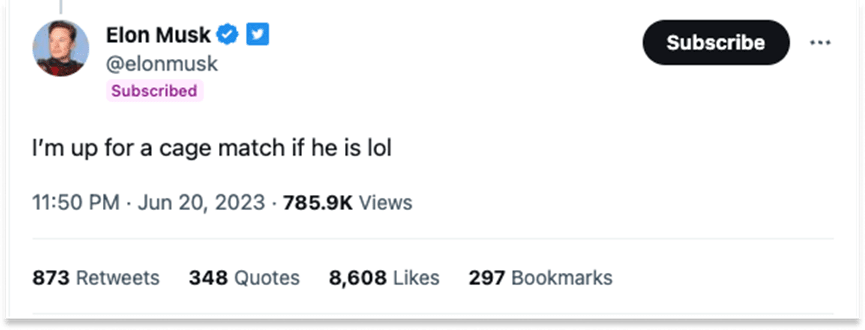
Of course, Zack responded with an affirmative, or more specifically, “Tell me where.” Elon was close to success.
As a final product bait, Twitter throttled users’ speeds over the July 4th weekend a week ago, ostensibly to prevent scraping but likely because of problems with Twitter’s infrastructure, which was certainly a bait for a company whose motto is “Moving fast with stable infrastructure.”
It worked. On July 5, presumably after windsurfing with a large American flag kite, Zuck announced his Twitter clone: Threads. The product looked almost identical to Twitter, but with more Instagram users. Zuck had joined the fray.
But Elon has been living in the hell of running Twitter for nearly a year now. He knows how difficult things can get, and he wants to make sure Zuck stays motivated to build something truly great despite the inevitable challenges.
So, to top off his masterstroke, Elon challenges Zach’s manliness by calling him a “cuck” and proposing a “real fight.”
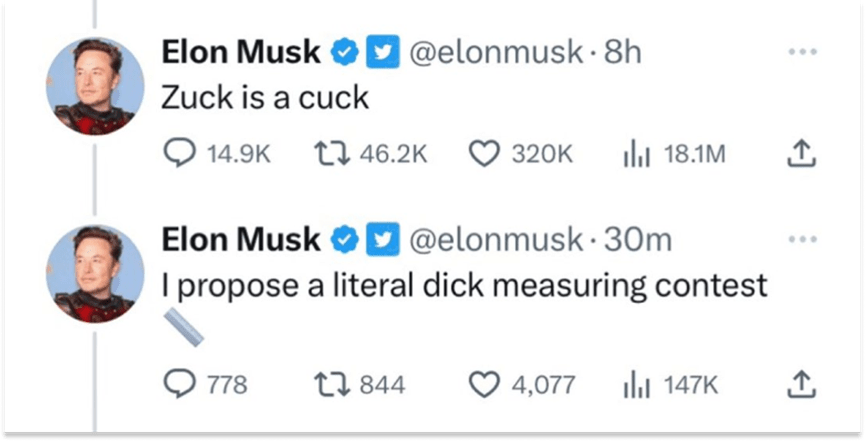
Do you think Zuck will give up now? Absolutely not. Zuck is now unknowingly carrying out Elon's orders. He is going against Twitter's core users. He keeps changing the product, trying to find a new direction.
And just like that, Elon accomplished another mission in just three quarters with almost no effort.
Elon officially acquired Twitter on October 27, 2022. In just three quarters, he has managed to destroy the product, drive away advertisers, alienate core users, revitalize the social networking startup community, and inspire Mark Zuckerberg to build a competitor himself. In just three quarters.
All this because he realized Twitter had a problem before the rest of us, and that problem was spreading to all of us, but it wasn't completely dead yet. He sacrificed his time and reputation to destroy it for the good of all of us, to increase our chances of having a great future. Praise Elon.
I’m not saying this is what Elon was thinking at the time by any means, but I would say so if I were one of those weirdos who defends Elon’s every move.
Whether it was intentional or not, who cares? The end result is... good.
I say this as someone who relies heavily on Twitter, I have a lot of followers on Twitter but almost no followers on Instagram or Threads, and my business is built on Twitter. It would be great for me if we could go back to the Twitter of 2020. I wish Twitter was still the place it was in the past, but it’s not.
Despite my personal concerns, I think Twitter's decline is a good thing in many ways.
At the most basic level, it could be beneficial for all of us to spend less time on Twitter.
Sure, Twitter can be a great way to discover new information, make friends, find opportunities, and learn about different perspectives. But it seems harder to reap those benefits today, perhaps because the current paradigm has become tired and reached the natural end of readable algorithmic feeds. The noise outweighs the signal to the point where there are more nutritious ways to get information and make connections.
Personally, when I spend more time on Twitter, my brain feels more scattered and less focused. When I deleted the Twitter app from my phone for a few weeks, I felt noticeably clearer in my thinking, even though I occasionally checked Twitter on my laptop and phone browser.
It’s much more productive to start with the questions I want answered, read books, read Substack articles, do deep dives with ChatGPT on specific topics, and have good old-fashioned conversations with people.
Without the distraction of Twitter robbing us of our focus every few minutes, we should be able to do more deep work, generate fresher ideas, and have the time and space to implement them more completely. Personally, I can't wait to see how productive Elon himself can be without being able to tweet. Nuclear fusion? Longevity? Mars? They're all under consideration.
Going one level deeper, we need new forms of social networking based on ideas.
Twitter may be dying, but that doesn't mean we don't need ways to communicate online.
The consumer internet started booming in the late 90s. Twitter was founded in 2006. None of this stuff is that old, and I find it hard to believe that we have figured out the ideal way to exchange information and ideas between billions of connected people. We are still in the very early stages.
With Twitter no longer so dominant, there should be an opportunity for more startups with novel approaches to taking people’s attention and turning it into something useful or at least interesting. Farcaster. Notes. Subconscious. Something even more exotic. Small, intimate group conversations. Shared canvases. Bring it on.
I hope and expect that we’ll see all sorts of text-based attempts to get people thinking together. For example, starting with a question and encouraging people to contribute answers to it, encouraging well-researched debates on difficult topics, and fundamentally designing products for a world where AI exists and can help, but human connection is still vital. Maybe we can even reallocate some of the time we waste on Twitter to spending time together in nature.
Next up is the wider development of Threads and Meta.
Threads hit the 100 million user mark in less than five days, breaking ChatGPT’s recent record. That’s pretty impressive. For me, the product isn’t quite up to par yet, but that’s probably partly because I’m trying to re-build a social network after years of focusing on Twitter and ignoring Instagram.
In its current form, I don’t think Threads will replace Twitter — it rewards the same things as Twitter, as Wei writes: “To carve out a unique space in the market, the social network earns its own unique status token through some unique proof of work.” There’s nothing unique about being successful on Threads unless you already have a large existing following on Instagram.
But it’s still early days, and Adam Mosseri and his team say they’ll continue to improve the product. I wouldn’t be surprised if they find a way around it. It’s hard to be skeptical of Zuck. (If he wants to grow further, he should acquire Substack.)
That being said, I don’t think replacing Twitter is Meta’s ultimate goal. What if Meta is pursuing a bigger goal?
If I were building an open social metaverse in competition with Apple's closed personal metaverse, I would make sure users' social networks reflected the people they actually wanted to hang out with. Facebook and Instagram's social networks are stale. Maybe Threads is a way for people to update their interests and connections to feel more like they belong in the metaverse.
If I were building an open-source base language model while competing against OpenAI’s closed-source base language model, being able to collect training data from hundreds of millions of users in real time would seem extremely useful:
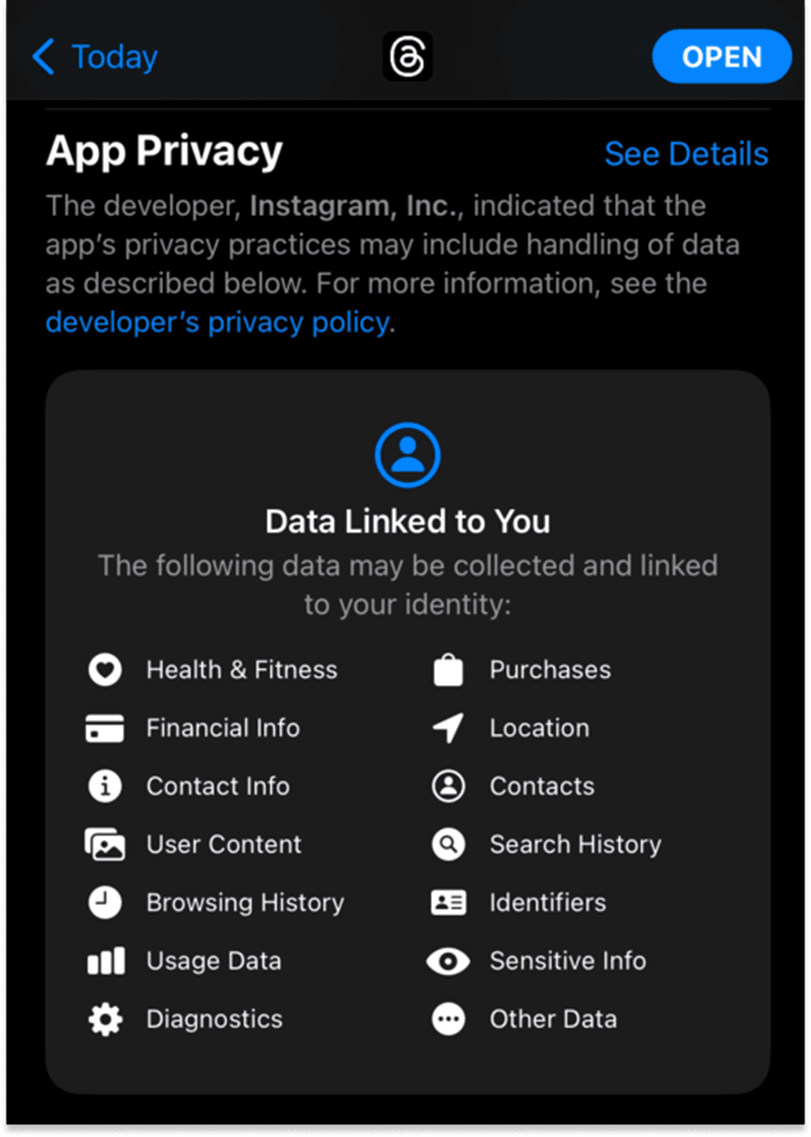
The open internet is becoming less open as companies like Reddit and Twitter block their content in order to charge companies like OpenAI and Google large fees for access. Rumor has it that Twitter recently restricted its product for the sake of AI model acquisition. Meta could try to get as many people as possible to share their thoughts, conversations, and analysis for free on Threads, and use that to train better and better versions of the language model without having to tangle with it all.
Zuck can play 3D chess, too. Whether or not Threads becomes a better, bigger, more profitable version of Twitter, whether or not it replaces Twitter, Zuck and his team can extract a lot of value from this product to use in making bigger bets in the Metaverse and open source AI. And of course, Meta can also use the information you provide on Threads to serve you more relevant ads across its family of apps.
Regardless, Meta has shown a willingness to be an open alternative to more closed competitors, whether out of the goodness of its heart or market dynamics, as I wrote in Low Extraction Meta. I think it’s good for the world to have open alternatives to OpenAI’s AI and to Apple in AR/VR/MR, and Twitter’s missteps in this regard may have contributed to that positivity in its own indirect way.
Overall, Twitter's loss is our gain. We'll spend less time on Twitter, freeing up time for more productive and meaningful things. Entrepreneurs will have room to come up with novel evolutions of social products based on words and ideas. Meta might even get the ingredients it needs to make big tech companies more open.
After leaving Twitter
In the early stages of the history of the Internet, the first generation of social products (such as Twitter, Facebook, Instagram, Reddit, etc.) were always at a disadvantage when they were seen as the ideal form of social products.
Overall, decades from now, they may be viewed as early experiments that a later generation of entrepreneurs will learn from to create better products. But network effects are a very powerful force, and very difficult to overcome. Even if this generation’s products are not perfect, they are fixed.
Whether out of incompetence or good intentions, Elon broke the shackles of social by destroying what made Twitter unique and what holds it together. The world is better for it. Praise Elon.
…or Twitter will find a way to recapture our hearts and top our screen time reports once again, and I’ll just waste more time talking about this beautiful, horrible, depressing app for nothing.
There's only one way to find out. See you on Twitter.