

Author | Produced by Joyce | Vernacular Blockchain (ID: hellobtc)
The zkSync Era mainnet was opened to everyone on March 24. In just over two months, TVL reached US$480 million, with a weekly growth rate of nearly 20%. At present, the number of independent addresses of zkSync Era has reached 920,000, far exceeding popular Layer2 networks such as Arbitrum, Optimism and Starknet.
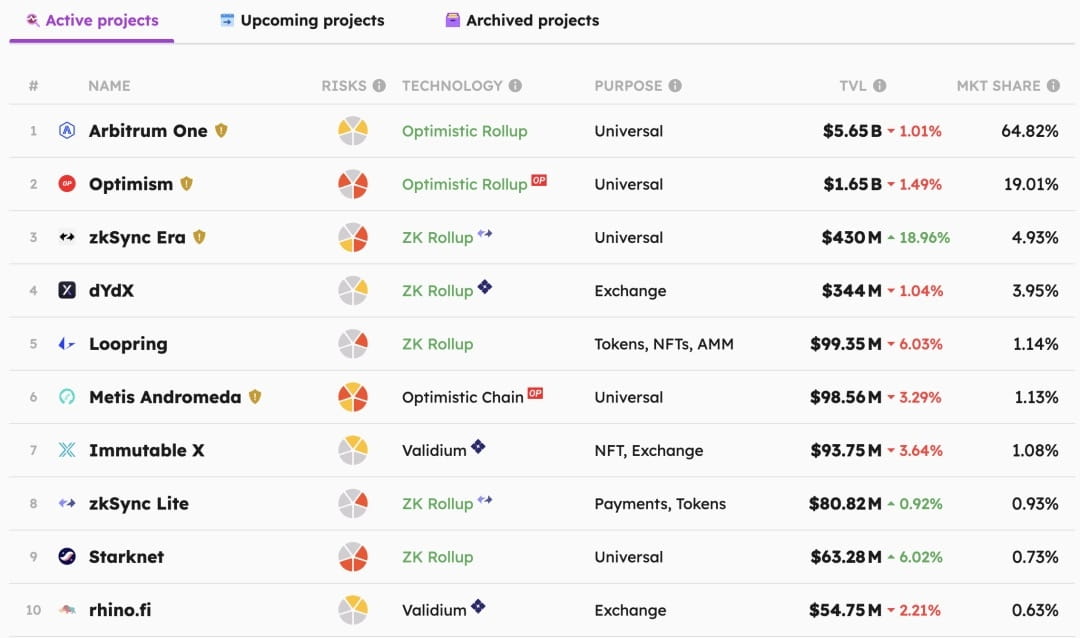
Layer2 project TVL ranking, zkSync Era currently ranks third, second only to Optimism. Data source: L2beat
Although these impressive data are related to the expected Token distribution of zkSync Era, after the Bitcoin ecosystem, led by BRC-20, has faded, zkSync Era has become a rare hot topic in the market. So what is the current ecological development of zkSync Era? What is the availability of ZK Rollup, which has always been criticized for its high technical difficulty and slow progress? After the expected end of the Token incentive, can zkSync Era continue to maintain high popularity and high TVL growth?
01 The Layer2 war spreads, what are the advantages of zkSync Era
The high fees, low speed and even congestion of the Ethereum mainnet have brought about the explosion of the Layer2 sector. Especially in the past six months, Arbitrum, Optimism and others have successively released token airdrops. A large number of stories of getting rich have attracted wool parties to turn their attention to Layer2 projects that have not yet released tokens. For a time, Layer2 has become the focus of financial resources and topics in the industry. In addition, Binance, Coinbase, ConsenSys and others have successively entered the Layer2 sector. The support of giant funds has made Layer2 a highly anticipated crypto narrative. So, among all the Layer2s, what is the position of zkSync Era and what are its advantages? The current focus of the industry on Layer2 is mainly Rollup solutions, including Optimistic Rollup and ZK Rollup. The basic principle of both is to package some transactions in Layer2 and then submit them to the Ethereum mainnet chain, but the difference lies in the form of data verification. Optimism Rollup first assumes that all transaction data is fine, but provides a period of inspection. Once someone finds transaction data involving fraud, they will receive penalty funds pledged by the audit node as a reward. ZK Rollup uses zero-knowledge proof. After the data is packaged, a large amount of calculation is performed to generate the zero-knowledge proof of the data and submit it to the chain together with other relevant core data to verify whether it is correct. It directly gives a deterministic result by relying on algorithms and computing power. Compared with the tortuous game process in the middle of Optimism Rollup, it is indeed much smarter. However, the problem with ZK Rollup is that the technical implementation is much more complicated than Optimism Rollup. Therefore, when the main network of Optimistic Rollup projects such as Arbitrum and OP went online early to seize the opportunity, other ZK projects could only be anxious. After all, technical difficulties require real time and resource investment, and there is no rush. However, whether it is for public chains or Layer2 projects, the construction of the ecosystem is particularly important. Moreover, the construction of many projects is a process of repairing while flying an airplane. It is difficult to wait until a project is perfect before going online. Bitcoin is an exception. After all, the functions and incentive mechanisms of Bitcoin are very simple. For most projects, it is a process of running and iterating after going online. Ethereum is a typical example.Compared with when Ethereum was first launched, the performance, architecture and even consensus mechanism of today's Ethereum have changed a lot, but the continuous construction of the ecosystem has made Ethereum a giant in the industry. Therefore, it is not difficult to understand why some public chains or Layer2 projects are in a hurry to go online before the technical solutions are fully mature. From the current Layer2 ecosystem, since Arbitrum launched its mainnet in September 2021, its TVL has soared to more than 1 billion US dollars in just a few days. Although OP was launched a month earlier than Arbitrum, the stability and experience of the mainnet were not as good as expected when it was launched, and the TVL growth was not as fast as Arbitrum. But in any case, compared with ZK projects such as zkSync and Starknet, which launched their mainnet a year later, they have indeed seized the initiative in ecological construction. However, as the first ZK Rollup launched on the mainnet, the data after zkSync Era was launched is also remarkable. Unlike Starknet, which uses an independent contract language, the language tools used by zkSync Era are highly compatible with the existing Ethereum mainnet. This high compatibility allows projects on the Ethereum mainnet to migrate to the zkSync Era mainnet quite smoothly. Like the early Arbitrum, zkSync Era's TVL has risen rapidly after the mainnet was launched, exceeding $2 billion in TVL in just 20 days, which is not inferior to the current leading Arbitrum in its initial launch. Therefore, although zkSync Era's TVL currently accounts for less than 5% of the entire Layer2, with the current weekly growth rate of nearly 20%, is it promising in the future?
02 zkSync Ecosystem Overview
Arbitrum currently has a TVL of 5.6 billion US dollars, accounting for about 65% of the TVL of all Layer2 projects. After a year and a half of ecological construction, there are now more than 500 DApps on Arbitrum, especially GMX (launched on Arbitrum in September 2021), which once dominated the hot list in the bear market. It is the ace project native to the Arbitrum ecosystem. It can be said that the rise of Arbitrum is inseparable from these native high-quality projects. Even though the Token distribution incentive has been completed, Arbitrum TVL still ranks first. Although at the beginning, Arbitrum’s high compatibility with the Ethereum mainnet EVM allowed a large number of DApps on Ethereum to migrate smoothly and complete the initial TVL accumulation, but the real continuous competitive advantage still depends on its native high-quality DApps on the chain. So, how is the current zkSync ecosystem? Are there any signs of powerful projects like GMX? According to the statistics on the zkSync official website, nearly 300 Dapps have been connected to the zkSync Era ecosystem. Although there are many star projects such as Uniswap, 1inch, and LayerZero, only 58 projects are actually online at present, which are marked as "Live on Era". Moreover, it is difficult to see well-known DApps in the list of online projects.
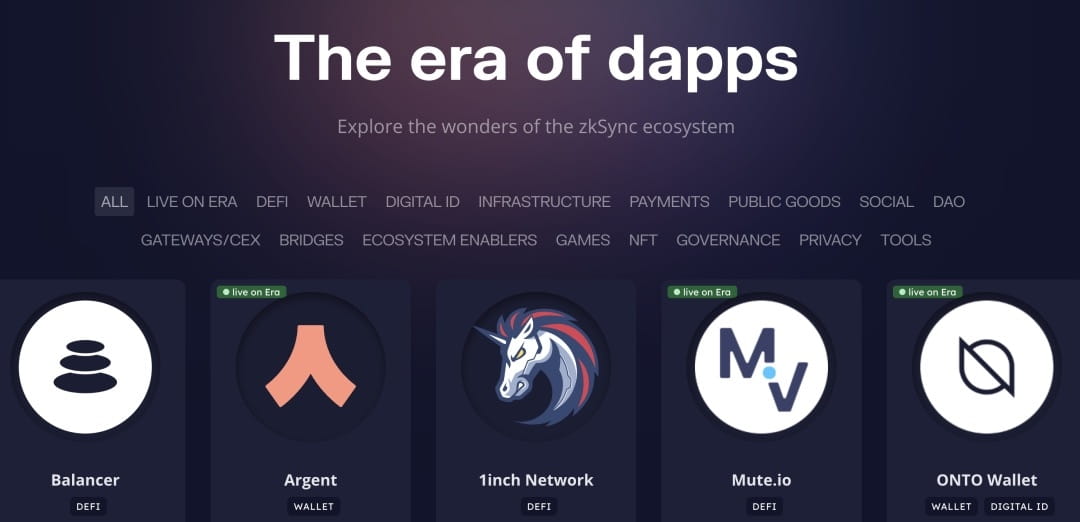
Source: zkSync official website
It can be said that the entire zkSync ecosystem is still in a relatively poor state. Although the TVL is growing rapidly, the total amount is not high. SyncSwap, which ranks first, accounts for more than 41% of the DeFi TVL on the entire chain, and the TVL of the top ten DApps accounts for nearly 96%. Moreover, these DApps are mainly Dex, plus several loan agreements. At present, there are no projects in the top ten projects that have some unique innovative advantages like GMX.
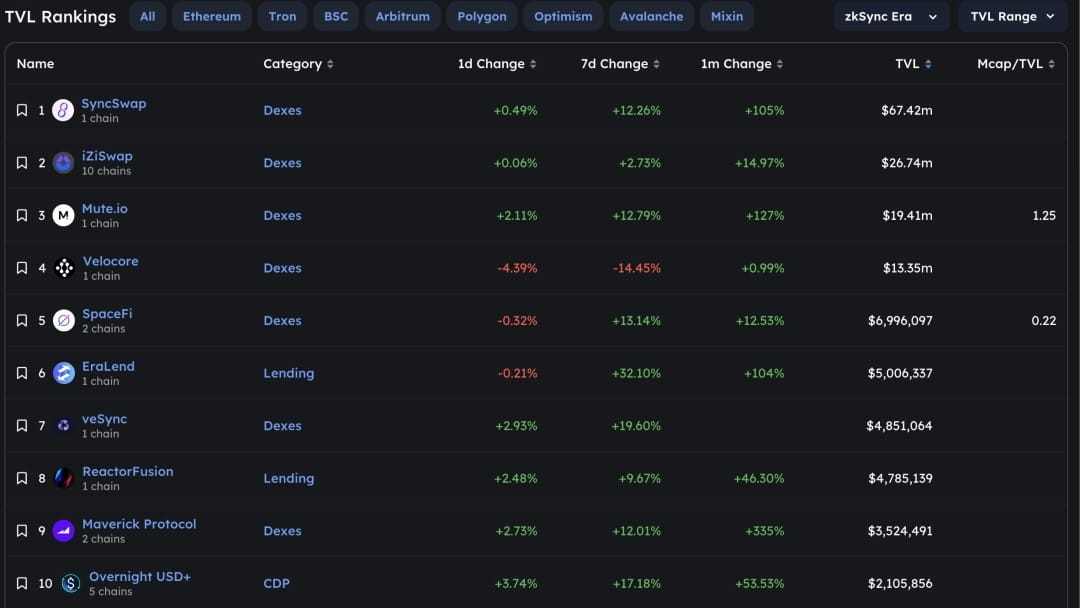
Data source: defillama
Moreover, although the number of independent addresses of zkSync Era has grown very rapidly, reaching 920,700 in just two months, and the number of ETH on the cross-chain bridge has also broken through new highs, exceeding 280,000, but from the perspective of the ETH balance of each address, more than 61.4% of the address balance is less than 0.1ETH, 30.6% of the address balance is between 0.1~1ETH, 7.7% of the address balance is between 1~10ETH, and the remaining 0.3% of the address balance is above 10ETH. From the distribution of zkSync Era independent address balances, it is not difficult to see that the vast majority of users are currently wool parties attracted by the expected distribution of zkSync Era Token.
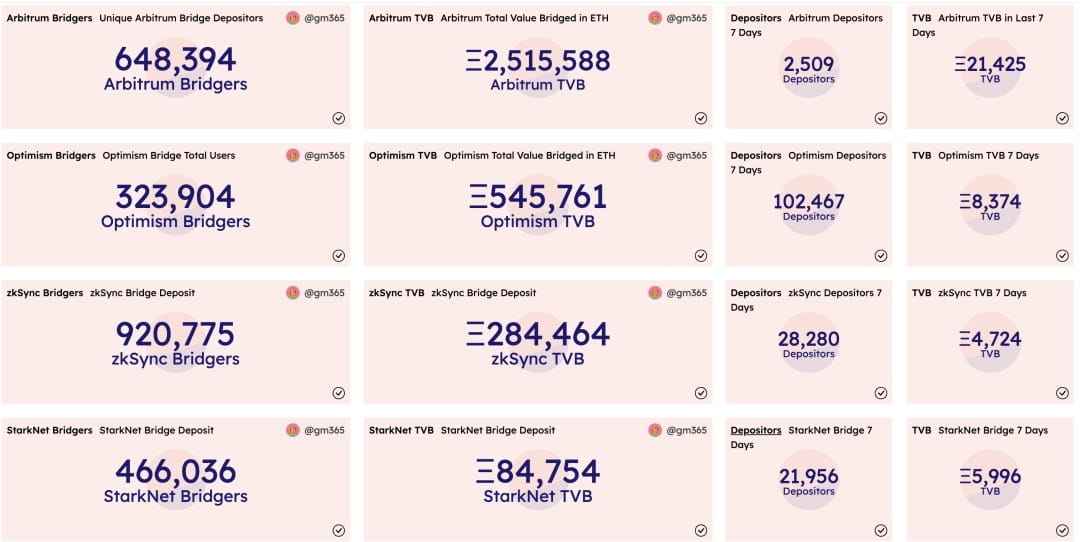
Data on independent addresses of popular Layer2 projects such as zkSync and Arbitrum, source: Dune
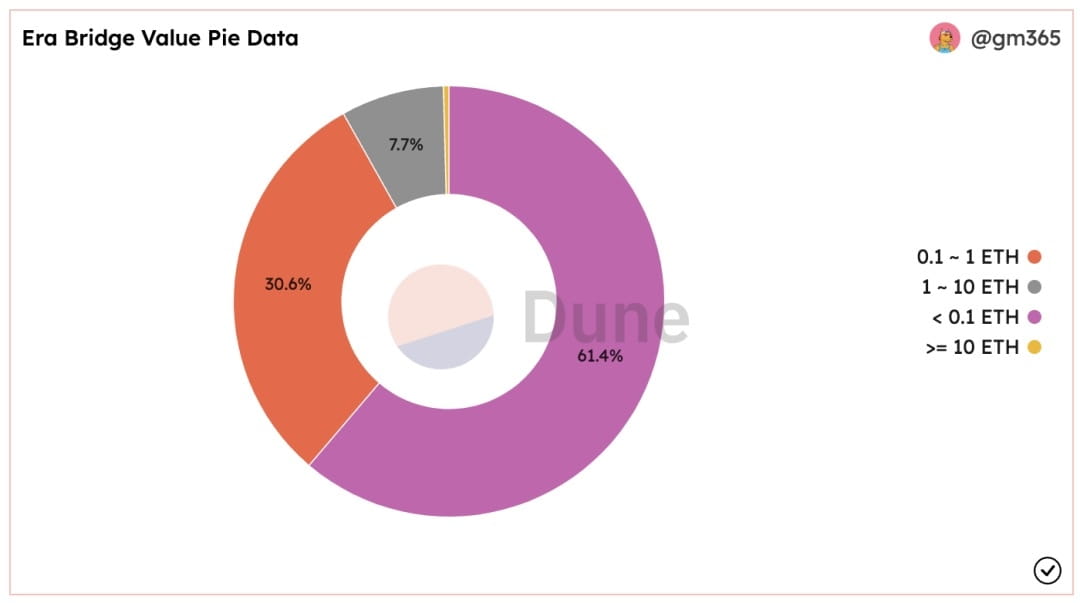
Schematic diagram of zkSync Era address balance distribution, source: Dune
Deyi is a member of the zkSync Era wool army. When talking about zkSync, he said: At present, due to the lack of star projects such as Uniswap and AAVE on zkSync Era, it is difficult to undertake large-scale fund lock-up (participating in DEX liquidity mining or loan agreement), and most of them are wool-pulling users. In particular, zkSync has clearly stated that it will release tokens. Under Arbitrum's innovative token incentive model, the expectation of zkSync airdrop has attracted a large number of wool-pulling studios, bringing an explosive growth in the number of independent addresses. However, there are limited projects that are really worth participating in the interaction. They are nothing more than DEXs and loans with relatively high TVL rankings, as well as several commonly used cross-chain bridges. As for the official cross-chain bridge of zkSync, because it can only cross-chain from the Ethereum mainnet to zkSync at present, the cost is 5-6U, and even reaches more than 10U when the chain is congested. Therefore, for wool-pulling parties, unless it is for the expected interaction of airdrop, other cross-chain bridges are generally selected when funds are really needed for cross-chain, after all, the cost savings are more than 70%.
03 Current issues with zkSync Era
As the ZKEVM project that claims to be the first to launch the mainnet, zkSync Era has reached more than 920,000 independent addresses in just two months, surpassing all other mainstream Layer2 projects, and its TVL has also achieved explosive growth. However, compared with star Layer2 projects such as Arbitrum, its problems are also very obvious: 1. It is still in its early stages. Although the official website has announced many cooperative projects, the star projects have not really been launched. There are not many native projects that have been launched, and the quality is also uneven. It is difficult to rely on star projects with institutional endorsements and a large community base to quickly accumulate TVL. 2. The top-ranked native projects that have been launched are mainly Dex and borrowing. There are no projects with unique competitive advantages such as GMX that have broken through. For users, at present, in addition to the attractiveness of token distribution, there are not many other reasons to use it. After the expectation of token distribution disappears, how to compete with Layer2 giants Arbitrum and Optimism that have the first-mover advantage to obtain high-quality TVL is a problem that must be considered. 3. The complexity of zkSync Era technology leads to the instability of its block generation. Compared with Optimistic Rollup projects such as Arbitrum and Optimism, the ZK Rollup project is much more difficult in terms of technical development. zkSync is relatively compatible with the Ethereum mainnet, but there are still some compatibility challenges for DApps on zkSync Era. However, with the further maturity of ZKEVM technology and the arrival of the decentralized stage, these problems will be effectively improved in the future.
04 Summary
In addition to traditional star Layer2 projects, giants such as Binance, Coinbase, and ConsenSys have also laid out Layer2 sectors, which are likely to be the light of the next bull market. Can zkSync Era come out? There are still too many variables.