

Original author: Joy, PANews
Joseph Kennedy, the first chairman of the U.S. Securities and Exchange Commission, once said: "The SEC must strike fear into the hearts of dishonest businesses." But today, the actions of the then chairman Gary Gensler have made crypto companies feel not fear but disgust.
Due to the recent massive prosecution of crypto institutions, Gensler has not only been criticized by the crypto community, but also called on to step down by the House of Representatives. Of course, Gensler has never taken these public opinions seriously, and still righteously cites the old Howey test, which may not be applicable to cryptocurrencies, to judge many crypto projects. As the iron-fisted regulator who understands crypto the most, he repeatedly accused the crypto projects of hiding too many "little thoughts" under their "medals of honor".
A financial Jew from Wall Street, a heavy-handed regulator who once "bloodbathed" derivatives
Like SBF, the founder of FTX, Gensler is also Jewish and was born into a Jewish family in Baltimore, Maryland, USA. Gary Gensler started his career at Goldman Sachs and worked his way up to co-head of finance. At the age of 30, he became one of the youngest partners of the company at the time. Robert Rubin, CEO of Goldman Sachs, joined the Clinton administration in 1993 and became the U.S. Treasury Secretary in 1995. Gensler then followed his former boss to join the U.S. Treasury Department as Assistant Secretary of Financial Markets in 1997, starting his political career.
During Hillary Clinton's 2008 presidential campaign, Gensler served as a senior advisor and provided advice to Obama's campaign. During Obama's presidency, Gensler served as chairman of the U.S. Commodity Futures Trading Commission (CFTC) from 2009 to 2014. At that time, Gensler, who had just taken office at the CFTC, faced a situation quite similar to the current crypto market - the mess after the 2008 financial crisis and the derivatives market was in the Wild West. But he successfully promoted the implementation of new regulations on U.S. derivatives regulation. As a result, the Wall Street Journal called Gensler "a tough regulator who has pushed for stricter rules to manage the trillion-dollar derivatives market."
Later, Gensler also served as the chief financial officer of Hillary Clinton's 2016 presidential campaign. But during the term of Trump, the Democratic Party lost the election, Gensler went to teach at the Massachusetts Institute of Technology's School of Economics. At that time, one of the courses he taught was blockchain and currency, focusing on the development of Bitcoin and the impact of blockchain on the financial industry. He also served as the chairman of the Maryland Financial Consumer Protection Committee, and these years were his dormant period. With Biden's coming to power, Gensler's political career scored a second goal in 2021 and was appointed chairman of the SEC.
Gary Gensler, who taught at MIT
The relationship with FTX is ambiguous, and its downfall has become a watershed in crypto regulation
In 2021, US President Biden nominated Gensler to serve as the 33rd Chairman of the U.S. Securities and Exchange Commission. On April 19, 2021, Gensler was confirmed to serve a five-year term until 2026. In June 2021, he succeeded SEC Acting Chairman Allison Lee as the new SEC Chairman. When Gensler first took office at the SEC, many crypto practitioners were delighted and believed that the crypto industry had welcomed a friendly regulator. Because just a few days before he officially took office, he also called for support for the "Green Crypto" (#GreenCrypto) retweet campaign on Twitter and released his own "green laser eye" meme. He asked netizens if they needed to invite more people to retweet for the "Green Crypto" campaign on Twitter.

Later, everyone gradually realized that it was precisely because he understood crypto that he was more confident in his strong attack. His regulatory policy on crypto was stricter than any previous SEC chairman. He hoped to launch a "taming finance" campaign to strengthen the regulation of the crypto market. Gary Gensler's series of speeches emphasized the importance of investor protection and sent a signal that the SEC would strengthen regulation of the cryptocurrency field.
According to incomplete statistics from PANews, since Gensler took office, his work related to encryption projects has included not only multiple investigations and prosecutions, but also the approval of the listing of the first Bitcoin futures ETF.
In July 2021, Circle said it had received an investigation subpoena from the SEC, and Circle's application for listing has been unsuccessful.
In September 2021, the SEC warned Coinbase not to launch lending products, otherwise it would file a lawsuit against Coinbase.
In September 2021, the SEC said it was investigating Uniswap Labs, collecting information to study how users interact with the platform and Uniswap's marketing methods.
In September 2021, Gensler called on cryptocurrency exchanges to register with the SEC in an interview, warning that if they fail to do so, they will be hit by SEC enforcement actions.
On October 19, 2021, the first Bitcoin futures ETF, The ProShares Bitcoin Strategy (code name BITO), was approved for listing.
In November 2021, the SEC investigated BlockFi's interest-bearing crypto accounts of up to 9.5% and determined that they were securities. Subsequently, in February 2022, BlockFi and the SEC reached a settlement and paid the SEC $50 million.
In December 2022, after the collapse of FTX, the SEC sued FTX and founder SBF for violating anti-fraud regulations.
In January 2023, Nexo settled for $45 million after being accused by the SEC of issuing and selling EIPs without registration.
In February 2023, Kraken was accused by the SEC of illegally issuing securities and soon settled for $30 million.
In February 2023, the US dollar stablecoin BUSD was accused by the SEC of illegally issuing securities.
In June 2023, it sued the Coinbase exchange, Binance US and its founder Changpeng Zhao.
However, his regulation of cryptocurrencies has intensified since the collapse of FTX, from investigation to formal prosecution. The collapse of FTX has become a watershed event in the regulation of cryptocurrencies in the United States.
PANews previously wrote an article titled "The End of FTX: A Deep Look into SBF's "Political Business" and the Private Relationship with Senior Regulators" which mentioned the relationship between Gensler and FTX. After Gensler returned to the political stage, his former colleagues from the CFTC went to work at FTX.US. For example, Mark Wetjen, the former acting head of the CFTC, was hired as the head of policy and regulation for FTX US in 2021; Ryne Miller, the general counsel of FTX US, was also Gensler's personal legal counsel when he was at the CFTC. This has also triggered public speculation about the deep relationship between FTX and Gensler. It is worth mentioning that SBF's ex-girlfriend Caroline, who is also the CEO of Alameda, has a father who is a professor and director of economics at MIT, that is, Gensler's former boss when he taught at MIT. U.S. Congressman Tom Emmer tweeted in November last year: "My office has received reports that SEC Chairman Gary Gensler is helping SBF and FTX exploit legal loopholes to gain regulatory monopoly status."
Gensler’s close relationship with the FTX executive team has also become a stain on his political career, which has been seized upon by his competitors. After FTX collapsed, the Republicans launched fierce criticism, and Congressman Warren Davidson proposed a new legislation to remove Gensler and fill the vacancy with the executive director of the U.S. Securities and Exchange Commission. Patrick McHenry, chairman of the House Financial Services Committee, said in his tweet that the SEC’s crackdown on cryptocurrencies has failed to bring stability to the digital asset market. He wrote: "Your actions are driving overseas innovation and endangering America's competitiveness."
Gensler: What’s Changing and What’s Not Changing About Regulation as Crypto’s Night of the Long Knives Begins
Gary Gensler's attitude towards cryptocurrency has a sharp contrast before and after he took office, but he has always supported Bitcoin and called cryptocurrency securities.
At a blockchain business summit in 2018, Gary Gensler said blockchain technology has real potential to change the financial world; although there are still many technical and business challenges to overcome, this innovation can reduce costs and risks in the financial system. He is a blockchain optimist and wants to see the technology succeed.
According to Forbes, a new video shows that Gary Gensler, chairman of the U.S. Securities and Exchange Commission (SEC), told institutional investors in 2018 that BTC, ETH, LTC and BCH were not securities. These tokens accounted for 75% of the crypto market at the time. The remarks came at a time when cryptocurrencies were in the midst of a bull market and a little more than two years before Gensler was appointed chairman of the SEC. The video comes from a crypto-themed institutional investor event hosted by Bloomberg and Fidelity in 2018, which contradicts his recent statement that he now believes that all cryptocurrencies other than Bitcoin are securities. Related reading: "A picture to understand the tokens that have been identified as securities by the U.S. SEC"
In a U.S. congressional hearing in July 2018, a congressman said that the cryptocurrency project was a Ponzi scheme and had no value. Gensler also refuted that gold had no value either, and its value was the economic value given to it by people. He also believed that cryptocurrency could be regarded as a digital rare metal with certain value.
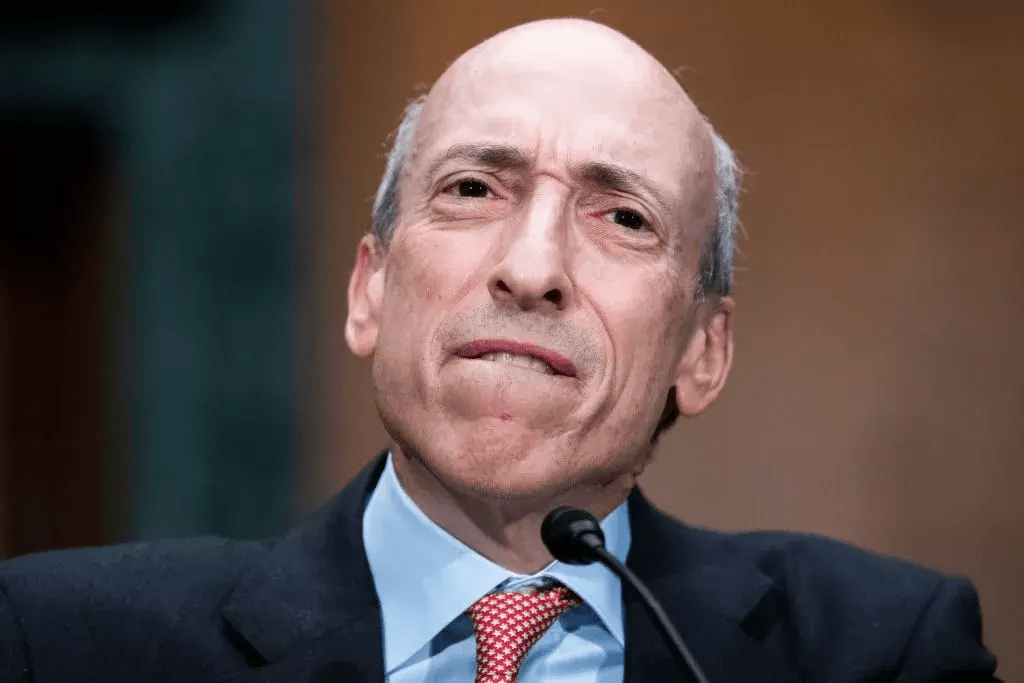
While teaching at MIT, Gensler also encouraged students to get involved in Crypto. Manta Network co-founder and COO Kenny said on Twitter that he was a student in Gensler's class. Gary Gensler sent his report on BNB to Zhao Changpeng and encouraged him to get more involved in crypto. He also had in-depth exchanges and discussions with Gensler on crypto projects in the summer of 2019. This statement seems to confirm the previous statement of Binance's lawyers. Lawyers from Binance's two law firms Gibson Dunn and Latham Watkins claimed that Gary Gensler had offered to serve as a consultant to Binance's parent company in 2019. The lawyers said that before Gensler began to pursue Binance, he had been trying to "get close" to the company. Due to Gensler's relationship with Zhao Changpeng, Binance's lawyers said that they had asked Gensler to recuse himself from any actions involving the company.
But after taking office as chairman of the SEC, Gensler has been more critical of encryption. For example, he gave a speech at the SEC's annual "SEC Speaks" event in 2022, focusing on the regulation of the cryptocurrency market. "There are nearly 10,000 crypto tokens in the current crypto market, and I believe that the vast majority of them are securities, so the issuance and sale of these security-type crypto tokens will be regulated by securities laws. ..... I have asked the staff of the SEC to work directly with crypto project entrepreneurs to register and regulate the tokens they create as securities where appropriate. ..... Given that many crypto tokens fall into the category of securities, this means that many crypto intermediaries are obtaining securities transactions, so they must be registered with the SEC in some capacity." His remarks on encryption on other occasions are also of this tone.
In February of this year, after the SEC accused BUSD, a crypto KOL said that the SEC was actually implementing its own crypto version of the "Night of the Long Knives". The Night of the Long Knives refers to the liquidation operation that took place in Nazi Germany from June 30 to July 2, 1934. Hitler used this purge to eliminate his political opponents and strengthen his control over the military.
Undoubtedly, Gensler’s purge of the crypto circle is entering its climax.