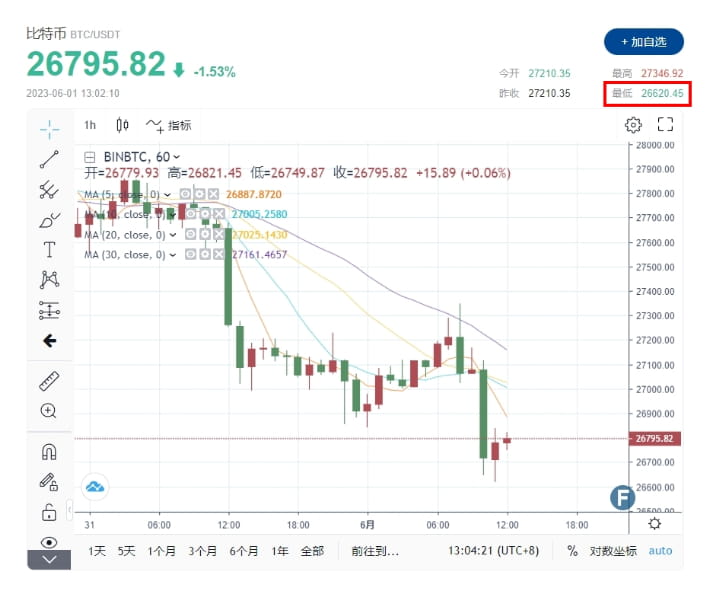
On Thursday (June 1) in the Asian market, Bitcoin fell to a low of $26,620, and the short-term plunge was sudden. The renminbi depreciated by 2.7% against the US dollar, the worst performance since September 2022. Observers said that the potential intervention of the People's Bank of China to curb the volatility of the renminbi could accelerate the rise of the US dollar index and further aggravate the difficulties of the crypto market.
The People's Bank of China (PBOC), the central bank of China, loosely pegs the value of the RMB to a basket of 24 currencies through a managed floating exchange rate system. Daily fixings or midpoints are set every trading day to provide direction to the market. The currency basket reflects China's trading partners, with the United States being the largest and the US dollar having the highest weighting at 19.83%. The Euro, Japanese Yen, British Pound, Australian Dollar, Mexican Peso are some of the other currencies in the basket.
The PBOC's managed floating exchange rate allows the RMB to fluctuate 2% above or below the daily central parity rate, and the bank manages this range by actively trading the RMB. For example, if the USD/CNY exchange rate threatens to rebound beyond the 2% limit, the PBOC sells dollars and buys RMB to support the value of the RMB. At the same time, the bank buys dollars against other currencies to keep the proportion of dollars in reserves stable, ensuring that intervention is recycled back to other foreign units.
This process inadvertently put upward pressure on the US dollar index, which is mainly based on the euro and the yen, leading to global financial tightening and triggering risk aversion.
On Thursday, the RMB central parity rate continued to search for a bottom, hitting a new low since December 1, 2022. The RMB central parity rate was 7.0965 to 1 US dollar, down 144 basis points from the previous day's central parity rate. The offshore and onshore RMB remained at the 7.1 mark, but rebounded slightly. Chinese media quoted analysts as saying that China will increase its economic stabilization policies in the future, including continuing to introduce policies to stabilize foreign trade, and there is no basis for the continued depreciation of the RMB.
Beijing Business Daily published an article saying that the depreciation of the RMB is not sustainable. The article quoted an analysis saying that the depreciation was mainly affected by the strengthening of the US dollar index and the weakening market expectations for the recovery of the mainland economy. China's PMI in May was lower than expected, "the recovery of domestic demand has experienced short-term fluctuations, which has triggered market expectations of monetary policy easing, and has put a certain drag on the RMB."
"But the impact of RMB depreciation is double-edged, helping to boost foreign trade exports of some companies, and the current fluctuations in the RMB exchange rate have not deviated from the equilibrium level."
David Brickell, director of institutional sales at Paradigm, a cryptocurrency liquidity network, said: “The rebound in USD/CNY means that the People’s Bank of China will sell the currency pair to maintain the 2% range and will have to buy dollars against other currencies to maintain a stable ratio of dollar reserves. This pushes up the dollar index, leading to financial tightening and risk aversion.”
When the dollar soars, those who borrow in dollars and receive payments in other currencies have trouble repaying their debts. According to Brickell, more than $17 trillion of dollar debt is issued outside the U.S. As a result, a stronger dollar tends to spark risk aversion around the world.
The dollar index rose 2.7% in May, while bitcoin fell 7.3%, its biggest monthly drop since December 2022.
Noelle Acheson, former head of research at Genesis Trading, said intervention by the central bank could be bullish for the dollar, but stressed that such actions are not certain. “The People’s Bank of China has been signaling that the RMB target range is more flexible than in the past, so it will not intervene, especially if a weaker RMB helps exports.”
“China’s priorities are different now, and the PBOC has been diversifying its reserves and could buy gold instead of more dollars.”
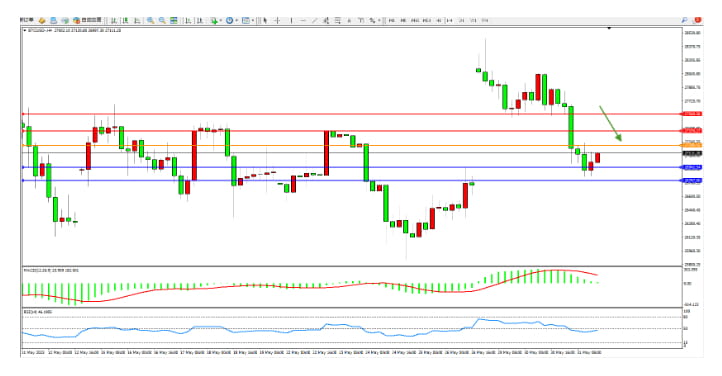
Below is CMTrade’s daily Bitcoin technical analysis
In the 4-hour chart, the market is shrouded in bearish sentiment, and the short-term momentum continues to fluctuate downward. Although there is reversal support in the short term, the downward trend is positive. The MACD indicator remains volatile and moves downward to the 0 axis, indicating poor consolidation.
Resistance: 27370 27969
Support: 26942 26787
Trading strategy: Bearish below 27200, target 26942 26787