
Over the past year, Ethereum Shapella has been upgraded (Shanghai Upgrade). Now, developers are working hard to prepare "Dencun" (Cancun+Deneb), focusing on scalability through proto-danksharding (also known as EIP-4844).
Since 2014, the Ethereum blockchain has undergone several improvements that have helped it maintain its position as the top smart contract platform. Over the years, these upgrades have varied in focus, with features such as increased efficiency, account abstraction, proof-of-stake, and changes to fee structures, all of which will make Ethereum a near-instant decentralized computing layer for Web3.

After the Shanghai upgrade, the latest update in April 2023 that enabled staking withdrawals, developers’ focus turned to improving Ethereum’s scalability, enabling faster transactions and lower fees through a technique called proto-danksharding.
Sharding is a relatively mature scalability concept that involves breaking a blockchain into smaller parts or shards, with each shard handling a portion of the total transactions. This allows transactions to be processed in parallel, thereby increasing efficiency. Each shard has a subset of all nodes in the network that will process transactions for its shard. Some blockchains have already implemented sharding, namely Harmony and NEAR Protocol.
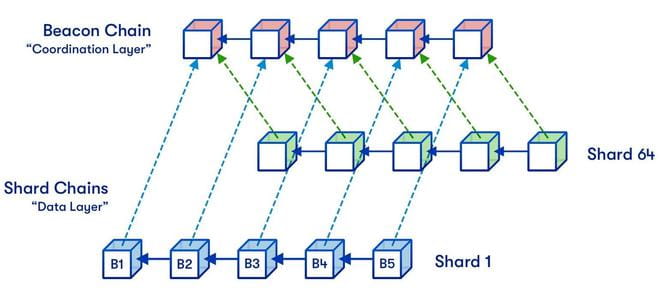
Around 2020, Ethereum shifted to a rollup-centric roadmap and planned to use Layer 2 primarily for scaling, rather than increasing transaction times on the base layer. As a result, its sharding strategy shifted from creating more space for transactions to providing space for Blobs (a data standard for post-sharding Ethereum) or simple storage spaces that are hosted on the mainnet but not further parsed. These blobs will store data from Layer 2 that can be cryptographically verified off-chain through zero-knowledge proofs and other techniques.
Sharding is named after Dankrad Feist, the ethereum researcher who developed the concept, and its main innovation is the use of merged market fees.
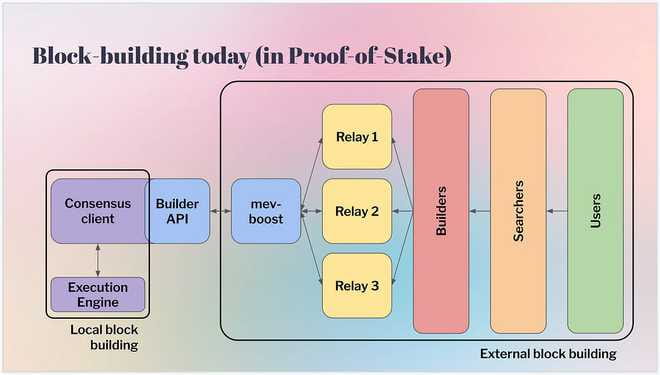
Currently, Ethereum blocks are constructed and proposed by the same source, which leads to the emergence of Maximum Extractable Value (MEV), which refers to the manipulation of the order of transactions by block validators in order to earn profits from them. For example, if there is a buy order for a token in a block, then the MEV sandwich attack causes the block validators to arrange the transactions in an order where they buy a large amount of tokens and increase the price, followed by the user's buy order to further increase the price, and finally the validator's sell order.
Danksharding introduces a combined market fee and proposer/builder separation, which means that the roles of builder and proposer are separated. Builders will create blocks and bid for their inclusion, and one proposer per block will choose the order of transactions based on this bid, but cannot see the transactions in it. This will help prevent MEV attacks from stealing billions of dollars from Ethereum users.
Proto-danksharding is the first step towards a full danksharding implementation, named after Ethereum researcher Proto Lambda. Its main goal is to introduce the previously mentioned blob data structure. Storing data in blobs is much cheaper than Ethereum transaction data, as it is not compatible with Ethereum's execution engine, and it will be used for layer 2 transaction information. As a result, interactions with Ethereum layer 2 will become cheaper while retaining the security and decentralization benefits of mainnet Ethereum.
One concern with introducing blobs is that it will significantly increase the size of Ethereum blocks. The hardware requirements to run nodes can become prohibitively expensive, leading to greater network centralization. To solve this problem, future Ethereum upgrades may automatically delete blob information after a period of time, which will sacrifice Ethereum's ability to store the complete blockchain history transactions, but as Ethereum founder Vitalik Buterin said: "Ethereum The purpose of the Fang consensus protocol is not to guarantee permanent storage of all historical data, but to provide a highly secure real-time bulletin board and leave room for other decentralized protocols for longer-term storage.”
The introduction of proto-danksharding in EIP-4844 and Cancun-Deneb will pave the way for a full danksharding implementation, which will reduce fees, increase transaction times, and create a more efficient, MEV-minimized blockchain. The expected upgrade date has not yet been finalized, but is expected to be released before the end of the year.


