

I spent the last two days going line by line through Coinkite’s postmortem on the Coldcard exploit, and honestly, my head is spinning a bit. 🧵
For more than five years, a silent configuration mistake sat inside a hardware wallet most Bitcoiners treated like a gold standard.
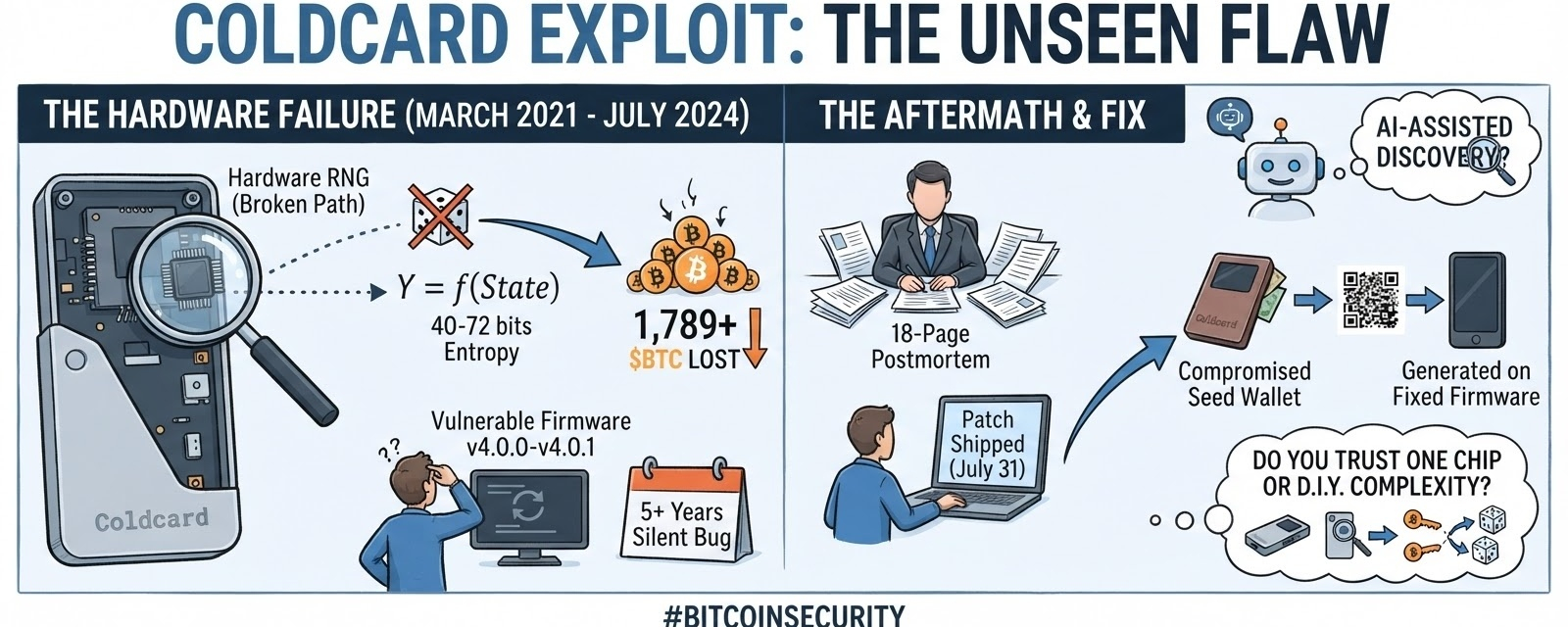
At least 1,789 $BTC walked out the door across thousands of addresses, without an attacker ever touching a physical device or guessing a single PIN.
When the sweeps started hitting back in late July, I remember thinking, okay, maybe someone compromised a batch or phished users. 💡
Reading the full write-up now, it wasn't flashy at all—it was a quiet plumbing mistake that turned hardware randomness into something predictable.
How the Entropy Loop Actually Broke
When you set up a cold wallet, you’re really just betting that your seed phrase can’t be guessed.
Normally, your device pulls physical noise from a hardware random number generator chip inside the board, not software tricks.
From what I traced in the postmortem, starting back in March 2021 with firmware v4.0.0/v4.0.1, the seed path stopped reaching the hardware RNG properly and fell back to Yasmarang inside MicroPython.
Software generators don’t create real physical surprise out of thin air; once you know the state and call pattern, the math narrows fast.
Instead of full cryptographic strength, affected seeds dropped down into roughly 40 to 72 bits of effective entropy depending on the model and firmware.
That’s the part that feels surreal when you use a cold wallet: you buy an air-gapped box, keep it offline, lock your backup away, and assume the math on day one is rock-solid.
Once attackers mapped out that smaller search space offline, they didn’t need your device—they could check addresses on-chain and sweep balances whenever funds showed up.
The Business Model & Market Timing Tension
I do want to give Coinkite credit for shipping a patch on July 31 and laying out an 18-page postmortem instead of sweeping the details under the rug.
Still, looking at the economics of hardware wallets makes me uneasy about how this system sustains itself over time.
You pay once for a piece of hardware, yet there’s no recurring revenue stream paying for endless adversarial testing—and right now there’s no compensation plan for users who lost funds.
Even with ~300 loss tickets across 242 accounts reported to Coinkite by mid-November, the real count is likely higher because not everyone speaks up.
And the timing feels way too loud to ignore. 🤔
Frontier AI models like Kimi K3 rolled out right before the late-July sweeps began, and Coinkite noted AI-assisted discovery is plausible even if attribution isn’t proven.
If cheaper, stronger AI tools can spot subtle integration blind spots that 15 prior reviews missed, old open-source assumptions face way harsher pressure than they used to.
The Catch That Keeps Bugging Me
The catch is that updating your firmware today does not fix a seed phrase that was already generated on vulnerable code.
If you’re holding $BTC,$BNB, or anything else on an older seed, patching the device doesn’t magically erase a key someone could have already reconstructed.
You actually have to generate a fresh seed on fixed firmware and move the coins yourself—assuming no one beat you to it.
What nags at me even more is the bigger contradiction we’re sitting inside right now. 📉
We tell people to self-custody so they don’t rely on third parties, yet mixing dice rolls or running multi-vendor multisig adds real complexity—and if people get intimidated or burned by hardware bugs, some will just drift back toward ETFs and custodians.
That leaves me stuck between two uncomfortable truths: trusting one chip blindly feels naive now, yet overcomplicating setups can backfire on everyday holders.
Do you feel safer sticking to a simple setup you actually understand, or pushing through the friction of dice entropy and multisig after seeing this? 👇
#EvolveAtBinanceBlockchainWeek #BitcoinSecurity #SelfCustody #Write2Earn
No
t financial advice. Always DYOR.