
How were the keys stolen? Chainflip publishes its second post-mortem; the 122.86 BTC taken has yet to move
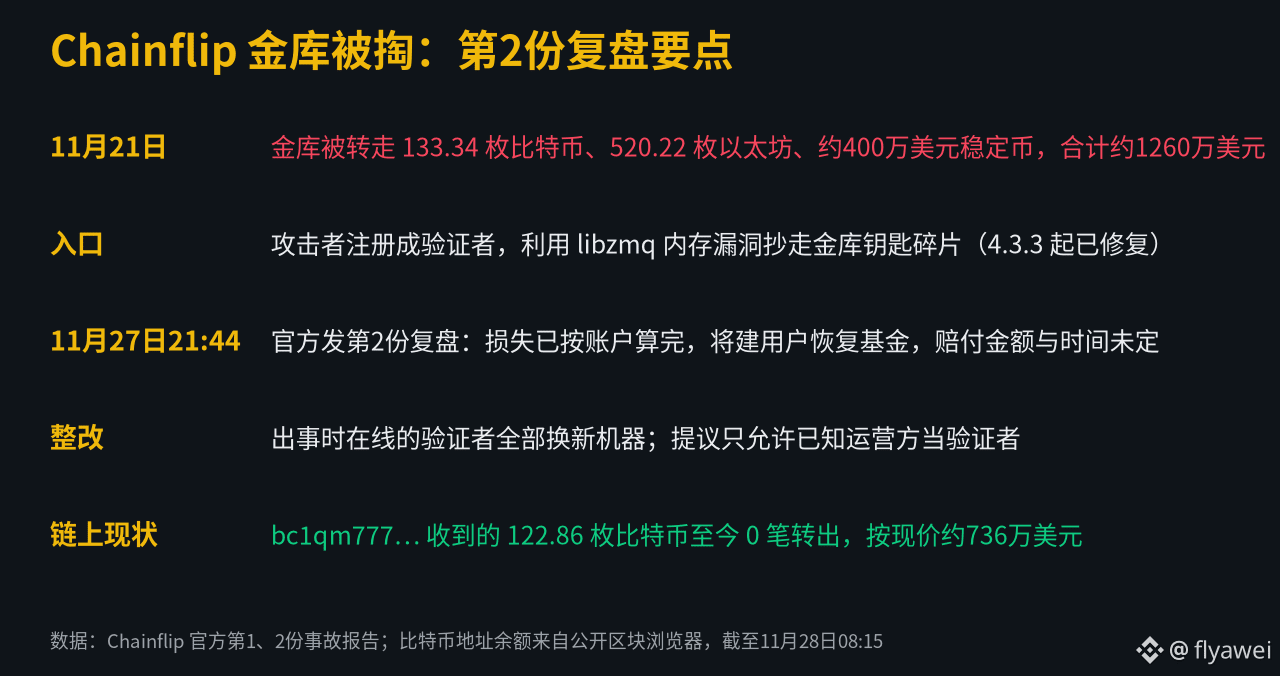
According to the official announcement, Chainflip published its second incident post-mortem at 21:44 on November 27. On November 21, 133.34 BTC, 520.22 ETH, and about $4 million in stablecoins were transferred out of its vault, for a total of roughly $12.6 million.
The post-mortem says the attacker first registered as a validator according to the rules, gaining the ability to communicate with other validators.
Then, the attacker exploited a memory vulnerability in the open-source communications library libzmq to copy enough vault key shards and bypass the network to sign transactions independently.
More strangely, this vulnerability had already been fixed in libzmq 4.3.3. My understanding is that many nodes were still running older versions when the incident occurred.
In other words, the keys were copied from validators’ machines. The official statement says the contracts themselves were not at fault.
The team says it has calculated losses by account and will set up a user recovery fund, but it has yet to say how much will be reimbursed or when. According to on-chain records, the 122.86 BTC sent to bc1qm777… has yet to move, and is worth about $7.36 million at current prices.
The biggest concern here is that the attacker joined by following the rules. This means that open admission itself was the entry point. The team now only allows known operators to join.
The funds haven’t moved, and the team also has an IP address previously exposed by the attacker. I think there’s a chance some of the funds could be recovered, but until compensation is paid out, users’ money remains at risk.
My advice for beginners: watch and learn more, and trade less. If you buy crypto, stick to $BTC