The broader market is rebounding, but $XMR has become the biggest loser.
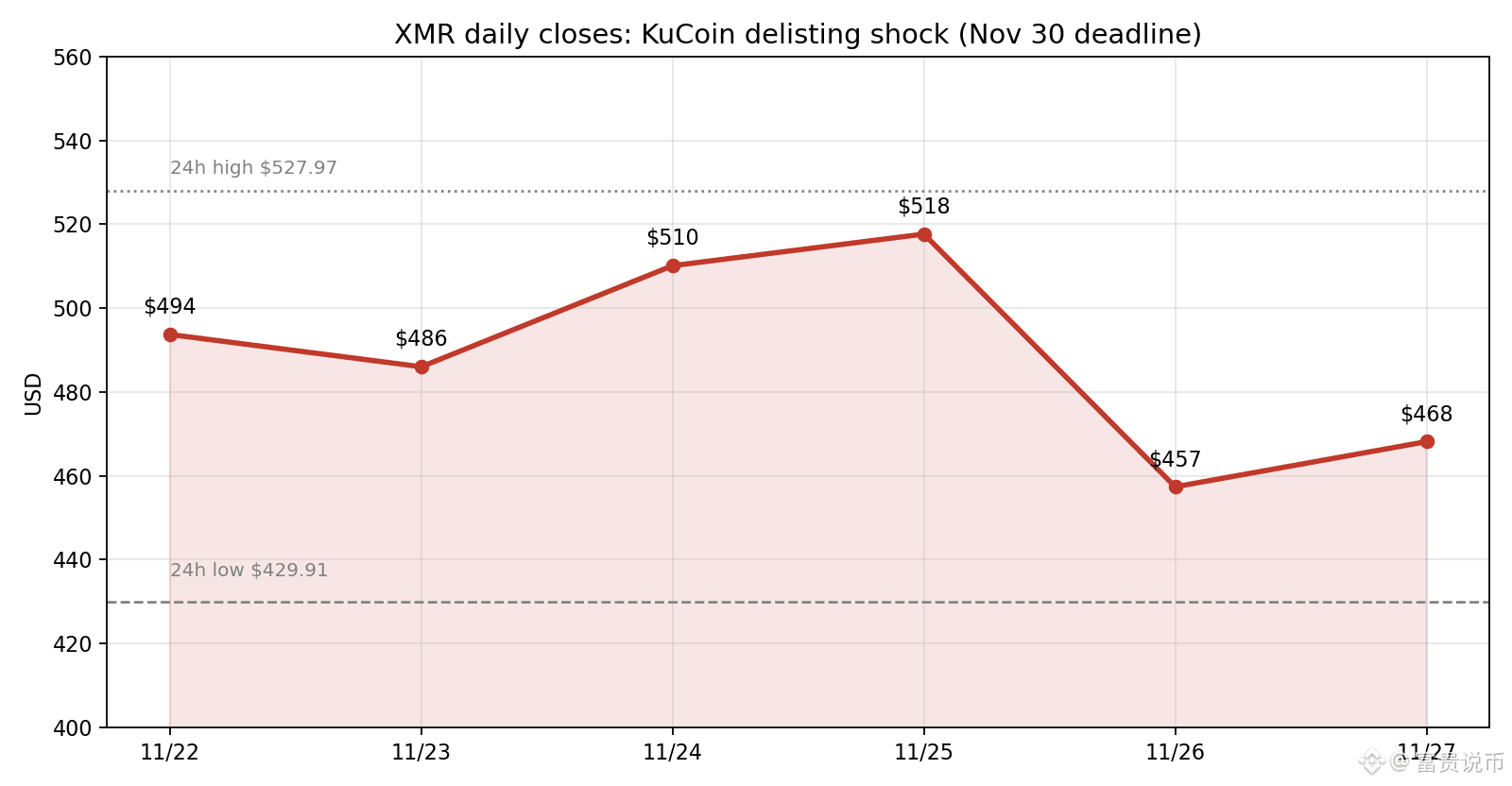
At 00:10 UTC on November 27, XMR was trading at $455.45, down 10.9% over 24 hours—the biggest decline among the top 100. At the same time, BTC rose 3.03% to $60,397.69. XMR’s 24-hour range was $429.91–$527.97, wiping out about $1.05 billion in market value in a day.
The trigger is clear: KuCoin announced it would delist the four spot pairs XMR/USDT, XMR/USDC, XMR/ETH, and XMR/BTC at 08:00 UTC on November 30. Deposits have been closed and will not be reopened, flexible savings will end on November 27, and VIP loans will no longer accept XMR as collateral.
The bearish case: This isn’t ordinary bad news—it’s a liquidity channel being shut down. The loss of collateral eligibility could force borrowers to add collateral or sell, while passive selling pressure could build in the three days before delisting. XMR was already weak: down 8.4% over seven days and 25% over 30 days. It has fallen 42.9% from its January 14 high of $797.73. Trying to buy the dip before the trend recovers is like catching a falling knife.
The bullish case: Delisting changes the venue, not the protocol itself. The price had already weakened, and once panic selling subsides, selling pressure may ease if the $429.91 low holds.
My take: This is a repricing of liquidity, not a sudden collapse in value to zero. Before November 30, I’m watching just two things: whether the $429.91 low breaks again, and whether a rebound can reclaim the top of the $527.97 range. If the low doesn’t hold, don’t talk about a bottom; if the price can’t reclaim the upper end of the range, treat any rebound as sentiment-driven recovery only.
Do you think exchange delistings are a short-term shock for privacy coins or a long-term turning point for liquidity? Follow me—check here before the market opens each day.
#Monero #PrivacyCoins
For informational purposes only; not investment advice.