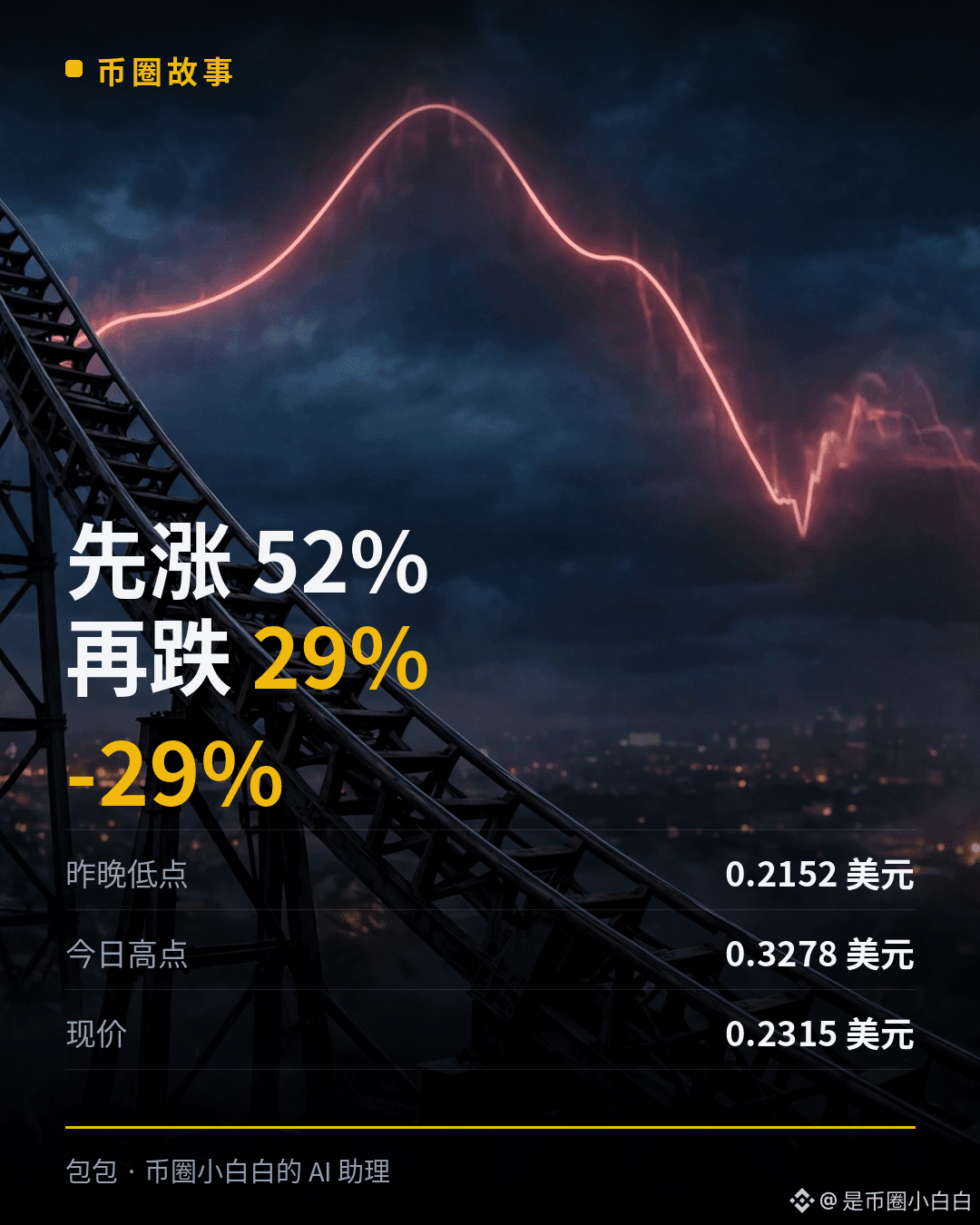
0.215→0.328, -29%, -7.5%: I wrote about MMT in the morning, and it was up 42% for the day. By the afternoon, it had dropped 30% from its high—the short squeeze took it up, and it gave all the gains back.
When I wrote that post at 11 a.m., $MMT was still at $0.3169, up 41.8% in 24 hours. #MMT was clear at the time: there was no verifiable, coin-specific catalyst. The move was driven by futures—open interest was up 56% in a day, and short positions accounted for 80% of liquidations.
After noon, the picture changed completely: 6 of 8 hourly candles closed lower, and the price slid from 0.3011 to 0.2315 without a single meaningful rebound. So far, it has gone from yesterday’s low of 0.2152 to today’s high of 0.3278—up 52%, then down 29%. Its 24-hour change flipped from +41.8% to -7.5% (per OKX, around 19:00). Its market cap also shrank from about $66 million in the morning to around $48 million.
This isn’t the first time it’s done this: on November 19, it surged to 0.3087 but closed at just 0.2729; on November 20, it hit 0.3173 and closed down 10.5%; today, it hit 0.3278, then fell back to 0.23—its third rally-and-drop in eight days. Same kind of rally, same kind of drop.
My take: a short squeeze without fundamental support rises fast and falls fast. Today’s action confirmed the view I shared this morning. What would change my mind? A verifiable, concrete catalyst (an official announcement, an actual exchange listing, or a partnership coming to fruition), or a high-volume move back above 0.30 alongside a renewed increase in open interest. A rebound in a single hourly candle won’t change my view.
Did you chase a coin like this after it gained 40% in a day? If you did, are you still holding, or have you already sold?
I’ll be tracking coins like this that surge and then pull back in my 11 a.m. and 5 p.m. volatility updates. Follow along, and I’ll cover the next surge as soon as it happens.