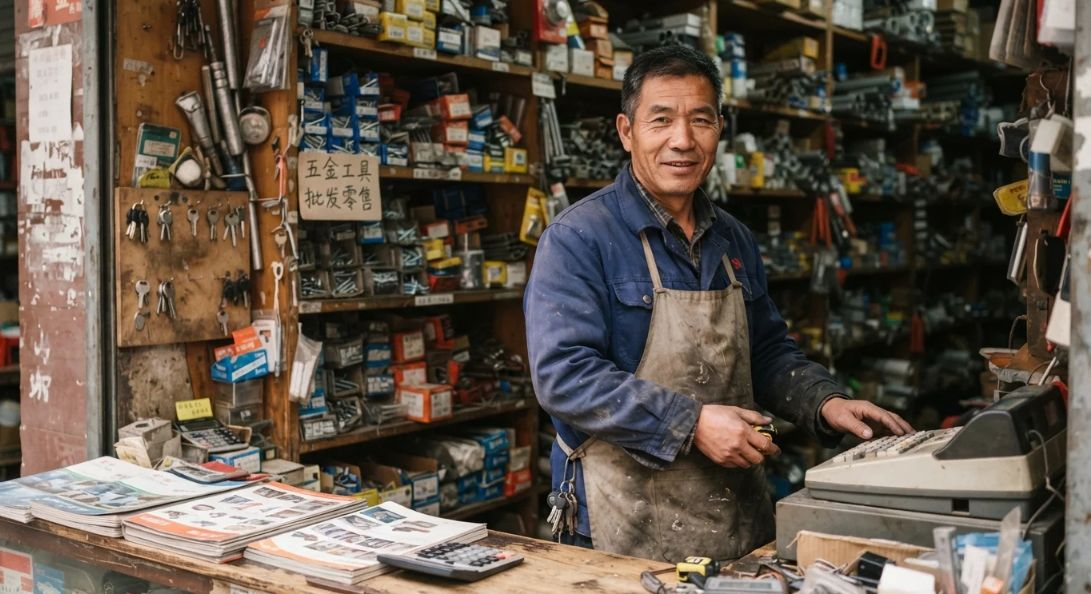

Many people think business owners are the best at managing money. But even in crypto, some people get carried away when they make a profit and panic when they lose money, eventually losing everything they’ve built up over the years. Today’s follower is 38 and has run a hardware store for over a decade. In real life, he deals with payments, inventory, and cash flow every day, yet he once took a hard fall in crypto.
His family’s hardware store was originally opened by his father. When his father got older, he took over the business. Power tools, screws, locks, plumbing fittings, building supplies—the shop isn’t large, but most of the local renovation crews and construction sites know him. Business used to be fairly steady, and on busy days he could serve several groups of customers. After years of hard work, he had saved his first 300,000 yuan.
But business has indeed been tough for brick-and-mortar stores in recent years. The property market has cooled, renovation projects have dwindled, and customers have become more cautious about purchasing. In the past, customers could take goods on credit and settle up at the end of the month. Now, some construction crews go months without paying their bills. The warehouse is full of stock, and the books show revenue, but there’s less and less cash actually available to use.
He first came across BTC while chatting with a young renovation contractor as he was delivering goods to him. While waiting for the delivery, the man kept watching the market, so he casually asked him a few questions. That was when he learned there was a market that traded around the clock. He didn’t rush into futures trading at first. Instead, he started by studying Bitcoin, thinking it had some similarities to running a business: buy too high and there’s no profit; tie up too much capital and cash flow can dry up; make the wrong call and you have to adjust quickly.
Later, when BTC went through a sustained correction, he didn’t rush to buy the dip. He bought spot in several installments. As the price kept falling, he didn’t put all his money in at once, but kept some aside for a better entry. When the market gradually recovered, he sold in stages, ultimately making about $13,000 in profit in his account.
That money gave him a real sense of accomplishment. After all, even a month of hard work at the hardware store might not bring in that much profit. At the time, he felt he had finally found a way to earn extra income outside his brick-and-mortar business.
But one of the easiest mistakes to make is to treat one profitable trade as proof that you’ve mastered the market.
After making money, he started wanting more than spot trading could offer. A friend recommended a popular coin, saying it might be on the verge of a big move. He listened, put up a large sum, and used high leverage. At first, the market rewarded him, which only made him more confident in his judgment. But then the market hit him hard: the price suddenly corrected sharply, and his account suffered a string of losses.
His thinking at the time was simple: a small drop didn’t matter because the price would bounce back eventually. He kept putting off his stop-loss and failed to reduce his position in time. By the time he realized something was wrong, his losses had far exceeded what he could initially accept.
As if that weren’t enough, the hardware store ran into trouble around the same time. Several renovation crews he’d worked with for years were late paying their bills, while a large amount of capital was tied up in inventory in the warehouse. His trading account was shrinking, and the store’s cash flow was getting tighter by the day. After closing up at night, he would sit in the warehouse doing the books and even seriously consider whether he should shut down the store he’d run for more than a decade.
The most dangerous thing isn’t a falling market. It’s being unable to afford further losses and still hoping the next trade will solve all your problems.
Eventually, he calmed down and started dealing with his trading and business separately. He focused first on resolving the store’s cash-flow problems, and stopped blindly chasing popular coins in his trading account. He refocused on BTC and ETH, first checking key levels on the daily chart and the trend on the four-hour chart, then looking for entry signals on the one-hour chart. Before each trade, he worked out the stop-loss distance and set his position size according to the loss he could afford—not by throwing money at every opportunity he saw.
He also set a few rules for himself: if the trend isn’t clear, wait; don’t enter a trade just because someone else calls it. Set the stop-loss in advance and don’t move it farther away just because you don’t want to accept a loss. Take profits in stages instead of expecting to sell every trade at the very top. After a string of losses, stop trading voluntarily and take time to get back in the right frame of mind.
There was also a frightening moment during that period. BTC dropped sharply, and the long position he was holding was close to its stop-loss level. The chart looked as if it could rebound at any moment. He hesitated, his hand hovering over the close-position button, but in the end he followed the plan he’d made in advance and accepted the loss. As it turned out, the price fell further afterward. If he’d stubbornly held on out of wishful thinking, his losses would only have been greater.
That experience made him truly understand that a stop-loss isn’t admitting defeat—it’s giving yourself a chance to enter the market again.
After some time adjusting his approach and trading through several trends, his account gradually recovered to around $26,000. Meanwhile, the hardware store also began changing how it operated: it cut back on offering credit, expanded its power-tool rental and online sales, and gradually recovered some of the overdue payments. At last, its cash flow began to improve.
These days, he has no intention of giving up his brick-and-mortar business entirely to rely on trading. If anything, he appreciates even more the store he’s run for more than a decade. Trading has given him a new source of income and made him rethink how he manages capital. His brick-and-mortar business, meanwhile, has taught him that steady operations matter more than short-term windfalls.
I really agree with what he said in the end: in business, you shouldn’t tie up all your money in one shipment, and in trading, you shouldn’t pin all your hopes on a single trade.
This is a lesson many people still need to learn. A rapidly growing account doesn’t mean you’re truly skilled; making the right call on the market doesn’t mean you can ignore risk. What really determines how far someone can go in the market is whether they can protect their profits, exit promptly when they’re wrong, and keep their hands off the keyboard when there are no opportunities.
If you’re trading too but keep making money only to lose it again, and then rushing into trades after a loss, why not join our trading group and chat with us? We regularly look at BTC and ETH trend structures together, share ideas on entries and exits, and review trades that went wrong. We’re not asking you to blindly copy trades—just offering another place to connect and learn.
There are always opportunities in the market, but your capital isn’t unlimited. First, stay in the game. When the next opportunity that’s truly yours comes along, you’ll be in a position to seize it.\u003cc-68/\u003e\u003cc-69/\u003e\u003cc-70/\u003e