
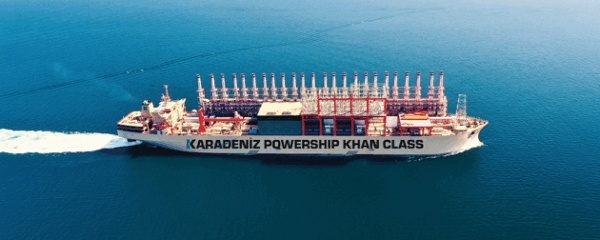

Karpowership: Details about the Turkish company behind the power barges that will boost electricity supply in Zulia
With the signing of an agreement to provide 200 megawatts to western Venezuela, the company adds Venezuela to its list of operations in Latin America, where it already serves Brazil, Guyana, and the Dominican Republic
The National Electric Corporation (Corpoelec) signed an agreement with Turkish company Karpowership to bring in two power-generation barges that will contribute 200 megawatts (MW) to the power system in Zulia state, one of the areas hardest hit by power outages in Venezuela.
The agreement, announced in early November by Delcy Rodríguez, aims to shore up the stability of electricity supply in the western part of the country, although key details have yet to be disclosed, including the contract amount, its duration, installation dates, and the fuel supply arrangements for the units.
The operation marks a new step in the government’s strategy of turning to foreign firms to ease the generation shortfall. Karpowership is part of Karadeniz Holding, a Turkish family-owned conglomerate with more than seven decades of history and a presence in various energy markets.
Its arrival comes alongside the reform of the Organic Law on the Electric System and Service, approved by the National Assembly on November 10. The reform enables private and mixed capital to participate in generation, transmission, distribution, and marketing under state authorizations, and provides for concessions of up to 25 years in a sector that remained under exclusive state control for nearly two decades.
The deployment of these floating power plants is a response to electrical infrastructure degraded by years of insufficient maintenance, low thermal generation availability, and failures in transmission and distribution.
Prolonged outages—which in several regions last for hours or days—affect water pumping, telecommunications, agriculture, industry, and oil production itself, which is highly dependent on electricity supply. Estimates cited by Bloomberg put the investment needed to restore the system at at least US$25 billion.
Although the legal opening aims to attract capital and technical expertise, payment and financing terms continue to weigh on project execution.
One example is U.S.-based GE Vernova, which, after signing agreements with the government and Corpoelec to rehabilitate thermal and hydroelectric generation, transmission, and substations, made the start of work conditional on receiving an initial payment. In October, its CEO, Scott Strazik, said that engineering, planning, and contractor selection were ready, but payments and specific contracts for each unit were still outstanding.
Behind Karpowership is Karadeniz Holding, founded in Turkey in 1948 by Rauf Osman Karadeniz, initially trading in machinery and heavy industrial products. The group entered the energy business in 1996 and, ten years later, made floating power plants its main vehicle for international expansion.
The Karadeniz family continues to lead the company, with Osman Murat Karadeniz heading the board of directors and Orhan Remzi Karadeniz, Nuri Doğan Karadeniz, and Zeynep Harezi Yılmaz serving as vice presidents. Orhan Remzi Karadeniz is also listed as the holding company’s CEO and is involved in managing Karpowership.
Although the company does not publish an up-to-date breakdown of each executive’s shareholding, a 2004 filing with Turkey’s competition authority listed a 42.5% stake for Osman Murat Karadeniz, 42% for Orhan Remzi Karadeniz, and 15% for Karadeniz Yatçılık ve Turizm. This historical data does not necessarily reflect the current ownership structure.
Karpowership’s business model is based on its Powerships: ship-mounted thermal power plants that can be moved and connected to onshore grids without waiting for a conventional plant to be built, making them an attractive option when generation is urgently needed.
The company reports a fleet of 45 floating units with a combined capacity of 8,500 MW operating in markets across Africa, Asia, the Middle East, and Latin America, including projects in countries such as the Dominican Republic, Brazil, and Guyana, as Caracas seeks to rebuild its electricity supply with private operators, Bloomberg Línea reports.
#venezuela #ElectricRevolution #turquia #Inversiones #inversión $BTC