
What happened between Silicon Valley and the White House over the past twelve days is one of those stories where decisions made behind closed doors move billions of dollars in a matter of hours.
If you want to understand how a personal scandal ended with the president of the United States intervening directly in a private company—and watching his own fortune grow in the process—this is the timeline of what happened.
It all began on November 12, when the tech world was hit by an unexpected shock.
Jensen Huang, the face, founder, and brains behind Nvidia, the most valuable company and a decisive player in the current race for artificial intelligence, submitted his resignation.
Behind his departure was a delicate scandal:
An investigation into a personal relationship with a former executive at an Asian company accused of routing U.S. technology to China.
For financial markets, losing Huang was like taking the pilot out of a plane mid-flight.
Panic set in immediately, and Nvidia's value plummeted, dragging down Wall Street's mood with it.
For more than a week, uncertainty dominated the conversation. However, behind the scenes, an unusual maneuver was beginning to take shape in Washington.
According to press reports and President Donald Trump's own words, the White House decided that the United States could not afford to lose its leading figure in artificial intelligence to China, nor could it keep watching a key player in its stock market collapse.
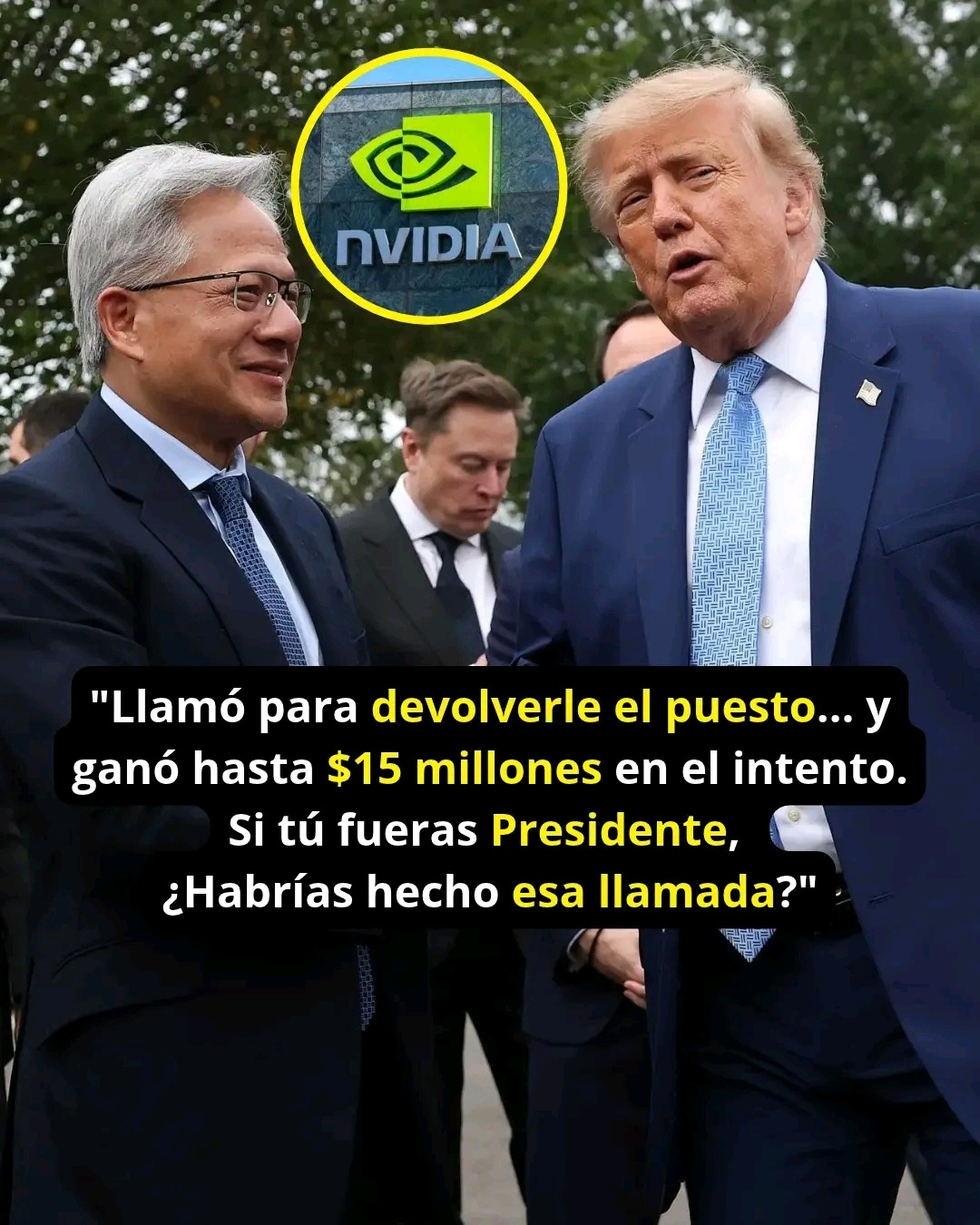
That was how, over the weekend, Trump himself and his vice president, J. D. Vance, picked up the phone and called Nvidia's board members directly.
The message was clear: they wanted Jensen Huang back in his seat.
To dispel the board's concerns about the earlier scandal, the government assured them that the businessman faced no criminal charges and posed no threat to national security.
The pressure worked.
On Monday, November 23, just eleven days after resigning, Jensen Huang triumphantly returned as Nvidia's CEO.
"I convinced them. I managed to close the deal," Trump himself admitted shortly afterward, making no secret of his pride at having resolved the situation.
The stock market's reaction was explosive: in a single day, Nvidia shares soared by more than 31%.
But just as they were celebrating the financial rebound, a new question emerged that ignited political debate in Washington:
How much did Donald Trump make from this move?
After reviewing the president's official financial disclosures, economic analysts discovered that Trump owns a substantial number of Nvidia shares in his personal portfolio.
With Monday's surge, the value of those investments increased by between $1.3 million and $15 million in a matter of hours.
The range is wide because the law allows officials to disclose their assets in approximate categories rather than exact figures; moreover, technically, this is "paper" money—that is, the value rose, but that doesn't mean he sold the shares and cashed in.
Even so, the coincidence sparked a storm in Congress.
The White House maintains that nothing improper happened, claiming that the president's finances are managed by outside advisers who simply invest in the country's biggest companies without his involvement.
However, both Democratic and Republican lawmakers have already announced that they will investigate the case:
Some are concerned that Huang's return could leave a security gap with China, while others are demanding to know whether shares were bought or sold just before the deal was announced.
Ultimately, the story offers a revealing snapshot of our times:
In the age of artificial intelligence, tech companies are no longer simply private businesses, but strategic players at the intersection of geopolitics, national security, and, inevitably, money.
What's your take on this story? Do you think it was a necessary intervention to protect the economy and U.S. technological leadership, or do you think it crossed a dangerous line between politics and financial interests?
I'll be reading your comments. 👇
#JensenHuang #DonaldTrump #negocio #dinero #Ro3erto