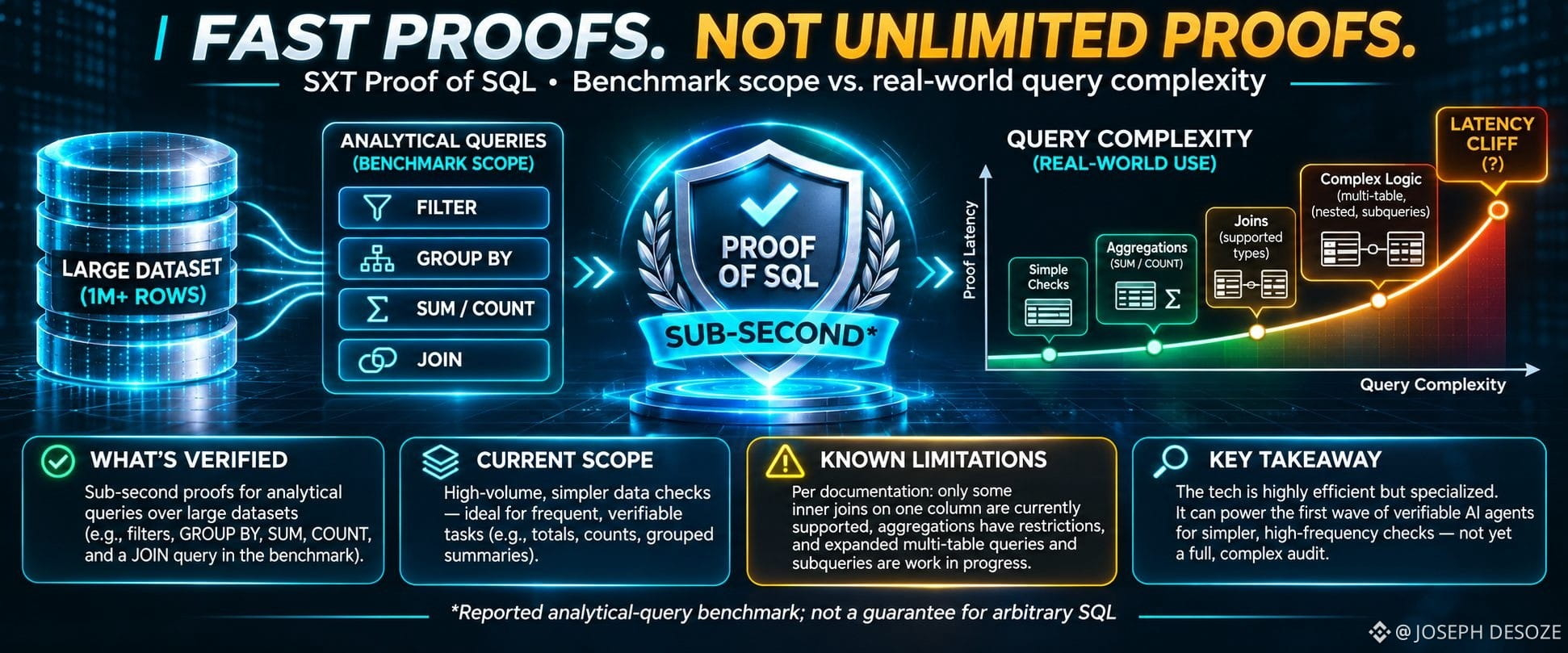

The "sub-second" Proof of SQL benchmark is real, but it’s probably not what you think.
I initially assumed that speed applied to any company expense calculation. Looking at the technical documentation, the focus is on "analytical queries"—specifically aggregations like SUM and COUNT over large datasets.
That’s a crucial distinction.
The obvious narrative is that an AI can now cryptographically prove any financial report. The reality is more nuanced. Verifying a simple total is fast. Verifying a complex operational report that relies on multi-table joins and nested logic is a different computational challenge.
What changed my view was the specific scope of the benchmark. It proves SXT is highly efficient at a narrow, high-volume task. This doesn't make the tech weak; it makes it specialized. It suggests the first wave of verifiable AI agents will likely handle high-frequency, simpler data checks, not the entire audit.
That made me look twice at the "autonomous business" claim. The infrastructure for simple proofs is here. The infrastructure for complex logic is still being built.
The unresolved question is where the latency cliff sits: at what level of query complexity does the "sub-second" proof become unusable for real-time automated decisions?
VERIFY BEFORE POSTING:
· The specific "sub-second" benchmark performance claim and the exact query types (aggregations vs. joins) it applies to in SXT's technical documentation.
· Whether the official documentation explicitly states limitations regarding complex query verification speed.
@SpaceandTime #sxt $SXT