Ever since I got into STRC, I’ve been wondering: besides collecting dividends, what else can you do with preferred stock?
Saturn’s answer: put it on-chain, use it as collateral, lend it out, and split it into tranches.
According to Saturn, this path has three steps, leading to what they call Digital Money.
STRC is Strategy’s perpetual preferred stock. According to its official website, its November dividend is annualized at 12%, and it now accrues daily.
The first step is bringing credit on-chain: sUSDat is a vault share backed by Ondo’s STRCon.
The stablecoin USDat and sUSDat are not pegged to each other.
Back in April, I also bought sUSDat thinking it was a yield-bearing version of USDat, and learned the hard way when I ended up with an unrealized loss.
But if all you do is hold it, the asset is still just a “ticket sitting idle.”
The second step, which Saturn calls Digital Money on STRC, is to use sUSDat as collateral to borrow stablecoins on Morpho, then lend USDC to earn interest on the loans.
Based on previous data, during monthly distributions, the median drop on the ex-dividend date was about 43 basis points;
After switching to daily distributions, the dividend is only about 3.3 basis points a day, making STRC more suitable as collateral, with a more stable collateral ratio.
The official target for this type of lending is a 6–8% allocation to the senior tranche, with borrowers’ principal absorbing the first layer of losses.
But a target isn’t a promise. First ask where the yield comes from, then ask who absorbs losses first.
When STRC plunged in June, sUSDat fell along with it. I recapped it in “From Getting into STRC to Turning a Profit: How It All Began.”
So the value of Digital Money isn’t how high the annualized yield is, but whether its structure can withstand volatility.
According to the official team, the senior tranche, srUSDat, had no drawdown during either the June or November downturn.
Why put it in DeFi? Because it’s composable: Curve provides liquidity, Morpho and Lista enable lending and borrowing, Strata enables tranching, and Pendle lets you split the yield.
According to DefiLlama, Saturn’s TVL is about $140 million; the official figure puts AUM at over $148 million.
The third step is to expand the underlying assets to more tokenized stocks. A more diversified pool of collateral is what could make scaling possible.
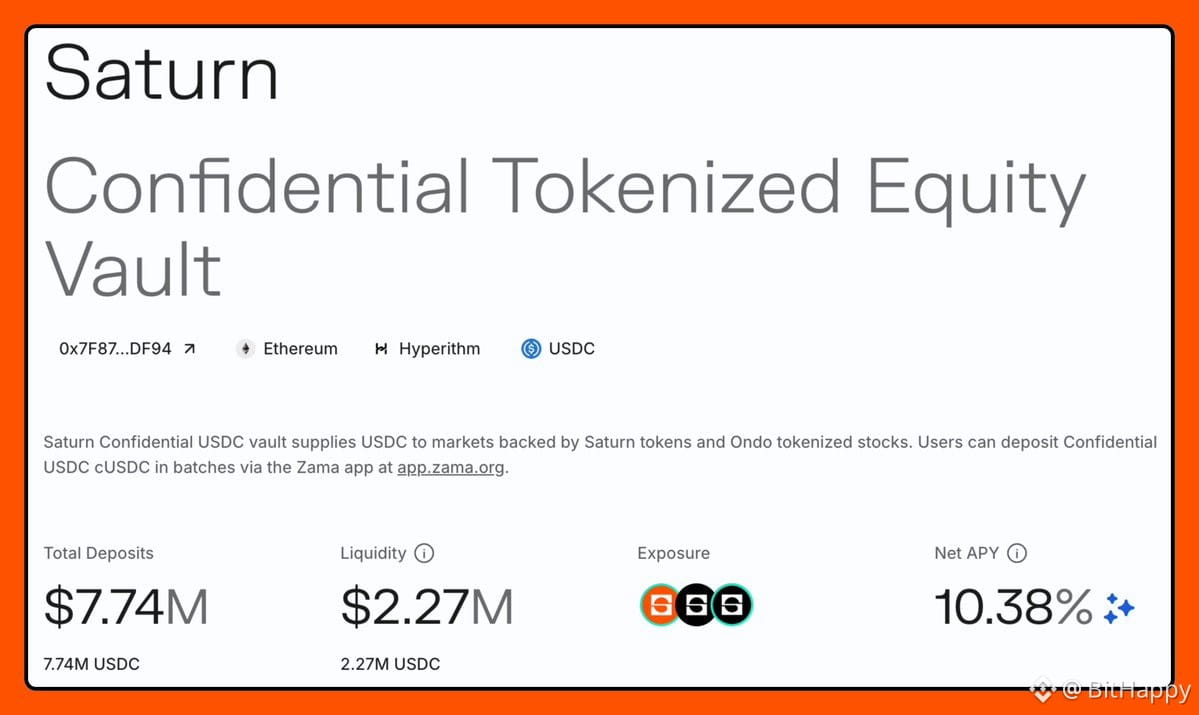
The Tokenized Equity Vault, launched on November 18, is headed in this direction. It’s still at an early stage, more like a hint of what’s to come before the TGE.
The risks are also stated plainly: STRC isn’t backed by Bitcoin, sUSDat’s net asset value rises and falls with STRC, and redemptions require waiting in line.
Back to the original question: on-chain, it can be used as collateral, lent out, and split into tranches—giving it more uses than simply collecting dividends.
As for whether it’s worth using, look at the risk structure first, then the annualized yield.
The official team is hosting a Chinese-language AMA at 8 p.m. on November 24. Feel free to tune in if you’re interested~
The above is for informational purposes only and does not constitute investment advice.
BitHappy, continuously evolving