
SignalX 💣
671 Posts

SignalX 💣
 Square Verified
Report
Block User
KITE-906830
Open Trade

BNB Holder
High-Frequency Trader
5.6 Years
160 Following
19.0K+ Followers
11.2K+ Liked
Posts
Portfolio
All
Videos
Live
PINNED
·
--
🚀 $SXT – Powering the Future of Verifiable Data!
In Web3, data is everywhere. But here’s the real question: Can we actually trust it?
That’s where @SpaceandTimeDB (SXT) comes in, building the foundation for verifiable data across AI, tokenization, and DeFi.
🤖 AI: Helping AI agents access cryptographically verifiable data to make more informed decisions.
🌐 Tokenization: Enabling transparent verification of asset records, financial calculations, and on-chain activity.
🔗 DeFi: Empowering smart contracts with proven historical data for rewards, loyalty programs, and dynamic fee mechanisms.
💡 What makes $SXT interesting?
Beyond its role as a token, SXT powers network workloads and supports validator security through staking.
My perspective: The next evolution of Web3 won’t just be about faster transactions. It will be about making data verifiable, transparent, and trustworthy.
⚠️ Purchasing SXT is risky. You are encouraged to DYOR and to consult professional advice before buying SXT or any other cryptocurrency.
#sxt $SXT
🚀 $SXT – Powering the Future of Verifiable Data!
In Web3, data is everywhere. But here’s the real question: Can we actually trust it?
That’s where @SpaceandTime (SXT) comes in, building the foundation for verifiable data across AI, tokenization, and DeFi.
🤖 AI: Helping AI agents access cryptographically verifiable data to make more informed decisions.
🌐 Tokenization: Enabling transparent verification of asset records, financial calculations, and on-chain activity.
🔗 DeFi: Empowering smart contracts with proven historical data for rewards, loyalty programs, and dynamic fee mechanisms.
💡 What makes $SXT interesting?
Beyond its role as a token, SXT powers network workloads and supports validator security through staking.
My perspective: The next evolution of Web3 won’t just be about faster transactions. It will be about making data verifiable, transparent, and trustworthy.
⚠️ Purchasing SXT is risky. You are encouraged to DYOR and to consult professional advice before buying SXT or any other cryptocurrency.
#sxt $SXT
3
4
119
PINNED
·
--
Verified

Article
KITE AI: The Day Machines Become Customers, Workers, and Economic CitizensThe next billion participants in the digital economy might not be human.
Imagine it's 2030.
A small business owner in Singapore is sleeping.
Meanwhile, her AI Agent notices that inventory is running low. It contacts another Agent representing a supplier in Germany, compares quotations, negotiates delivery terms, and initiates a payment within its authorized spending limit.
A third Agent arranges logistics.
A fourth verifies the transaction.
By sunrise, the supply chain has moved forward without a single email, phone call, or manual spreadsheet update.
This isn't simply automation.
It's the beginning of a fundamentally different economic architecture.
And it raises a question that projects like Kite AI are trying to answer:
Who builds the financial and trust infrastructure for an economy where machines transact with machines?
🧠 1. AI Has Intelligence. But Does It Have Economic Freedom?
We've spent years making AI smarter.
We taught machines to understand language, generate software, interpret images, and solve increasingly complex problems.
But intelligence alone doesn't create economic independence.
An AI Agent might know exactly which service to purchase, yet still lack the infrastructure to make that purchase securely.
It might identify a profitable business opportunity, yet have no verifiable identity or authorized way to execute a transaction.
This exposes a critical gap between AI that recommends actions and AI that can execute them.
Closing that gap requires more than better algorithms.
It requires infrastructure for identity, authorization, payments, and accountability.
This is where Kite AI enters the conversation.
🔗 2. Kite AI: Building the Economic Rails for Autonomous Agents
Kite AI is developing blockchain infrastructure designed for an emerging agent-driven economy.
Its broader vision addresses a problem that becomes increasingly important as autonomous systems grow more capable:
How can AI Agents interact economically without sacrificing trust, transparency, or human control?
Consider three foundational requirements.
Identity: An Agent needs a verifiable way to establish who or what it represents.
Authority: An Agent must operate within clearly defined permissions rather than receiving unlimited control over its owner's resources.
Payments: Agents need mechanisms to exchange value efficiently, potentially across platforms and borders.
These requirements are interconnected.
A payment system without identity creates accountability problems.
Identity without programmable authorization creates security risks.
And authorization without efficient payments limits economic usefulness.
The real opportunity lies in connecting these capabilities into infrastructure that developers can build upon.
That is what makes Kite AI's direction particularly interesting.
⚡ 3. The Most Overlooked Opportunity: An Economy of Micro-Decisions
Most discussions about AI Agents focus on replacing repetitive human tasks.
I believe the bigger opportunity is something less obvious.
AI could make previously uneconomical transactions economically viable.
Think about a $0.02 data request.
Today, involving a human to approve, negotiate, and settle such a transaction would be absurd.
The administrative cost would exceed the value being exchanged.
But what happens when autonomous Agents can evaluate and execute thousands of tiny transactions?
A research Agent could purchase specialized information from a data provider.
A logistics Agent could pay for a real-time traffic prediction.
A creative Agent could compensate another service for a specific computational task.
Each transaction might be insignificant individually.
Together, they could support entirely new digital marketplaces.
This is a powerful idea:
The Agent Economy may not simply automate existing markets. It could create markets that were previously impossible to operate efficiently.
Of course, making this practical requires low transaction costs, dependable infrastructure, and safeguards against abuse.
But the economic implications are enormous.
🛡️ 4. The Real Breakthrough Isn't Autonomy. It's Controlled Autonomy.
There's an uncomfortable truth about autonomous AI.
The more freedom we give an Agent, the more damage it could potentially cause if something goes wrong.
An Agent with unrestricted spending power isn't necessarily innovative.
It might simply be dangerous.
That's why I believe the defining feature of successful Agent infrastructure will be programmable trust.
Imagine giving your AI assistant permission to:
Spend up to $100 per day.Purchase only approved categories of services.Interact with verified counterparties.Request human approval for unusually large transactions.
Now autonomy becomes something measurable and controllable.
The goal shouldn't be to eliminate humans from economic decision-making.
It should be to move humans from approving every individual action toward defining the rules under which actions can occur.
That distinction could determine whether the Agent Economy becomes a useful global infrastructure or remains an interesting experiment.
💎 5. Where Does $KITE Fit Into the Bigger Picture?
For me, the most important question surrounding $KITE isn't whether AI is a popular market narrative.
It's whether the Kite ecosystem can translate its technological vision into sustained economic activity.
A useful framework is to examine three questions:
First: Are developers building applications that genuinely need agent-native infrastructure?
Second: Are those applications producing real transactions and measurable user value?
Third: Does network adoption translate into sustainable utility and demand within the Kite ecosystem?
These questions matter because technological innovation and token appreciation are not automatically the same thing.
A compelling narrative can attract attention.
But only practical utility, reliable execution, and sustainable adoption can support a durable ecosystem.
The strongest long-term thesis for Kite AI would therefore be based on actual agent activity rather than speculation alone.
🌍 6. My Prediction: The Internet Is Moving Toward an Agent-to-Agent Economy
The internet has already experienced several major transformations.
Web1: Humans consumed information.
Web2: Humans created content and interacted through platforms.
Web3: Blockchain introduced new ways to establish ownership and coordinate digital value.
The Agent Economy: Intelligent software may increasingly discover, negotiate, and transact on behalf of humans and organizations.
This next stage won't necessarily replace previous generations of the internet.
It could build on top of them.
Websites may increasingly serve not only human visitors but also software Agents acting as customers.
Digital businesses may optimize their services for both people and autonomous systems.
And payment infrastructure may need to accommodate transactions happening at machine speed.
If that future materializes, the winners won't necessarily be the projects with the loudest AI marketing.
They may be the ones solving the least glamorous but most essential problems:
Identity. Permissions. Settlement. Security. Interoperability.
These are the foundational challenges that make Kite AI worth studying.
🚀 Final Thought: The Next Economic Revolution May Be Invisible
The most important technological revolutions don't always announce themselves.
Sometimes they begin quietly.
A payment executed without friction.
A service purchased without human intervention.
A supply chain coordinated by software.
A thousand microtransactions that would never have made economic sense before.
Individually, these events may seem ordinary.
Collectively, they could signal a profound transformation in how economic value moves across the internet.
My thesis is simple:
The next phase of AI won't be defined only by machines becoming more intelligent.
It will be defined by whether intelligent machines can participate in economic activity safely, efficiently, and under meaningful human control.
Kite AI is positioning itself around that challenge.
Its success is not guaranteed, and the Agent Economy still faces significant technical and adoption hurdles.
But the problem it is addressing is real, and the opportunity is worth examining.
We spent decades building an internet where humans could connect with information.
Now we may be building an internet where intelligence can connect directly with economic value.
And that could change everything.
💬 One question for the community:
If AI Agents eventually conduct millions of transactions every day, what will become more valuable: the intelligence making decisions, or the infrastructure making those decisions trustworthy?
#KiteBBW #KiteAI #AgentEconomy #ArtificialIntelligence #Web3 #Blockchain $KITE
{future}(KITEUSDT)
KITE AI: The Day Machines Become Customers, Workers, and Economic Citizens
The next billion participants in the digital economy might not be human.
Imagine it's 2030.
A small business owner in Singapore is sleeping.
Meanwhile, her AI Agent notices that inventory is running low. It contacts another Agent representing a supplier in Germany, compares quotations, negotiates delivery terms, and initiates a payment within its authorized spending limit.
A third Agent arranges logistics.
A fourth verifies the transaction.
By sunrise, the supply chain has moved forward without a single email, phone call, or manual spreadsheet update.
This isn't simply automation.
It's the beginning of a fundamentally different economic architecture.
And it raises a question that projects like Kite AI are trying to answer:
Who builds the financial and trust infrastructure for an economy where machines transact with machines?
🧠 1. AI Has Intelligence. But Does It Have Economic Freedom?
We've spent years making AI smarter.
We taught machines to understand language, generate software, interpret images, and solve increasingly complex problems.
But intelligence alone doesn't create economic independence.
An AI Agent might know exactly which service to purchase, yet still lack the infrastructure to make that purchase securely.
It might identify a profitable business opportunity, yet have no verifiable identity or authorized way to execute a transaction.
This exposes a critical gap between AI that recommends actions and AI that can execute them.
Closing that gap requires more than better algorithms.
It requires infrastructure for identity, authorization, payments, and accountability.
This is where Kite AI enters the conversation.
🔗 2. Kite AI: Building the Economic Rails for Autonomous Agents
Kite AI is developing blockchain infrastructure designed for an emerging agent-driven economy.
Its broader vision addresses a problem that becomes increasingly important as autonomous systems grow more capable:
How can AI Agents interact economically without sacrificing trust, transparency, or human control?
Consider three foundational requirements.
Identity: An Agent needs a verifiable way to establish who or what it represents.
Authority: An Agent must operate within clearly defined permissions rather than receiving unlimited control over its owner's resources.
Payments: Agents need mechanisms to exchange value efficiently, potentially across platforms and borders.
These requirements are interconnected.
A payment system without identity creates accountability problems.
Identity without programmable authorization creates security risks.
And authorization without efficient payments limits economic usefulness.
The real opportunity lies in connecting these capabilities into infrastructure that developers can build upon.
That is what makes Kite AI's direction particularly interesting.
⚡ 3. The Most Overlooked Opportunity: An Economy of Micro-Decisions
Most discussions about AI Agents focus on replacing repetitive human tasks.
I believe the bigger opportunity is something less obvious.
AI could make previously uneconomical transactions economically viable.
Think about a $0.02 data request.
Today, involving a human to approve, negotiate, and settle such a transaction would be absurd.
The administrative cost would exceed the value being exchanged.
But what happens when autonomous Agents can evaluate and execute thousands of tiny transactions?
A research Agent could purchase specialized information from a data provider.
A logistics Agent could pay for a real-time traffic prediction.
A creative Agent could compensate another service for a specific computational task.
Each transaction might be insignificant individually.
Together, they could support entirely new digital marketplaces.
This is a powerful idea:
The Agent Economy may not simply automate existing markets. It could create markets that were previously impossible to operate efficiently.
Of course, making this practical requires low transaction costs, dependable infrastructure, and safeguards against abuse.
But the economic implications are enormous.
🛡️ 4. The Real Breakthrough Isn't Autonomy. It's Controlled Autonomy.
There's an uncomfortable truth about autonomous AI.
The more freedom we give an Agent, the more damage it could potentially cause if something goes wrong.
An Agent with unrestricted spending power isn't necessarily innovative.
It might simply be dangerous.
That's why I believe the defining feature of successful Agent infrastructure will be programmable trust.
Imagine giving your AI assistant permission to:
Spend up to $100 per day.Purchase only approved categories of services.Interact with verified counterparties.Request human approval for unusually large transactions.
Now autonomy becomes something measurable and controllable.
The goal shouldn't be to eliminate humans from economic decision-making.
It should be to move humans from approving every individual action toward defining the rules under which actions can occur.
That distinction could determine whether the Agent Economy becomes a useful global infrastructure or remains an interesting experiment.
💎 5. Where Does $KITE Fit Into the Bigger Picture?
For me, the most important question surrounding $KITE isn't whether AI is a popular market narrative.
It's whether the Kite ecosystem can translate its technological vision into sustained economic activity.
A useful framework is to examine three questions:
First: Are developers building applications that genuinely need agent-native infrastructure?
Second: Are those applications producing real transactions and measurable user value?
Third: Does network adoption translate into sustainable utility and demand within the Kite ecosystem?
These questions matter because technological innovation and token appreciation are not automatically the same thing.
A compelling narrative can attract attention.
But only practical utility, reliable execution, and sustainable adoption can support a durable ecosystem.
The strongest long-term thesis for Kite AI would therefore be based on actual agent activity rather than speculation alone.
🌍 6. My Prediction: The Internet Is Moving Toward an Agent-to-Agent Economy
The internet has already experienced several major transformations.
Web1: Humans consumed information.
Web2: Humans created content and interacted through platforms.
Web3: Blockchain introduced new ways to establish ownership and coordinate digital value.
The Agent Economy: Intelligent software may increasingly discover, negotiate, and transact on behalf of humans and organizations.
This next stage won't necessarily replace previous generations of the internet.
It could build on top of them.
Websites may increasingly serve not only human visitors but also software Agents acting as customers.
Digital businesses may optimize their services for both people and autonomous systems.
And payment infrastructure may need to accommodate transactions happening at machine speed.
If that future materializes, the winners won't necessarily be the projects with the loudest AI marketing.
They may be the ones solving the least glamorous but most essential problems:
Identity. Permissions. Settlement. Security. Interoperability.
These are the foundational challenges that make Kite AI worth studying.
🚀 Final Thought: The Next Economic Revolution May Be Invisible
The most important technological revolutions don't always announce themselves.
Sometimes they begin quietly.
A payment executed without friction.
A service purchased without human intervention.
A supply chain coordinated by software.
A thousand microtransactions that would never have made economic sense before.
Individually, these events may seem ordinary.
Collectively, they could signal a profound transformation in how economic value moves across the internet.
My thesis is simple:
The next phase of AI won't be defined only by machines becoming more intelligent.
It will be defined by whether intelligent machines can participate in economic activity safely, efficiently, and under meaningful human control.
Kite AI is positioning itself around that challenge.
Its success is not guaranteed, and the Agent Economy still faces significant technical and adoption hurdles.
But the problem it is addressing is real, and the opportunity is worth examining.
We spent decades building an internet where humans could connect with information.
Now we may be building an internet where intelligence can connect directly with economic value.
And that could change everything.
💬 One question for the community:
If AI Agents eventually conduct millions of transactions every day, what will become more valuable: the intelligence making decisions, or the infrastructure making those decisions trustworthy?
#KiteBBW #KiteAI #AgentEconomy #ArtificialIntelligence #Web3 #Blockchain $KITE
79
42
89
5.3k
·
--
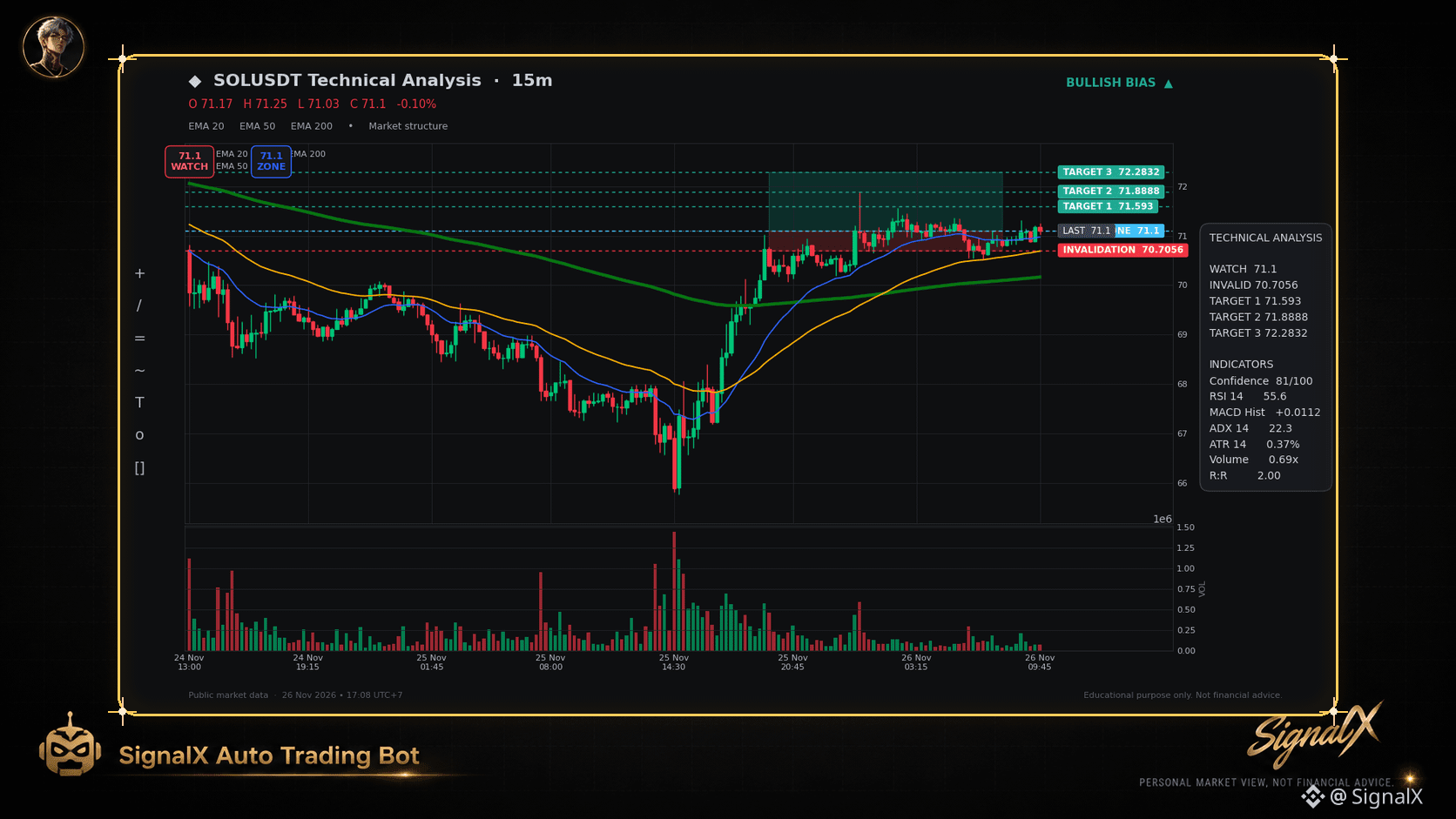
SOL | LONG 🟢 | Bullish | 15m
24h: +5.18% | Volume: 1664.0M USDT
Why LONG: price above EMA200; EMA20/50/200 aligned long; RSI14 55.6; MACD histogram positive; ADX14 22.3; volume 0.69x 20-bar average; trend pullback/continuation.
Entry: 71.1
SL: 70.7056
TP1: 71.593 | TP2: 71.8888 | TP3: 72.2832
Entry reference only; no chasing. Setup invalid at SL.
Technical setup only. Not financial advice.
$SOL
23
·
--
Evolution isn’t just about technology. It’s about changing lives. 🔶
As a Vietnamese creator heading to Binance Blockchain Week 2026, I’m excited to explore how blockchain, AI and digital finance can transform everyday life.
I look forward to connecting with global builders, exchanging ideas and bringing fresh insights back to Vietnam.
The future of crypto isn’t just about prices. It’s about adoption, real-world utility and financial freedom.
See you in Bangkok! 🇻🇳🇹🇭
#EvolveAtBinanceBlockchainWeek
$BTC
{future}(BTCUSDT)
Evolution isn’t just about technology. It’s about changing lives. 🔶
As a Vietnamese creator heading to Binance Blockchain Week 2026, I’m excited to explore how blockchain, AI and digital finance can transform everyday life.
I look forward to connecting with global builders, exchanging ideas and bringing fresh insights back to Vietnam.
The future of crypto isn’t just about prices. It’s about adoption, real-world utility and financial freedom.
See you in Bangkok! 🇻🇳🇹🇭
#EvolveAtBinanceBlockchainWeek
$BTC
32
·
--
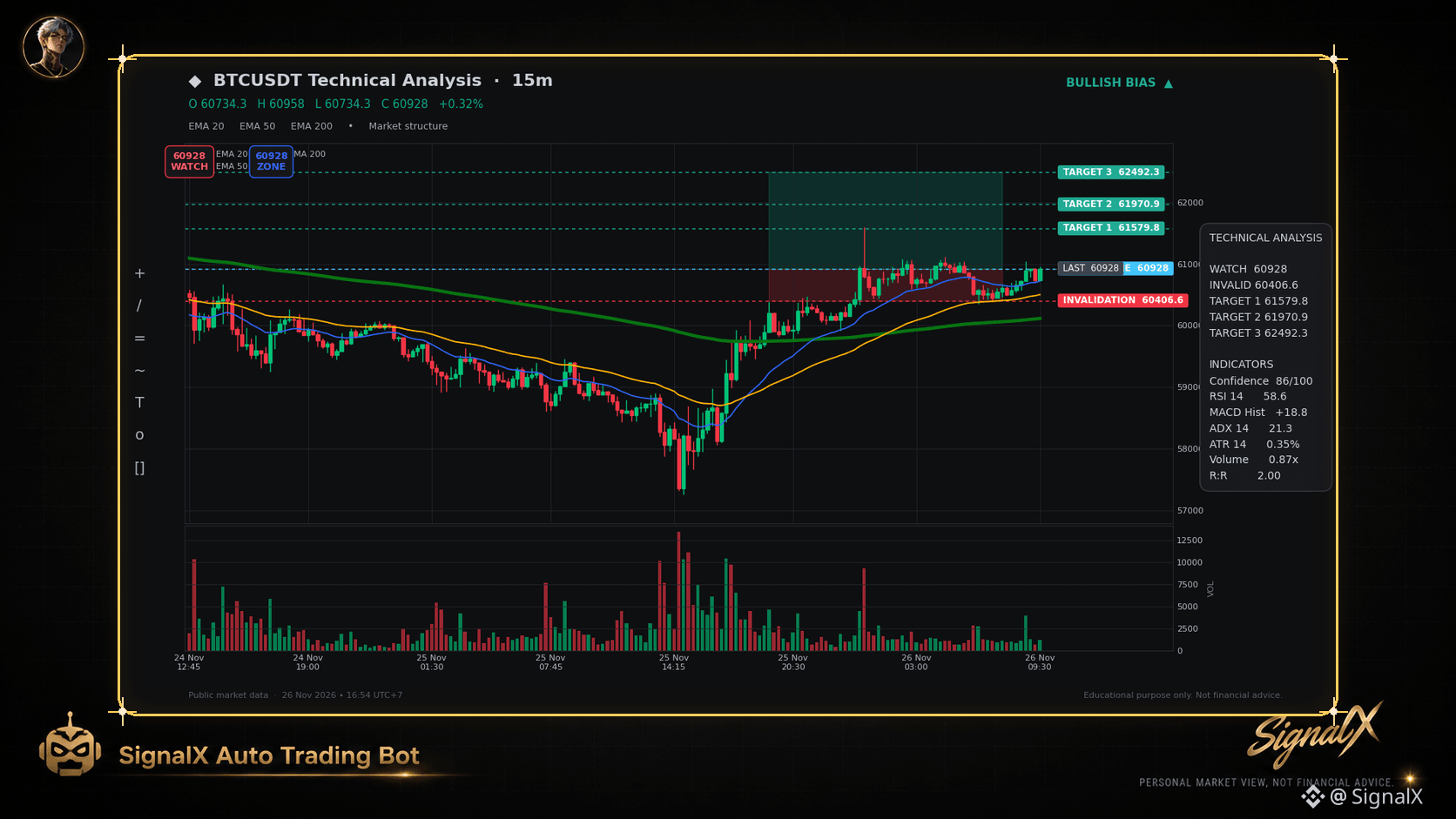
BTC | LONG 🟢 | Bullish | 15m
24h: +3.50% | Volume: 15936.1M USDT
Why LONG: price above EMA200; EMA20/50/200 aligned long; RSI14 58.6; MACD histogram positive; ADX14 21.3; volume 0.87x 20-bar average; trend pullback/continuation.
Entry: 60928
SL: 60406.6
TP1: 61579.8 | TP2: 61970.9 | TP3: 62492.3
Entry reference only; no chasing. Setup invalid at SL.
Technical setup only. Not financial advice.
$BTC
33
·
--
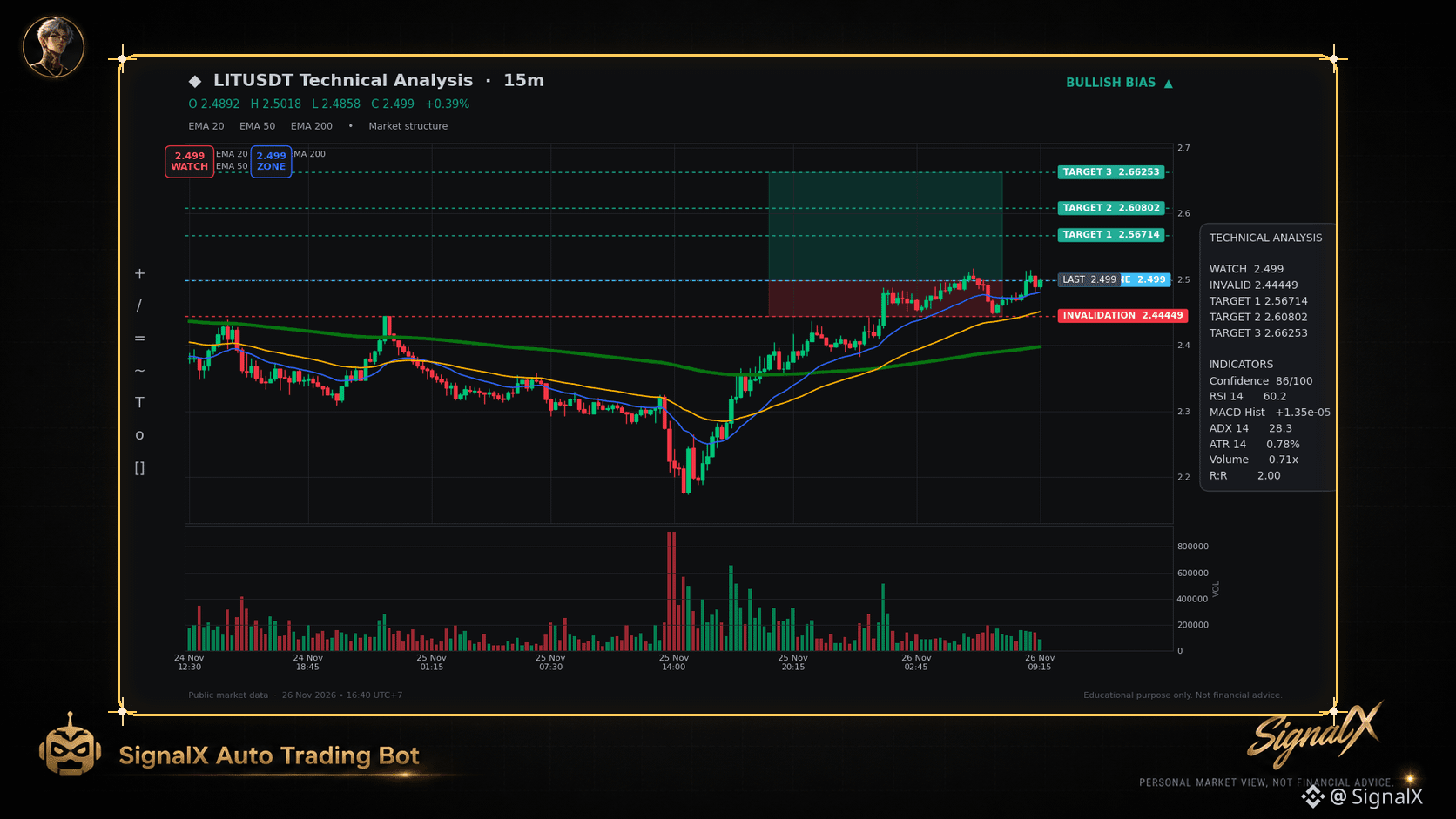
LIT | LONG 🟢 | Bullish | 15m
24h: +8.78% | Volume: 43.2M USDT
Why LONG: price above EMA200; EMA20/50/200 aligned long; RSI14 60.2; MACD histogram positive; ADX14 28.3; volume 0.71x 20-bar average; trend pullback/continuation.
Entry: 2.499
SL: 2.44449
TP1: 2.56714 | TP2: 2.60802 | TP3: 2.66253
Entry reference only; no chasing. Setup invalid at SL.
Technical setup only. Not financial advice.
$LIT
64
·
--
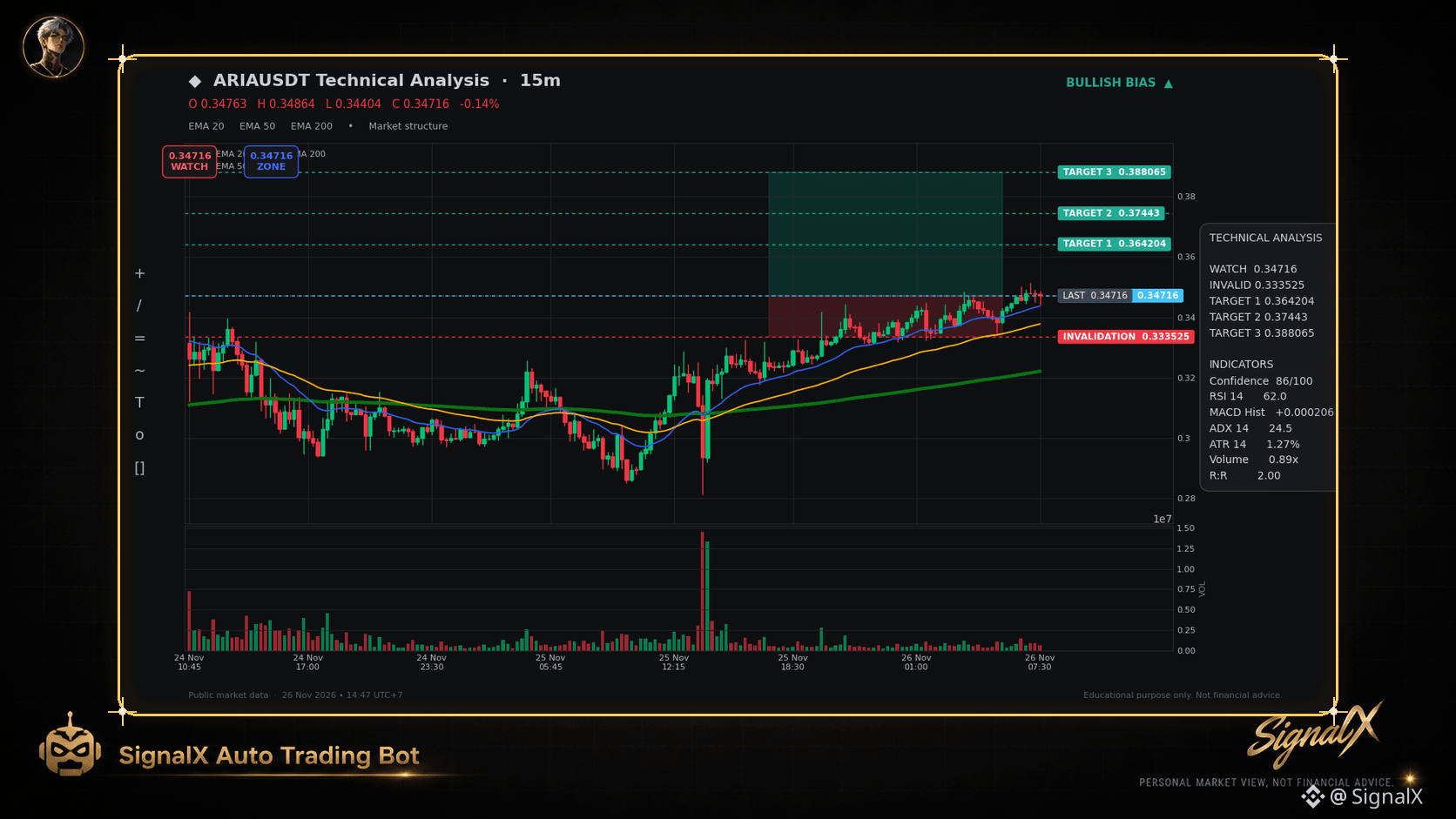
ARIA | LONG 🟢 | Bullish | 15m
24h: +15.39% | Volume: 39.1M USDT
Why LONG: price above EMA200; EMA20/50/200 aligned long; RSI14 62.0; MACD histogram positive; ADX14 24.5; volume 0.89x 20-bar average; trend pullback/continuation.
Entry: 0.34716
SL: 0.333525
TP1: 0.364204 | TP2: 0.37443 | TP3: 0.388065
Entry reference only; no chasing. Setup invalid at SL.
Technical setup only. Not financial advice.
$ARIA
157
·
--
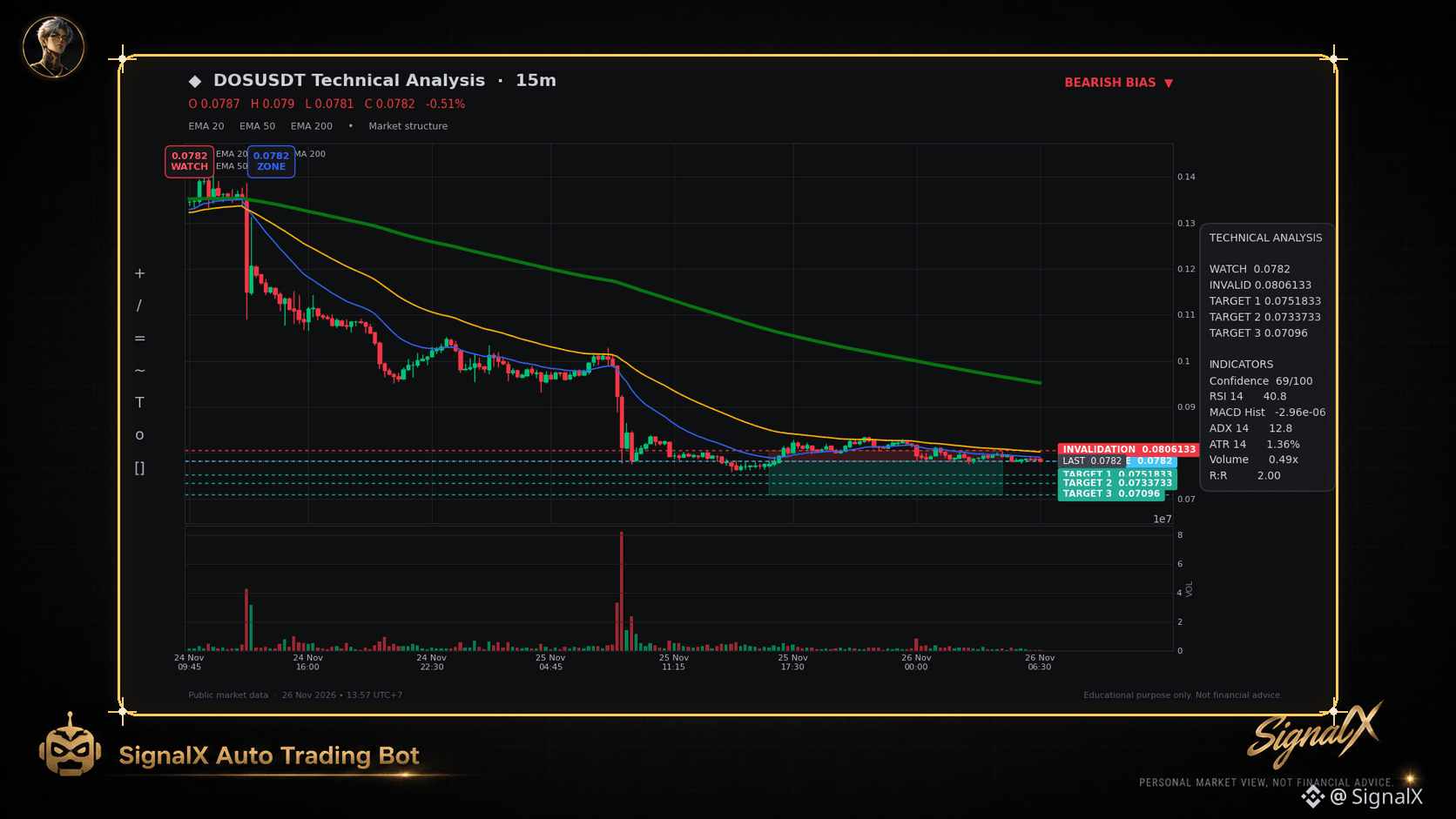
DOS | SHORT 🔴 | Bearish | 15m
24h: -20.85% | Volume: 33.5M USDT
Why SHORT: price below EMA200; EMA20/50/200 aligned short; RSI14 40.8; MACD histogram negative; ADX14 12.8; volume 0.49x 20-bar average; trend pullback/continuation.
Entry: 0.0782
SL: 0.0806133
TP1: 0.0751833 | TP2: 0.0733733 | TP3: 0.07096
Entry reference only; no chasing. Setup invalid at SL.
Technical setup only. Not financial advice.
$DOS
117
·
--
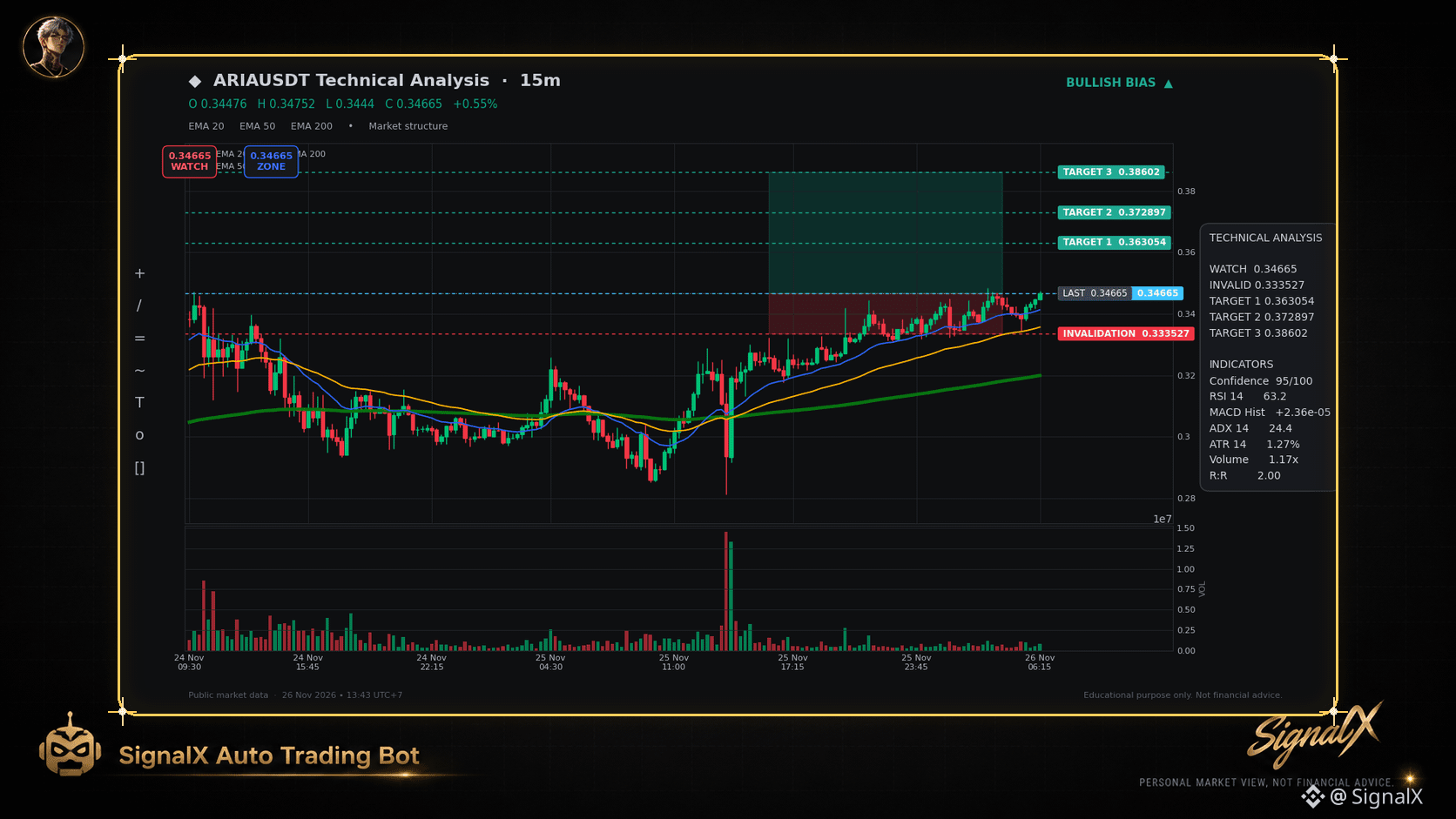
ARIA | LONG 🟢 | Bullish | 15m
24h: +13.80% | Volume: 39.3M USDT
Why LONG: price above EMA200; EMA20/50/200 aligned long; RSI14 63.2; MACD histogram positive; ADX14 24.4; volume 1.17x 20-bar average; trend pullback/continuation.
Entry: 0.34665
SL: 0.333527
TP1: 0.363054 | TP2: 0.372897 | TP3: 0.38602
Entry reference only; no chasing. Setup invalid at SL.
Technical setup only. Not financial advice.
$ARIA
159
·
--

Article
Bitcoin at $64K: A Market Trying to Find Its Floor, Not Yet Its DirectionNovember 18, 2026 | BTC Market Analysis
Bitcoin has spent the past three days trying to stabilize after a sharp selloff pushed prices toward $62,000. The immediate selling pressure has eased, but the recovery has been anything but convincing.
What concerns me isn't necessarily the decline itself. Bitcoin has experienced far more aggressive corrections throughout its history. The more important question is why buyers have struggled to regain control despite a meaningful reset in leverage and signs of renewed demand at lower prices.
Looking at the market between November 16 and 18, I see early evidence of stabilization, but very little to suggest that a durable bottom has been established.
Price action tells us more than the initial bounce.
After briefly trading near $62,018 on November 15, Bitcoin recovered to close around $65,305. That was a relatively strong reaction to a significant selloff.
But the follow-through was disappointing.
$BTC closed November 16 near $64,856 and November 17 around $64,894. By the morning of November 18, it was still struggling around the $64,000–$65,000 area.
Two consecutive sessions of consolidation after a sharp decline can be interpreted in different ways. Buyers may be absorbing supply, or sellers may simply be waiting for better prices to exit.
For now, the evidence doesn't allow us to confidently distinguish between the two.
What I would like to see is a sustained move above $65,500, followed by a successful retest of that level as support. Until then, the recent bounce remains a recovery attempt within a damaged market structure.
Institutional demand remains the missing piece
The ETF data is particularly revealing.
US spot Bitcoin ETFs recorded approximately $1.91 billion in cumulative net outflows over seven consecutive trading sessions before finally returning to modest positive territory on November 16.
BlackRock's IBIT attracted roughly $76.5 million that day. However, redemptions from Fidelity's FBTC and Grayscale's GBTC offset much of those inflows, leaving aggregate net inflows at just $7.9 million.
The preliminary November 17 figures subsequently pointed to renewed net outflows.
To put that into perspective, a single positive session following nearly $2 billion in withdrawals is hardly evidence of a meaningful institutional reversal.
IBIT's inflow is encouraging, but aggregate ETF flows matter considerably more than the performance of any individual fund.
This is where I think some market participants are becoming too optimistic. Institutional demand hasn't disappeared, but it is no longer providing the consistent support that helped sustain previous advances.
Until we see several consecutive sessions of substantial net inflows, I would be reluctant to interpret the current price action as the beginning of a new accumulation phase.
On-chain data suggests capitulation, but capitulation isn't always the bottom
Glassnode's latest analysis adds another dimension to the picture.
Realized losses have increased considerably as short-term holders, particularly those who accumulated Bitcoin during the previous six months, have been forced to reassess their positions.
This matters because selling at a loss can accelerate during periods of declining confidence. Once enough investors begin cutting exposure, price movements can become increasingly disconnected from longer-term fundamentals.
At the same time, the $62,000–$66,000 area has emerged as an important concentration of short-term holder cost basis.
Glassnode's observations suggest that approximately 66,000 additional BTC accumulated within this cost-basis cluster during the two most intense days of selling.
That tells us something important: supply is changing hands.
However, I would be careful about describing this activity as aggressive whale accumulation. On-chain cost-basis data can identify changes in ownership and positioning, but it doesn't necessarily establish the intentions or investment horizons of the buyers involved.
What it does suggest is that there is meaningful interest in Bitcoin at current valuations.
Whether that demand is sufficient to establish a lasting floor remains unresolved.
The leverage reset has improved conditions, but it hasn't repaired market confidence
Another development worth examining is the change in derivatives positioning.
The selloff triggered substantial liquidations across the crypto market, disproportionately affecting leveraged long positions.
By November 18, Bitcoin futures open interest remained around $41.8 billion, with funding rates relatively subdued at approximately +0.0041% per eight hours.
The reduction in speculative excess is constructive.
Highly leveraged markets are vulnerable to liquidation cascades, where falling prices trigger forced selling that subsequently drives prices even lower. Removing some of that leverage reduces one source of instability.
But there is an important distinction between eliminating excess leverage and attracting fresh capital.
Short covering and reduced liquidation pressure can support temporary recoveries. They cannot, on their own, sustain a broader uptrend.
For a convincing reversal, I want to see stronger spot market participation rather than a rally driven primarily by derivatives positioning.
That distinction will become particularly important if Bitcoin begins approaching resistance around $66,000.
The macro backdrop is still working against risk assets
Bitcoin's weakness also needs to be considered within the broader financial environment.
Persistent inflation concerns, uncertainty surrounding the Federal Reserve's policy path, elevated bond yields and a firm US dollar have complicated the outlook for risk-sensitive assets.
Bitcoin may have increasingly sophisticated institutional infrastructure, but it remains highly sensitive to global liquidity conditions.
When investors become more defensive and the opportunity cost of holding speculative assets rises, crypto markets frequently experience pressure.
This is also why I am paying attention to stablecoin liquidity.
Glassnode reported a roughly 4.2% contraction in circulating stablecoin supply over the preceding 90 days. While this is not a direct measure of capital available to purchase BTC, it does point to a less supportive liquidity environment.
A sustainable Bitcoin recovery would be considerably more convincing if accompanied by expanding stablecoin supply, improving ETF flows and stronger spot demand.
At present, those conditions are not clearly aligned.
The levels that matter from here
I am primarily watching three areas.
$65,500–$68,000: The recovery test.
A sustained move through $65,500 would be the first meaningful improvement in the short-term structure. The $68,000 area is particularly significant given its proximity to the 200-week moving average highlighted by Wintermute.
Reclaiming that region would materially improve the technical picture, although it would not automatically confirm a return to a long-term bullish trend.
$62,000–$63,000: The immediate demand zone.
This is where buyers recently demonstrated their willingness to absorb selling pressure.
If Bitcoin revisits the area and holds above the previous low, the possibility of a developing base becomes more credible.
The quality of that defense matters more than the speed of the initial rebound.
Below $62,000: The downside risk increases.
A decisive breakdown, particularly if accompanied by expanding spot selling and renewed long liquidations, would weaken the stabilization thesis.
In that scenario, $60,000 becomes the next important psychological reference, followed by the previous support area around $58,500.
Glassnode's estimated realized price near $53,700 provides a deeper on-chain reference if market conditions deteriorate significantly. I would treat that as a potential valuation reference rather than a price target.
My assessment
I am not convinced Bitcoin has established its bottom. Equally, I don't think the available evidence justifies assuming another major breakdown is inevitable.
What we have today is a market attempting to find equilibrium following a substantial liquidation event.
The encouraging developments are the absorption of supply around $62,000, the reduction in excessive leverage and the first signs that some institutional demand is returning.
The less encouraging developments are the lack of sustained ETF inflows, declining stablecoin liquidity, continued macroeconomic uncertainty and a technical structure that remains vulnerable below $68,000.
My base case is continued volatility and consolidation until one side demonstrates a clear advantage.
I would become more constructive if Bitcoin reclaimed $66,000 with improving spot volume and persistent ETF inflows. Conversely, a confirmed loss of $62,000 would force me to reassess the likelihood of a deeper correction.
For longer-term investors, current levels may offer a more attractive starting point for gradual accumulation than the elevated prices seen earlier in the cycle. But attractive valuations and favorable timing are not necessarily the same thing.
For short-term traders, I see little justification for aggressively anticipating a breakout before the market provides confirmation.
The critical point is that Bitcoin has shown buyers are willing to defend lower prices. It has not yet shown they are willing to chase higher ones.
That is the difference between a market finding temporary support and one genuinely preparing for its next sustained advance.
And until that changes, I would rather remain patient than mistake a pause in selling for the beginning of a new bull market.
Are we witnessing the early stages of accumulation around $62K, or does Bitcoin still need another capitulation event before a sustainable recovery can begin?
#Bitcoin #BTC #CryptoMarkets #MarketAnalysis
Market commentary based on data available on November 18, 2026. Not financial advice.
{future}(BTCUSDT)
Bitcoin at $64K: A Market Trying to Find Its Floor, Not Yet Its Direction
November 18, 2026 | BTC Market Analysis
Bitcoin has spent the past three days trying to stabilize after a sharp selloff pushed prices toward $62,000. The immediate selling pressure has eased, but the recovery has been anything but convincing.
What concerns me isn't necessarily the decline itself. Bitcoin has experienced far more aggressive corrections throughout its history. The more important question is why buyers have struggled to regain control despite a meaningful reset in leverage and signs of renewed demand at lower prices.
Looking at the market between November 16 and 18, I see early evidence of stabilization, but very little to suggest that a durable bottom has been established.
Price action tells us more than the initial bounce.
After briefly trading near $62,018 on November 15, Bitcoin recovered to close around $65,305. That was a relatively strong reaction to a significant selloff.
But the follow-through was disappointing.
$BTC closed November 16 near $64,856 and November 17 around $64,894. By the morning of November 18, it was still struggling around the $64,000–$65,000 area.
Two consecutive sessions of consolidation after a sharp decline can be interpreted in different ways. Buyers may be absorbing supply, or sellers may simply be waiting for better prices to exit.
For now, the evidence doesn't allow us to confidently distinguish between the two.
What I would like to see is a sustained move above $65,500, followed by a successful retest of that level as support. Until then, the recent bounce remains a recovery attempt within a damaged market structure.
Institutional demand remains the missing piece
The ETF data is particularly revealing.
US spot Bitcoin ETFs recorded approximately $1.91 billion in cumulative net outflows over seven consecutive trading sessions before finally returning to modest positive territory on November 16.
BlackRock's IBIT attracted roughly $76.5 million that day. However, redemptions from Fidelity's FBTC and Grayscale's GBTC offset much of those inflows, leaving aggregate net inflows at just $7.9 million.
The preliminary November 17 figures subsequently pointed to renewed net outflows.
To put that into perspective, a single positive session following nearly $2 billion in withdrawals is hardly evidence of a meaningful institutional reversal.
IBIT's inflow is encouraging, but aggregate ETF flows matter considerably more than the performance of any individual fund.
This is where I think some market participants are becoming too optimistic. Institutional demand hasn't disappeared, but it is no longer providing the consistent support that helped sustain previous advances.
Until we see several consecutive sessions of substantial net inflows, I would be reluctant to interpret the current price action as the beginning of a new accumulation phase.
On-chain data suggests capitulation, but capitulation isn't always the bottom
Glassnode's latest analysis adds another dimension to the picture.
Realized losses have increased considerably as short-term holders, particularly those who accumulated Bitcoin during the previous six months, have been forced to reassess their positions.
This matters because selling at a loss can accelerate during periods of declining confidence. Once enough investors begin cutting exposure, price movements can become increasingly disconnected from longer-term fundamentals.
At the same time, the $62,000–$66,000 area has emerged as an important concentration of short-term holder cost basis.
Glassnode's observations suggest that approximately 66,000 additional BTC accumulated within this cost-basis cluster during the two most intense days of selling.
That tells us something important: supply is changing hands.
However, I would be careful about describing this activity as aggressive whale accumulation. On-chain cost-basis data can identify changes in ownership and positioning, but it doesn't necessarily establish the intentions or investment horizons of the buyers involved.
What it does suggest is that there is meaningful interest in Bitcoin at current valuations.
Whether that demand is sufficient to establish a lasting floor remains unresolved.
The leverage reset has improved conditions, but it hasn't repaired market confidence
Another development worth examining is the change in derivatives positioning.
The selloff triggered substantial liquidations across the crypto market, disproportionately affecting leveraged long positions.
By November 18, Bitcoin futures open interest remained around $41.8 billion, with funding rates relatively subdued at approximately +0.0041% per eight hours.
The reduction in speculative excess is constructive.
Highly leveraged markets are vulnerable to liquidation cascades, where falling prices trigger forced selling that subsequently drives prices even lower. Removing some of that leverage reduces one source of instability.
But there is an important distinction between eliminating excess leverage and attracting fresh capital.
Short covering and reduced liquidation pressure can support temporary recoveries. They cannot, on their own, sustain a broader uptrend.
For a convincing reversal, I want to see stronger spot market participation rather than a rally driven primarily by derivatives positioning.
That distinction will become particularly important if Bitcoin begins approaching resistance around $66,000.
The macro backdrop is still working against risk assets
Bitcoin's weakness also needs to be considered within the broader financial environment.
Persistent inflation concerns, uncertainty surrounding the Federal Reserve's policy path, elevated bond yields and a firm US dollar have complicated the outlook for risk-sensitive assets.
Bitcoin may have increasingly sophisticated institutional infrastructure, but it remains highly sensitive to global liquidity conditions.
When investors become more defensive and the opportunity cost of holding speculative assets rises, crypto markets frequently experience pressure.
This is also why I am paying attention to stablecoin liquidity.
Glassnode reported a roughly 4.2% contraction in circulating stablecoin supply over the preceding 90 days. While this is not a direct measure of capital available to purchase BTC, it does point to a less supportive liquidity environment.
A sustainable Bitcoin recovery would be considerably more convincing if accompanied by expanding stablecoin supply, improving ETF flows and stronger spot demand.
At present, those conditions are not clearly aligned.
The levels that matter from here
I am primarily watching three areas.
$65,500–$68,000: The recovery test.
A sustained move through $65,500 would be the first meaningful improvement in the short-term structure. The $68,000 area is particularly significant given its proximity to the 200-week moving average highlighted by Wintermute.
Reclaiming that region would materially improve the technical picture, although it would not automatically confirm a return to a long-term bullish trend.
$62,000–$63,000: The immediate demand zone.
This is where buyers recently demonstrated their willingness to absorb selling pressure.
If Bitcoin revisits the area and holds above the previous low, the possibility of a developing base becomes more credible.
The quality of that defense matters more than the speed of the initial rebound.
Below $62,000: The downside risk increases.
A decisive breakdown, particularly if accompanied by expanding spot selling and renewed long liquidations, would weaken the stabilization thesis.
In that scenario, $60,000 becomes the next important psychological reference, followed by the previous support area around $58,500.
Glassnode's estimated realized price near $53,700 provides a deeper on-chain reference if market conditions deteriorate significantly. I would treat that as a potential valuation reference rather than a price target.
My assessment
I am not convinced Bitcoin has established its bottom. Equally, I don't think the available evidence justifies assuming another major breakdown is inevitable.
What we have today is a market attempting to find equilibrium following a substantial liquidation event.
The encouraging developments are the absorption of supply around $62,000, the reduction in excessive leverage and the first signs that some institutional demand is returning.
The less encouraging developments are the lack of sustained ETF inflows, declining stablecoin liquidity, continued macroeconomic uncertainty and a technical structure that remains vulnerable below $68,000.
My base case is continued volatility and consolidation until one side demonstrates a clear advantage.
I would become more constructive if Bitcoin reclaimed $66,000 with improving spot volume and persistent ETF inflows. Conversely, a confirmed loss of $62,000 would force me to reassess the likelihood of a deeper correction.
For longer-term investors, current levels may offer a more attractive starting point for gradual accumulation than the elevated prices seen earlier in the cycle. But attractive valuations and favorable timing are not necessarily the same thing.
For short-term traders, I see little justification for aggressively anticipating a breakout before the market provides confirmation.
The critical point is that Bitcoin has shown buyers are willing to defend lower prices. It has not yet shown they are willing to chase higher ones.
That is the difference between a market finding temporary support and one genuinely preparing for its next sustained advance.
And until that changes, I would rather remain patient than mistake a pause in selling for the beginning of a new bull market.
Are we witnessing the early stages of accumulation around $62K, or does Bitcoin still need another capitulation event before a sustainable recovery can begin?
#Bitcoin #BTC #CryptoMarkets #MarketAnalysis
Market commentary based on data available on November 18, 2026. Not financial advice.
85
·
--
From discovering Bitcoin to co-founding Binance, @CZ journey is a remarkable story of curiosity, ambition, setbacks, and hard lessons. This animated short explores the people, persistence, and difficult choices behind that journey—and the responsibility that comes with building at scale.
#CZ #Binance @BinanceSquareCN @Binance_Vietnam
From discovering Bitcoin to co-founding Binance, @CZ journey is a remarkable story of curiosity, ambition, setbacks, and hard lessons. This animated short explores the people, persistence, and difficult choices behind that journey—and the responsibility that comes with building at scale.
#CZ #Binance @币安广场 @Binance Vietnam
#CZ #Binance @币安广场 @Binance Vietnam
37
Log in to explore more content
Join global crypto users on Binance Square
⚡️ Get latest and useful information about crypto.
💬 Trusted by the world’s largest crypto exchange.
👍 Discover real insights from verified creators.
Email / Phone number
Trending Topics
CanMarketsReboundAfterThanksgiving?
33,407 views
726 Discussing
Rate-Hike Bets Linger as US Markets Head Into Thanksgiving Closure
Binance News
·2 Likes
·2.1k views
CouldSpaceX’sOrbitalDataCentersBoostAIChipDemand?
20,794 views
447 Discussing
EvolveAtBinanceBlockchainWeek
682,646 views
7,713 Discussing