
From $150,000 to $1.41 million, then back down to $120,000: Six months in the life of a 30-year-old chip engineer
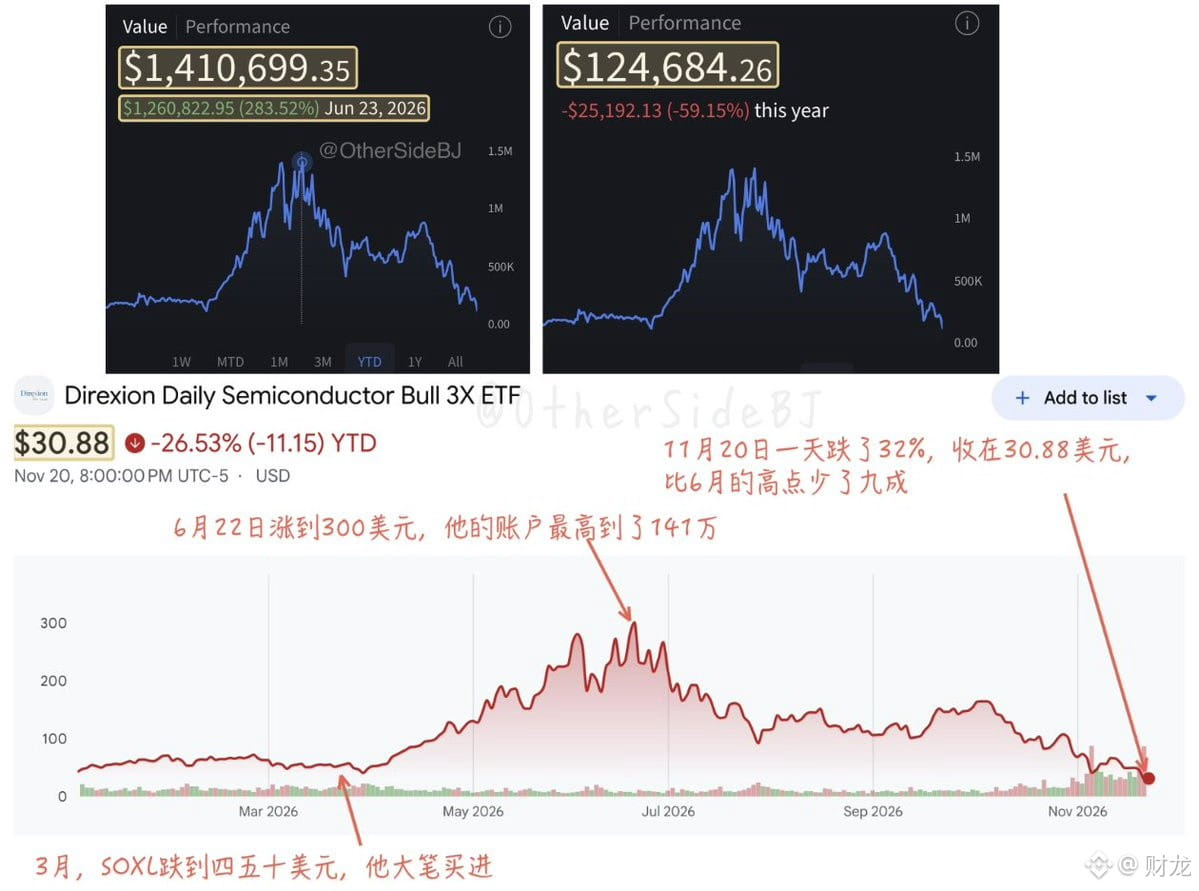
On November 20, SOXL plunged 32% in a single day. A 30-year-old guy in Taiwan checked his account again and found he had just over $120,000 left—less than the $150,000 he originally invested.
Back in June this year, the account had peaked at $1.41 million.
He works at one of Taiwan’s top chip-design companies. Last April, when U.S. stocks plunged over tariffs, he blew up his futures account and lost all of his more than $700,000. After that painful lesson, he made a rule for himself: no more investments that could be forcibly liquidated. So he switched to leveraged ETFs, choosing SOXL, which had soared the most in recent years—a three-times leveraged bet on chip stocks.
In March this year, when SOXL fell to around $40 or $50, he bought a large amount. By June, it had risen to $300 and his account had ballooned to $1.41 million—roughly 20 years’ worth of his salary. He had planned to sell everything once it reached $2 million and never have to work again. At the time, he was just over 40% away from his target.
Chip stocks began to pull back in late June, but he didn’t sell. He thought they would eventually hit new highs again. After October, chip stocks kept falling, and on November 20, news broke that Nvidia was being investigated by the U.S. Securities and Exchange Commission. SOXL plunged 32% that day, down 90% from its June peak.
This summer, he still thought it would be his last summer at work. Given how things look now, he’ll probably have to keep working for another decade or so 😢
Looking back, the lesson he took from blowing up his account was not to get forcibly liquidated again—and he did manage that. But a three-times leveraged ETF can fall just as fast. A pullback in chip stocks can send SOXL down 90%, with an outcome not much different from getting liquidated.
When his account reached $1.41 million, he was just one step away from never having to work again. It’s hard to say who wouldn’t have struggled to sell at that point. But looking back now, even if he’d sold half, he’d still have had $700,000 in hand 😢