

For the past twenty years, the advice I’ve heard most often is: when stocks fall, buy gold; when the economy is weak, buy bonds.
That line is useless this year.
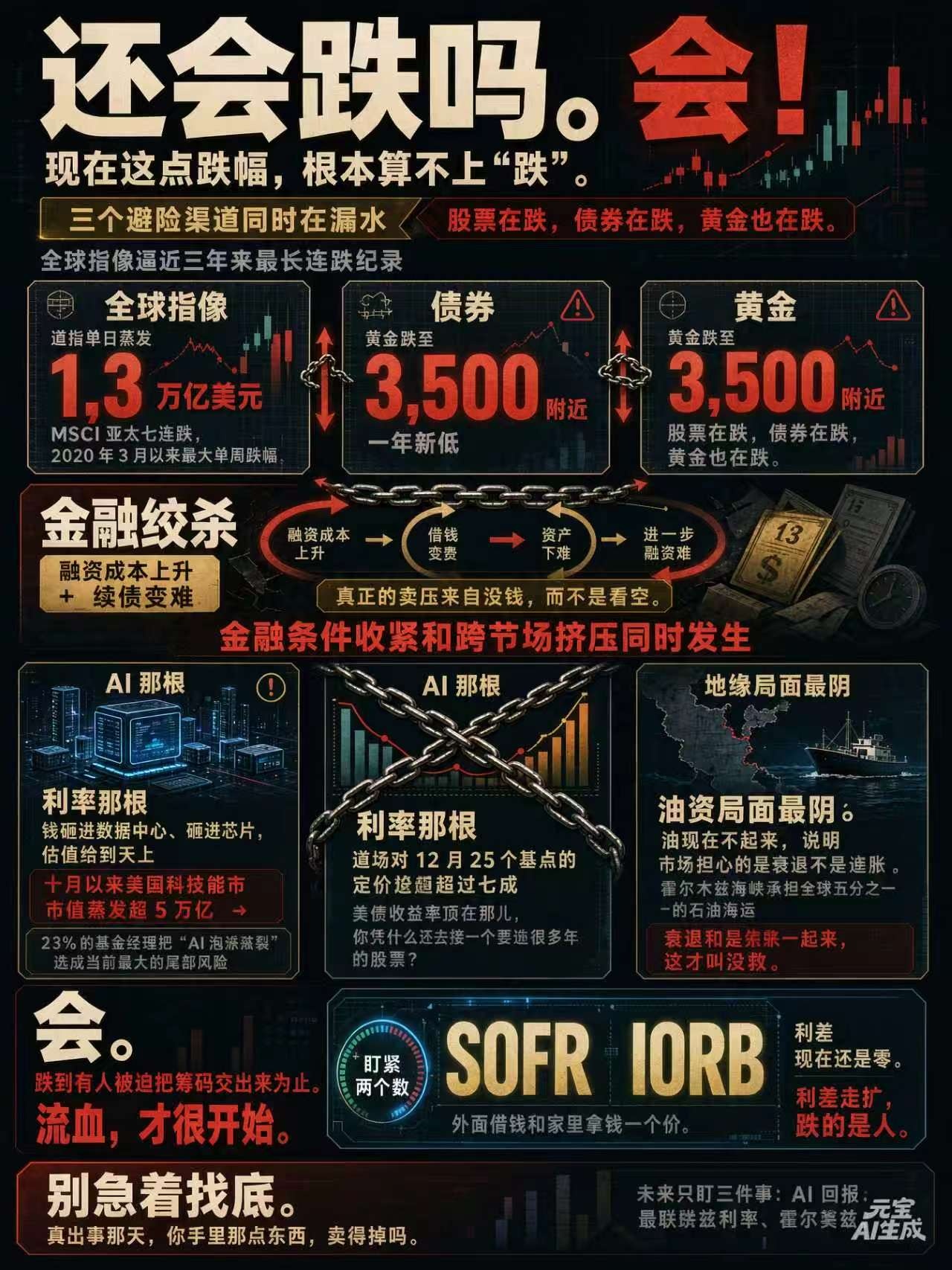
Global stock indexes are nearing their longest losing streak in three years.
The Dow shed $1.3 trillion in a single day, and the MSCI Asia Pacific index fell for a seventh straight session, its biggest weekly drop since March 2020.
Gold has fallen to around 3,500, a one-year low.
Stocks are falling, bonds are falling, and gold is falling too.
All three safe havens are leaking at once.
This isn’t safe havens failing. It’s there being no safe haven at all.
Because everyone is scrambling for the same thing: cash.
When everyone’s scrambling for cash, there’s no such thing as a “safe-haven asset” in the market. There are only things you can sell and things you can’t.
Whatever can be sold gets sold first. Whatever can’t just hangs there, falling day after day.
The real selling pressure comes from running out of money, not from being bearish.
By now, the picture is clear: tighter financial conditions and a cross-market squeeze are happening at the same time.
This is financial strangulation.
Financial strangulation doesn’t start by crashing the market. First it makes borrowing more expensive and refinancing harder.
So that little drop you’re seeing doesn’t even count as a “fall.”
This is just the cost of financing going up.
But don’t start calling it 2008 just yet.
Credit defaults and a debt-servicing crisis haven’t erupted at the same time. This isn’t a crisis yet.
This is a global short-sellers’ celebration.
The people sitting on piles of cash are waiting for gold at half price and tech stocks at 20 or 30 cents on the dollar.
They got what they were waiting for.
And here’s the hardest part to swallow: in a market like today’s, which still isn’t even at its worst, some people who don’t want to sell no longer have the option not to.
Wanting to sell and being able not to sell are two different things.
Gold, Treasuries, tech stocks—no one stepping in to buy, no one there to bail them out, can stop the slide.
Because the people selling aren’t bearish. They’ve been backed into a corner.
Looking further up the chain, three wires are tightening at once.
The AI wire: money is pouring into data centers and chips, valuations are through the roof, and nobody can say when the profits will show up.
Since October, more than $5 trillion has been wiped off the market value of U.S. tech stocks. In its November report, the European Central Bank found that 23% of fund managers named an “AI bubble burst” as the biggest tail risk right now.
These are institutions writing reports, not retail investors panicking.
The interest-rate wire: the market is now pricing in over a 70% chance of a 25-basis-point rate hike in December.
With Treasury yields stuck up there, why would you buy a stock that could take years to pay off?
What makes it worse is that this AI rally was built on cheap money during a rate-cutting cycle.
When money gets expensive, the payback period gets longer.
The model hasn’t been proven, and the financing has already come due.
The geopolitical picture is the darkest part: oil isn’t rising right now, which means the market fears recession, not inflation.
But the Strait of Hormuz carries a fifth of the world’s seaborne oil. If it’s ever shut, oil prices will surge, inflation will flare up again, and the Fed won’t just hold off on cuts—it’ll have to hike.
Recession and inflation hitting at the same time—that’s what hopeless looks like.
These three wires aren’t three separate things side by side. They’re links in the same chain.
Rates go up, bonds go down. A stronger dollar drags gold and stocks down together. Higher financing costs push AI’s returns further into the future.
The squeeze keeps tightening.
So this selloff is hitting the same thing across the board: the price of money. Stocks, bonds, gold—it makes no distinction.
Money has gotten more expensive, and every asset built on borrowed money has to be weighed again.
Nobody’s bailing you out this time. Fucking fair, isn’t it.
There’s another layer to this.
The U.S. wants AI supremacy, but it doesn’t want to bear all the costs that come with it: power, energy, capital, and the whole bill for globalization.
The Fed hikes rates and says, “That’s not my burden to bear.”
States worry that data centers will drive up energy costs and say, “I’m not bearing that either.”
Fine. Then hand over the top spot in computing power to places with low-interest financing and cheap electricity.
But it won’t do that either.
So the only option is to make the capital markets pay the bill.
Debt doesn’t disappear. It just gets transferred.
Today’s short sellers are celebrating—not because they were right, but because the chips are starting to bleed.
And the real short-selling pressure hasn’t even kicked in yet.
So far, the market has done just one thing: made borrowing more expensive and refinancing harder.
So, back to the question on everyone’s mind: will it keep falling?
Yes.
Until someone is forced to hand over their chips.
And the bleeding has only just begun.
As for where we are in this process, don’t look at the chart. Watch two numbers: SOFR and IORB.
The spread between them is still zero.
That means getting money from inside the system costs the same as borrowing it from outside.
When that spread widens—when borrowing from outside costs more than getting money from inside—that’s a real liquidity crisis.
When the spread doesn’t move, prices fall.
When the spread widens, people fall.
We’re still in the first scenario.
From here, you only need to watch three things: whether AI can deliver returns, where the Fed takes interest rates, and whether something happens in the Strait of Hormuz.
If two of those three go wrong, it’s no longer about whether to buy the dip. It’s about whether you can survive until the next cycle.
Don’t rush to call the bottom.
Ask yourself one thing first: if things really go wrong, can you sell what little you have?