
#sxt $SXT @SpaceandTime
Can SXT Make Blockchain Data Truly Verifiable?
When I first came across SXT, I couldn't quite picture what "verifiable data" meant in practice. Then I read through the Proof of SQL design, and the answer turned out to be more interesting than just "put more data on a blockchain."
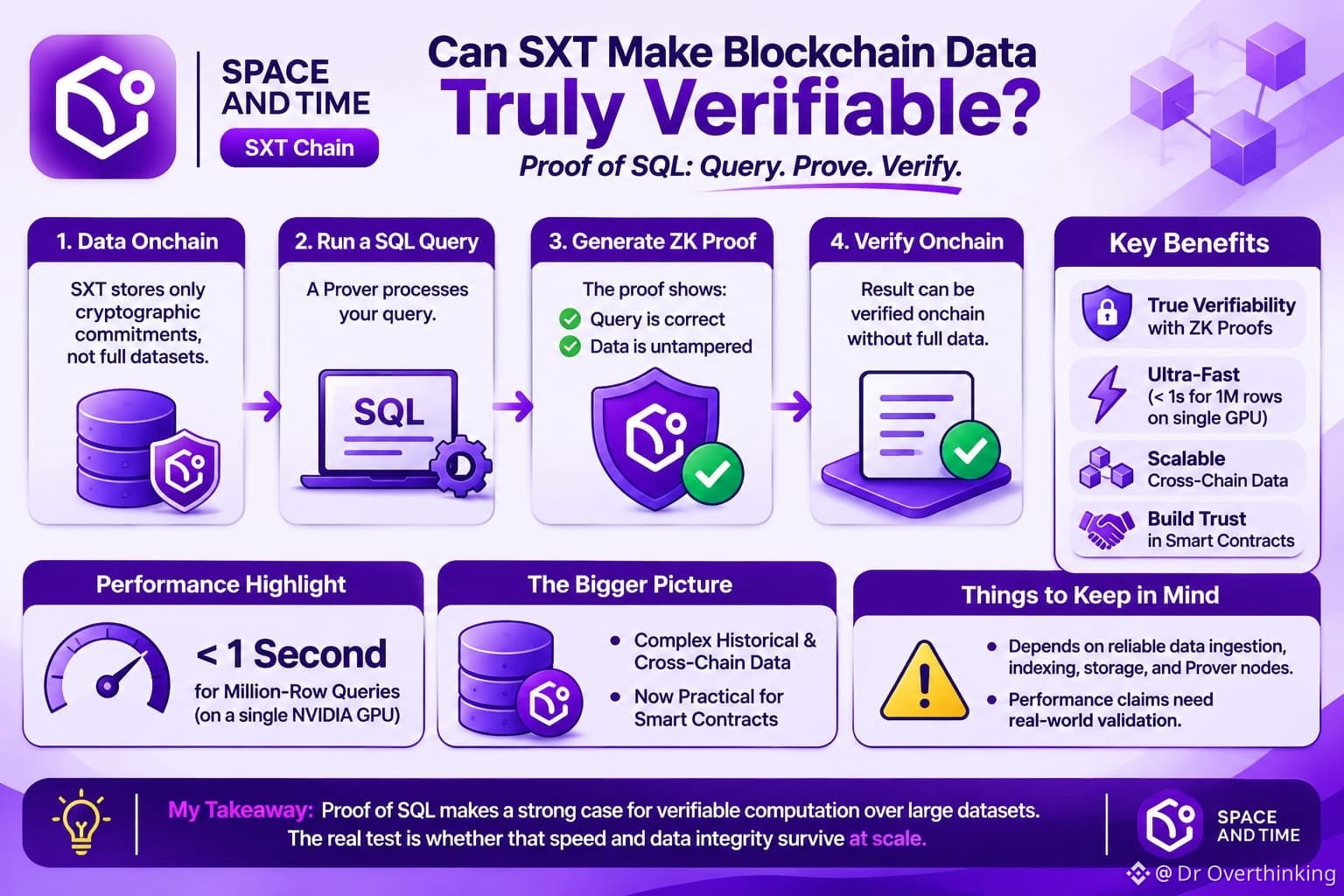
SXT doesn't store whole datasets onchain. It stores small cryptographic commitments instead, a bit like a fingerprint of each table. When someone runs a SQL query, a Prover does the heavy lifting offchain and generates a zero-knowledge proof. That proof shows two things at once: the query was run correctly, and the data underneath wasn't tampered with. The result can then be checked onchain without the full dataset ever sitting there.
The part that caught my eye was the speed. SXT says Proof of SQL can prove analytical queries over million-row tables in under a second on a single NVIDIA GPU. That's the team's own benchmark, so I'd take it with some caution. But if it holds up outside controlled tests, complex historical and cross-chain data could finally become practical for smart contracts.
Still, "verifiable" doesn't automatically mean "trustless in every sense." The system leans on reliable data ingestion, indexing, storage, and Prover infrastructure. SXT splits these jobs across Indexer, Prover, and Validator nodes, which spreads the risk, but each layer still has to do its job well.
So my takeaway is simple. Proof of SQL makes a strong case for verifiable computation over large datasets. The real test is whether that speed and data integrity survive at scale, across messy real-world workloads.#SXT