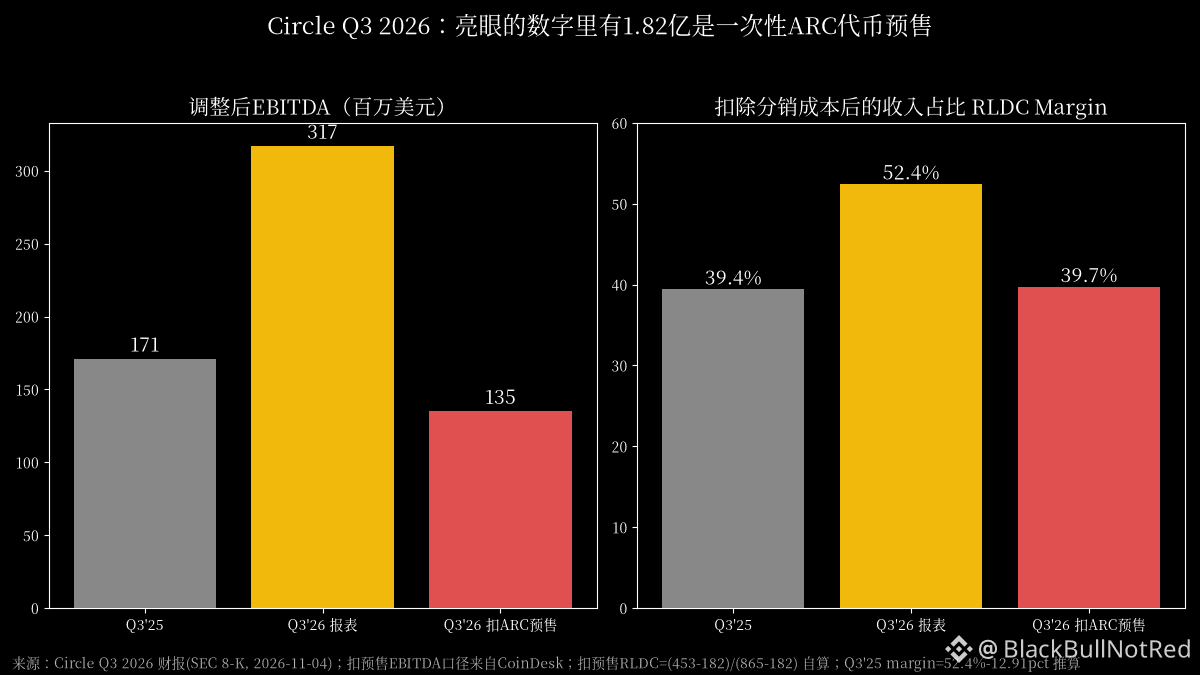
For Circle, the headline for Q3 was adjusted EBITDA of $317 million, up 85% year over year. I went through the original financial report, and that 85% increase basically came from selling its own token.
The report is very clear: Other Revenue was $207 million, of which $182 million came from the presale of ARC tokens. ARC is the native token of Circle’s own L1, Arc, and 10 billion tokens were minted in a one-off issuance. Strip out that $182 million and adjusted EBITDA was about $135 million, compared with $171 million in the same period last year—a decline of 21% in reality.
Next, take the RLDC margin (revenue minus distribution costs, as a share of revenue), which everyone loves to cite. The reported figure was 52.4%, up nearly 13 percentage points year over year. I worked out the figure excluding the presale: ($453 million - $182 million) / ($865 million - $182 million) ≈ 39.7%. The figure for the same period last year works out to 39.4%. In other words, after splitting the revenue with channels like Coinbase, the core business’s profitability has barely budged over the past year. The supposed leap in margins is entirely due to that presale.
The core business is actually weakening:
Reserve income was $658 million, down 8% year over year, because reserve yields fell 61 basis points to 3.5%. USDC in circulation at quarter-end was $73.9 billion, unchanged year over year—no growth in a year. Stablecoin market share was 27%, down 1.83 percentage points. $104 billion was minted during the quarter, and $104 billion was redeemed: as much came in as went out.
My take: Circle is still, at its core, an interest-rate business. When scale isn’t growing and rates are falling, profits naturally shrink. This quarter, management chose to make the financials look better with token issuance revenue. That’s not illegal, and it was disclosed in the report, but if the secondary market values the company based on 85% growth, it’s assigning a PE multiple to one-off revenue. What’s more worth watching is the full-year Other Revenue guidance of $310–330 million, which already includes a large chunk from the presale. There is also about $60 million in deferred revenue tied to Arc’s transition to PoS as a performance obligation. Without a new presale next quarter, the numbers will look pretty bad.
At the end of the day, a stablecoin issuer can tell stories about “payment networks” and “its own blockchain,” but the money it can generate sustainably, as reflected in its financials, still comes from that 3.5% Treasury yield.
Data: Circle Q3 2026 financial report (SEC 8-K, November 4); adjusted EBITDA excluding the presale based on CoinDesk’s figures; margin calculated by me. Not investment advice.
#USDC #Circle
The report is very clear: Other Revenue was $207 million, of which $182 million came from the presale of ARC tokens. ARC is the native token of Circle’s own L1, Arc, and 10 billion tokens were minted in a one-off issuance. Strip out that $182 million and adjusted EBITDA was about $135 million, compared with $171 million in the same period last year—a decline of 21% in reality.
Next, take the RLDC margin (revenue minus distribution costs, as a share of revenue), which everyone loves to cite. The reported figure was 52.4%, up nearly 13 percentage points year over year. I worked out the figure excluding the presale: ($453 million - $182 million) / ($865 million - $182 million) ≈ 39.7%. The figure for the same period last year works out to 39.4%. In other words, after splitting the revenue with channels like Coinbase, the core business’s profitability has barely budged over the past year. The supposed leap in margins is entirely due to that presale.
The core business is actually weakening:
Reserve income was $658 million, down 8% year over year, because reserve yields fell 61 basis points to 3.5%. USDC in circulation at quarter-end was $73.9 billion, unchanged year over year—no growth in a year. Stablecoin market share was 27%, down 1.83 percentage points. $104 billion was minted during the quarter, and $104 billion was redeemed: as much came in as went out.
My take: Circle is still, at its core, an interest-rate business. When scale isn’t growing and rates are falling, profits naturally shrink. This quarter, management chose to make the financials look better with token issuance revenue. That’s not illegal, and it was disclosed in the report, but if the secondary market values the company based on 85% growth, it’s assigning a PE multiple to one-off revenue. What’s more worth watching is the full-year Other Revenue guidance of $310–330 million, which already includes a large chunk from the presale. There is also about $60 million in deferred revenue tied to Arc’s transition to PoS as a performance obligation. Without a new presale next quarter, the numbers will look pretty bad.
At the end of the day, a stablecoin issuer can tell stories about “payment networks” and “its own blockchain,” but the money it can generate sustainably, as reflected in its financials, still comes from that 3.5% Treasury yield.
Data: Circle Q3 2026 financial report (SEC 8-K, November 4); adjusted EBITDA excluding the presale based on CoinDesk’s figures; margin calculated by me. Not investment advice.
#USDC #Circle