

The History of World Inventions: X-Rays—Seeing What Shouldn’t Be Seen
Friday, November 8, 1895. University of Würzburg, Germany.
Physics professor Röntgen was conducting an experiment with cathode rays. The tube was wrapped in thick black cardboard, so in theory no light could escape. But a fluorescent screen a meter away lit up.
Cathode rays can’t pass through cardboard. So what was making the screen glow?
Someone else might have rubbed their eyes, thinking they’d seen things. Not Röntgen. He shut the laboratory door and spent six weeks eating and sleeping inside. His wife thought he’d gone mad, and his friends couldn’t get hold of him. He placed all kinds of things between the rays and the screen: wood, glass, thin sheets of metal. The rays passed through most of them, but were blocked by just two things: a thick lead plate and bone.
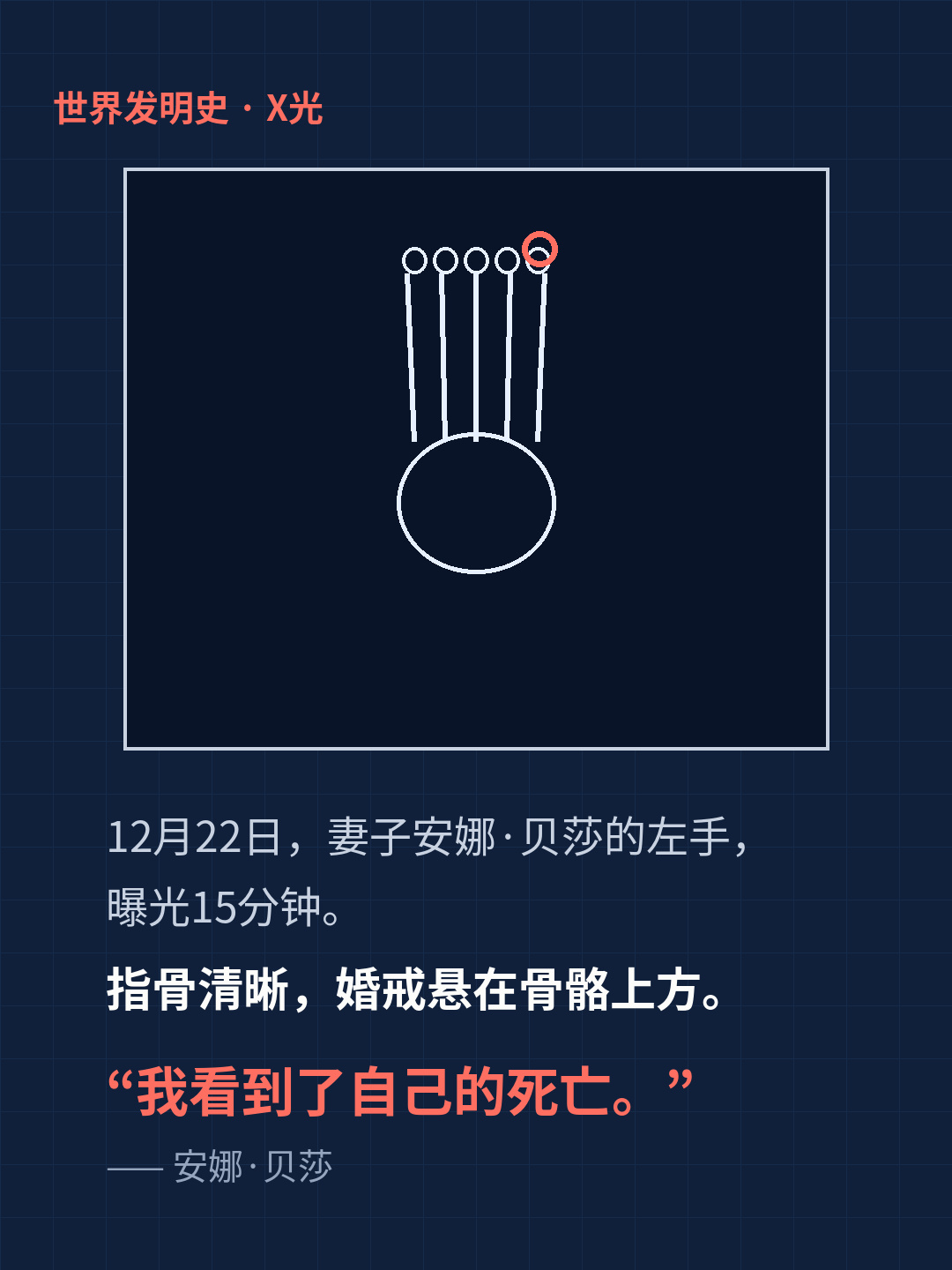
On December 22, he placed his wife Anna Bertha’s left hand on a photographic plate and exposed it for 15 minutes. When the photograph was developed, her finger bones were clearly visible, with the wedding ring on her ring finger hanging above the bones.
Anna looked at the photograph and said a line that has endured to this day: "I have seen my own death."
Röntgen called them "X-rays"—X for the unknown. He published a paper on December 28 and did not apply for a patent. He said the discovery should belong to everyone. In 1901, he was awarded the first Nobel Prize in Physics, and donated the prize money to the university. Some felt sorry for him, saying he had missed out on an entire industry. But if he had patented it, X-rays would not have made it into hospitals so quickly, nor onto the battlefield. Some discoveries are gold when held close, but become civilization when shared.
News of the discovery spread at astonishing speed. On January 5, 1896, a Vienna newspaper reported that surgeons could now see fractures without cutting patients open. Within a week, London newspapers followed suit; by January 9, the news had reached North America. That year, around 400 medical papers on X-rays were published worldwide. During World War I, Marie Curie fitted cars with X-ray machines and drove them to the battlefield to locate shrapnel. Less than twenty years passed between the discovery and its use on the battlefield.
Of course, the costs came quickly too. Early operators did not know how dangerous radiation was, and many suffered finger ulcers or cancer. Several of Edison’s assistants died of radiation poisoning. In 1896, American physicist Thomson deliberately used his own fingers in an experiment, exposing them for several days; they became red and blistered. The lesson was devastating, but no one rejected X-rays because of it—the problems of technology were solved with technology, and protective standards were gradually established. Today, the radiation dose from a chest X-ray is only a few hundredths of what it was back then.

Looking back, on that Friday night in 1895, Röntgen stared at the screen that should not have been glowing—and did not dismiss it. Everyone has unexpected moments; few are willing to close the door and investigate one for six weeks.
So the story of X-rays is not about luck. It is about curiosity—and refusing to give up.