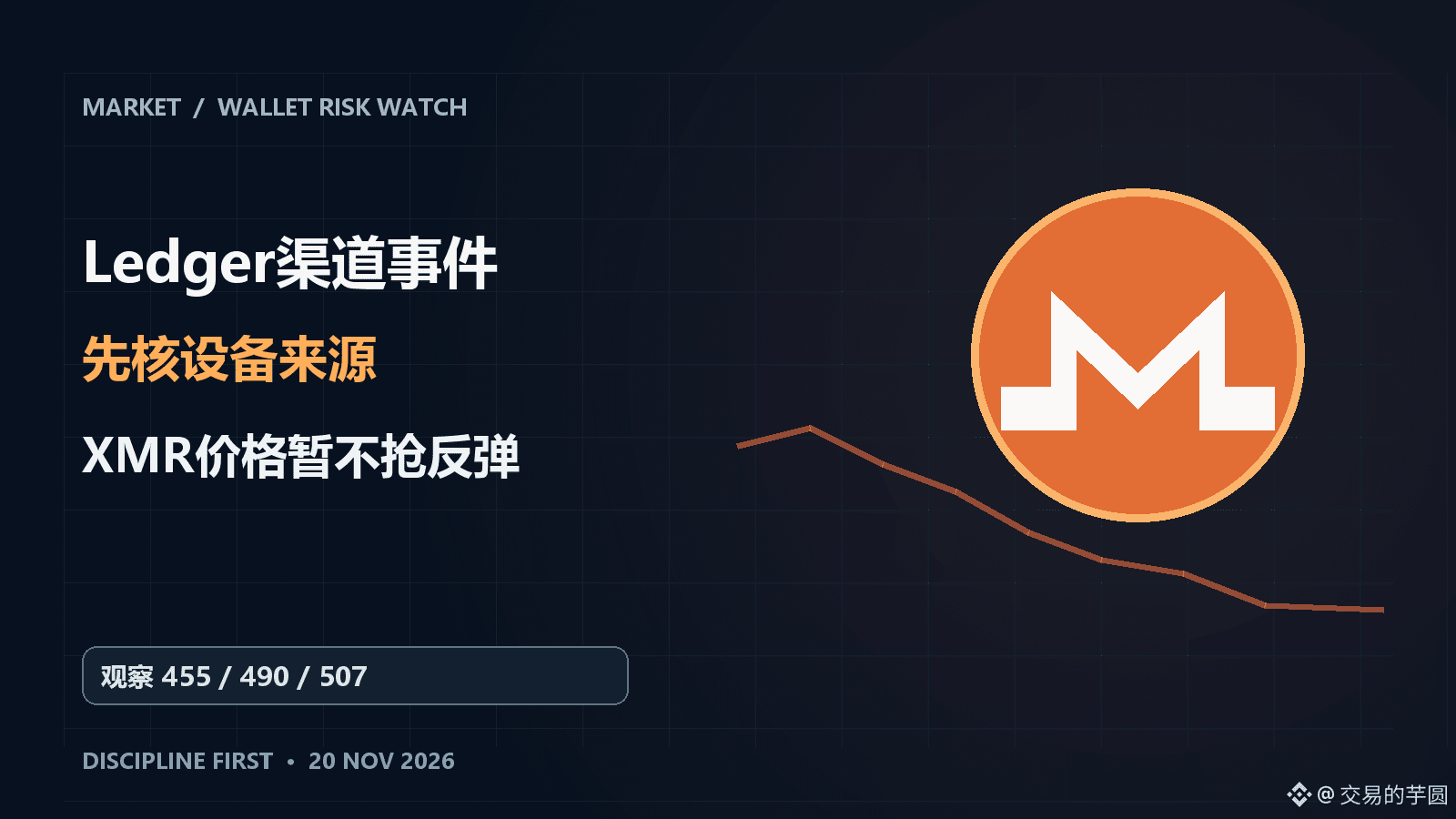
Ledger distribution-channel incident | XMR holders should verify device origins first | Don’t rush to buy the rebound
My view is to manage custody risks first, then discuss an XMR rebound. The current trending topic on Binance Square, #LedgerProbesTamperedWalletsInBerlinAndDubai, concerns hardware-wallet distribution channels and is worth XMR holders examining against the original announcement. On November 18, Ledger updated its investigation: a small number of modified devices have been confirmed in Berlin, Germany, and one affected Nano Gen 5 was found in Southeast Asia; two suspected devices in Dubai are still under investigation. The company says the confirmed devices were physically modified in the same way to capture recovery phrases during device initialization. So far, no devices confirmed to have been affected were purchased directly from ledger.com, and no such vulnerability has been found in the devices’ secure chips or operating systems. Confirmed, suspected, and not found are three different descriptions and should not be conflated.
This incident has a real connection to XMR, but it should not be overstated. The Monero website lists Ledger Nano S, S Plus, and X as compatible with Monero wallets; that does not mean the affected devices necessarily held XMR, much less that the Monero network was compromised. The problem lies at the end of the supply chain, before the device reaches its user. If a recovery phrase is exposed during setup, holders may face the risk of their assets being transferred out later, even if they use legitimate wallet software. On-chain transfers of privacy coins are also difficult for outside observers to fully reconstruct, making routine backups and verifying device origins all the more important.
Ledger’s recommendations are very specific: anyone who bought from a third-party channel in Berlin after January 2026, or in Dubai or Southeast Asia, and is concerned that their device may be abnormal should contact support through the official website. If you suspect the device has been modified, do not use it to create or restore a wallet, and do not take it apart yourself. If you have already used a suspicious device, generate a completely new recovery phrase using a device purchased directly from the official website, transfer your assets to a new wallet, do not reuse the old phrase or passphrase, and arrange an inspection through an official support ticket. Any “customer service agent” who privately messages you asking for your seed phrase is not part of the official verification process.
As for price, at the time of writing, XMR/USD was around $478 on Kraken, with an intraday low of about $455 and a high of about $507, still below the day’s opening reference price of $497. This decline cannot be attributed to the Ledger investigation; macro risk appetite, trading channels, and XMR’s own liquidity can all affect the price. For the short term, I’m watching $455, $480, $490, and $507: a break below $455 would mean the defense line has given way again; $480 would merely return to the middle of the range; holding above $490 would be the first sign of recovery; and $507 is the next confirmation level above. If official confirmation emerges that a broader batch of devices is involved, the custody-risk assessment needs to be revisited immediately. If the investigation is later resolved, that still does not automatically imply that XMR will rise.
If I were trading this myself, I would stay out for now and only consider a conditional spot long. I would first need to confirm that my personal device and recovery phrase are secure, and see XMR hold above $490 without breaking below it on a retest. Only then would I consider opening a test position with 2% of my total capital. The first target would be $507, where I would take half off, with the rest aimed at $525. The stop-loss would be below $470, with risk on any single trade capped at 0.3% of the account. I would cancel the plan or close the entire position if the price fell below $455, the investigation revealed a material new risk, or the price broke out and then fell back below $480. If you have concerns about a device, address wallet security first; don’t skip verification to chase the price, and don’t use high leverage.
#LedgerProbesTamperedWalletsInBerlinAndDubai #XMR
The above is solely my personal market observation and does not constitute investment advice.