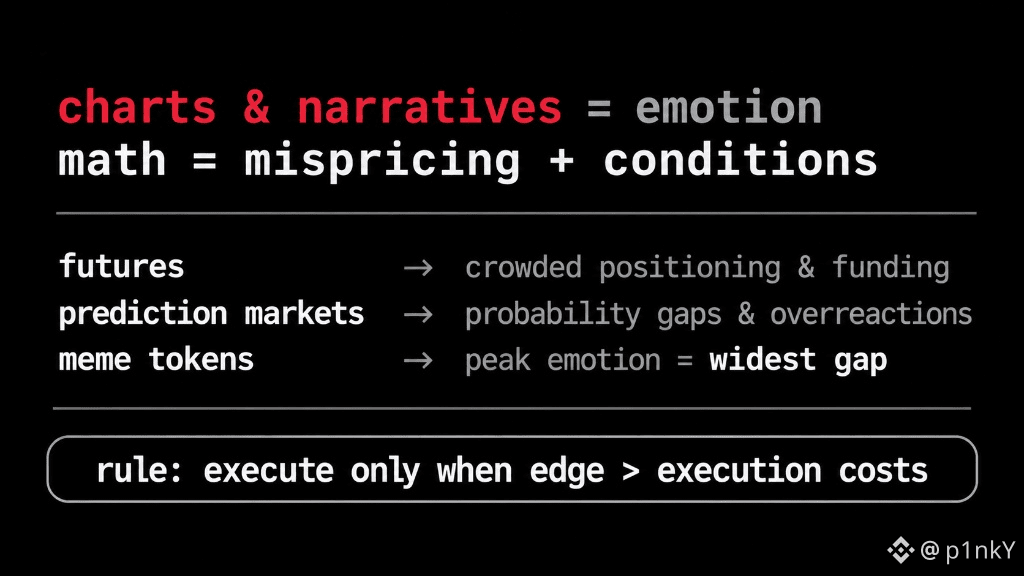
reading charts doesn’t make you consistent money on futures or prediction markets.
i think you make it by finding mathematical inefficiencies, mispricings, and forced positioning.
charts and narratives run on emotion and hindsight.
math doesn’t care how things “look.”
it only acts when time, place, and conditions actually line up.
this shows up on futures, prediction markets, and even meme tokens.
the difference is that on meme tokens emotion is louder, so the mathematical gap is even wider.
on futures, that’s crowded positioning, funding extremes, or regime shifts.
on prediction markets, that’s probability gaps, overreactions, or structural biases.
the goal isn’t guessing the future.
it’s stepping in when the math shows mispricing,and execution costs still leave real edge.
most people still override the rules because a chart or headline feels convincing.
that’s usually where the edge dies.
do you think real mathematical edges still exist on these markets, or have they mostly been arbed away?