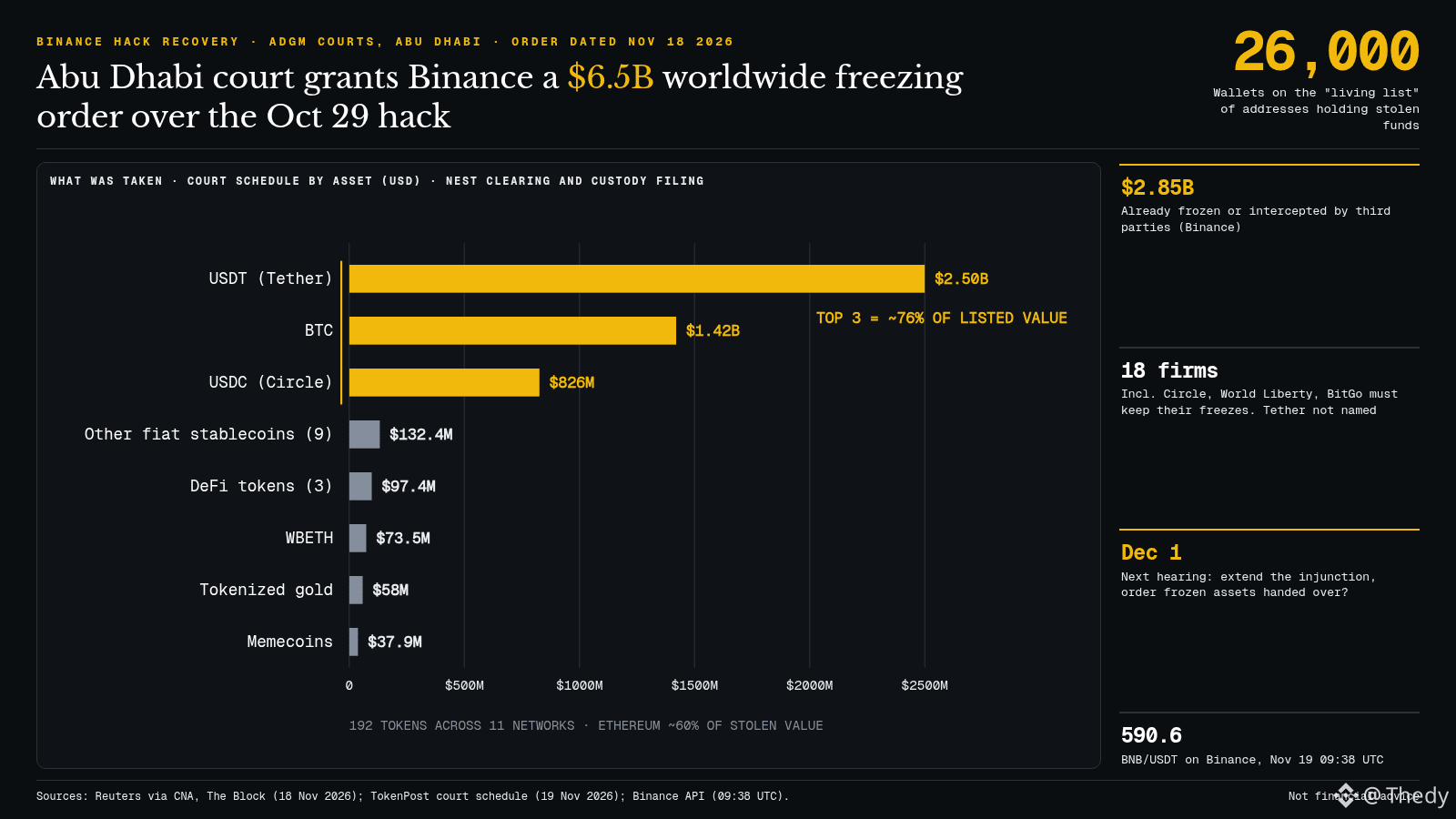
On 18/11, Binance obtained a worldwide freezing order for $6.5bn from the ADGM courts in Abu Dhabi against the perpetrators of the October 29 hack. Its lawyer at Gibson Dunn called it one of the largest publicly issued orders of this kind.
The question that keeps coming up under every post on the subject: why pursue the funds if customers have already been reimbursed?
Because several issuers and platforms refuse to return what they have frozen without a court order, Binance explains (The Block). About $2.85bn has already been frozen or intercepted by third parties, but frozen doesn’t mean returned.
What the ruling contains, according to Reuters and The Block:
- 18 companies, including Circle, World Liberty Financial and BitGo, must maintain their freezes, without lending, swapping or mixing these tokens. None is accused of wrongdoing.
- Tether is not included: it says it has frozen $1.5bn and will reissue the tokens directly with Binance.
- A “living list” of 26,000 addresses, with the possibility of on-chain notification.
- The attackers must declare any assets worth more than $50,000 by 30/11.
The appendix filed with the court (TokenPost) details the loot: $2.50bn in USDT, $1.42bn in $BTC and $826m in USDC, about 76% of the total, across 192 tokens and 11 networks.
My take: the tool is mainly effective against stablecoins, which an issuer can freeze and then reissue. BTC can’t be frozen at source, and the hacker continues converting ETH to BTC via THORChain. The figure to watch is the amount actually returned.
The next step is on December 1: the court will decide whether the injunction is extended and whether the companies must hand over the frozen assets. If so, some of the $2.85bn could be returned fairly quickly. If it is contested or delayed, the case could drag on for months. As for the market, $BNB is trading at $590.6 at 09:38 UTC (-0.3% over 24 hours), with no notable reaction.
In your view, will Binance recover less than a third or more than half of the $6.3bn by the end of 2026?
#Binance #SAFU #CryptoSecurity