
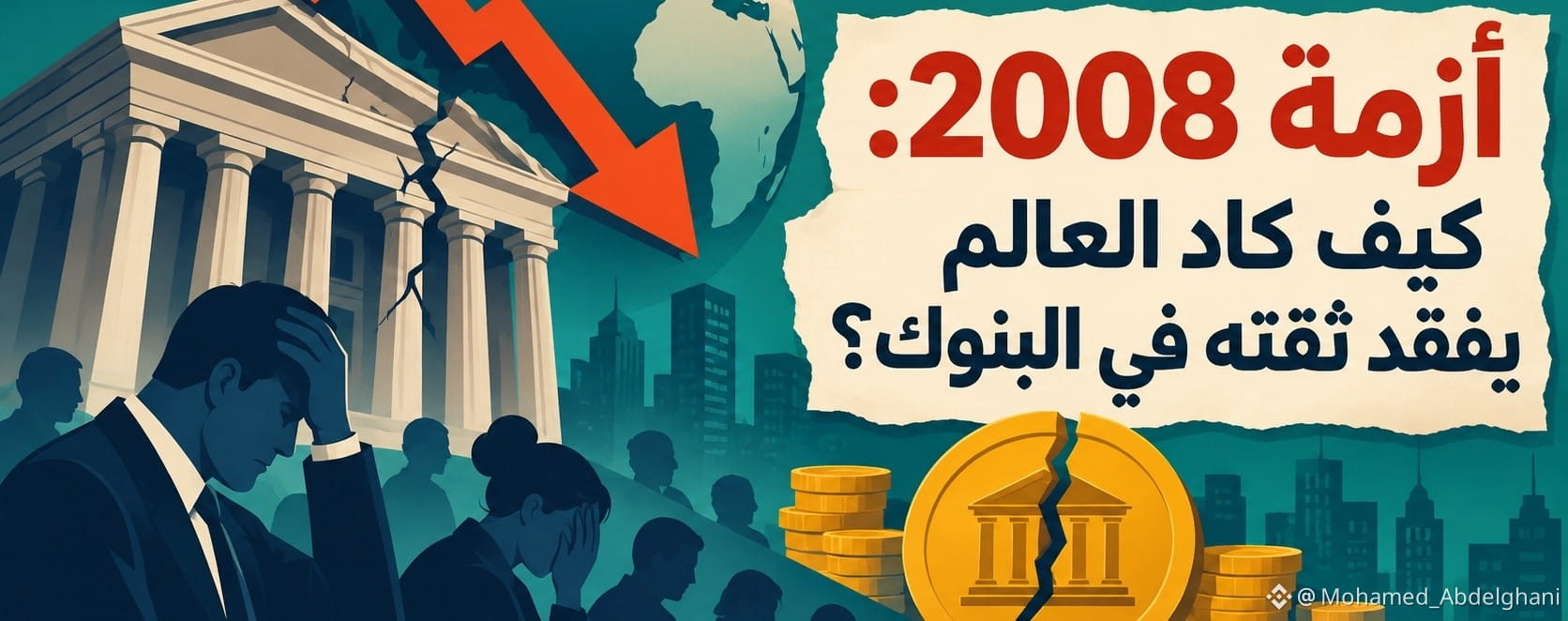

On the morning of September 15, 2008, the world awoke to news few had ever imagined they would see: Lehman Brothers, one of the oldest financial institutions in the United States, had declared bankruptcy.
It was not just a company closing its doors, or simply another loss in the stock market. Lehman was a giant financial institution that did business with banks, companies, and investment funds around the world. When it fell, it did not fall alone; an entire network of relationships, debts, and financial promises that the world had taken for granted was shaken along with it.
In New York, employees were leaving their offices carrying cardboard boxes. In London, financial institutions were trying to figure out who would still be able to meet their obligations. And far from Wall Street, homeowners, factories, and shops were bracing to pay the price of a crisis most of them had played no part in creating.
But the question worth pausing over is not: Why did a major bank fail?
The real question is: How did the world reach a point where the failure of a single institution could threaten the entire financial system?
To understand how this happened, we need to go back several years, to a time when the United States was experiencing a housing boom that seemed as if it would never end.
The American Dream That Became a Trap
In the United States, owning a home represented more than just buying a property. It was a symbol of stability, success, and achieving the American Dream. As home prices rose, many came to see property as an almost guaranteed investment.
Banks were lending, finance companies were expanding, buyers were entering the market, and prices were rising. The higher prices went, the more people believed that property could not lose significant value.
But behind this glittering picture, a problem was quietly growing.
Some financial institutions began issuing mortgages to people who could not afford to repay them, or who did not meet the credit requirements that would make a loan safe by traditional standards. These loans became known as subprime mortgages.
The logic used to justify the expansion was simple: if the borrower defaulted, the house could be sold and the money recovered. And if the home’s price rose, all the better for everyone.
But this logic relied on a dangerous assumption: that property prices would keep rising.
This is where things began to go wrong.
Some institutions no longer treated a person’s ability to repay as the decisive factor. A person could get a loan to buy a home, and those loans could then be sold and bundled with other loans into securities known as mortgage-backed securities.
Put simply, a loan was no longer just a direct relationship between a person and their bank. It became raw material for a complex financial industry, passing through multiple institutions and turning into products bought by investors around the world.
A borrower might sign loan documents in an American city, only for the effects of that signature to find their way into investment portfolios at institutions thousands of miles away.
And so homes became financial assets, and loans became products that could be bought and sold.
How Did Debt Become Products That Seemed Safe?
This brings us to one of the most important links in the story: securitization.
Instead of holding mortgages until borrowers paid them off, institutions bundled large numbers of them and turned them into securities that could be sold to investors. Investors received returns tied to the payments made by the borrowers.
The process then evolved into more complex products, such as collateralized debt obligations (CDOs), which combined different tranches of debt and related securities.
Securitization was not inherently a sinister invention; in principle, it can distribute risk and provide financing. But the problem lay in how it was used, the quality of the loans included in these products, and the difficulty of knowing the true scale of the risks institutions were carrying.
Some products received high credit ratings despite being tied to a housing market that was beginning to show signs of weakness. Investors sometimes bought complex securities without having a clear picture of all the risks they contained.
More troubling still, some institutions did not stop at buying these products. They built additional financial bets on top of them, using instruments such as credit default swaps—contracts used to protect against the risk of default, but which could also become a major source of risk if the obligations were not adequately covered or clearly understood.
Imagine someone buys a home with a loan. The bank then sells the loan, an institution bundles it with other loans, the resulting securities are sold to investors, and additional financial contracts are used to insure against their risks.
At the end of the chain, an investor may not easily know who the original borrower is, how able they are to repay, or how the product’s value will be affected if home prices fall.
Risk had become widely distributed, but distributing it did not make it disappear. Instead, it became harder to know where it was or how large it was.
When the Market Turned
At some point, what many did not want to believe came to pass: home prices began to fall.
As prices fell, some homeowners found themselves owing more than their properties were worth. Defaults began to rise, especially among the most vulnerable borrowers.
Investors then discovered that the securities they had bought were not as safe as they had thought.
Losses began to emerge, and institutions started reassessing their assets. But the problem was that no one knew exactly how large the losses held by others were.
This was when the financial system entered its most dangerous crisis: a crisis of confidence.
Banks do not operate on their own money alone. They also rely on short-term borrowing, daily dealings with other institutions, and the confidence that counterparties can meet their obligations.
If one bank doubts another bank’s ability to repay, it may hesitate to lend to it. If many institutions do the same, access to liquidity becomes difficult even for institutions with substantial assets.
This is an important point for understanding the crisis: an institution may have assets on paper, yet be unable to provide the cash it needs to meet its obligations on time.
The difference between solvency and liquidity was no longer a theoretical matter in economics textbooks; it had become a question that determined who would survive and who would fall.
Bear Stearns: The Warning That Failed to Stop the Disaster
In March 2008, one of the clearest signs of the crisis’s depth emerged when investment bank Bear Stearns came under severe pressure after its ability to secure the funding needed to continue operating deteriorated.
The bank was a major player in several financial markets, and its sudden collapse could have spread risk to other institutions connected to it.
The Federal Reserve intervened and helped arrange its acquisition by JPMorgan Chase.
It was a clear warning: the crisis was no longer just a problem in the housing market; it was threatening the infrastructure through which money moves between institutions.
Even so, the rescue was not enough to end the fear.
Over the following months, pressure continued, and fears grew that other institutions might face the same risks.
September 15: The Day Lehman Fell
Then came September 15, 2008.
Lehman Brothers declared bankruptcy after efforts to reach a deal to save it failed.
Its fall was not merely the end of an institution more than a century old. It sent a message to markets that even huge institutions were not immune to collapse, and that a seemingly solid network of financial relationships could unravel quickly when confidence disappeared.
The next day, insurance giant AIG faced a severe liquidity crisis linked to its losses and financial obligations, including credit default swaps. The Federal Reserve intervened to provide emergency support.
This raised the contradiction that sparked widespread debate: Why was one major institution allowed to fail while another was rescued?
There was no simple answer. Each institution faced different circumstances, with different assets and obligations, available collateral, and estimates of how its collapse would affect the rest of the system.
But to the public, the situation was bewildering: financial institutions had made extremely risky decisions, and governments and central banks were then expected to prevent their collapse because their failure could drag the entire economy down with them.
This did not mean every bank escaped punishment or that every executive profited from the crisis. But the public’s sense of injustice was understandable: losses were not shared equally, and ordinary people found themselves bearing the consequences of decisions they had played no part in making.
From Wall Street to Main Street
Financial crises do not stay on the trading floor.
When banks stop lending or become more restrictive, businesses that need financing to run their factories, expand their operations, and pay their employees are affected.
When businesses contract, jobs disappear, spending declines, and the economy weakens.
Homeowners unable to repay their loans faced the risk of losing their homes. Workers who lost their jobs discovered that a crisis that began in the world of securities could reach the dinner table, the rent bill, and a family’s future.
Those affected were not just investors who lost money in the stock market. Families lost their homes, workers lost their jobs, businesses could not get financing, and savers lost part of their wealth.
According to the U.S. Department of the Treasury, at the height of the crisis the U.S. economy reached a point where credit markets that financed things like credit cards, student and auto loans, and small businesses were at risk of shutting down. The threat of a run on banks was also real.
This is where the meaning of the crisis becomes clearer: money is not just numbers in electronic accounts; it is a network of promises made between people. When individuals and institutions lose confidence in others’ ability to keep their promises, large parts of the economy grind to a halt.
Did Governments Rescue the Banks or the Economy?
Faced with the threat of collapse, governments and central banks intervened on a broad scale.
In the United States, the Troubled Asset Relief Program (TARP) was approved in October 2008, authorizing the government to use up to $700 billion through the program to address the crisis and restore financial stability.
The stated goals were to prevent the financial system from collapsing, get credit markets working again, and limit the crisis’s spread to the real economy.
The Federal Reserve also used extraordinary tools to provide liquidity and support financial markets and institutions, while government agencies intervened in rescue and restructuring efforts.
But these interventions opened a debate that is still relevant today: Was rescuing financial institutions necessary to protect millions of people from a broader collapse, or did it send a dangerous message that some institutions are too big to be allowed to fail?
This dilemma is sometimes known as the “too big to fail” problem.
If an institution is so large and interconnected that its collapse threatens the entire economy, the government may find itself compelled to intervene, even if the institution has made serious mistakes.
But if institutions believe the government will always rescue them, they may be encouraged to take on more risk than they should.
This is both an ethical and an economic problem: How can society be protected from collapse without turning government rescues into a free guarantee against risk?
There was no easy answer, and the crisis did not end simply because money was injected into the system. Its effects on employment, production, and confidence continued for years.
The Paradox: The Crisis That Put the Question of Money Back in the Spotlight
On January 3, 2009, just months after Lehman fell, the first block in the Bitcoin network appeared.
Inside the block, the network’s anonymous creator, Satoshi Nakamoto, placed a message referring to a headline in The Times about a bailout plan for British banks.
This message alone does not prove that the 2008 crisis was the sole reason Bitcoin was invented, nor does it reveal all of Satoshi’s motives. But it offers a telling historical sign: the traditional financial system was experiencing a profound crisis of confidence, while an experiment proposing a different form of digital money was emerging.
The question raised by the crisis was bigger than the question of stock prices or bank losses: Who has the authority to issue money? Who sets the rules of exchange? Who bears the consequences of decisions? And how can a financial network operate if its participants do not have to rely on a single central institution to record every transaction?
Bitcoin introduced a different idea: a network where participants could verify transactions according to shared rules, without needing a central bank to manage the ledger.
But it is important not to confuse two things.
The 2008 crisis did not prove that all banks are bad or that every form of centralized finance is doomed to fail. Nor did the emergence of Bitcoin eliminate financial risks or make trust, protection, and regulation unnecessary.
Bitcoin has challenges of its own: sharp price fluctuations, risks related to safeguarding keys, scalability problems, and uses that are not free from fraud and speculation.
But it reopened an old debate in a new technological form: Is it possible to build a monetary system that does not rely on a central intermediary to record transactions?
This is the historical connection between the crisis and the emergence of digital currency. It is not that the crisis alone created Bitcoin, but that it exposed the fragility of some financial structures and made questions about trust in institutions more urgent.
What Did the World Learn from 2008?
After the crisis, the United States moved toward broad regulatory and legislative reforms. Among the most significant was the Dodd-Frank Act of 2010, which aimed to strengthen oversight of financial institutions, improve transparency, and reduce some systemic risks.
But laws alone cannot prevent crises from recurring if the wrong incentives remain in place, if institutions continue to hide risks behind highly complex products, and if investors treat credit ratings as an absolute guarantee.
The most important lesson is that risk does not always come from a single financial asset or one wrong decision. Sometimes a collapse occurs when decisions that seem reasonable on their own accumulate and collectively turn into a fragile system.
A loan that seems safe, a high credit rating, an institution that seems strong, an insurance contract, a rising market, and lenders who trust one another. Each piece seems defensible until conditions change and everyone discovers that the risks were greater than they had imagined.
Perhaps what makes the 2008 crisis so important even today is that it was not just a historical event that came and went. It is a lesson in the limits of trust, in the relationship between money and power, and in the cost of believing that markets can always correct their own mistakes.
Ultimately, the collapse of Lehman Brothers was less the beginning of the crisis than the moment when its scale could no longer be concealed.
The world discovered that money moving at enormous speed between continents might be built on fragile confidence, and that the failure of one institution could reveal connections that many people had not understood.
Amid this turmoil, a new question emerged, one that was not merely technical: Could we redesign the way money itself moves?
After the story of the man who invented money that needs no bank, we now know why the world was ready to listen to the idea.
Beyond Money | Beyond Money
This article is a historical and economic analysis, not investment advice or a recommendation to buy or sell any financial asset.
---
Sources and Further Reading
1. Financial Crisis Inquiry Commission – The Financial Crisis Inquiry Report
The official report of the U.S. commission investigating the causes of the financial crisis:
https://fcic.law.stanford.edu/report
2. Federal Reserve – Origins of the Financial Crisis
The Federal Reserve’s explanation of the causes of the crisis, the mortgage market, and the shadow banking system:
https://www.federalreserve.gov/newsevents/speech/20100407a.htm
3. FDIC – Crisis and Response: An FDIC History, 2008–2013
A detailed historical account of events and government interventions during the crisis:
https://www.fdic.gov/sites/default/files/2024-03/crisis-response.pdf
4. U.S. Department of the Treasury – About TARP
Background on the Troubled Asset Relief Program and its goals:
https://home.treasury.gov/data/troubled-assets-relief-program/about-tarp/
5. Federal Reserve History – The Great Recession and Its Aftermath
A historical overview of the crisis, its consequences, and the measures that followed:
https://www.federalreservehistory.org/essays/great-recession-and-its-aftermath
6. Bank for International Settlements – The Financial Crisis
An analysis of the stages of the crisis and its progression from financial deterioration to a global loss of confidence:
https://www.bis.org/publications/ii_3.htm