
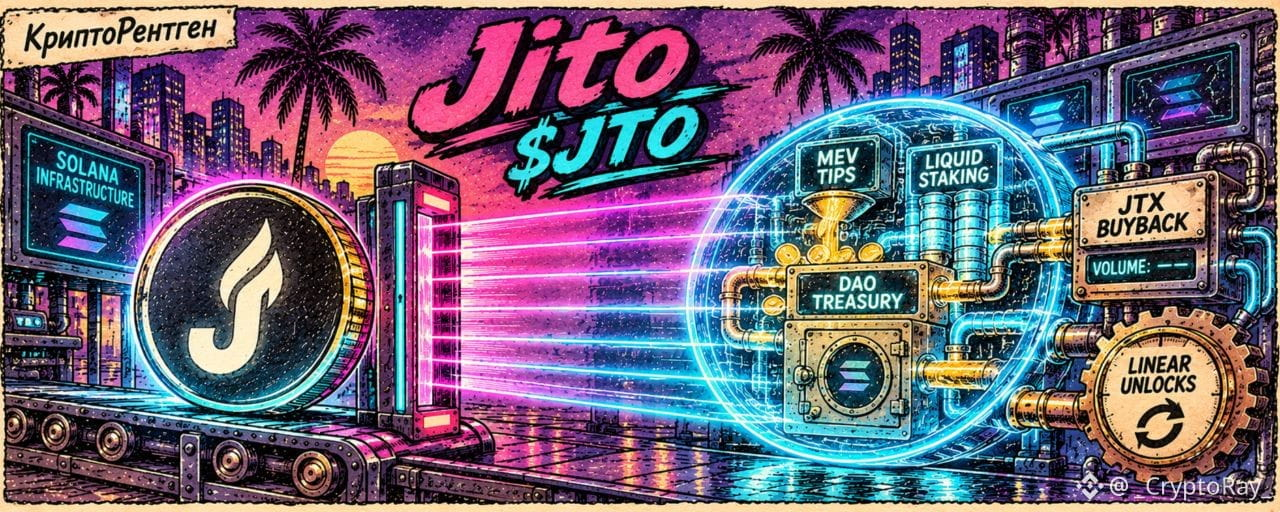
Jito is Solana’s infrastructure ecosystem: liquid staking with JitoSOL, MEV and tips, StakeNet, TipRouter, BAM, and JTX. $JTO JTO is the governance token here. At the time of writing, its price is around $0.265, its market cap is around $144–145 million, and approximately 545 million JTO are in circulation. The main conflict: the primary cliff has ended, but tokens continue to enter circulation, while a buyback-and-burn mechanism exists in the rules but its actual scale has not been calculated.
Product and token role
JitoSOL captures returns from SOL staking and MEV mechanisms. JTO is a separate asset: it does not give its holder JitoSOL's yield. However, it governs fees, the treasury, and a number of network parameters. Historical caveat: according to an official page dated November 2024, JitoSOL was Solana's largest liquid staking token at the time; its current ranking is not confirmed by the data. Evaluating JTO solely based on JitoSOL is incorrect: revenue streams from different products cannot be added together without eliminating double counting.
Tokenomics
Initial supply: 1 billion JTO. Distribution:
Community Growth: about 34.3% (including a 10% airdrop)
Ecosystem Development: 25%
Core Contributors: 24.5%
Investors: about 16.2%
Of the community allocation, the DAO controls 24.3% of the initial supply. Aggregators show different total supply figures: DefiLlama lists a maximum of around 799.07 million, so the initial issuance should not automatically be treated as the current total supply.
The 60.2% and 39.8% split is a division within the two insider categories (Contributors and Investors), not shares of the total supply.
Unlocks
Official documentation describes a three-year schedule for investors and core contributors, with a one-year cliff. Tokenomics.com shows the main cliff schedule ending on November 7, 2026. Secondary sources disagree on the end date: some trackers continue to show linear unlocks through November, ending around December 2026. As of November 18, DefiLlama shows linear releases of around 1.59 million JTO per week.
So the accurate summary is: the main cliff has ended, but distributions from linear unlocks and DAO programs continue. The rate of community token distribution is determined by governance and may change, so the supply cannot be described as stable.
Investors
The 2022 round was led by Multicoin Capital and Framework Ventures. The amount varies by source: some publications report $12 million as total funding, while DefiLlama attributes $10 million directly to Series A. DefiLlama also lists $50 million in strategic funding from a16z crypto in October 2025. These are aggregator figures, and the deal's connection to the JTO allocation has not been independently verified. Investment in the company is not the same as buying the token.
Buybacks and burning
JIP-38 describes the JTX program: 80% of JTX platform fees go to the DAO, and the remaining 20% goes toward JTX development. 100% of the DAO share is allocated to market purchases of JTO and burning, at least until the review in Q4 2027. Official materials also describe using revenue for buybacks, grants, and incentives.
What to bear in mind:
the forum document describes the mechanism but does not prove the volume of purchases made;
JTX revenue is not all ecosystem fees;
buybacks from treasury reserves differ from regular buybacks funded by new revenue;
Holders Revenue is $0 in the aggregator, but this does not prove there are no ecosystem-level buybacks; the adapter may not cover these flows.
Fees are not the same as DAO revenue: Jito's methodology accounts for staking rewards, MEV tips, liquid staking fees, and DAO fees.
Market
The price is around $0.265, circulating supply is around 545 million, and daily trading volume is around $12 to $13 million. We do not provide exact highs, lows, or annual performance here, as these figures have not been verified.
The inside story
Facts
Initial allocations have been disclosed, and JTO governs parameters and the treasury.
JIP-38 describes a buyback-and-burn program funded by the DAO's share of JTX revenue.
The main cliff ended on November 7 according to Tokenomics.com; linear unlocks are still ongoing.
Rumors and insider claims
“All unlocks ended on November 7”: unverified; linear unlocks are ongoing.
“Insiders hold 100% of the allocation” (based on the 60.2/39.8 split): disproven; these are shares within two categories.
“There are no buybacks”: disproven; the mechanism exists, but the scale of its execution has not been calculated.
Strengths
Operating Solana infrastructure, not just JitoSOL.
Multiple product revenue streams: staking, MEV, BAM, JTX.
Governance over actual fees and the treasury.
A documented JIP-38 buyback-and-burn model.
Disclosed initial tokenomics.
Weaknesses
Trackers disagree on the remaining unlock schedule.
The DAO and Foundation can increase the float even after insider vesting.
The scale of buybacks depends on JTX revenue and subsidy policy.
There is no automatic dividend for holders.
Dollar-denominated TVL is sensitive to the price of SOL.
Product metrics cannot be added together without eliminating double counting.
Sources
Jito Foundation documentation, Jito forum (JIP-38), DefiLlama, and Tokenomics.com.
