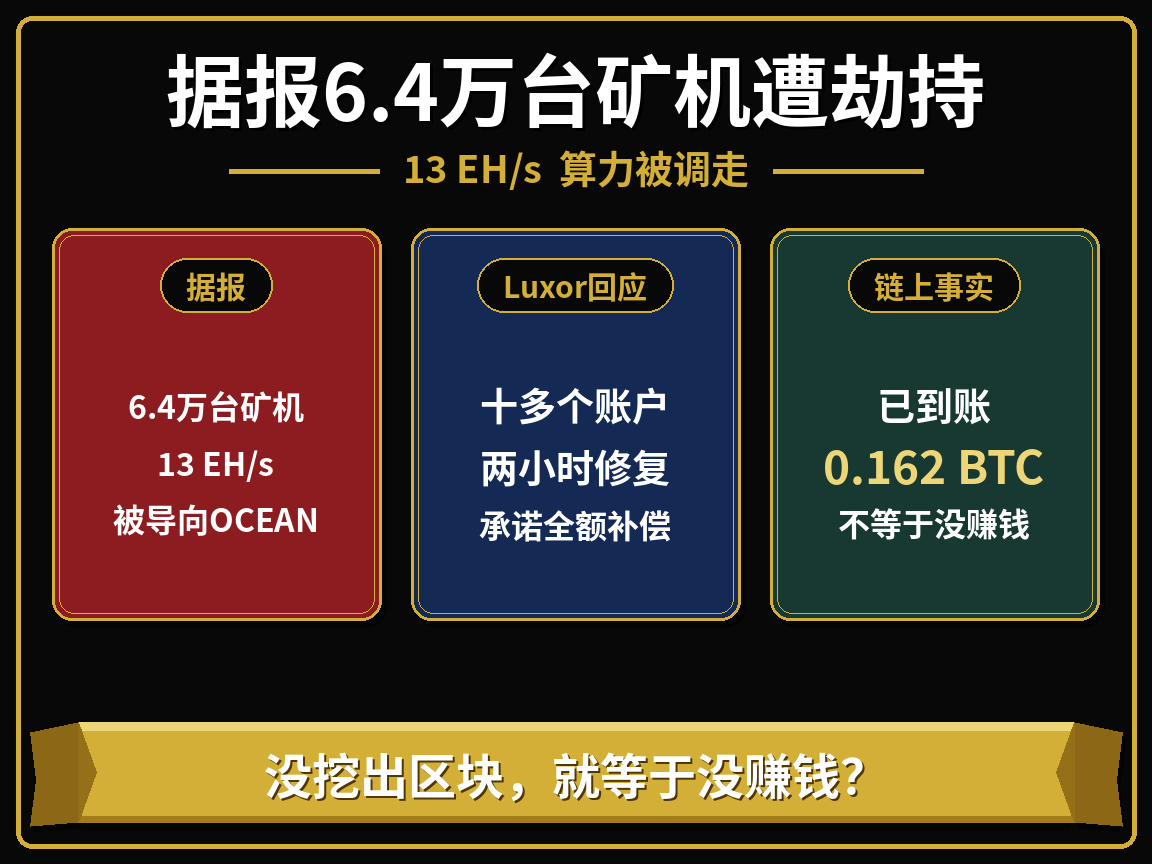
According to reports, 64,000 Bitcoin mining machines were hijacked, and 13 EH/s of hash power was redirected to someone else’s mining pool.
The mining world was rocked this weekend.
On November 14, hosting provider CoreX Hosting was the first to raise the alarm. About 64,000 mining machines, with 13 EH/s of hash power, were redirected to the OCEAN mining pool, and the payout address was changed to one controlled by the attacker.
Luxor later came forward and acknowledged that its own Commander management tool had been used to make unauthorized changes to mining pool configurations. A patch was deployed within two hours. The impact was limited to accounts belonging to just over ten customers; the mining pool and firmware were unaffected. Luxor also promised to provide full compensation based on the earnings miners would have received under normal mining conditions.
But Luxor has yet to confirm either figure: 64,000 machines and 13 EH/s.
Early reports said the attacker didn’t mine any blocks, meaning they didn’t make any money.
There’s one important point to clarify here.
Not mining any blocks doesn’t mean the attacker came away empty-handed.
OCEAN distributes earnings according to shares. Mononaut, a developer at Mempool.space, pointed out at the time that the dashboard showed about 0.657 Bitcoin in miner shares coming from the hijacked hash power. Blockchain records later showed that the address had received two OCEAN payouts totaling 0.162 $BTC .
The Bitcoin protocol itself wasn’t compromised. What was breached was the software layer that manages the mining machines.
CEO Nick Hansen described it as a sophisticated AI-assisted attack, but the specific attack method has not yet been disclosed. The full postmortem is also needed to determine how many machines were hijacked.
Miners hand over control of their entire fleet to management tools for convenience. But the flip side of that convenience is that one key can turn tens of thousands of machines at once.
Which layer do you think warrants the most vigilance here: permissions in mining management software, a second confirmation for mining pool configuration changes, or miners’ own incident response?
#Luxor矿机劫持 #矿业安全 #About 64,000 Bitcoin mining machines reportedly hijacked