
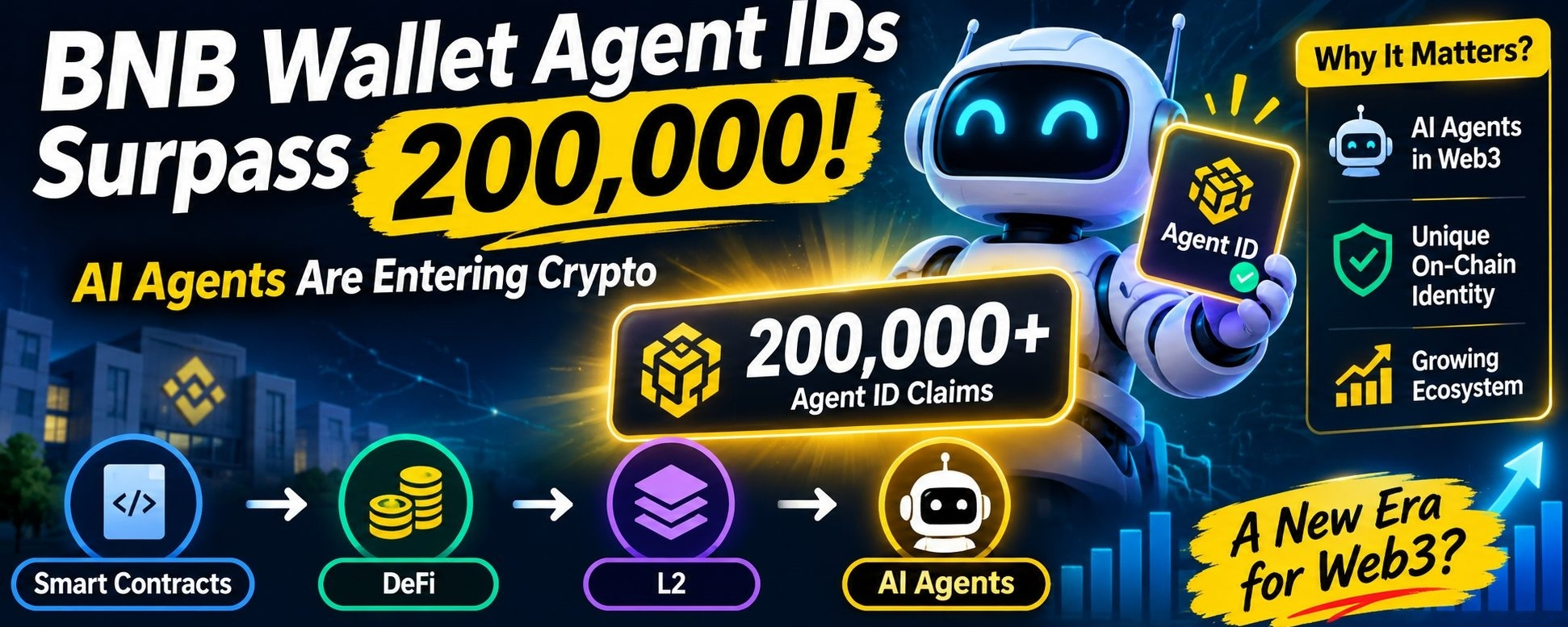


AI Agents Are Entering Crypto: Binance Wallet Agent IDs Surpass 200,000
Something interesting is happening in crypto, and I think the bigger story is not simply another adoption milestone.
AI is gradually moving beyond being a tool that helps people analyze information. It is beginning to interact with blockchain networks, execute tasks, manage digital assets, and operate through dedicated wallet infrastructure.
That shift could become one of the more important developments in the next phase of Web3.
And Binance Wallet's latest milestone caught my attention.
Binance Wallet has announced that Agent ID claims have surpassed 200,000.
These Agent IDs provide unique, non-transferable on-chain identities for AI agents.
At first glance, 200,000 claims might look like just another ecosystem growth statistic. But I think there is a more interesting question underneath it: What happens when AI agents become active participants in the blockchain economy?
From smart contracts to AI agents: another evolution?
Looking back at crypto's development, several major narratives have shaped different stages of the industry.
- Smart Contracts: Made programmable blockchain applications possible.
- DeFi: Expanded financial activities beyond traditional intermediaries.
- Layer 2: Focused on improving scalability and transaction efficiency.
- AI and Blockchain: Now exploring how autonomous software can interact with decentralized infrastructure.
These developments are not necessarily replacing one another. They are building on capabilities developed during earlier stages.
AI agents could represent another layer in that evolution.
Instead of requiring a person to manually initiate every interaction, an agent may eventually perform specific blockchain tasks based on instructions and permissions.
That creates a different kind of demand for infrastructure.
Why Agent IDs matter
I find the identity aspect particularly interesting.
If AI agents are going to interact with multiple applications, users and protocols, they need ways to establish recognizable identities.
A unique, non-transferable on-chain identity could help provide that foundation.
It is not just about giving an AI agent a name. It is about creating an identifiable presence within a blockchain environment.
However, there is an important distinction here:
An Agent ID claim does not automatically mean an active, useful or economically productive AI agent exists behind it.
That is where the real adoption test begins.
The difference between narrative and execution
I have seen crypto narratives attract enormous attention before their actual utility becomes clear.
AI is no exception.
The 200,000 milestone demonstrates meaningful interest in the Binance Wallet ecosystem, but the next questions matter more:
- How many registered agents are actually performing useful tasks?
- How frequently are these identities interacting with blockchain applications?
- Can developers build sustainable services around this infrastructure?
- Will users trust AI agents with increasingly complex on-chain activities?
Binance's broader Agentic Wallet infrastructure, including isolated balances and configurable permissions, also makes the security and control question important.
Why the timing matters
AI is attracting attention across technology, while Web3 continues searching for practical applications beyond speculation.
The combination creates an interesting opportunity for blockchain infrastructure providers.
Binance Wallet also has something important: ecosystem visibility and an established user distribution channel. That can help introduce new technologies to a much wider audience.
But visibility alone does not guarantee long-term adoption.
I would pay less attention to the headline number and more attention to what develops around it over the coming months.
The real breakthrough will not be how many AI agent identities get claimed. It will be how many become useful, trusted and consistently active participants in the on-chain economy.
Are AI agents becoming the next major infrastructure layer in Web3, or is the market getting ahead of the actual utility?