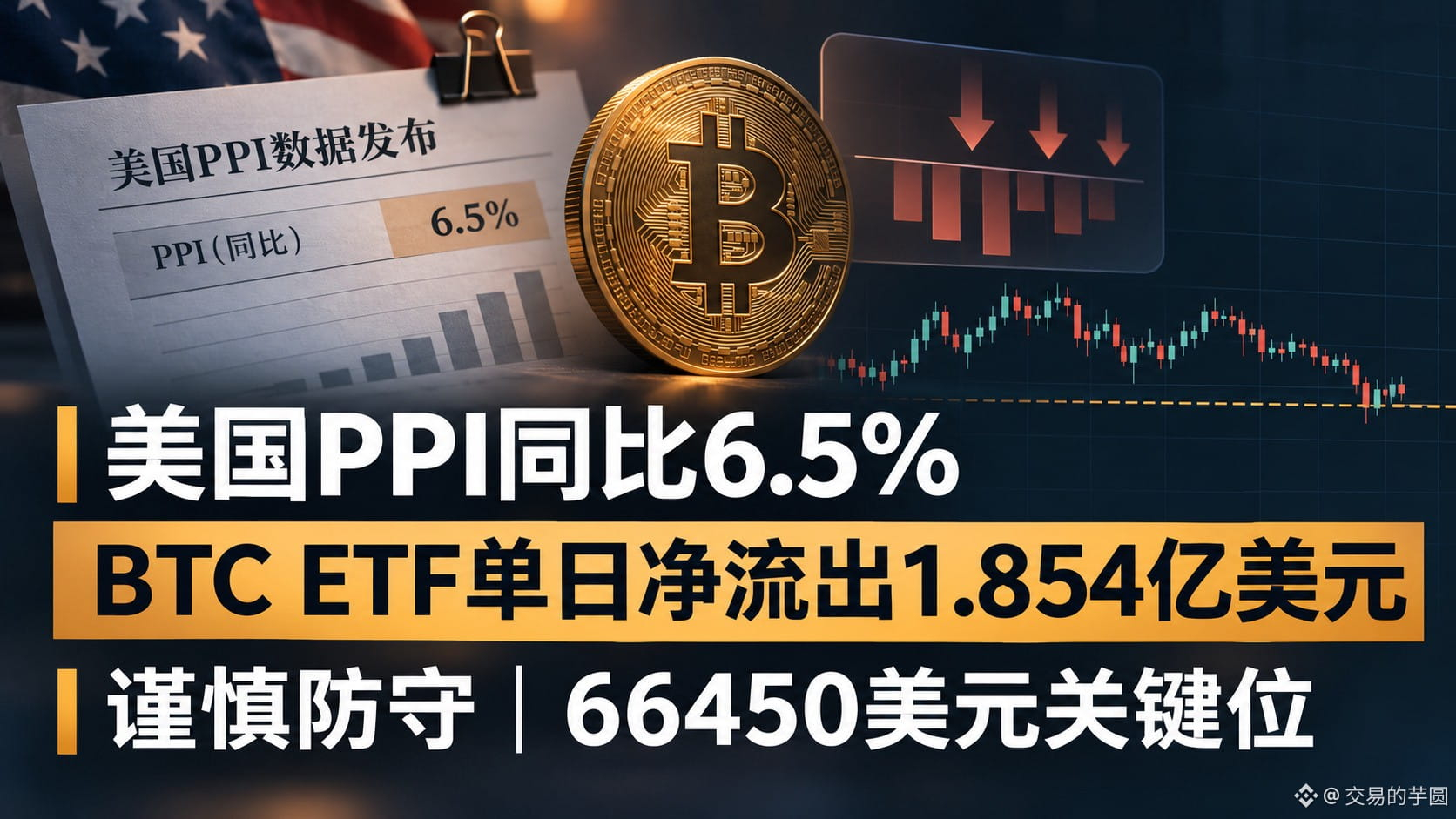
PPI comes in slightly below expectations|BTC spot ETFs still seeing outflows|I don’t mistake a rebound for a reversal
My stance is cautious and tilted toward defense. The exact topic being discussed on Binance Square is #USPPIMissMayEaseBTCPressure. The central question is whether the US Producer Price Index coming in below market expectations can ease pressure on BTC. First, the raw data: on November 13, the US Bureau of Labor Statistics reported that the October PPI for final demand rose 0.3% month over month and 6.5% year over year; the annual rate continued to climb from 6.3% in September. The market expectation cited by Binance News was 6.6% year over year. So “below expectations” refers to the difference between the actual figure and the forecast. It does not mean inflation has fallen to a comfortable range, much less that the Fed has decided to cut rates. At its October meeting, the Fed kept its target range at 3.75% to 4.00% and emphasized in its statement that inflation remained high; two officials had also argued for a rate hike. The November data needs to be understood in this policy context.
I care more about whether capital flows are backing up the positive narrative. According to Farside, US spot Bitcoin ETFs saw combined net outflows of about $185.4 million on November 13, including approximately $143.5 million from IBIT and $41.9 million from FBTC. This is a product-level flow table; it does not mean that all institutions sold spot BTC that day, nor can it directly reveal the execution price of each trade. However, observing outflows over multiple sessions at least suggests that one PPI reading slightly below expectations has not automatically reversed the direction of ETF creations and redemptions. The transmission to BTC works as follows: inflation expectations affect interest rates and the cost of dollar funding; ETF flows affect visible marginal demand; ultimately, it still comes down to whether spot demand can absorb selling pressure. In my view, there is not enough evidence to call a trend reversal based on the first link alone.
The market has already given its answer. A query of the public 24-hour BTC/USDT market data on Binance showed a latest price of about $67,148, with a high of about $70,214, a low of about $66,456, and a 24-hour decline of about 2.8%. This is not an event study of the moment the PPI was released, so the entire decline cannot be attributed to the data. But the price has not held steadily above $70,000, which is a verifiable fact right now. In the short term, I’m watching to see whether the $66,450–$66,500 area continues to find support, then whether $68,000 can be reclaimed. A stronger reversal would also require BTC to get back above $70,000. If it breaks below $66,450 and fails to reclaim that level on a bounce, my short-term stabilization thesis is invalidated. If ETF outflows ease, the price holds above $68,000 for multiple sessions, and BTC gets back above $70,000, I’ll give the bullish case more weight.
If I were trading this myself, I wouldn’t chase a rally right now. I’d only consider a spot trade using conditional orders, and keep my position size at 0. Only if BTC/USDT gets back above $68,000 and holds that level on a retest, while there is no significant new expansion in ETF outflows, would I test a long position with 3% of my account funds. I’d take half off at the first target of $69,000, then reduce most of the remainder at the second target of $70,000. I’d exit at a loss if the price fell back below $67,200. If BTC first breaks below $66,450, I’ll cancel the long plan and stay out of the market. If new information emerges about regulation or exchange security after entering a trade, I’ll prioritize closing the position and reassessing. These are trigger conditions, not a review of trades that have already been executed.
Data sources: US Bureau of Labor Statistics PPI release, the Fed’s October monetary policy statement, Farside’s Bitcoin ETF flow table, and Binance’s public BTC/USDT market data.
#USPPIMissMayEaseBTCPressure #BTC
This is solely my personal market observation and does not constitute investment advice.