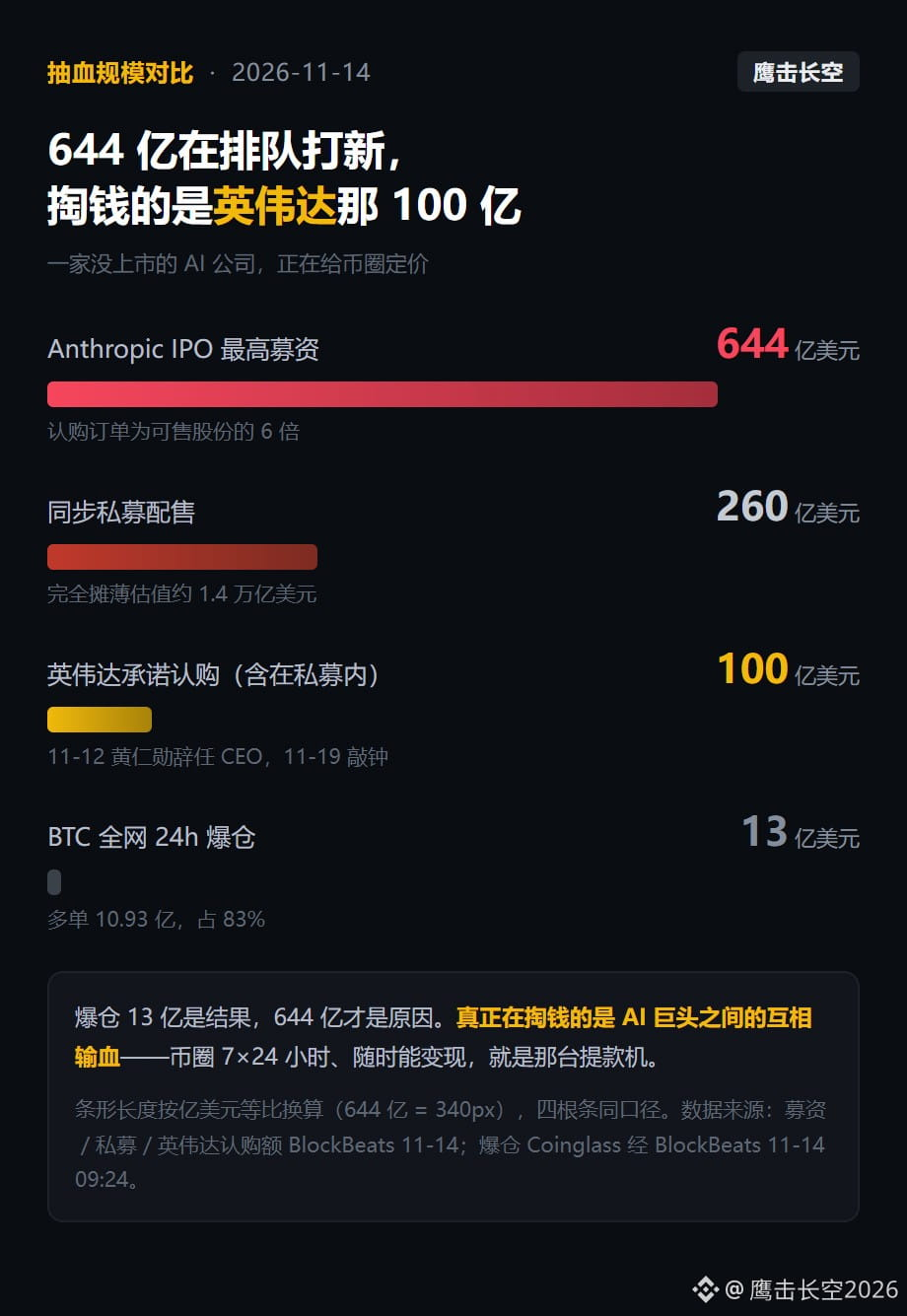
$64.4 billion is lining up to subscribe, and Nvidia is putting up that $10 billion
1. It wasn’t the Fed that triggered the sell-off. At 16:09, $BTC was at 67,262, down 2.18% in 24 hours, with an intraday low of 66,456—the lowest since August. It’s down 11% so far in November and has closed lower for six straight weeks. The real thing weighing on prices has nothing to do with crypto: Anthropic goes public next week, seeking to raise up to $64.4 billion, plus a concurrent $26 billion private placement. Subscription orders are six times the shares on offer.
2. The three reasons financial accounts gave today were: October PPI up 6.5% year over year, a possible 25-basis-point hike on December 9, and continued net outflows from ETFs. All three are true. But they don’t explain two things: why this week in particular, and why spot buyers are buying while only leveraged positions are getting liquidated.
3. Barron’s cited figures from CoinMarketCap Research: $913 million in BTC leveraged positions were liquidated over the past 24 hours, with longs accounting for 95%; yet over that same period, spot buyers made net purchases of $160 million for three consecutive trading days. In plain English: leveraged traders are cutting their losses, while spot buyers are picking up the pieces. This isn’t a collapse of faith—it’s a bill for forced liquidations.
4. Here’s the overlooked part: Nvidia has committed to subscribe for about $10 billion in this round of private placement. And on November 12, Jensen Huang resigned as Nvidia’s CEO. Within a week, the CEO leaves and the company puts $10 billion in cash toward buying shares in another company that hasn’t gone public yet. Money doesn’t fall from the sky. AI giants are propping each other up—but where does the money come from? From the most readily monetized marginal liquidity. Crypto markets run 24/7, have the deepest liquidity, and let you exit at any time. They’re the ATM.
5. History offers a harder example than macro speculation. From June 1 to 5, before SpaceX went public, BTC plunged from $75,000 to $60,000, down 20% in five days. SpaceX listed on June 12, and BTC later rebounded to nearly $68,000. This time, Anthropic goes public on November 19, and BTC has already fallen 20% since early October. The numbers line up almost too neatly. I don’t dare treat it as a rule; I’m just noting it down. Historical similarities don’t make an outcome inevitable, and I won’t buy the dip based on one analogy.
6. My own calculations are a little more granular. For Binance BTC perpetuals margined in USDT, the 24-hour taker buy/sell ratio is 0.915, with sellers in control. Looking only at the most recent 6 hours, it’s 0.951—higher than the 24-hour figure. Selling pressure is easing, not accelerating. BNB is the reverse: 0.896 over 24 hours and 0.886 over 6 hours, getting worse. Put the two figures side by side, and the conclusion is uncomfortable: this isn’t a broad-based collapse; it’s divergence, with money choosing where to run.
7. The 4-hour RSI is already at extreme lows: BTC 15.14, BNB 17.59, SOL 20.98. This isn’t a “healthy pullback”; it’s a spring compressed all the way down. Being compressed all the way down doesn’t mean it will bounce—it needs someone to catch it. $SOL is down 5.9%, with a funding rate of -0.0078%, the most negative among the five coins, and shorts are more crowded than anywhere else. I won’t add to shorts here; shorts will first be driven out by the cost of holding their positions. $ETH ’s relative strength has already fallen to zero. That little bit of downside-resistant premium from this afternoon evaporated completely in two hours.
8. My notes: if BTC rebounds to 67,682 (the previous 1-hour candle’s closing level), I’ll mark out a short entry, with a stop at 68,290, or 0.9% above, and a target of 66,456; if that breaks, I’ll look at 66,187. 66,456 has been tested three times today without breaking. If there’s no rebound, I won’t trade; I won’t chase a short at 66,500. For ETH, 1,928 overhead is firm resistance. If it breaks below 1,878, I’ll look for 1,855. These aren’t recommendations—they’re my own trades.
9. One line to go with the screenshot: $1.3 billion in leveraged positions liquidated, $160 million bought in spot—the market hasn’t collapsed; it’s just changed hands.
10. So here’s the question I’d like to hear your thoughts on today: do you believe in “IPO liquidity drain,” or do you believe “the Fed is the main culprit”? And while you’re at it, tell me whether you’re still holding a position, how much leverage you’re using, and where your stop is. I’ll read every reply. I’ll only talk about what these levels have looked like historically, not tell you what to buy or sell.
For real-time price levels and intraday alerts, find me in the comments—Eagle Soars Through the Sky · Crypto Study Group
Lu You | “Mountains upon mountains, waters upon waters—no way ahead; then, in the shadow of willows and among bright flowers, another village appears.”
Crypto assets are highly volatile. The above is my personal trading record and does not constitute investment advice. Make your own decisions and manage your risk.