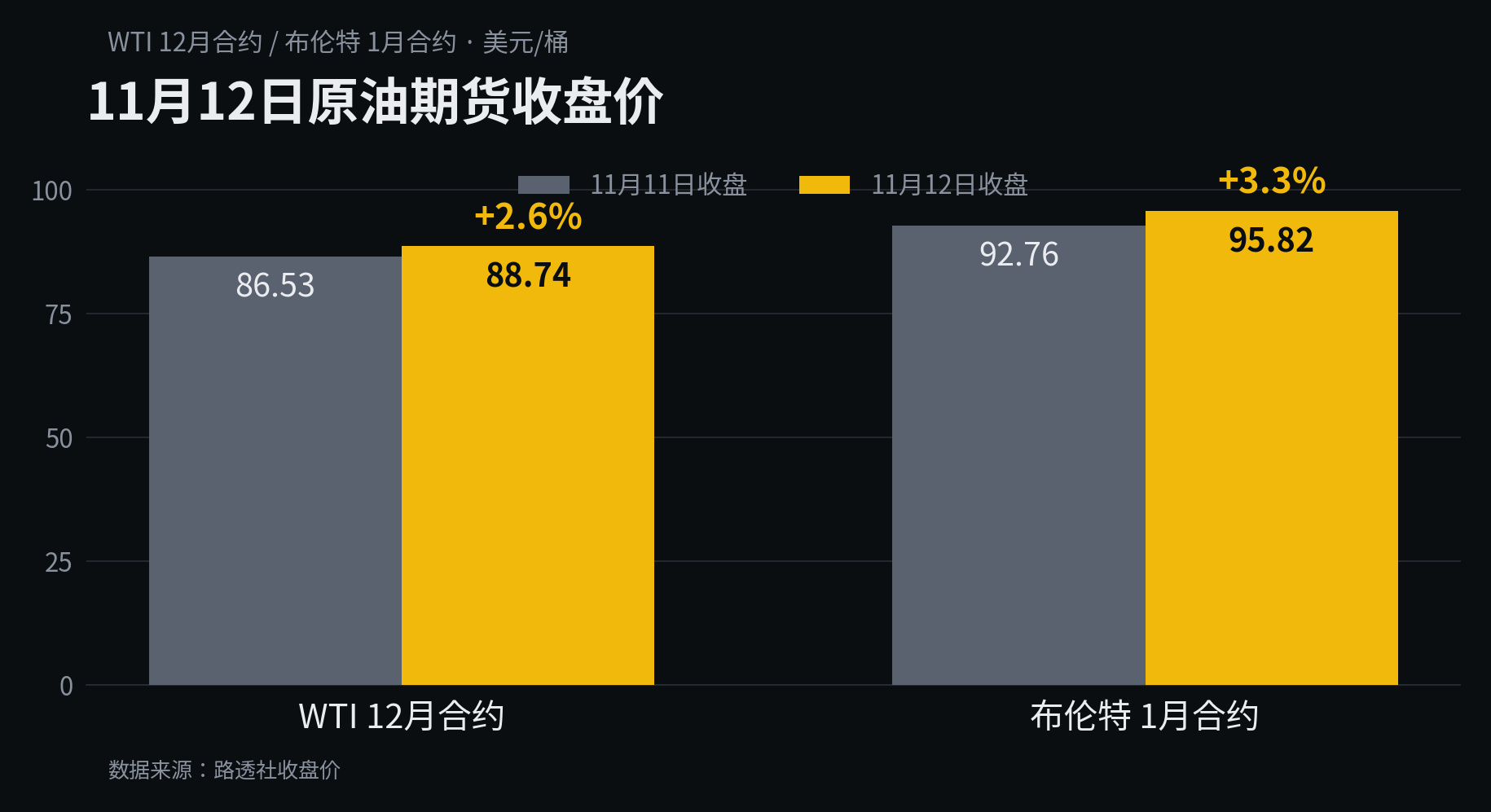
“No need for a deal with Iran”: WTI +2.6% in a day, Brent +3.3%
On Thursday, Trump posted on social media that there was no need for a deal with Iran, saying the money and the Strait were already in their hands. He also removed Vice President Vance, who had been leading negotiations with Iran, from Iran-related matters and reassigned him to oversee domestic urban corruption investigations.
Just the day before, The Wall Street Journal had reported that Vance was considering meeting directly with Iran’s national security chief. A complete reversal in a single day.
The 14-point memorandum marked the closest the sides had come to reaching an agreement since October 21. Now the negotiating track has effectively collapsed.
November 12 closing prices: WTI December futures at $88.74, up $2.21 (+2.6%) from $86.53 in the previous session; Brent January futures at $95.82, up $3.06 (+3.3%) from $92.76 in the previous session.
Even bearish data failed to halt the rally: EIA crude inventories rose by 4.7 million barrels for the week, far more than expected.
On the same day, the Houthis claimed to have attacked pumping stations on the East-West pipeline and facilities in Yanbu, while Iran claimed that four oil tankers had been attacked. Neither side’s claims have been independently verified.
The expectation of an “imminent deal” that had weighed on oil prices for nearly two weeks vanished as soon as the chief negotiator was reassigned. WTI could close above $90 over the coming week; if the White House clarifies that Vance still retains responsibility for Iran-related matters, or Iran offers a substantive response to the 14-point memorandum, the rally would immediately lose its support.
The risk lies on the other side: claims of attacks on oil tankers and pumping stations remain unverified. If they are disproved or the White House changes its tune, the gains could be given back just as quickly as they were made.
$CLUSDT $BZUSDT
#原油 #USIranTalks
On Thursday, Trump posted on social media that there was no need for a deal with Iran, saying the money and the Strait were already in their hands. He also removed Vice President Vance, who had been leading negotiations with Iran, from Iran-related matters and reassigned him to oversee domestic urban corruption investigations.
Just the day before, The Wall Street Journal had reported that Vance was considering meeting directly with Iran’s national security chief. A complete reversal in a single day.
The 14-point memorandum marked the closest the sides had come to reaching an agreement since October 21. Now the negotiating track has effectively collapsed.
November 12 closing prices: WTI December futures at $88.74, up $2.21 (+2.6%) from $86.53 in the previous session; Brent January futures at $95.82, up $3.06 (+3.3%) from $92.76 in the previous session.
Even bearish data failed to halt the rally: EIA crude inventories rose by 4.7 million barrels for the week, far more than expected.
On the same day, the Houthis claimed to have attacked pumping stations on the East-West pipeline and facilities in Yanbu, while Iran claimed that four oil tankers had been attacked. Neither side’s claims have been independently verified.
The expectation of an “imminent deal” that had weighed on oil prices for nearly two weeks vanished as soon as the chief negotiator was reassigned. WTI could close above $90 over the coming week; if the White House clarifies that Vance still retains responsibility for Iran-related matters, or Iran offers a substantive response to the 14-point memorandum, the rally would immediately lose its support.
The risk lies on the other side: claims of attacks on oil tankers and pumping stations remain unverified. If they are disproved or the White House changes its tune, the gains could be given back just as quickly as they were made.
$CLUSDT $BZUSDT
#原油 #USIranTalks