What South Korea is about to give exchanges is the power to avoid liability just by saying they “suspect” something
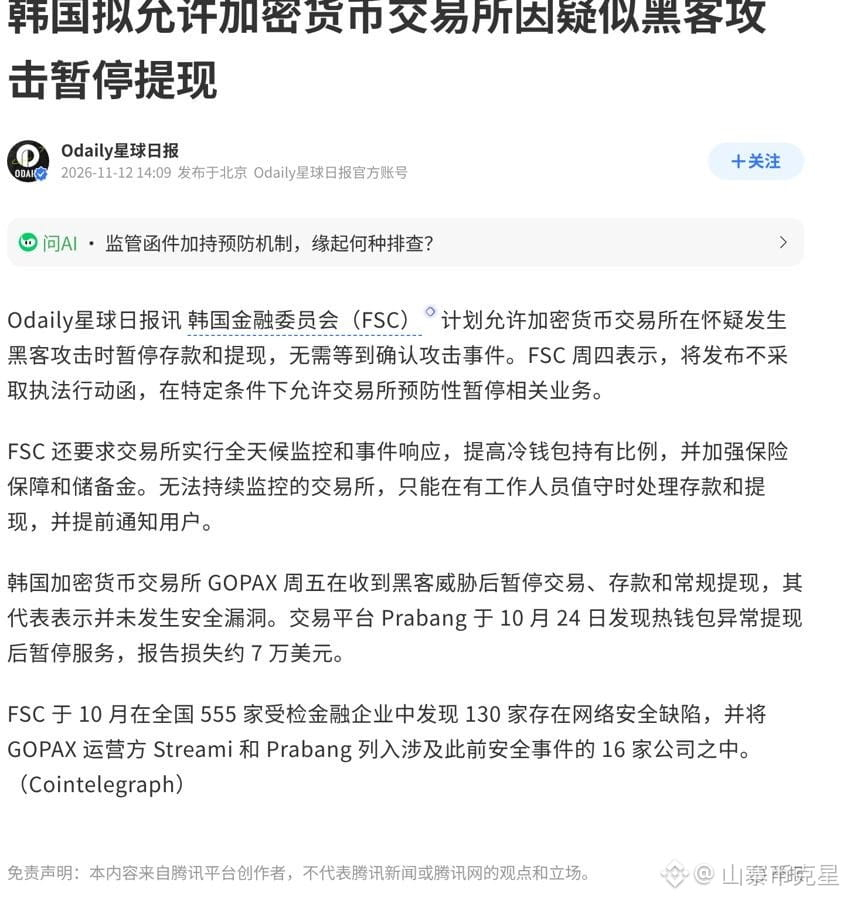
On November 12, South Korea’s Financial Services Commission (FSC) announced that it would issue a no-action letter allowing exchanges to suspend deposits and withdrawals if they suspect a hack, without waiting for the attack to be confirmed.
That sounds like stronger protection, but let’s look at what it actually changes.
Under the current Virtual Asset User Protection Act, exchanges cannot block users from withdrawing without a valid reason. They are only allowed to restrict withdrawals after a hacking incident has been “confirmed.”
Now that requirement is being sidestepped: suspicion is enough.
Who comes out ahead?
For exchanges, receiving a threatening email is enough to halt withdrawals. They no longer have to choose between “violating the rules by suspending withdrawals” and “risking the loss of billions.”
For users, your coins could suddenly become inaccessible one night, and the exchange wouldn’t be held liable.
GOPAX is a real-world example.
On November 6, it received a threatening email from hackers. That afternoon, it suspended deposits and withdrawals, halted trading, and moved all assets to cold wallets.
The exchange says it found no evidence of an actual attack—not even any traces of one.
As of today, the sixth day, it still hasn’t announced when services will resume. Binance owns about 67% of its shares.
Some of the FSC’s other requirements are more concrete:
24/7 monitoring and incident response; considering raising the cold-wallet ratio to above 80%; and strengthening insurance and reserve funds.
Exchanges that can’t provide continuous monitoring will only be allowed to process deposits and withdrawals during staffed hours, and must notify users in advance.
I have three takeaways.
First, the direction is right. Under the current law, exchanges get penalized either way. After Binance’s $6.3 billion incident, no one dares to gamble on “waiting and seeing.”
Second, the problem is in the details: the FSC hasn’t defined “suspicion” or set a time limit for suspensions. Three sources familiar with the matter have all confirmed this; the conditions still haven’t been announced.
Third, what this rule really protects is the stability of the system, not your ability to access your funds. It replaces the risk of “losing your principal” with the risk of “being unable to withdraw temporarily.”
When choosing an exchange, look at these three figures together:
Cold-wallet ratio—the South Korean requirement is 80%; Upbit is at 99.17%, while GOPAX is only at 80.54%.
The size of its insurance and reserve funds—these are what payouts come from when something goes wrong.
How many times it has suspended services in the past, how long each suspension lasted, and whether anything went wrong after services resumed.
If an exchange freezes your coins because it suspects a hack, do you think it’s protecting you, or protecting itself?
#韩国拟准交易所疑遭黑客停充提
On November 12, South Korea’s Financial Services Commission (FSC) announced that it would issue a no-action letter allowing exchanges to suspend deposits and withdrawals if they suspect a hack, without waiting for the attack to be confirmed.
That sounds like stronger protection, but let’s look at what it actually changes.
Under the current Virtual Asset User Protection Act, exchanges cannot block users from withdrawing without a valid reason. They are only allowed to restrict withdrawals after a hacking incident has been “confirmed.”
Now that requirement is being sidestepped: suspicion is enough.
Who comes out ahead?
For exchanges, receiving a threatening email is enough to halt withdrawals. They no longer have to choose between “violating the rules by suspending withdrawals” and “risking the loss of billions.”
For users, your coins could suddenly become inaccessible one night, and the exchange wouldn’t be held liable.
GOPAX is a real-world example.
On November 6, it received a threatening email from hackers. That afternoon, it suspended deposits and withdrawals, halted trading, and moved all assets to cold wallets.
The exchange says it found no evidence of an actual attack—not even any traces of one.
As of today, the sixth day, it still hasn’t announced when services will resume. Binance owns about 67% of its shares.
Some of the FSC’s other requirements are more concrete:
24/7 monitoring and incident response; considering raising the cold-wallet ratio to above 80%; and strengthening insurance and reserve funds.
Exchanges that can’t provide continuous monitoring will only be allowed to process deposits and withdrawals during staffed hours, and must notify users in advance.
I have three takeaways.
First, the direction is right. Under the current law, exchanges get penalized either way. After Binance’s $6.3 billion incident, no one dares to gamble on “waiting and seeing.”
Second, the problem is in the details: the FSC hasn’t defined “suspicion” or set a time limit for suspensions. Three sources familiar with the matter have all confirmed this; the conditions still haven’t been announced.
Third, what this rule really protects is the stability of the system, not your ability to access your funds. It replaces the risk of “losing your principal” with the risk of “being unable to withdraw temporarily.”
When choosing an exchange, look at these three figures together:
Cold-wallet ratio—the South Korean requirement is 80%; Upbit is at 99.17%, while GOPAX is only at 80.54%.
The size of its insurance and reserve funds—these are what payouts come from when something goes wrong.
How many times it has suspended services in the past, how long each suspension lasted, and whether anything went wrong after services resumed.
If an exchange freezes your coins because it suspects a hack, do you think it’s protecting you, or protecting itself?
#韩国拟准交易所疑遭黑客停充提