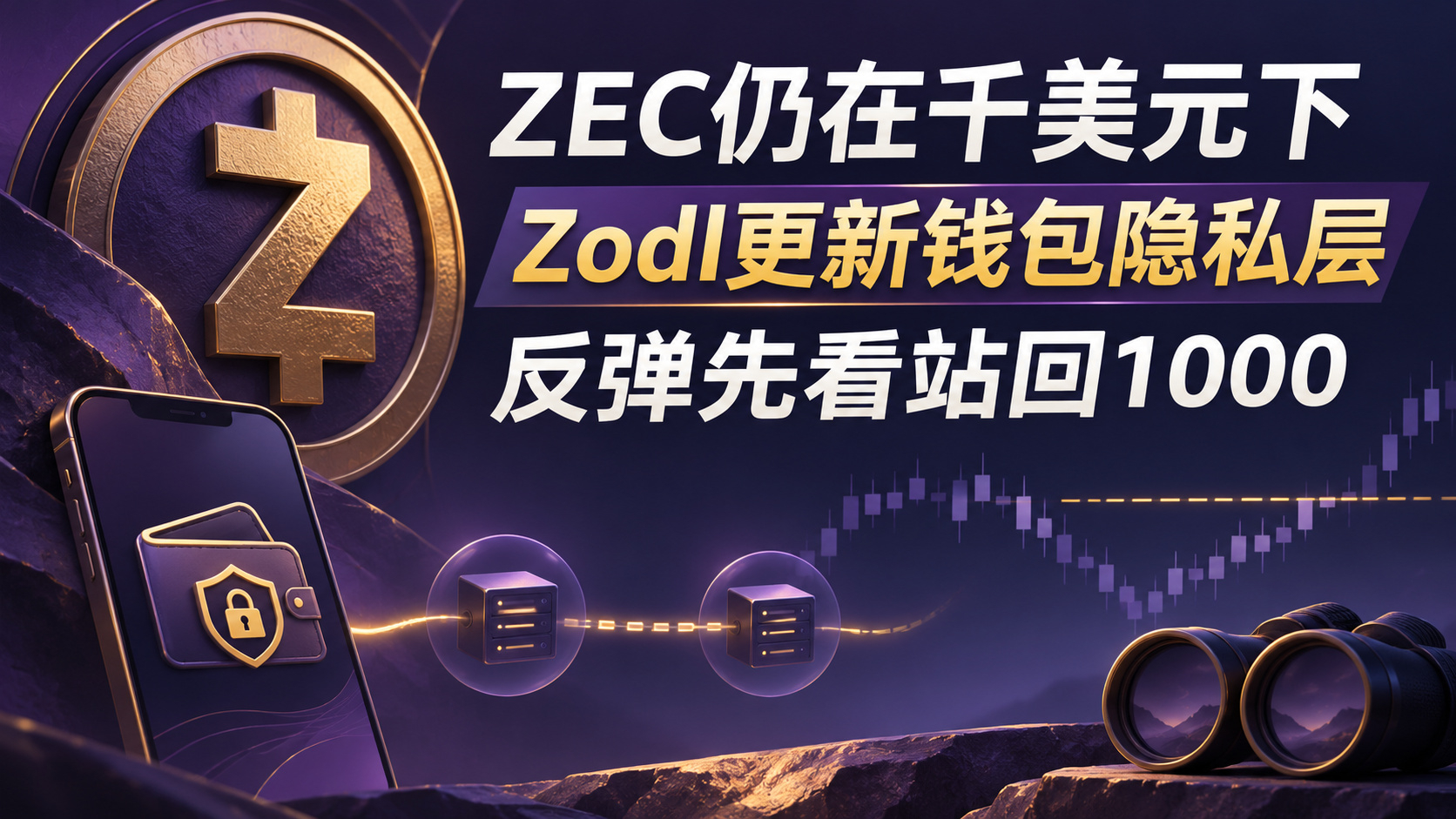
ZEC remains below $1,000 | Zodl updates wallet privacy layer | First watch whether the rebound can reclaim 1000
My stance is to observe rather than chase the rally. #ZcashFallsBelow$1000ForFirstTimeSinceSeptember is still trending on Binance Square, with around 188 discussions so far. At the time of writing, ZEC/USDT is around $990.81, up about 1.50% over 24 hours, but still below $1,000. What’s more worth discussing today is not this round-number level itself, but whether wallet privacy can extend from the blockchain to the metadata of network connections. In an official announcement on November 9, Zodl said it had begun gradually rolling out its own lightweight wallet servers, with OHTTP access through independent relays operated by Cloudflare and Fastly. The relays can see users’ IP addresses, but cannot read encrypted wallet requests; Zodl processes the requests but cannot see the original IP addresses. Zodl 3.20.0 will initially cover Android and iOS, with the rollout happening gradually—not all users have switched over at once.
This has practical significance for ZEC: while shielded transactions protect on-chain amounts and address information, the IP addresses, request times, and synchronization patterns associated with lightweight wallet connections may still reveal behavioral clues. OHTTP divides this information among different parties, improving privacy by default. But it is not a guarantee of “complete anonymity.” Zodl explicitly acknowledged in a community discussion that if the relay and gateway collude, or are both subject to legal demands, the privacy assumptions change; for a higher threat model, it still recommends using Tor as well. Technical improvements may enhance the long-term user experience, but they do not mean buying pressure must increase today, nor should a wallet update be mistaken for an upgrade to the Zcash protocol. My independent assessment is that if the market focuses only on the words “privacy coin” and ignores the limits of the privacy design, it could misprice application-layer progress as an unconditional positive.
The market reaction has offered no clear confirmation. ZEC’s 24-hour range was around $951.21 to $1,024.57. Although it has rebounded from the intraday low, it has yet to hold above $1,000. Separately, according to Farside, the fund corresponding to ZCSH saw estimated net outflows of around $14.6 million on November 11. This is an estimate of fund flows, separate from the Zodl wallet upgrade; it would be a stretch to claim the former was driven by the latter. Next, I’m watching whether 1000 can turn into support, with the intraday high near 1025 above that; below, I’m watching 980 first, and then 951 if that level breaks. If the market remains below 1000, the idea that technical progress is driving a short-term rally would be invalidated.
If I were trading this myself, I would sit this one out for now. I’d only consider a small spot position on the long side if the conditions are met, capped at 2.5% of total capital. The entry trigger would be an hourly close above 1000, followed by a successful retest and a move back up. The first target is 1025, where I’d take half off, with a target of 1050 for the remainder. I’d stop out if an hourly close falls back below 980 after entry. If the price reaches 1025 and then quickly falls back below 1000, or if fund outflows continue while spot volume and price action fail to follow through, I’d close the remaining position. If 980 breaks first, I’d cancel this long setup and wait for new evidence rather than betting on a round-number level with high leverage. Privacy infrastructure is a long-term variable; a trade still needs market confirmation.
#ZcashFallsBelow$1000ForFirstTimeSinceSeptember #ZEC
The above is solely my personal market observation and does not constitute investment advice.