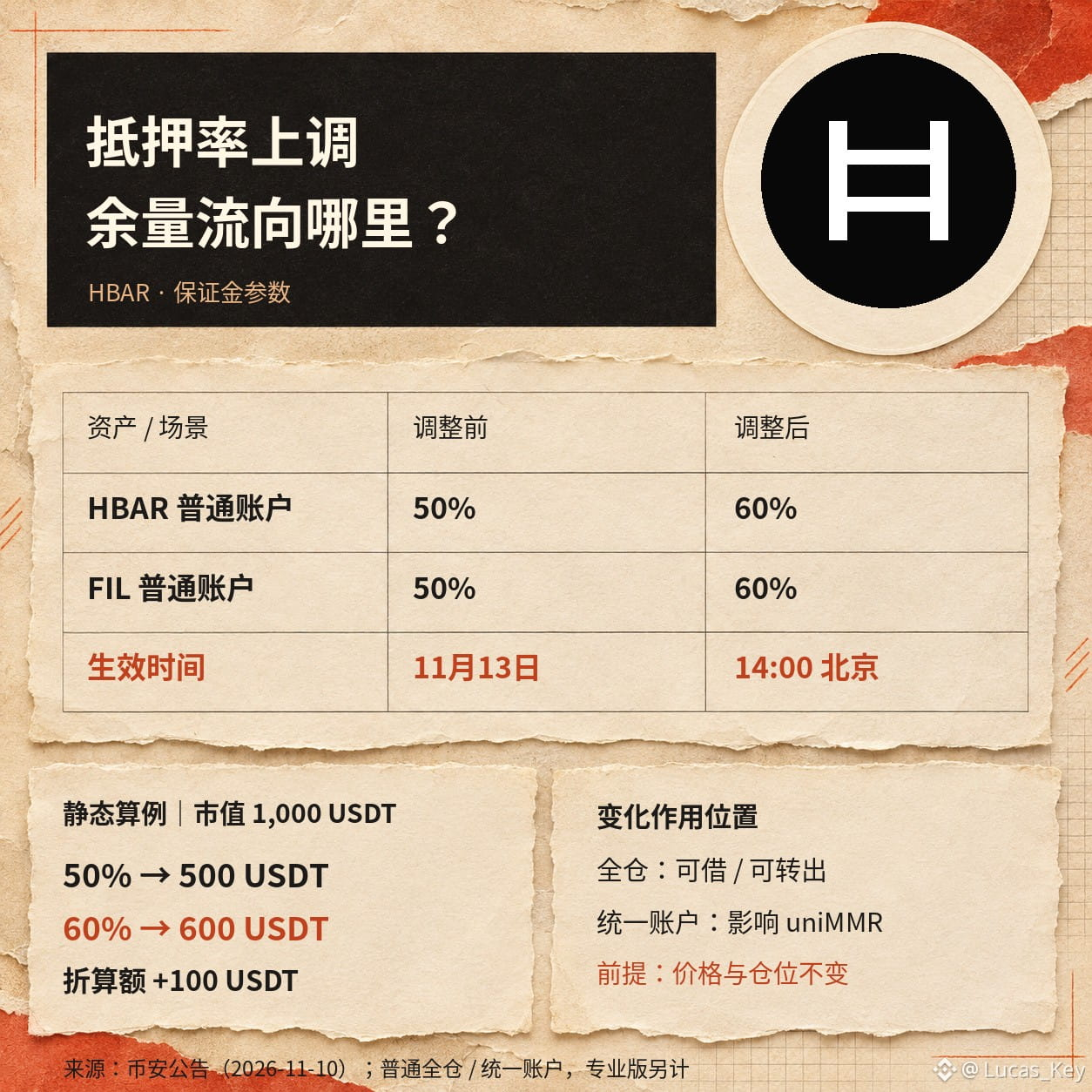
The collateral ratio for $HBAR will rise from 50% to 60%. I think it’s too quick to read this announcement as a direct signal of spot buying. Binance’s November 10 announcement states that, starting November 13 at 14:00 (Beijing time), the collateral ratios for HBAR and $FIL in Cross Margin borrowing/transfers and standard Unified Accounts will be raised from 50% to 60%. The adjustment is expected to take about 30 minutes. Unified Account Pro will continue to use a tiered schedule.
The bullish side does have a basis. For people who already hold these two assets and use the relevant margin features, the collateral value credited for the same market value will increase. Assuming a static market value of 1,000 USDT for a coin, with its price and all other positions unchanged, a 50% ratio values it at 500 USDT, while a 60% ratio values it at 600 USDT—a 100 USDT increase. If these assets support $BTC contract exposure in a Unified Account, the account’s risk buffer may also change accordingly.
The cautious side has solid grounds too: for Cross Margin, the official statement explicitly says the change affects only the amount that can be borrowed or transferred. Unified Accounts are assessed using overall uniMMR, and price declines, increased borrowing, or contract losses could all wipe out that 100 USDT of static headroom. This is not new cash, nor does it automatically create buy orders for HBAR or FIL.
I’m more interested in whether holdings, spot trading volume, and funding rates for the relevant coins change in tandem after the adjustment takes effect. Only when there is a genuine increase in risk exposure can we talk about capital transmission; a parameter increase alone doesn’t indicate price direction. Margin and contracts carry liquidation risk, and the example above is not investment advice.
The bullish side does have a basis. For people who already hold these two assets and use the relevant margin features, the collateral value credited for the same market value will increase. Assuming a static market value of 1,000 USDT for a coin, with its price and all other positions unchanged, a 50% ratio values it at 500 USDT, while a 60% ratio values it at 600 USDT—a 100 USDT increase. If these assets support $BTC contract exposure in a Unified Account, the account’s risk buffer may also change accordingly.
The cautious side has solid grounds too: for Cross Margin, the official statement explicitly says the change affects only the amount that can be borrowed or transferred. Unified Accounts are assessed using overall uniMMR, and price declines, increased borrowing, or contract losses could all wipe out that 100 USDT of static headroom. This is not new cash, nor does it automatically create buy orders for HBAR or FIL.
I’m more interested in whether holdings, spot trading volume, and funding rates for the relevant coins change in tandem after the adjustment takes effect. Only when there is a genuine increase in risk exposure can we talk about capital transmission; a parameter increase alone doesn’t indicate price direction. Margin and contracts carry liquidation risk, and the example above is not investment advice.