The storage boom is in full swing, but Morgan Stanley threw cold water on it today.
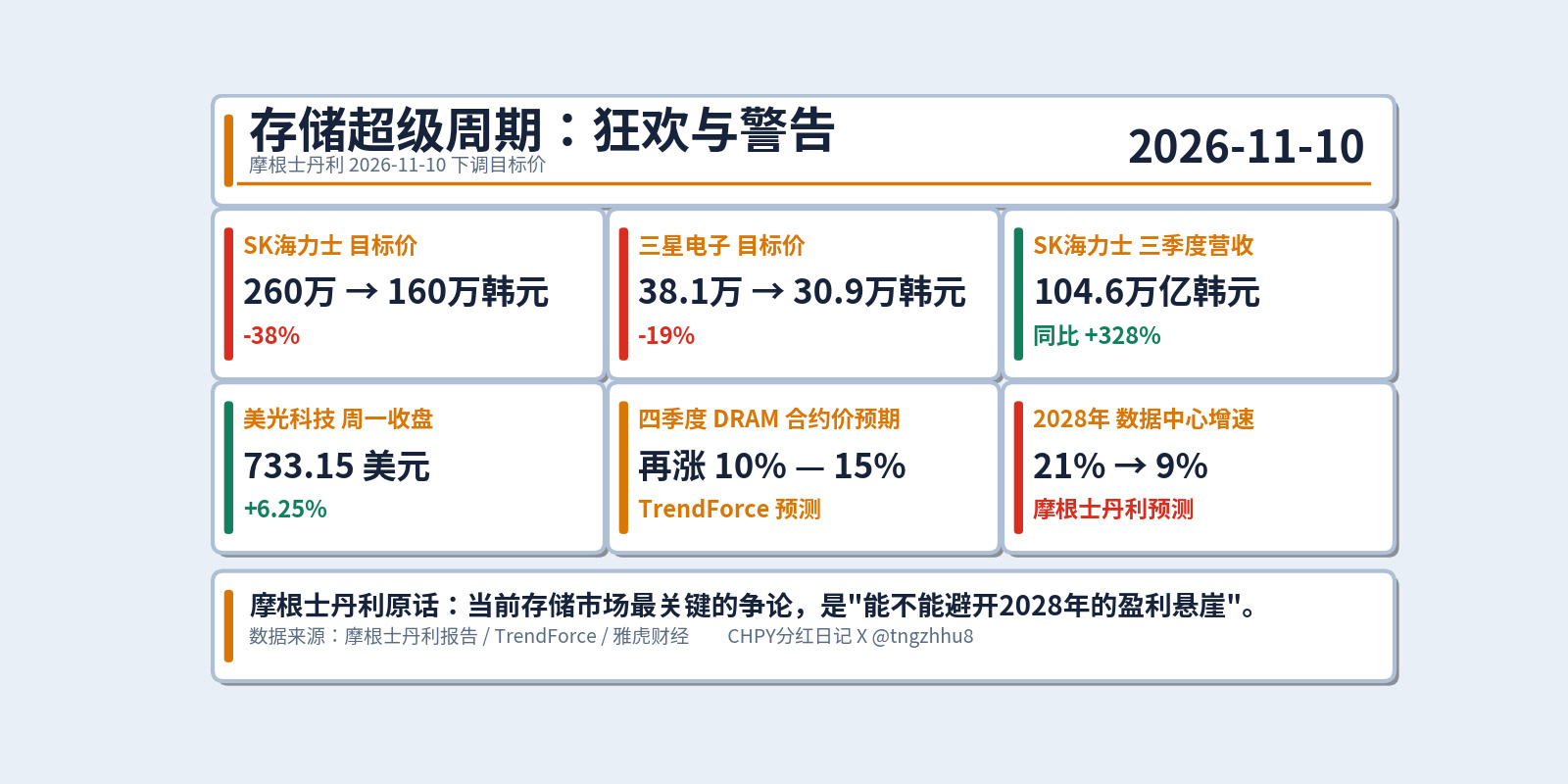
At 1:44 p.m. today, Morgan Stanley published a report titled “Storage Semiconductors—Key Questions After the U.S. Midterm Elections.” It raised its forecasts for Samsung Electronics’ and SK hynix’s operating profits next year by 9% and 13%, respectively, while sharply cutting its price targets for both companies: SK hynix from 2.6 million won to 1.6 million won, a 38% reduction; Samsung Electronics from 381,000 won to 309,000 won, a 19% reduction. It maintained its Overweight ratings, but the cuts were to valuations.
The warning comes at just the right time, because third-quarter figures were dazzling: SK hynix reported revenue of 104.6 trillion won, up 328% year over year, and an operating margin of 80%; Samsung Electronics reported record revenue of 195.3 trillion won, with its chip division up 15% quarter over quarter. Market research firm TrendForce expects fourth-quarter DRAM contract prices to rise another 10%–15%, and NAND flash prices to climb 15%–20%. Micron Technology rose 6.25% on Monday to $733.15, and has at one point gained more than 193% this year. SK hynix itself says the shortage will last at least until 2030.
Morgan Stanley’s concern is not next year, but 2028. The report puts it this way: “The key debate in the current memory market is whether it can avoid an earnings cliff in 2028.” Its reasoning has three parts. First, new fabs will start coming online in late 2027, adding to supply. Second, some data center construction plans were delayed after the U.S. midterm elections, with projects totaling about 5 gigawatts pushed from 2028 to 2029; global data center capacity additions growth in 2028 was cut from 21% to 9%. Third, Chinese manufacturers are expanding capacity, and competition in HBM is intensifying. The report cut its forecast for SK hynix’s HBM operating margin in 2027–2028 from 78%–80% to about 70%, and its average operating margin for 2029–2035 from 53% to 28%.
The chain of cause and effect is clear: AI data centers are taking up global memory capacity. Each gigabyte of HBM consumes about three times the wafer capacity of ordinary DRAM. Samsung Electronics, SK hynix, and Micron Technology together account for more than 90% of global DRAM, so when capacity is diverted, consumer memory runs short and prices rise. Those higher prices, in turn, boost the three companies’ profits and share prices. In the short term, this chain remains intact: Apple CEO John Ternus said on the latest earnings call that the current memory price increases are “unprecedented,” and prices will keep rising after December; more than 75% of Micron Technology’s 2027 capacity is already committed. Morgan Stanley itself acknowledges that its earnings forecast for next year has been raised.
The real disagreement is about timing. The most dangerous point in a price upcycle isn’t when prices stop rising; it’s when everyone simultaneously assumes they’ll rise forever and expands capacity. One line in Morgan Stanley’s report is worth writing down: “Share prices often run ahead of fundamentals, creating a risk that earnings forecasts will be revised down as supply catches up with demand and AI infrastructure spending slows.” In plain English: share prices have already priced in high profits beyond 2028. Once supply increases and demand slows, a double whammy of falling earnings and lower valuations could arrive much faster than the price increases did. Analyst Sean Kim has warned of winter before: he published “Memory: Winter Is Coming” in 2021 and sharply cut his price targets in 2024 over oversupply concerns. This is the third time.
With prices continuing to rise in the short term but a cliff looming further out, this market is a major test of position management. Investors can enjoy the gains from price increases in 2026–2027, but should watch 2028 as the real dividing line: the pace at which new fabs come online, data center capital spending, and changes in HBM market share for SK hynix and Samsung Electronics (TrendForce expects Samsung Electronics to reach about 39% next year, overtaking SK hynix at about 37%). A turn in any one of these three factors could be a signal to reduce positions. The U.S. October Consumer Price Index, due tonight at 9:30 p.m., and CoreWeave’s earnings report after the close will provide an initial check on the strength of AI infrastructure spending.
The supercycle in memory hasn’t been disproven, but Wall Street has already started pricing in an expiration date.
#存储超级周期 #U.S. Stocks
At 1:44 p.m. today, Morgan Stanley published a report titled “Storage Semiconductors—Key Questions After the U.S. Midterm Elections.” It raised its forecasts for Samsung Electronics’ and SK hynix’s operating profits next year by 9% and 13%, respectively, while sharply cutting its price targets for both companies: SK hynix from 2.6 million won to 1.6 million won, a 38% reduction; Samsung Electronics from 381,000 won to 309,000 won, a 19% reduction. It maintained its Overweight ratings, but the cuts were to valuations.
The warning comes at just the right time, because third-quarter figures were dazzling: SK hynix reported revenue of 104.6 trillion won, up 328% year over year, and an operating margin of 80%; Samsung Electronics reported record revenue of 195.3 trillion won, with its chip division up 15% quarter over quarter. Market research firm TrendForce expects fourth-quarter DRAM contract prices to rise another 10%–15%, and NAND flash prices to climb 15%–20%. Micron Technology rose 6.25% on Monday to $733.15, and has at one point gained more than 193% this year. SK hynix itself says the shortage will last at least until 2030.
Morgan Stanley’s concern is not next year, but 2028. The report puts it this way: “The key debate in the current memory market is whether it can avoid an earnings cliff in 2028.” Its reasoning has three parts. First, new fabs will start coming online in late 2027, adding to supply. Second, some data center construction plans were delayed after the U.S. midterm elections, with projects totaling about 5 gigawatts pushed from 2028 to 2029; global data center capacity additions growth in 2028 was cut from 21% to 9%. Third, Chinese manufacturers are expanding capacity, and competition in HBM is intensifying. The report cut its forecast for SK hynix’s HBM operating margin in 2027–2028 from 78%–80% to about 70%, and its average operating margin for 2029–2035 from 53% to 28%.
The chain of cause and effect is clear: AI data centers are taking up global memory capacity. Each gigabyte of HBM consumes about three times the wafer capacity of ordinary DRAM. Samsung Electronics, SK hynix, and Micron Technology together account for more than 90% of global DRAM, so when capacity is diverted, consumer memory runs short and prices rise. Those higher prices, in turn, boost the three companies’ profits and share prices. In the short term, this chain remains intact: Apple CEO John Ternus said on the latest earnings call that the current memory price increases are “unprecedented,” and prices will keep rising after December; more than 75% of Micron Technology’s 2027 capacity is already committed. Morgan Stanley itself acknowledges that its earnings forecast for next year has been raised.
The real disagreement is about timing. The most dangerous point in a price upcycle isn’t when prices stop rising; it’s when everyone simultaneously assumes they’ll rise forever and expands capacity. One line in Morgan Stanley’s report is worth writing down: “Share prices often run ahead of fundamentals, creating a risk that earnings forecasts will be revised down as supply catches up with demand and AI infrastructure spending slows.” In plain English: share prices have already priced in high profits beyond 2028. Once supply increases and demand slows, a double whammy of falling earnings and lower valuations could arrive much faster than the price increases did. Analyst Sean Kim has warned of winter before: he published “Memory: Winter Is Coming” in 2021 and sharply cut his price targets in 2024 over oversupply concerns. This is the third time.
With prices continuing to rise in the short term but a cliff looming further out, this market is a major test of position management. Investors can enjoy the gains from price increases in 2026–2027, but should watch 2028 as the real dividing line: the pace at which new fabs come online, data center capital spending, and changes in HBM market share for SK hynix and Samsung Electronics (TrendForce expects Samsung Electronics to reach about 39% next year, overtaking SK hynix at about 37%). A turn in any one of these three factors could be a signal to reduce positions. The U.S. October Consumer Price Index, due tonight at 9:30 p.m., and CoreWeave’s earnings report after the close will provide an initial check on the strength of AI infrastructure spending.
The supercycle in memory hasn’t been disproven, but Wall Street has already started pricing in an expiration date.
#存储超级周期 #U.S. Stocks