SOL at $90, and you’re still waiting for alt season?
Alpenglow launches on mainnet, Samsung Wallet supports USDC, Breakpoint kicks off next week—and SOL is still stuck at $90. Is this a golden buying opportunity, or is the market setting a trap for you?
First, look at the surface: the news keeps getting bigger, but the price just won’t rise.
“Samsung Wallet launches USDC on Solana”—you think, surely this time it’ll take off?
Then you wake up and see it’s down 0.5% over 24 hours, 6% over 7 days, and nearly 20% over 30 days. It’s already 69% below its all-time high of $293.
“Is Solana finished?”
First up: Alpenglow isn’t a pump catalyst; it’s a moat.
On October 21, Alpenglow launched on mainnet, cutting finality time from 12.8 seconds to 150 milliseconds.
Visa, stablecoins, RWAs, payments—these institutional-grade use cases need exactly that kind of speed.
But why hasn’t the price reacted?
There’s no money in the market right now. ETFs are seeing outflows, leverage is being liquidated, tech stocks are falling, and even BTC can’t hold steady. Do you really expect one tech upgrade to ignite an entire alt season?
When good news doesn’t lift the price, it doesn’t mean the news is worthless—it means the market hasn’t finished rotating its holdings.
Second: Samsung, USDC, and RWAs are all real adoption, but the price is lagging.
Samsung Wallet supports USDC on Solana for Galaxy users in the US.
Stablecoin supply remains elevated at $15 billion. RWA tokenization involves firms like Schroders and JPMorgan, while DeFi TVL and DEX trading volume remain competitive among L1s.
This isn’t a meme narrative; it’s real money flowing through payments and on-chain assets.
But what’s the problem?
Macro risk aversion. Liquidations have topped $1 billion, ETFs are seeing outflows, tech-stock selloffs are spilling over, and there have also been negative statements from China. SOL is a high-beta asset: when BTC sneezes, SOL ends up in the ICU.
Third: $90 isn’t just a price—it’s the underwear of the 200-day moving average.
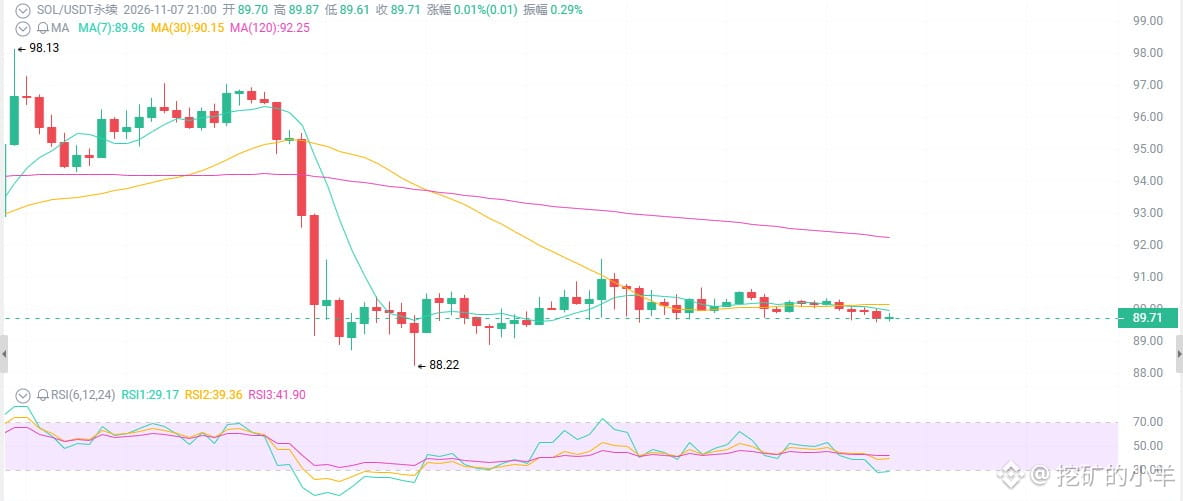
The daily chart shows a medium-term descending channel, lower highs, and a substantial 30-day decline.
The price has already crashed toward the 200-day moving average—around $88 to $90. That’s medium-term support and the line between bulls and bears.
The RSI previously fell to around 38, suggesting potential for an oversold bounce, but there’s been no strong divergence.
Trading volume has increased on the way down, showing that selling pressure remains.
On the 4-hour chart, the price has tested the lows several times, but hasn’t broken above the descending trendline on heavy volume.
Bears still have the upper hand, but the price has already reached the market’s underwear.
Hold $88–$90, and a double-bottom bounce is possible. Break below $88 on heavy volume, and the next levels are $85–$87, then $80, followed by $74–$70.