SNDK at $855: Are you buying the dip or catching a falling knife?
Blowout earnings, revenue up 378% year over year, an 85% gross margin, and a P/E of just 8x—but the stock plunged 36% in six days, halving again and again from $2,374, with intraday swings exceeding 20%. Is this the first domino in the collapse of the AI bubble, or the most massive overreaction of 2026?
First, the surface-level story: every piece of good news is being treated as bad news.
The earnings report came out on October 29: revenue of $11.03 billion, up 23% sequentially and 378% year over year; EPS of $49.51, beating expectations; and a gross margin of 85.1%. Data center revenue was $4.8 billion, up 61% sequentially. The company also announced an 8-for-1 stock split and a $5 billion buyback.
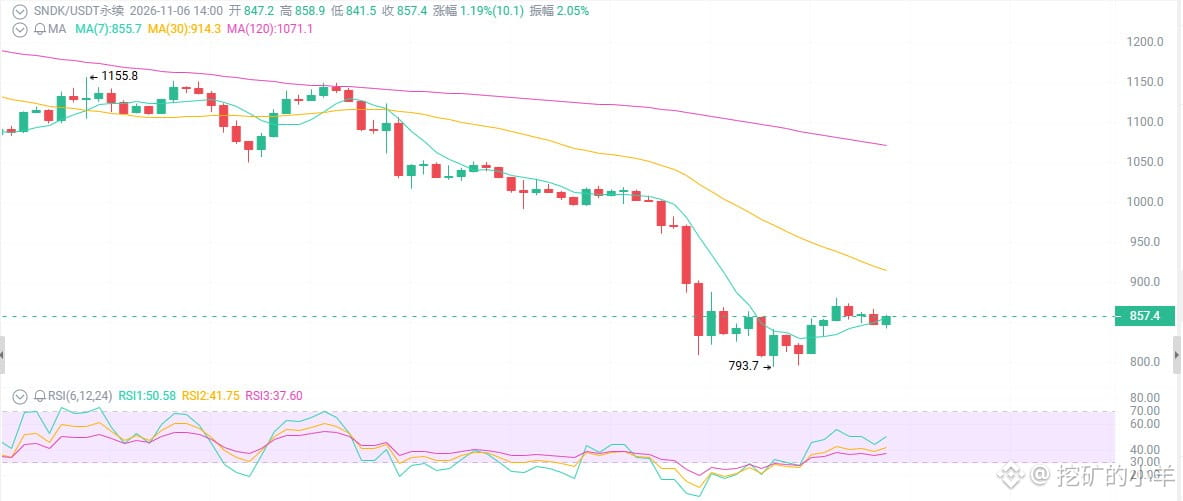
And the result? The stock plunged from $1,020 straight to $794, falling more than 36% in six trading days.
The RSI is deeply oversold, but the downward momentum has yet to fade. $800 is the last line of defense.
First point: the better the earnings, the harder the stock falls. Starting to see what’s going on?
Revenue is up 378% year over year, gross margin is 85%, quarterly free cash flow is $5.7 billion, the company has no debt, and it’s still buying back shares. With fundamentals like these, in any normal market, the stock should be limit-up.
But it fell 36%.
Why? Because the market is trading on one narrative: the AI bubble is about to burst.
NVDA is down, MU is down, AMD is down—the entire semiconductor and memory sector is being hit with a wave of valuation cuts. SNDK is simply one of the stocks caught in the stampede. Fox Advisors downgraded the stock, while a surge in advance payments to China’s CXMT raised competitive concerns. Every piece of bad news is amplified; every piece of good news is ignored.
Second point: a P/E of 8x—have you ever seen an AI core asset this cheap?
Its trailing P/E is 8–9x, with an even lower forward P/E. Compare it with its peers: MU, NVDA, AMD—which one doesn’t trade above 20x?
SNDK is a key global player in NAND flash and enterprise SSDs, and AI data centers can’t do without it. Its RPO is $88.9 billion, locked in by long-term contracts, giving it exceptional revenue visibility for the coming years.
The market’s current valuation assumes that “AI demand will collapse next year.”
Third point: $800 is the make-or-break level, and volatility could increase ahead of the stock split.
Technically: the daily moving averages are bearishly aligned, the price is well below all key moving averages, and consecutive down days have come on rising volume. The RSI is deeply oversold, but there’s no clear divergence.
Key levels: $800–790 is the zone around the 24-hour low and the early post-listing low; below that, watch $700–750.
November 9 is the stock split record date; the split takes effect after the market closes on November 19, and split-adjusted trading begins on November 20.
The trend is still down, but an oversold bounce could come at any moment. Shorting or buying the dip—either way, you’re walking on a knife’s edge.
Blowout earnings, revenue up 378% year over year, an 85% gross margin, and a P/E of just 8x—but the stock plunged 36% in six days, halving again and again from $2,374, with intraday swings exceeding 20%. Is this the first domino in the collapse of the AI bubble, or the most massive overreaction of 2026?
First, the surface-level story: every piece of good news is being treated as bad news.
The earnings report came out on October 29: revenue of $11.03 billion, up 23% sequentially and 378% year over year; EPS of $49.51, beating expectations; and a gross margin of 85.1%. Data center revenue was $4.8 billion, up 61% sequentially. The company also announced an 8-for-1 stock split and a $5 billion buyback.
And the result? The stock plunged from $1,020 straight to $794, falling more than 36% in six trading days.
The RSI is deeply oversold, but the downward momentum has yet to fade. $800 is the last line of defense.
First point: the better the earnings, the harder the stock falls. Starting to see what’s going on?
Revenue is up 378% year over year, gross margin is 85%, quarterly free cash flow is $5.7 billion, the company has no debt, and it’s still buying back shares. With fundamentals like these, in any normal market, the stock should be limit-up.
But it fell 36%.
Why? Because the market is trading on one narrative: the AI bubble is about to burst.
NVDA is down, MU is down, AMD is down—the entire semiconductor and memory sector is being hit with a wave of valuation cuts. SNDK is simply one of the stocks caught in the stampede. Fox Advisors downgraded the stock, while a surge in advance payments to China’s CXMT raised competitive concerns. Every piece of bad news is amplified; every piece of good news is ignored.
Second point: a P/E of 8x—have you ever seen an AI core asset this cheap?
Its trailing P/E is 8–9x, with an even lower forward P/E. Compare it with its peers: MU, NVDA, AMD—which one doesn’t trade above 20x?
SNDK is a key global player in NAND flash and enterprise SSDs, and AI data centers can’t do without it. Its RPO is $88.9 billion, locked in by long-term contracts, giving it exceptional revenue visibility for the coming years.
The market’s current valuation assumes that “AI demand will collapse next year.”
Third point: $800 is the make-or-break level, and volatility could increase ahead of the stock split.
Technically: the daily moving averages are bearishly aligned, the price is well below all key moving averages, and consecutive down days have come on rising volume. The RSI is deeply oversold, but there’s no clear divergence.
Key levels: $800–790 is the zone around the 24-hour low and the early post-listing low; below that, watch $700–750.
November 9 is the stock split record date; the split takes effect after the market closes on November 19, and split-adjusted trading begins on November 20.
The trend is still down, but an oversold bounce could come at any moment. Shorting or buying the dip—either way, you’re walking on a knife’s edge.